
Caregiver decision guide
How to Prepare an Aging Parent for a Power Outage
Standard blackout checklists don't account for the specific health risks older adults face, from medical device failures to falls in the dark. This guide uses the C.A.R.E. framework to help family caregivers create a comprehensive, medical-aware power outage plan before the next storm.
A standard blackout checklist assumes the worst problem is inconvenience. For an older parent, the real problem is that the outage collides with medication that should stay cold, a device that stops charging or delivering support, a bathroom trip in the dark, or a parent who says they are fine right up until they are not. In a nationwide study of more than 23 million Medicare beneficiaries, outages lasting 8 hours or more were linked to modest but real same-day or next-day increases in cardiovascular and respiratory hospitalizations, and the authors estimated 4,246 excess hospitalizations among older adults in 2018 attributable to outages [1].
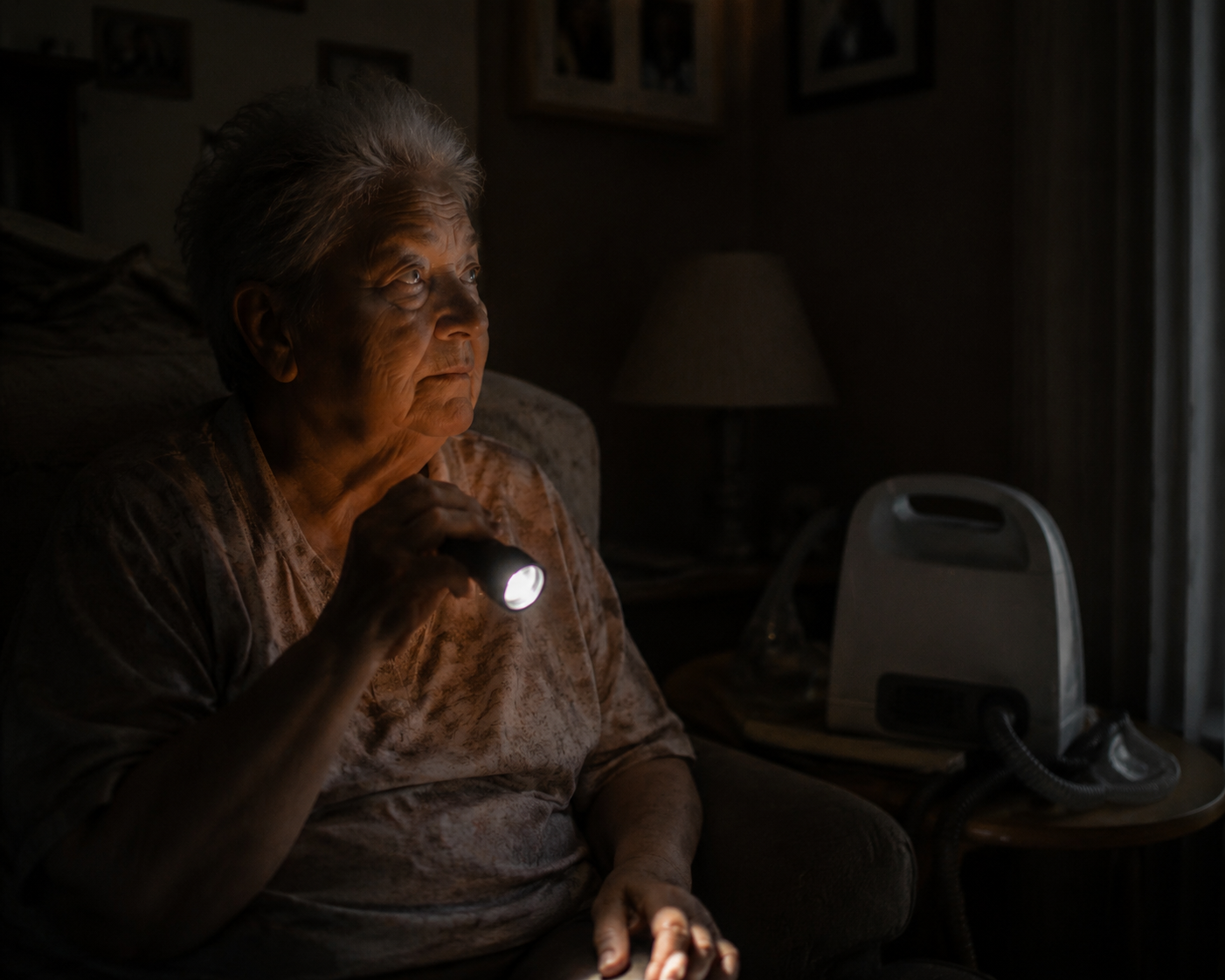
That risk is not hypothetical in institutional care. After Hurricane Irma, Florida nursing home residents who lost power had 25% higher odds of dying within 7 days [2]. The setting is different, but the failure pattern is familiar: heat, equipment downtime, delayed help, and a small problem in a dark house that becomes medical before anyone has time to improvise.
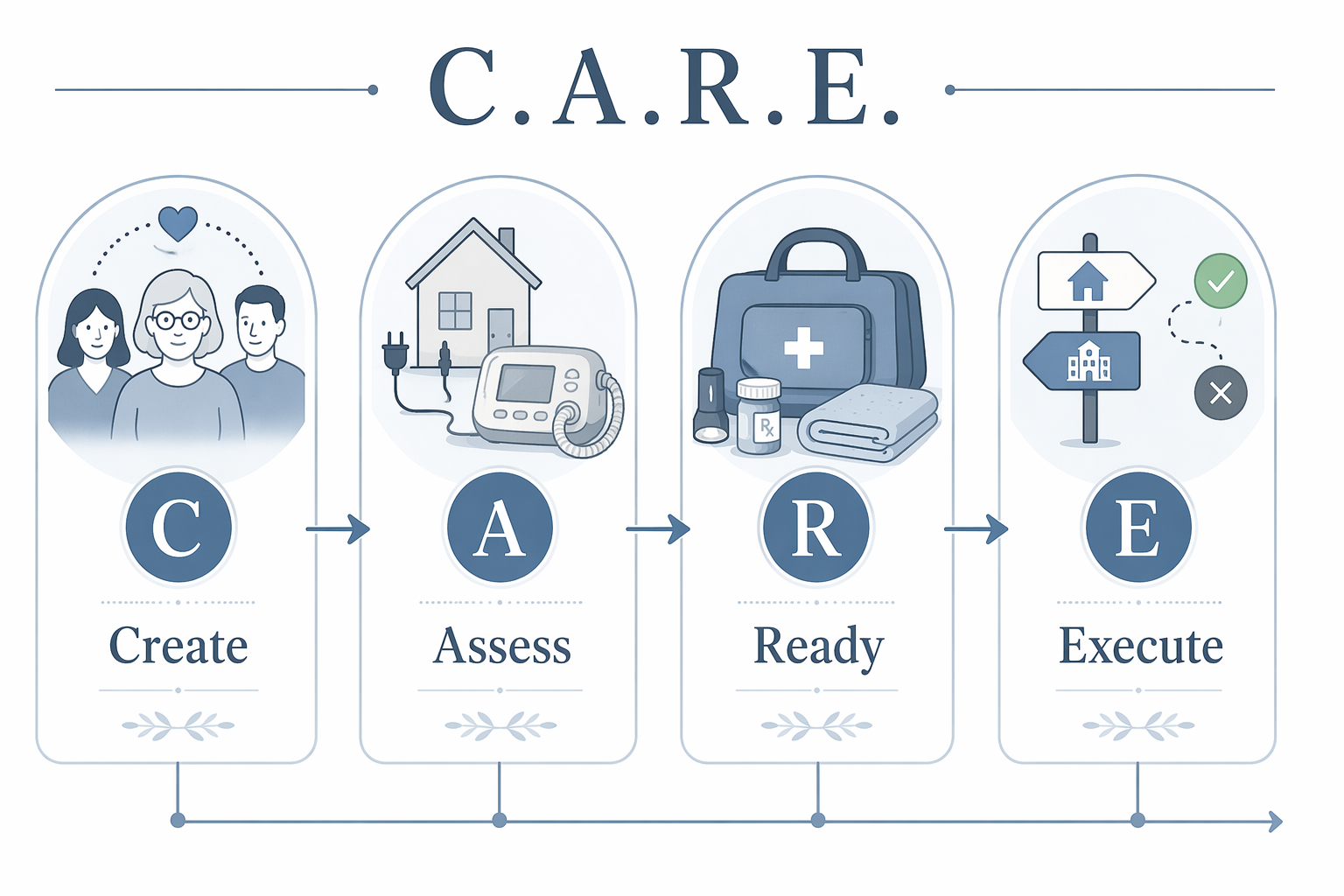
Create the support circle before the weather turns
The first job is not buying supplies. It is making sure the outage does not land on one person alone. Build a short list of people who need to know what happens if the power goes out: the caregiver who can check in, a nearby neighbor, another relative, the parent’s clinician if there is an electric medical device or temperature-sensitive medication, the pharmacy, and the utility company if outage alerts or medical baseline programs are available. If the parent lives alone, that notification chain matters even more because the first sign of trouble may be silence.
This is also where you decide who does what. One person can call the parent, another can drive over, another can watch the weather and utility alerts, and another can confirm whether a backup battery or alternate site is actually usable. A plan that only exists in one caregiver’s head is not a plan.
Assess every electrical dependency, not just the obvious ones
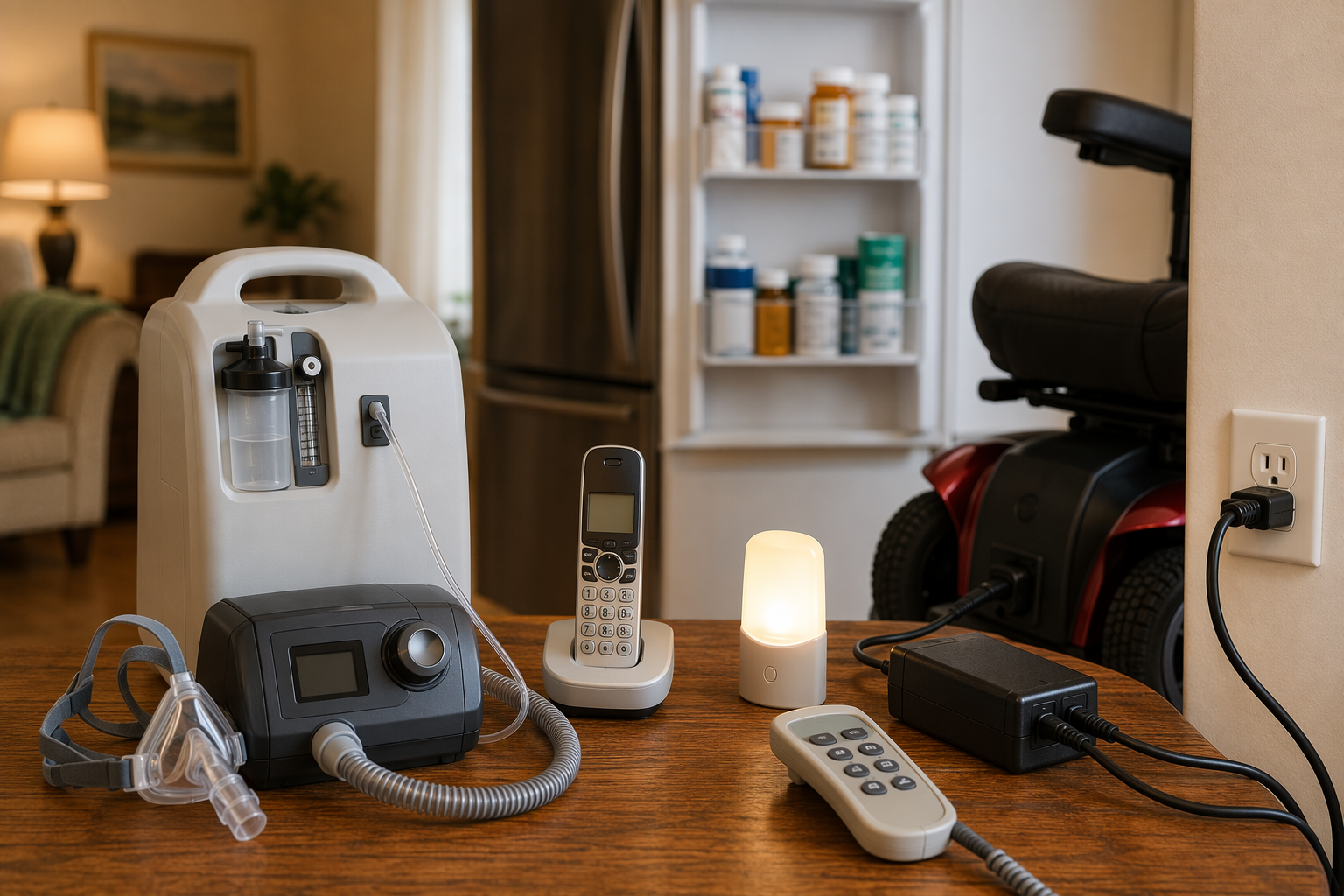
| Dependency | What to check before the outage | What can fail when the power goes out |
|---|---|---|
| Refrigerated medication | Which prescriptions must stay cold, where they are stored, and what the pharmacy says to do if refrigeration is interrupted | Medication can spoil before anyone notices |
| Breathing or treatment equipment | Whether the parent uses oxygen concentrators, CPAP, nebulizers, infusion pumps, or any other powered device, and how long the backup source really lasts | The problem can move from inconvenience to a breathing emergency |
| Mobility equipment | Whether the parent depends on a powered bed, lift chair, scooter, stair lift, or charger for a wheelchair or walker add-on | Transfers, standing, and toileting can become unsafe |
| Communication and alerting | What still works if the cordless phone, Wi-Fi, router, or cell charger stops | The caregiver may not be able to reach the parent or receive updates |
| Nighttime safety | Where flashlights, spare batteries, nightlights, glasses, hearing devices, and shoes are kept | The walk from bed to bathroom becomes a fall risk |
| Temperature control | Whether the home can stay safe without HVAC, fans, or space heaters | Heat or cold can push the parent out of a safe range faster than expected |
Do not treat this as a yes-or-no inventory. A device that technically has battery backup may still be unusable if the parent cannot manage it, if the tubing is missing, if the charger is in another room, or if the backup lasts less time than the outage forecast. If you are unsure whether a medical device, refrigerated drug, or mobility aid can ride through an outage, ask the prescribing clinician, durable medical equipment supplier, pharmacy, or utility contact before the next storm window, not after the lights are already out.
Ready a kit that fits an older adult, not a generic house
The kit should support the parent’s actual routine, especially if sensory loss, arthritis, limited mobility, or medication timing makes improvising hard. The baseline is simple: light, power, water, food, meds, information, and a way to move safely.
- Flashlights or headlamps, plus spare batteries; candles should not be the default
- Charged power banks, charging cables, and a backup way to keep a phone alive
- A paper list of medications, allergies, doctors, pharmacy, and equipment vendors
- Current prescriptions in a form the caregiver can grab quickly, with a separate plan for anything that must stay cold
- Water and shelf-stable food the parent can open, chew, and tolerate without much effort
- Glasses, hearing aid batteries or chargers, denture supplies, and any assistive devices used every day
- Non-slip shoes, a blanket, and a small cooling option if heat is the bigger problem
- Copies of ID, insurance cards, keys, and some cash
Execute early, not once the house is already dark
- When the warning comes in, alert the support circle and confirm who is checking on the parent, who is driving, and who is monitoring utility updates.
- Move chargers, flashlights, medications, and any essential equipment to one reachable place before the outage starts.
- Set up lighting along the path the parent will actually use, especially bed, hallway, bathroom, and kitchen.
- If the parent depends on powered medical equipment or a temperature-controlled medication, make the stay-or-go decision early enough to avoid a rushed transfer.
- If the outage arrives with heat and the home cannot stay comfortable and safe, move before the parent becomes weak, confused, or unsteady.
- If power returns, do not assume everything restarted correctly; check the device, the refrigerator, the charger, and the parent’s condition before settling back into routine.
The point is not to make the parent outage-proof. It is to make the first hours legible: who knows, what depends on electricity, what already lives in the kit, and when the family stops waiting and starts moving.
References
- Power outages and cardiovascular and respiratory hospitalizations among older adults in the United States — PLOS Medicine, March 2026 — https://journals.plos.org/plosmedicine/article?id=10.1371/journal.pmed.1004923
- Association of power loss after Hurricane Irma with mortality among nursing home residents in Florida — JAMA Health Forum, 2021 — https://pmc.ncbi.nlm.nih.gov/articles/PMC8796882/
Questions to bring to a clinician or OT
This is not medical, legal, or a family's final decision — only a framework. Bring these questions to a clinician, occupational therapist, or your local Area Agency on Aging.
Find Local HelpRelated reading
Noticed something outdated or inaccurate on this page? Flag a correction. We review every report against CDC, NIA, and AARP HomeFit guidance before updating a page.