
Caregiver decision guide
How to Protect Your Aging Parent During an Air Quality Alert
A detailed, AQI-level-based guide for adult children caregivers on how to protect older adults during air quality alerts, with specific actions tailored to each color-coded tier from 'Unhealthy for Sensitive Groups' through 'Hazardous'.
The hard part of an air quality alert is rarely the color itself. It is the next five minutes: deciding whether your 82-year-old mother should still water the tomatoes, whether your father should go to physical therapy, whether the window air conditioner is helping, and whether this is the day to have the mask argument again.
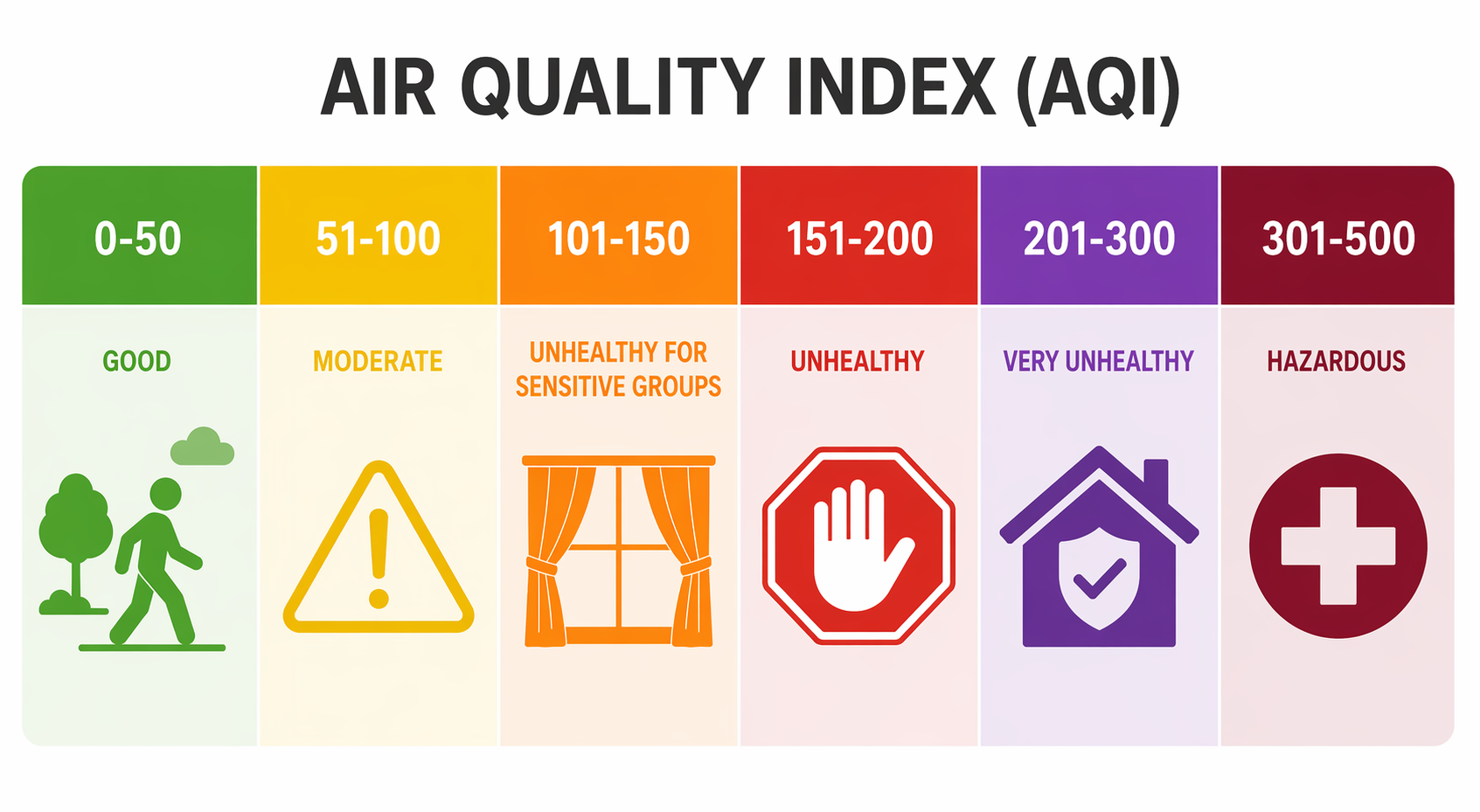
For older adults, the action point starts earlier than many families assume. The EPA and CDC treat adults 65 and older as a sensitive group beginning at AQI 101, the Orange level labeled “Unhealthy for Sensitive Groups.” That means the caregiver plan should begin at Orange, not wait until the air is unhealthy for everyone at Red or visibly smoky outside.[1]
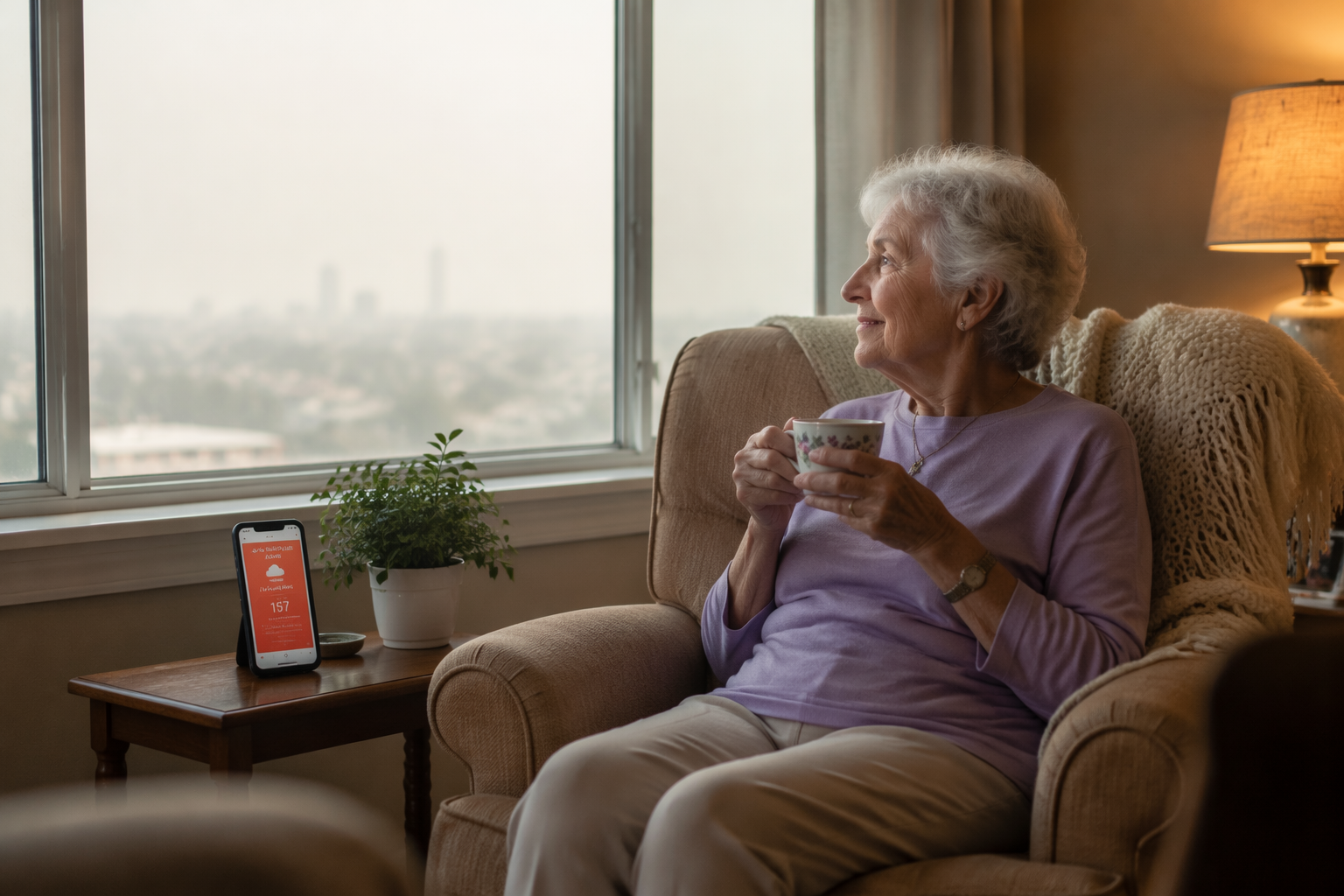
That earlier threshold is not fussy. A CDC national analysis found that emergency department visits for air quality-related respiratory illness were, on average, 17% higher than expected on days when AQI was above 101.[2] For a parent with COPD, asthma, heart disease, diabetes, a recent respiratory infection, or just less reserve than they used to have, Orange is already a day for changing the routine.
Why older adults need protection before the air looks dangerous
Poor air quality is not one single exposure. Alerts may reflect ozone, particle pollution, wildfire smoke, or a mix of pollutants. For caregiving decisions, fine particles deserve special respect because PM2.5 can travel deep into the lungs; NIEHS describes these particles as about 30 times smaller than the width of a human hair.[3]
Aging lungs are also less forgiving. With age, lung tissue loses elasticity, breathing muscles can weaken, and the immune system becomes less efficient at clearing inhaled particles. Add common chronic conditions and medications that affect fluid balance, heart rate, breathing, alertness, or heat tolerance, and a “moderate” errand can become a bigger physiologic demand than it looks from the sidewalk.[3]
The concern is not limited to coughing during a bad afternoon. NIEHS summarizes research linking particulate exposure in older adults with mortality risk, including a meta-analysis that found a 0.64% increase in mortality for each 10 μg/m³ rise in particulate matter among older adults.[3] A NIEHS-funded study also found that improved air quality was associated with lower dementia risk in older women, an effect the researchers described as equivalent to taking nearly 2.5 years off their age.[4] Those findings do not mean one alert day determines a parent’s future; they do mean exposure reduction is worth taking seriously.
The AQI action plan for an aging parent
Use the AQI color as a decision shortcut, then adjust for your parent’s actual health. A sturdy 67-year-old with no lung or heart disease may have more flexibility than an 86-year-old with heart failure and mild dementia. When in doubt, protect the person in front of you, not the average person implied by the weather app.
| AQI level | What changes for an older adult | Caregiver action |
|---|---|---|
| Orange, 101-150, Unhealthy for Sensitive Groups | Adults 65+ are in the group expected to be affected. | Reduce outdoor exertion, move optional tasks indoors, check symptoms, and close up the home before conditions worsen. |
| Red, 151-200, Unhealthy | Health effects are more likely, and sensitive groups need stronger limits. | Keep the parent indoors as much as possible and avoid all outdoor physical activity for older adults. |
| Purple, 201-300, Very Unhealthy | The alert is now serious for the whole community, with greater concern for older adults. | Avoid outdoor exposure, avoid physical exertion, run the cleanest indoor air setup available, and monitor symptoms closely. |
| Maroon, 301-500, Hazardous | This is an emergency-level air quality condition. | Shelter in the cleanest indoor space available, avoid all physical activity, and be ready to contact medical help quickly. |
Orange AQI 101-150: change the day before symptoms start
Orange is the level where many families hesitate because the neighborhood may look normal. This is exactly where the plan should begin. AirNow identifies adults 65 and older as part of the sensitive group at this level, and the CDC’s emergency department data makes the threshold hard to ignore.[1][2]
For an older parent, Orange means the outside routine gets edited. A slow walk to the mailbox is different from raking leaves, carrying groceries, climbing a hill, or watering plants in the heat. Keep necessary outdoor time short and easy. Move yard work, long walks, outdoor errands, and exercise classes to another day if possible.
- Close windows and exterior doors before the air gets worse, especially in the room where your parent spends the most time.
- Run central air or a room air conditioner on recirculation if that option is available and safe for the equipment.
- Postpone vacuuming, frying, broiling, burning candles, and using a fireplace, because these can raise indoor particle levels during an alert.[5]
- Check whether inhalers, oxygen supplies, heart medications, and rescue medications are where your parent can find them.
- Call or text early if you are remote; do not wait until evening, when the parent may already be tired or short of breath.
The parent who says, “I’m only going out for a minute,” may be right about the clock and wrong about the effort. The task matters. Carrying a watering can, dragging a trash bin, or walking quickly because dinner is on the stove increases breathing rate and dose. At Orange, the easiest win is to remove the exertion, not to make the parent feel trapped.
Red AQI 151-200: stop outdoor physical activity for older adults
At Red, the American Lung Association advises older adults to avoid all physical activity outdoors.[6] That is stronger than “take it easy.” It means the walk, garden work, golf, outdoor church event, and “quick” trip to sweep the porch should be canceled, moved indoors, or handled by someone else.
Medical appointments become judgment calls. If the appointment is routine, call and ask whether it can be rescheduled or converted to telehealth. If it is medically important, ask the office about timing, drop-off close to the entrance, wheelchair assistance, and whether the parent can wait indoors rather than outside or in a parking lot.
Inside the home, Red is the time to make one cleaner-air room rather than trying to perfect the entire house. Choose the room with the best filtration or the fewest leaks, close it off as much as practical, and keep the parent’s phone, water, medications, glasses, charger, and hearing aids nearby. If a portable air cleaner is available, use it according to the manufacturer’s instructions; do not treat it as permission to keep windows open or cook smoky meals.
This is also the level where symptom checks should become plain and specific. Ask about breathing, chest pressure, unusual fatigue, dizziness, confusion, wheezing, coughing, and whether rescue medications are helping as expected. Vague “Are you okay?” questions are easy to wave away. A parent who does not want to be fussed over may still answer a concrete question.
Purple AQI 201-300: treat exposure itself as the problem
Purple is not a day for negotiating outdoor chores. The American Lung Association advises that at Purple and Maroon levels, older adults should avoid all physical activity entirely.[6] That includes indoor exertion if the home is warm, stuffy, poorly filtered, or already smoky.
The practical goal is to lower breathing demand and lower particle exposure at the same time. Keep the parent in the cleanest room available. Avoid cooking methods that create smoke or particles. Skip vacuuming. Do not light candles. If the house is too hot with windows closed, air quality and heat have to be managed together; heat can also become dangerous for older adults, and CDC heat guidance emphasizes checking on people at higher risk and helping them stay cool.[7]
If your parent lives alone, Purple is a good threshold for scheduled check-ins rather than casual ones. Set times: morning, midafternoon, and evening. If they do not answer, have a neighbor, building manager, or nearby relative who can knock. This is where an emergency contact binder earns its place on the counter, because nobody should be searching for the cardiologist’s number while the air outside is getting worse.
- Call the clinician’s office or nurse line if breathing symptoms are new, worse than usual, or not responding to the parent’s usual plan.
- Seek urgent help for chest pain, severe shortness of breath, blue lips or face, fainting, severe weakness, sudden confusion, or symptoms that feel like a heart attack or stroke.
- If your parent uses oxygen, follow the prescribing clinician’s instructions and ask in advance what to do during prolonged poor-air events.
Maroon AQI 301-500: use the emergency plan, not willpower
Maroon is Hazardous. At this point, the plan should be boring and already written down: stay inside the cleanest available indoor space, avoid all physical activity, keep medications and communication tools within reach, and know who will check in if you cannot get there.
If the home cannot be kept cool and reasonably filtered, staying put may not be the safest option. A public clean-air space, a relative’s home with better filtration, or a temporary stay elsewhere may be safer, but the decision depends on the parent’s mobility, medical equipment, transportation, local emergency guidance, and whether the trip itself creates more exposure. Decide this before Maroon if your parent lives in an area that gets repeated smoke or pollution events.
For a parent with dementia, limited mobility, oxygen dependence, serious heart or lung disease, or a history of refusing help, Maroon also means the caregiver network should stop relying on persuasion by phone. Arrange an in-person check if symptoms, heat, confusion, or power interruptions are possible.
Prepare the home before the alert gets worse
The most useful air quality safety steps for aging parents are usually unglamorous. Close the right things early. Stop making particles indoors. Put supplies where tired hands can reach them. Make the room usable enough that your parent does not keep finding reasons to go outside.
Close, filter, and simplify
Start with windows and doors. Close them before smoke or pollution smells obvious indoors. If the home has central HVAC, check whether the system can run with outdoor air intake closed or minimized. If there is a high-efficiency filter installed, confirm it is seated correctly and not overdue for replacement. For complicated systems, an HVAC technician or professional home safety assessment can be more useful than guessing at vents and switches during an alert.
Window air conditioners vary. Some recirculate mostly indoor air; others may pull in outdoor air depending on model and settings. If your parent uses one, identify the vent or fresh-air setting before the alert season. A unit that cools well may still need the outdoor vent closed during poor air, while a hot room with sealed windows can create a separate heat risk. That tradeoff should not be solved by a parent alone at 4 p.m.
Stop adding particles indoors
During wildfire smoke or particle pollution events, EPA guidance says to avoid activities that increase indoor particle levels, including smoking, using gas, propane, or wood-burning stoves and furnaces when possible, spraying aerosol products, frying or broiling food, burning candles or incense, and vacuuming unless using a HEPA-filter vacuum.[5]
For many older adults, the sticking point is routine. They may vacuum every morning, fry an egg the same way every day, or light a candle because the closed-up house feels stale. Swap the routine instead of just banning it: microwave or cold meals for the day, wipe surfaces with a damp cloth, use battery candles, and save heavier cleaning for better air.
Build the cleaner-air room around real life
A cleaner-air room fails if it feels like exile. Put the favorite chair there, not the “best” chair nobody uses. Add the TV remote, phone charger, water, tissues, medication list, inhalers, hearing aid supplies, glasses, and a light blanket. If your parent naps, make sure the path to the bathroom is clear and well lit so air protection does not quietly create a fall risk.
If wildfire smoke is the specific problem, a dedicated wildfire smoke safety checklist can help with details such as portable air cleaners, vehicle travel, and local smoke updates. This broader AQI plan still applies: the color tells you when to act, and the pollutant source shapes the details.
If you are caregiving from another zip code
Remote caregiving during an air quality alert is a translation job. The alert says “limit prolonged outdoor exertion.” You have to turn that into, “Please do not walk to the pharmacy today; I moved the refill to delivery.” The more specific the instruction, the less it sounds like nagging.
- Set the parent’s ZIP code in your own weather or air quality app so you see the same alert they do.
- Agree on color-based rules in advance: Orange changes errands, Red cancels outdoor activity, Purple triggers scheduled check-ins, Maroon activates the emergency plan.
- Create a short phone script: “What color is your alert? Are the windows closed? What have you eaten? Any chest tightness, wheezing, dizziness, or unusual fatigue?”
- Line up one local person who can check the home if your parent does not answer or sounds confused.
- Keep a printable caregiver checklist and emergency contact binder updated so helpers do not need family history by memory.
Dignity matters here. A parent may resist being managed, especially if the day’s restrictions make them feel old. Offer substitutions: “Let’s move the walk to tomorrow morning if the AQI drops,” lands better than, “You can’t go outside.” The health goal is exposure reduction, but the relationship goal is cooperation without humiliation.
Where masks fit, and where they do not
An N95 respirator can reduce particle exposure only when it fits properly and is worn correctly. That small sentence carries a lot of caregiver reality. AARP notes that N95s need a proper fit, and fit can be harder for older adults because of facial structure changes, dentures, or facial hair.[8]
A mask is not the whole plan. It does not make outdoor exertion safe at Red, Purple, or Maroon. It may feel uncomfortable for someone with breathing problems. It may be removed under the nose without the wearer noticing. If a parent has heart or lung disease, ask their clinician in advance whether and when respirator use is appropriate.
When a respirator is used, keep the purpose narrow: a necessary short trip, a brief transfer from car to clinic, or an unavoidable exposure. Indoors, filtration, closed windows, lower exertion, and fewer indoor particle sources usually do more for an older parent than a mask worn loosely in the living room.
Symptoms that should change the plan
Air quality alerts become more serious when symptoms appear or change. For older adults, do not watch only for dramatic gasping. Pay attention to a new cough, wheezing, shortness of breath with usual activities, chest tightness, palpitations, unusual fatigue, dizziness, headache, confusion, or a drop in normal stamina.
If your parent has a written asthma, COPD, heart failure, or cardiac action plan, follow it. If they use a pulse oximeter, know their usual range and the clinician’s threshold for calling. A number without a baseline can create false reassurance or unnecessary panic; the value is in knowing what is normal for that person and what their clinician has told them to do.
- Call the clinician or nurse advice line for new or worsening respiratory symptoms, increased rescue inhaler use, swelling, unusual fatigue, or symptoms that do not improve indoors.
- Use urgent or emergency care for chest pain, severe shortness of breath, fainting, blue lips or face, sudden confusion, stroke-like symptoms, or distress that feels unsafe to manage at home.
- If heat is also present, act earlier for weakness, confusion, dizziness, or inability to stay cool; CDC heat guidance identifies older adults as a group needing extra attention during heat events.[7]
A calm rule for the next alert
When the alert appears, start with the color and your parent’s risk. At Orange, reduce outdoor exertion and set up the home. At Red, stop outdoor physical activity. At Purple, avoid exposure and monitor closely. At Maroon, use the emergency plan.
Poor air quality is not fully controllable from a kitchen table or a phone in another city. Exposure can be meaningfully reduced. The useful work is acting at the right AQI level, before the air looks frightening and before a bad afternoon turns into an emergency department visit.
References
- AQI Basics, AirNow.gov.
- Emergency Department Visits for Air Quality-Related Respiratory Illnesses During Wildfire Smoke Events — United States, April–August 2023, CDC MMWR, September 29, 2023.
- Air Pollution and Your Health, National Institute of Environmental Health Sciences.
- Cleaner air may reduce dementia risk in older women, National Institute of Environmental Health Sciences.
- Wildfires and Indoor Air Quality, U.S. Environmental Protection Agency.
- Outdoor Air Pollution and Physical Activity, American Lung Association.
- Heat and Older Adults, CDC Heat Health.
- How to Protect Yourself Against Wildfire Smoke, AARP.
Questions to bring to a clinician or OT
This is not medical, legal, or a family's final decision — only a framework. Bring these questions to a clinician, occupational therapist, or your local Area Agency on Aging.
Find Local HelpRelated reading
Noticed something outdated or inaccurate on this page? Flag a correction. We review every report against CDC, NIA, and AARP HomeFit guidance before updating a page.