
Caregiver decision guide
How to Choose Retirement Mutual Funds for Aging Parents
This guide helps adult children evaluate mutual funds for an aging parent's retirement portfolio, focusing on the three fund categories that suit older investors and the key red flags to avoid when reviewing their current holdings.
The question usually starts with a stack of statements, not a spreadsheet. A parent is in their 70s or 80s, the envelopes are arriving every month, and one mutual fund name after another looks either harmless or impossibly vague. The practical question is not, “What are the best mutual funds for retirement?” in the abstract. It is, “Are these still the right kinds of funds for someone who may need income, stability, and fewer surprises now?”
That shift matters. A fund that made sense while a parent was building savings may be too volatile, too expensive, or too complicated once the job of the portfolio has changed. For an aging parent, mutual funds should usually be judged first by suitability: how much stock-market risk they carry, how much income or preservation they are meant to provide, what they cost, and whether an ordinary family member can understand what is inside them well enough to ask good questions.

This is also personal territory. Looking through a parent’s holdings can feel intrusive, especially if that parent has handled money independently for decades. The goal is not to take over because a statement looks unfamiliar. The goal is to organize what exists, notice obvious red flags, and know when a licensed financial advisor should review the details.
Start With the Risk Level, Not the Fund Name
Schwab’s retirement allocation framework is a useful plain-English starting point because it shows how the stock, bond, and cash mix tends to become more conservative with age. Schwab describes a sample allocation of 60% stocks, 35% bonds, and 5% cash for ages 60–69; 40% stocks, 50% bonds, and 10% cash for ages 70–79; and 20% stocks, 50% bonds, and 30% cash for ages 80 and older.[1]
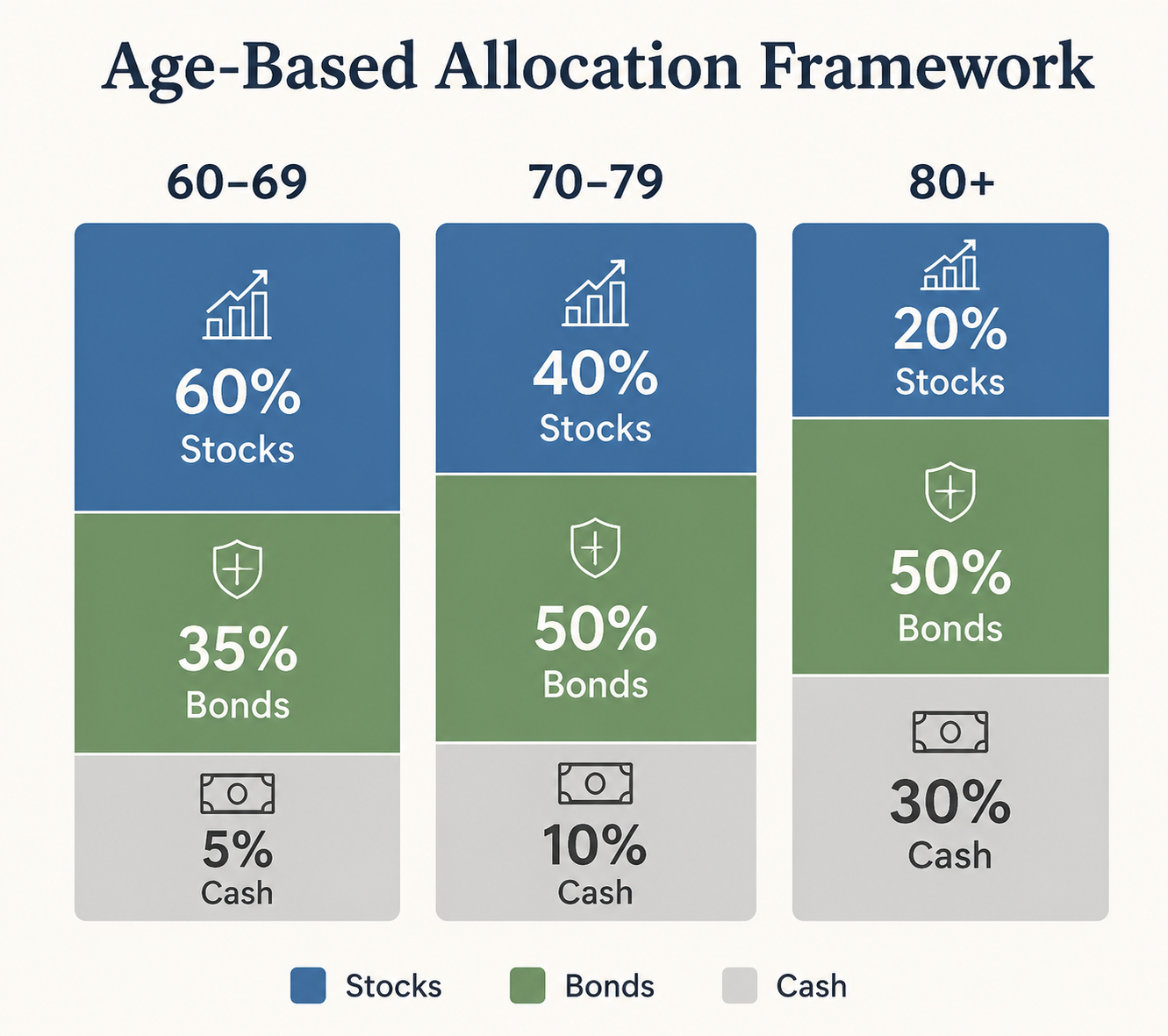
Those percentages are not a prescription for every parent. A healthy 78-year-old with a pension, low spending needs, and a long family history of longevity may reasonably hold a different mix than an 80-year-old drawing heavily from savings to pay for care. Taxes, account type, required withdrawals, other income, insurance, family support, and temperament all matter.
Still, the framework gives a caregiver something valuable: proportions. If an 82-year-old parent’s IRA is mostly aggressive stock funds, the issue is no longer whether the funds have famous managers or strong past returns. The first question is whether the total portfolio is carrying more growth risk than the parent can afford to live through.
| Parent’s Stage | What the Fund Mix Usually Needs to Emphasize | Fund Categories Worth Discussing |
|---|---|---|
| Recently retired or late 60s | Growth still matters, but withdrawals and volatility become more important | Target-date retirement or income funds, balanced funds, intermediate bond funds |
| 70s | Income, diversification, and lower portfolio swings usually move higher on the list | Target-date income funds, conservative balanced funds, short- and intermediate-term bond funds |
| 80s and older | Preservation, liquidity, simplicity, and care-related spending needs often become central | Conservative income funds, short-term bond funds, cash-like holdings reviewed with an advisor |
This is where the “best” mutual fund conversation becomes more useful if it is narrowed to categories. For many aging parents, the categories most worth understanding are target-date income funds, conservative balanced funds, and short- or intermediate-term bond funds. They are not interchangeable, and none is automatically right. But they are easier to evaluate than a pile of unrelated stock funds accumulated over 30 years.
Target-Date Income Funds: The Simplest Starting Point
A target-date income fund is often the cleanest category for a caregiver to understand because it puts the stock, bond, and cash decisions inside one fund. Instead of asking a parent to track six holdings and rebalance them, the fund company manages the broad allocation according to its glide path. For a household that is already juggling Medicare mail, prescriptions, appointments, and bank forms, fewer moving parts is not a small advantage.
The important detail is that target-date funds are built differently. Some are designed to reach their most conservative allocation “to” the retirement date. Others continue changing “through” retirement, which may leave the retiree with more stock exposure for longer. That distinction matters for a parent who may live 20 or 30 years past the retirement date but may also have limited emotional or financial room for large market losses.
The fund name alone does not settle the question. A fund with “Retirement Income” in the name may still hold stocks, bonds, and cash in proportions that need to be checked. The caregiver’s job is to find the allocation, expense ratio, and glide-path description, then bring those facts into a conversation with the parent and, when needed, an advisor.
Fees are one reason this category is worth examining carefully. NerdWallet’s July 2026 review lists Vanguard Target Retirement Income Fund, ticker VTINX, with a 0.08% expense ratio, describing it among low-cost target-date options.[2] That is not a recommendation to buy that specific fund for every parent. It is a useful fee reference point: single-fund simplicity does not have to come with a high annual cost.
Schwab’s retirement portfolio guidance says retirees should generally look for fund expense ratios under 0.50%.[1] For a family member reviewing statements, that threshold is a practical first screen. A fund charging well above it may still have an explanation, but it deserves a direct question: What is the parent receiving for the added cost, and is there a lower-cost way to get similar exposure?
What to Check Before Treating One Fund as “All-in-One”
- Current allocation: how much is in stocks, bonds, and cash or cash-like holdings.
- Glide path: whether the fund becomes conservative at retirement or keeps changing through retirement.
- Expense ratio: whether the annual cost is comfortably below common retiree screening thresholds.
- Account fit: whether the fund is held in an IRA, taxable account, or other account where taxes and withdrawals may matter.
- Overlap: whether the parent also owns other funds that make the total portfolio riskier than the single fund suggests.
The overlap point is easy to miss. A target-date income fund can look conservative by itself, but if it sits beside several aggressive stock funds, the total account may not be conservative at all. Statements need to be reviewed as a household picture, not as isolated fund names.
Conservative Balanced Funds Still Have a Job
A conservative balanced fund owns both stocks and bonds, usually with a more restrained stock allocation than an all-equity fund. For an older retiree, that mix can make sense when the parent still needs some growth to keep up with a long retirement but should not be exposed to the full force of the stock market.
This is not the same as safety. Bonds can fall. Stocks can fall. A balanced fund can lose money in a bad year. The point is that a mixed allocation may soften the ride compared with a pure stock portfolio, depending on the market environment and the fund’s design.
Kiplinger’s review of retirement income funds noted that American Funds’ Conservative and Moderate portfolios lost 10.1% in 2022, while the S&P 500 lost 18%.[3] That example is useful because it shows how a less aggressive allocation may provide downside protection in a specific market year. It does not prove that any conservative balanced fund will protect a parent in every future downturn.
For a caregiver, a conservative balanced fund is worth discussing when the parent’s current portfolio is a patchwork: one large-cap growth fund, one old sector fund, a bond fund purchased years ago, and no obvious plan tying them together. A balanced fund may reduce the monitoring burden if it replaces complexity rather than adds another layer to it.
The same cost discipline still applies. A conservative-sounding name does not excuse a high expense ratio, a sales load, or turnover that creates unnecessary tax complications in a taxable account. If the fund’s main promise is steadiness, the fees should not quietly eat away at that purpose.
Short- and Intermediate-Term Bond Funds: Useful, but Not Magic
Short-term and intermediate-term bond funds often enter the conversation when a parent needs income, preservation, or less stock exposure. They may hold government, corporate, or other debt securities, and their value can move when interest rates change. Shorter-term bond funds usually carry less interest-rate sensitivity than longer-term bond funds, but “less volatile” is not the same as guaranteed.
That distinction matters if a parent believes a bond fund is the same as a bank account. A bond mutual fund can decline in value. It also does not provide FDIC insurance the way a bank deposit may. If money is needed soon for assisted living, home care, taxes, or medical costs, that cash-flow need should be separated from the search for yield.
Bond funds can still be sensible tools. They may help reduce reliance on aggressive stock holdings, provide regular income, and fit into a broader allocation like the Schwab framework. But they should be chosen by duration, credit quality, cost, and purpose, not because the word “income” appears in the fund name.
A Caregiver’s Red-Flag Review of Existing Mutual Funds
Before anyone shops for new funds, review what is already there. Many parents own mutual funds purchased through former employers, old advisors, bank representatives, inherited accounts, or reinvested dividends that have been running for years. Some are perfectly reasonable. Others survive mainly because nobody has had the time or authority to question them.
The review does not require pretending to be an investment professional. It requires a short list of facts from each fund’s page or prospectus: expense ratio, sales load, turnover ratio, broad allocation, and main holdings. Those facts are enough to separate “probably fine to discuss at the next advisor meeting” from “this needs attention now.”
1. Check the Expense Ratio First
The expense ratio is the annual fund cost expressed as a percentage of assets. It is not the only thing that matters, but it is one of the easiest costs to identify and compare. Schwab’s under-0.50% retiree guideline is a clean screening point; funds above 0.50% deserve scrutiny, and funds above 0.75% should prompt even more direct questions unless there is a clear reason for the added cost.[1]
This is especially important when a parent owns several funds that all do ordinary jobs: broad U.S. stocks, broad bonds, or a simple retirement allocation. Paying extra for complexity that nobody in the family can monitor is not a virtue.
2. Look for Sales Loads
A sales load is a commission paid when buying or selling certain mutual fund shares. A front-end load reduces the amount invested at purchase. A back-end load may apply when shares are sold. For an aging parent, loads deserve a hard look because they can make changes more expensive and may signal that the fund was sold through a commission-based channel.
A load is not proof that someone did something wrong. It is, however, a reason to ask who was paid, whether the share class is still appropriate, and whether a no-load or lower-cost alternative could do the same job. If a parent no longer remembers why the fund was purchased, that is not a reason to panic, but it is a reason to document the facts.
If the concern is not just fund cost but whether a parent can still safely manage financial decisions, it may help to read How Buffett’s “Never Lose Money” Rule Applies to Aging Parents as a separate guide to cognitive decline and asset protection.
3. Review Turnover, Especially in Taxable Accounts
Turnover shows how much of a fund’s portfolio changes during a period. High turnover may mean more trading, which can increase costs inside the fund and may create taxable distributions when the fund is held in a taxable account. In an IRA, the tax issue works differently, but high turnover can still suggest a more active strategy than the parent may need.
The practical question is simple: Is this fund doing something the parent needs badly enough to justify the trading, cost, and complexity? For a retiree who needs dependable cash-flow planning and fewer surprises, a busy strategy should have a clear reason to be there.
4. Compare the Risk Profile With the Parent’s Actual Life
This is where statements have to meet reality. A parent may be 76 on paper but financially closer to 66 if they have strong guaranteed income, low expenses, and a long investment horizon. Another parent may be 72 and already drawing heavily from savings because care costs have arrived earlier than expected.
Aggressive growth stock funds, concentrated sector funds, high-yield bond funds, and complex allocation funds may all have a place in some portfolios. They should not be allowed to hide inside a retirement account simply because they have been there for years. If the fund can lose sharply at the same time the parent needs withdrawals, the family needs to know that before the next downturn.
| Red Flag | Why It Matters for an Aging Parent | Question to Bring to an Advisor |
|---|---|---|
| Expense ratio above 0.50% to 0.75% | Higher costs reduce the return the parent keeps and may be unnecessary for ordinary exposure | Is this fund providing value that a lower-cost fund cannot? |
| Front-end or back-end sales load | Commissions can make buying or selling more expensive and may indicate an outdated share class | Is there a no-load or lower-cost share class or fund that fits better? |
| High turnover | Frequent trading can add cost and may create taxable distributions in taxable accounts | Does this active strategy still fit the parent’s needs? |
| Heavy aggressive-growth exposure | Large losses may be harder to recover from when withdrawals or care costs are ongoing | How much total stock risk does the parent actually have? |
| Fund purpose is unclear | A parent and caregiver cannot monitor what they do not understand | What role is this fund supposed to play in the total portfolio? |
Do Not Let Caregiving Turn Into Silent Financial Absorption
Investment cleanup often happens at the same time as everything else: pharmacy calls, home repairs, transportation, insurance forms, and care decisions. That makes role boundaries part of the financial plan, not an emotional footnote.
Fidelity reports that 77% of caregivers rely on combined income sources, and that average out-of-pocket caregiver spending exceeds $7,000 per year.[4] Those numbers are not a reason to turn every family conversation into a warning. They are a reminder that an adult child’s own finances can be affected quickly when a parent’s investments, income, and care needs are not clearly understood.
MassMutual gives one stark illustration: $10,000 per year given to parents for 15 years would have grown to about $291,000 if it had instead been invested at an 8% return.[5] That is a hypothetical opportunity-cost calculation, not a moral judgment. Families help each other. But the adult child who is coordinating statements and appointments should not be expected to quietly absorb every shortfall without seeing the full picture.
If broader support programs may be part of the picture, a separate financial review can sit alongside fund review. Resources such as a Beyond Medicaid financial assistance guide or other caregiver guides can help keep the investment conversation connected to housing, care, benefits, and family capacity.
How to Prepare for the Advisor Conversation
A caregiver does not need to arrive with a proposed portfolio. In many families, that would only make the conversation more tense. A better contribution is to bring order: current statements, a list of holdings, expense ratios, account types, estimated income needs, known care costs, and the parent’s own preferences where they can express them.
- Ask what each fund is supposed to do: growth, income, preservation, liquidity, or diversification.
- Ask whether the total stock, bond, and cash allocation is suitable for the parent’s age, health, income, and withdrawal needs.
- Ask whether any funds carry sales loads, unusually high expenses, or tax consequences if sold.
- Ask whether a target-date income fund, conservative balanced fund, or bond fund could simplify the portfolio without creating new problems.
- Ask who will monitor the portfolio going forward and how often it will be reviewed.
The parent should be involved wherever possible. Even when an adult child is the one sorting papers and making calls, the money still belongs to the parent unless legal authority has shifted. If there is a power of attorney, trustee role, or guardianship issue, the investment discussion may need to include legal guidance as well as financial advice.
Specific fund data, performance figures, and expense ratios cited here are current as of July 20, 2026, based on the sources referenced. They can change. Past performance does not guarantee future results, and this article is educational rather than individualized investment advice.
The useful end point is not a single “best mutual fund for retirement.” It is a clearer conversation: whether the parent’s holdings now fit a retirement focused on income, preservation, manageable risk, low costs, and decisions the family can actually monitor.
References
- What Should Your Retirement Portfolio Include?, Schwab.
- 5 Low-Cost Target-Date Funds for 2026, NerdWallet, July 2026.
- Retirement Income Funds to Keep Cash Flowing for Retirees, Kiplinger.
- Hidden Costs of Caregiving, Fidelity.
- How to retire your parents while protecting your retirement, MassMutual.
Questions to bring to a clinician or OT
This is not medical, legal, or a family's final decision — only a framework. Bring these questions to a clinician, occupational therapist, or your local Area Agency on Aging.
Find Local HelpRelated reading
Noticed something outdated or inaccurate on this page? Flag a correction. We review every report against CDC, NIA, and AARP HomeFit guidance before updating a page.