
Caregiver decision guide
How to Create an Emergency Evacuation Plan for Your Aging Parent
Generic emergency checklists miss the specific needs of older adults — mobility aids, medication management, and cognitive support. This step-by-step guide provides six actionable steps to create a personalized evacuation plan for an aging parent living at home.
A family emergency plan can look finished on paper and still fail the moment someone asks the practical question: how will your parent actually get out?
The flashlight may work. The bottled water may be in the closet. The contact list may be taped inside a cabinet. But if the walker does not fit in the car, the medication list is two years old, the oxygen concentrator needs power, or your parent cannot manage the front steps in smoke or darkness, the plan is not ready for this person.
That gap matters. Two in five adults age 65 and older live with at least one disability, and older adults face a fire fatality risk about 2.5 times higher than the general population.[1] In a peer-reviewed survey of 2,256 community-dwelling adults ages 50 to 80, only about 40% had discussed evacuation plans with loved ones; adults living alone were also 36% less likely to have a stocked emergency kit.[2] The study does not include adults over 80, so it should not be stretched beyond its sample. Still, it describes a preparedness gap many families recognize immediately.
An emergency evacuation plan for seniors has to do more than name a meeting place. It has to account for the body, home, medications, equipment, habits, fears, pets, helpers, and transportation that will exist on a bad day.
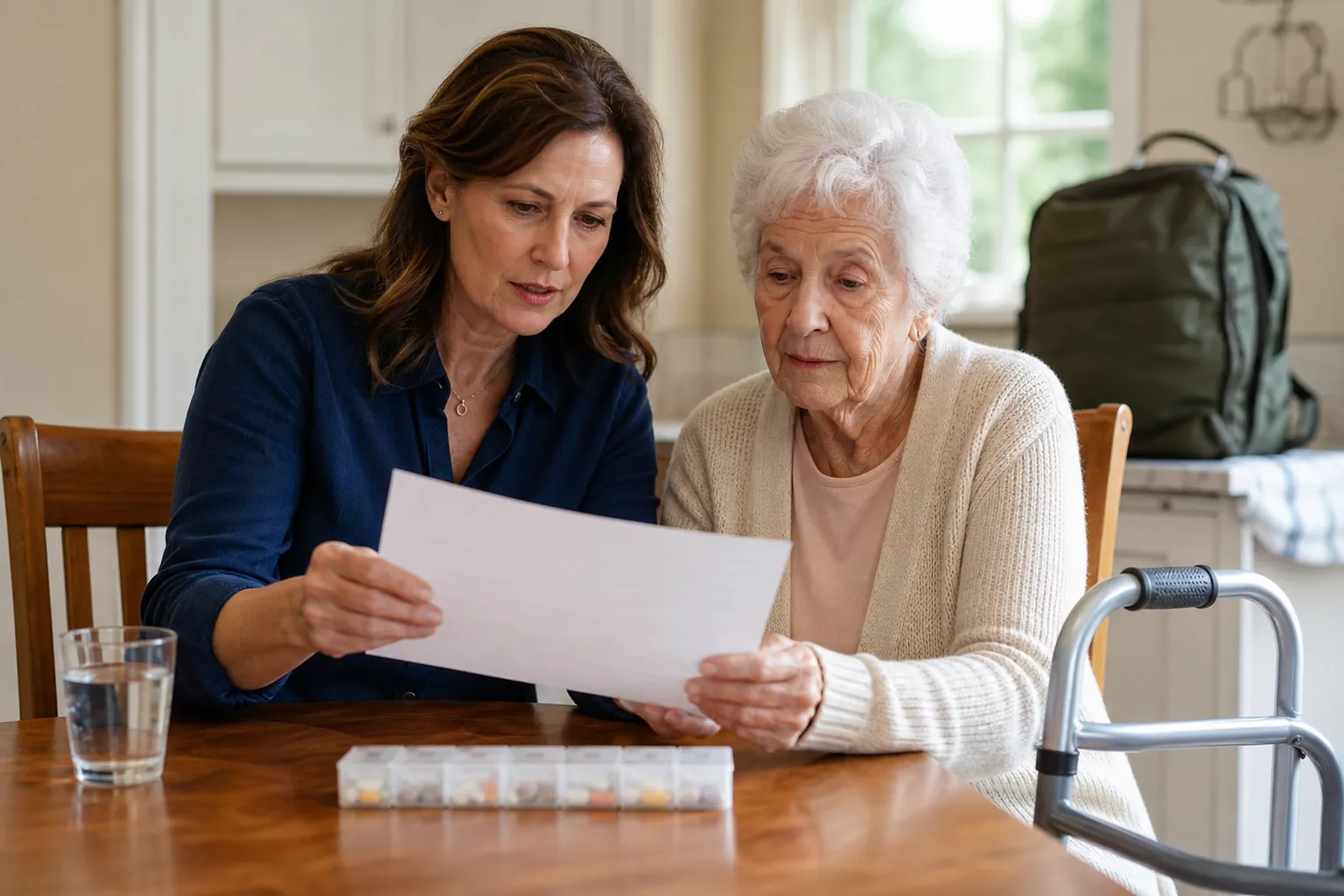
The six-step flow
If you are starting from scratch, do not begin by buying more supplies. Begin by understanding what your parent would need in order to leave safely, then build the rest around that.
| Step | What you are trying to make possible |
|---|---|
| 1. Assess your parent’s real evacuation needs | Know what help, equipment, timing, and accommodations evacuation would require. |
| 2. Map accessible routes and transportation | Make leaving the home physically possible in more than one direction. |
| 3. Build a senior-specific go-bag | Keep the items your parent actually depends on ready to move. |
| 4. Document and digitize medical information | Make sure another person can speak accurately for your parent if needed. |
| 5. Establish a support network | Assign people to calls, rides, check-ins, documents, pets, and backups. |
| 6. Practice gently and update regularly | Find the plan’s weak spots before a real emergency exposes them. |
This framework is consistent with preparedness guidance for older adults from Ready.gov, the American Red Cross, the National Council on Aging, and the California Department of Aging, but the work happens at the kitchen-table level: one parent, one home, one set of limitations and preferences.[1][3][4][5]
Step 1: Assess what evacuation would actually require
Start with a plain walk-through of your parent’s day. Not the version they give a doctor in a cheerful voice, and not the version you wish were true. Watch what they use to stand up, move between rooms, take medication, hear instructions, manage the bathroom, sleep, and leave the house.
This is where many generic plans quietly break. They assume a person who can hear an alert, read instructions, lift a bag, walk quickly, climb into any car, remember medication names, tolerate waiting, and adapt under pressure. Many older adults can do some of those things on a normal afternoon. Fewer can do all of them during smoke, flooding, heat, freezing temperatures, power loss, or confusion.
- Mobility: Can your parent stand without help, walk to each exit, manage stairs, transfer into a car, and travel without their usual chair, walker, cane, or wheelchair?
- Medical equipment: Do they use oxygen, CPAP, a nebulizer, refrigerated medication, mobility equipment, wound-care supplies, or other devices that require power, space, or careful handling?
- Medication dependence: Which medications cannot be missed, which need refrigeration, which cause problems if delayed, and who has the current list?
- Vision, hearing, and communication: Can they hear emergency alerts, read instructions, use a phone, charge a phone, and explain their needs to someone unfamiliar?
- Cognition and stress response: Do they become disoriented at night, resist leaving, repeat questions, misplace items, or become more confused when routines change?
- Daily care needs: Do they need incontinence supplies, special foods, dentures, glasses, hearing aid batteries, transfer help, pet support, or a familiar comfort item to stay calm?
If your parent lives alone, add another layer: how long could a warning sit unnoticed? Who would know if they did not answer the phone? Who has a key? Who can check the house if you are two hours away or in another state? Living alone is not just a household detail; in preparedness research, it was associated with lower odds of having a stocked emergency kit.[2]
It can help to ask your parent for permission to frame this as preserving choice, not taking it away: “If we write this down now, you have more say in where you go, what comes with you, and who helps.” That tone matters. An evacuation conversation can sound to an older parent like a vote of no confidence. Keep the first assessment factual and specific rather than arguing over whether they are “independent enough.”
Step 2: Map routes your parent can use, not just exits that exist
Walk every likely exit route with your parent’s actual mobility aid. A route is not accessible because the door opens. It is accessible if your parent can get to it, open it, pass through it, handle the steps or threshold, and reach transportation or a safe waiting point.
- Front door: Check rugs, narrow furniture gaps, uneven thresholds, locks that require grip strength, and whether smoke or fire could block the most familiar exit.
- Back door or side door: Confirm lighting, steps, railings, gate latches, outdoor surfaces, and whether a walker or wheelchair can pass.
- Bedroom-to-exit path: Assume a nighttime event. Glasses, shoes, cane, hearing aids, phone, and flashlight should be reachable from the bed.
- Apartment or condo route: Identify elevators, stairwells, refuge areas if available, building contacts, and what happens if elevators are out.
- Vehicle route: Test whether the walker, wheelchair, oxygen supplies, go-bag, pet carrier, and another passenger can actually fit in the assigned vehicle.
Do not skip the vehicle test. It is better to discover on an ordinary Saturday that the transport chair only fits if the back seat is folded down than to discover it while ash is falling or water is rising.
Choose at least two destinations: one nearby and one outside the immediate area. For some families, the nearby destination is a sibling’s house, a neighbor’s home, or a cooling or warming center. The farther destination might be a relative, hotel, or friend outside the likely hazard zone. Before writing any destination into the plan, ask whether it can handle your parent’s needs: stairs, bathroom access, pets, electrical outlets, quiet space, and proximity to medical care.
Evacuation is also not automatically the safest answer for every frail person in every emergency. Evidence from nursing home evacuations shows that transfer itself can carry risk for institutionalized residents, though this guide is focused on older adults living at home. For a medically fragile parent, ask their clinician what conditions would make evacuation urgent and what conditions might make sheltering in place safer until help arrives.
Step 3: Pack a go-bag around the person, not the checklist
Water, snacks, a flashlight, batteries, and a phone charger belong in the bag. They are not enough. A senior-specific go-bag should answer a harder question: what would keep your parent medically stable, reachable, understandable, and calmer for the first stretch away from home?
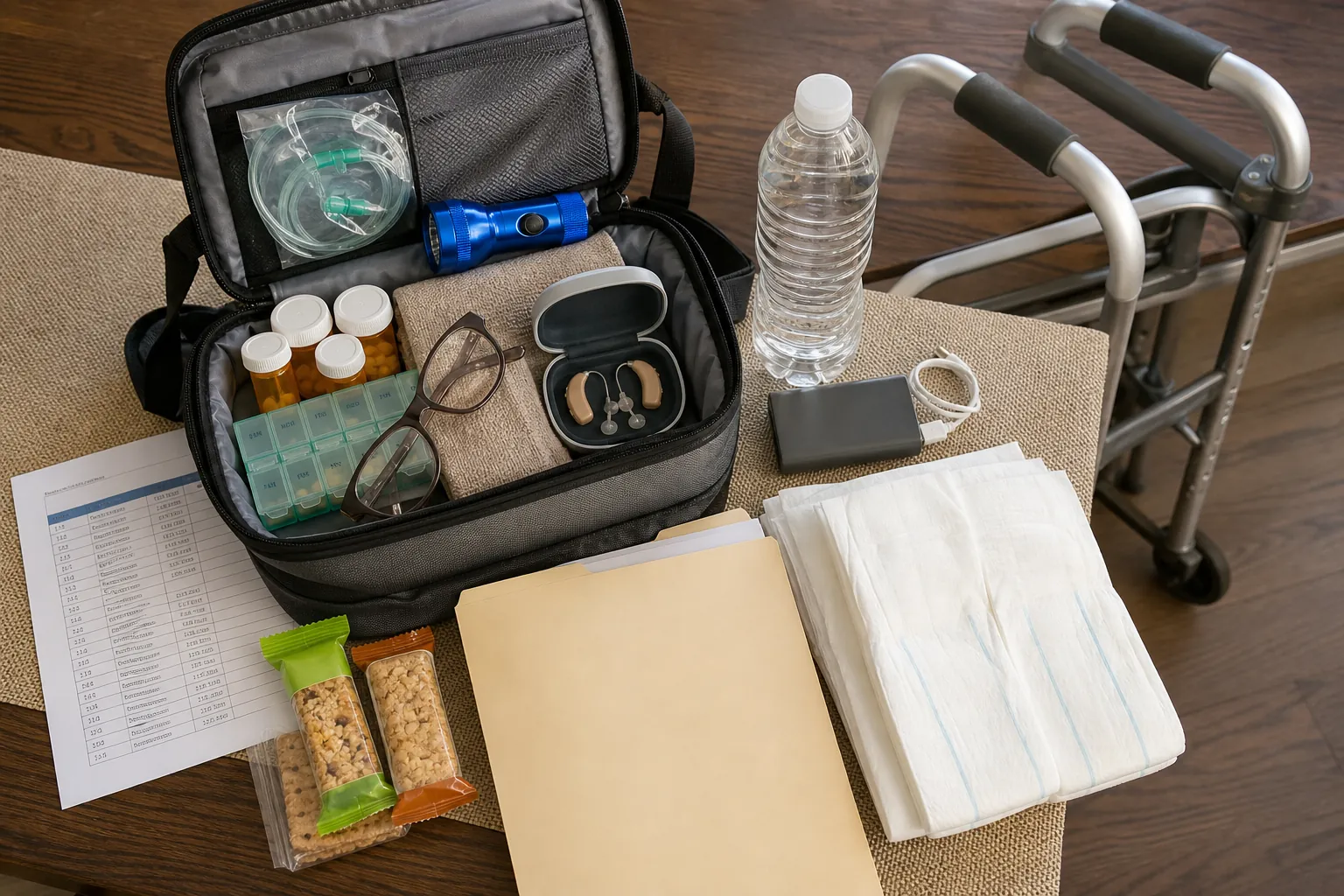
- Medications: Aim for a 30-day supply when possible, along with copies of prescriptions and instructions for refrigerated or time-sensitive drugs.[1][6]
- Medication tools: Include a current pill schedule, pill cutter if used, measuring device, glucose supplies if relevant, and the name and phone number of the pharmacy.
- Assistive-device backups: Pack extra cane tips, walker parts, wheelchair repair items when appropriate, hearing aid batteries, spare glasses, denture supplies, and labeled chargers.[1][6]
- Personal care: Add incontinence supplies, wipes, gloves if used for care, skin-protection items, a change of clothes, and any special food or thickened liquids your parent depends on.
- Medical equipment needs: Include portable oxygen instructions, CPAP details, backup battery information if available, extension cords where safe, and the supplier’s emergency number.
- Comfort and orientation: Pack a familiar sweater, small photo, written reassurance note, simple calendar, or other item that may reduce distress for a parent with memory loss or anxiety.
If money is tight, build the bag in layers. More than half of Americans age 50 and older have no emergency savings, so a plan that assumes an immediate shopping trip for every ideal item will leave many families with nothing done.[3] Start with what is hardest to replace quickly: medication information, glasses, hearing aid batteries, chargers, copies of documents, and supplies tied to toileting, breathing, diabetes, wounds, or mobility.
Label the bag clearly and keep it where a helper can find it without searching through closets. If there are refrigerated medications, put a bright note on the bag and another on the refrigerator: “Take insulin from refrigerator before leaving,” or whatever instruction applies. The bag cannot remember what is not in it.
Step 4: Make medical information portable
A pill organizer is useful only if someone also knows what the pills are. During an evacuation, the person answering questions may not be the family member who usually handles appointments. It may be a neighbor, paramedic, shelter worker, cousin, or home care aide.
Create one short medical document that can travel in the go-bag and live digitally with the people named in the plan. Keep it simple enough to update. A beautiful binder that no one maintains becomes dangerous because it looks authoritative after it stops being accurate.
- Full name, date of birth, address, preferred language, and emergency contacts.
- Current diagnoses, allergies, implanted devices, baseline mobility, and cognitive or communication needs.
- Current medications with dose, timing, purpose if known, prescribing clinician, and pharmacy.
- Medical equipment list, including oxygen, CPAP, mobility devices, hearing aids, dentures, diabetes supplies, and power requirements.
- Insurance information, clinician contacts, advance directive location, and health care proxy or power-of-attorney contact if one exists.
- Care notes that matter under stress, such as “becomes disoriented after dark,” “cannot hear without left hearing aid,” or “needs one-person assist to transfer.”
Take photos of the medication bottles, insurance cards, equipment labels, and the completed document. Share them only with the people who truly need access. If your parent is comfortable with it, store a copy in a secure cloud folder or caregiver app, but do not let technology become the only copy. Phones die, passwords fail, and emergencies have a talent for finding the one person who cannot log in.
Step 5: Assign the people before the warning comes
This is the part that determines whether the plan survives contact with real life. “We’ll all help” is not a role assignment. It is a hope. A workable support network names who calls, who drives, who checks the house, who brings the bag, who handles pets, and who becomes the backup when the first person cannot get there.
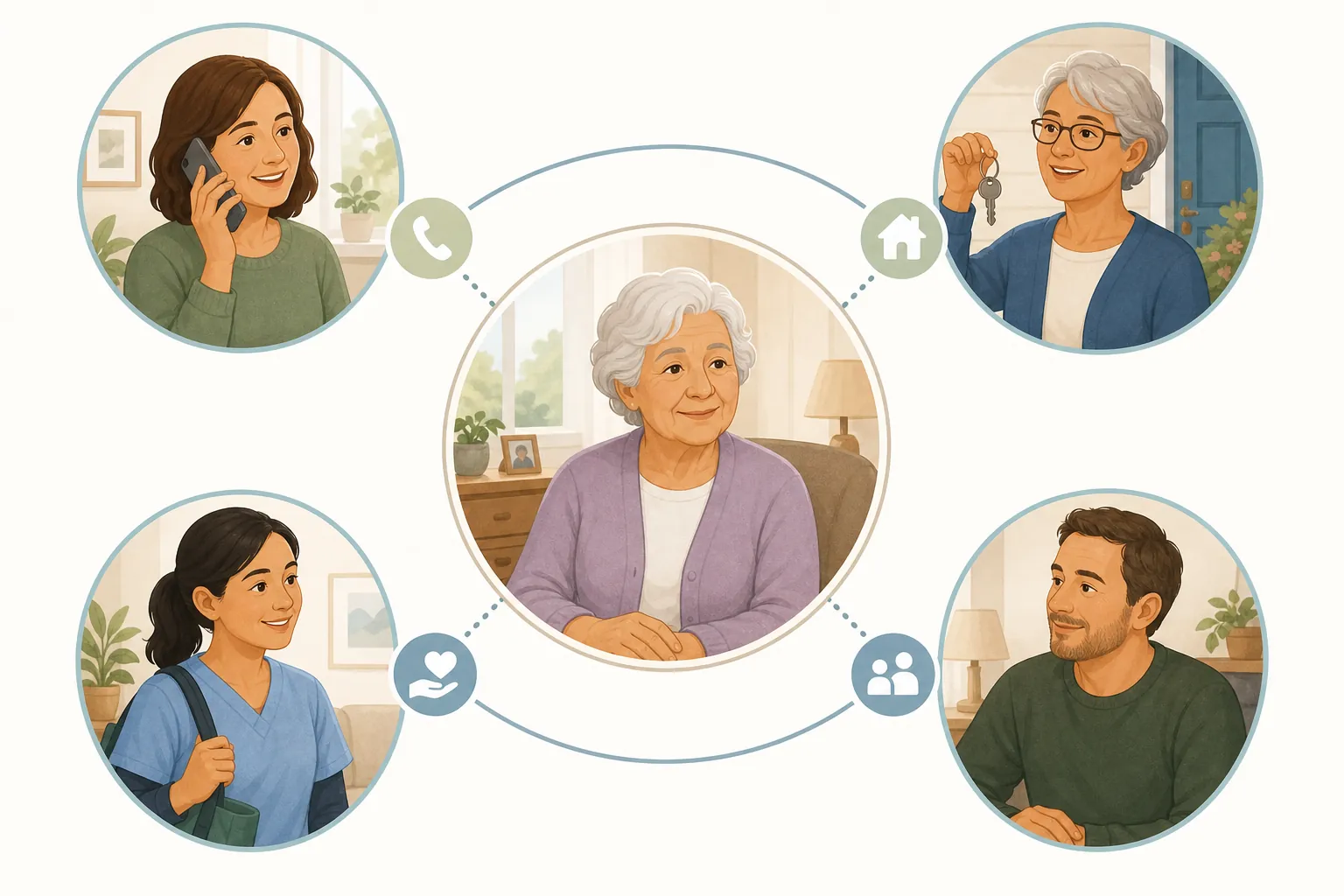
Preparedness guidance from the Red Cross and FEMA-style family communication planning emphasizes support networks because emergencies often separate families or interrupt normal communication.[4] For caregivers, that means the plan should work even if the adult child who usually manages everything is in a meeting, asleep, out of town, ill, or delayed by the same disaster.
| Role | Person assigned | Backup question to answer |
|---|---|---|
| First caller | The person who contacts your parent when an alert is issued | Who calls if they do not answer within a set time? |
| Local checker | A neighbor, relative, building manager, or aide who can physically check the home | Who has a key or access code? |
| Driver | The person with the right vehicle and physical ability to help your parent transfer | Can the vehicle fit the mobility aid, go-bag, equipment, and pet? |
| Medical-document holder | Someone who has the current medication list and medical summary | Who updates it after medication changes? |
| Pet helper | The person responsible for carrier, leash, food, medication, and destination rules | Where can the pet go if the first destination refuses animals? |
| Out-of-area contact | A person outside the hazard area who can receive updates and relay messages | Does every helper know this person’s number? |
For long-distance caregivers, the local checker is not optional. It may be a neighbor, a church member, a building staff person, a home care aide, or a nearby relative. Ask directly: “If there is a wildfire warning, power outage, flood alert, or evacuation order and I cannot reach my mom, are you willing to knock on the door?” Then write down what they are and are not comfortable doing.
Monitoring tools, smart speakers, medical alert systems, or check-in apps can support this plan, especially when family lives far away, but they do not replace human assignments. Someone still has to receive the alert, understand what it means, decide whether to act, and physically help if your parent cannot leave alone.
Share the plan in a way helpers can actually use. A one-page version on the refrigerator, a copy in the go-bag, a photo on each helper’s phone, and a printed copy with the neighbor who has a key may be more useful than a long document stored in a folder no one opens.
Step 6: Practice without turning it into a performance
Practice does not have to mean a full drill with alarms and a stopwatch. For many older adults, especially those with cognitive changes, that approach can backfire. The goal is to make the plan familiar enough that the first real attempt is not happening in total confusion.
- One week, practice finding the go-bag and reading the first instruction card.
- Another week, walk from the bedroom to the safest exit with the walker, cane, or wheelchair.
- On a calm day, test whether the assigned driver can load the mobility aid and help with a car transfer.
- During a regular phone call, ask your parent who they would call first and where the written plan is kept.
- After each medication change, appointment, fall, hospitalization, or new diagnosis, update the medical sheet and go-bag.
Practice should reveal friction, not shame anyone for it. If your parent cannot lift the bag, make it lighter or assign someone else to carry it. If they cannot remember the plan, simplify the first instruction. If they resist leaving, ask what would make leaving feel less frightening: a specific destination, a pet plan, a favorite blanket, a call from a trusted relative, or knowing which neighbor is coming.
Why this cannot wait for the perfect weekend
The point of using disaster examples is not to frighten families into buying supplies. It is to notice what disasters expose. During Hurricane Katrina, people age 75 and older were 6% of the population but accounted for 50% of deaths. In the 2018 Camp Fire, 71 of 84 identified fatalities were age 60 or older. During the 2021 Texas winter storm, 60% of 246 deaths were people age 60 or older, with most deaths from hypothermia.[3]
Those events were different, but the caregiving lesson is familiar: age, disability, isolation, power loss, transportation problems, and temperature extremes change what “just leave” or “just stay home” means. A parent who seems fine on a normal day may not be able to solve those problems while frightened, cold, overheated, short of breath, or in the dark.
If you can do only one thing today, do the assessment and assign one local checker. If you can do two, add a current medication list to the go-bag. The full plan can improve over time, but the most dangerous version is the one everyone assumes exists because the family cares.
A senior evacuation plan is a living family document. Its value is not measured by how tidy it looks. It is measured by whether another person could follow it when the primary caregiver is unavailable, frightened, delayed, or far away.
References
- Older Adults, Ready.gov
- Predictors of Emergency Preparedness among Older Adults, PMC/NCBI, 2020
- The Impact of Disasters on Older Adults — AARP Disaster Resilience Tool Kit, AARP
- Older Adults Emergency Preparedness, American Red Cross
- What Older Adults Can Do If Disaster Strikes, NCOA
- A Family Guide to Emergency Preparedness for Seniors, New Wave Home Care
Questions to bring to a clinician or OT
This is not medical, legal, or a family's final decision — only a framework. Bring these questions to a clinician, occupational therapist, or your local Area Agency on Aging.
Find Local HelpRelated reading
Noticed something outdated or inaccurate on this page? Flag a correction. We review every report against CDC, NIA, and AARP HomeFit guidance before updating a page.