
Caregiver decision guide
How to Set Up a Senior-Safe Clean Room During Code Purple Alerts
This guide explains how to protect an older adult during a Code Purple air quality alert by creating a clean room tailored to their mobility, budget, and cognitive needs. Learn room-selection criteria, affordable air cleaner options, and caregiver verification steps that standard guidance often overlooks.
During a Code Purple air quality alert, the first job is not to make the whole house perfect. It is to make one room safe enough for an older adult to stay in for several smoky hours without overheating, tripping, or having to remember a complicated setup. Code Purple is commonly used for AQI 201–300, a level described as very unhealthy, when health effects can increase for everyone and especially for people at higher risk.[1]
For seniors, that higher-risk group often includes people with heart disease, lung disease, diabetes, limited mobility, or reduced ability to sense and respond to changing conditions. AirNow specifically identifies older adults as more likely to be affected by particle pollution, including the fine particles in smoke.[2] So the practical answer to what seniors should do during a Code Purple air quality alert is: get into a prepared clean room, keep the air filtered, keep the room cool, and have someone verify that the room is still working.
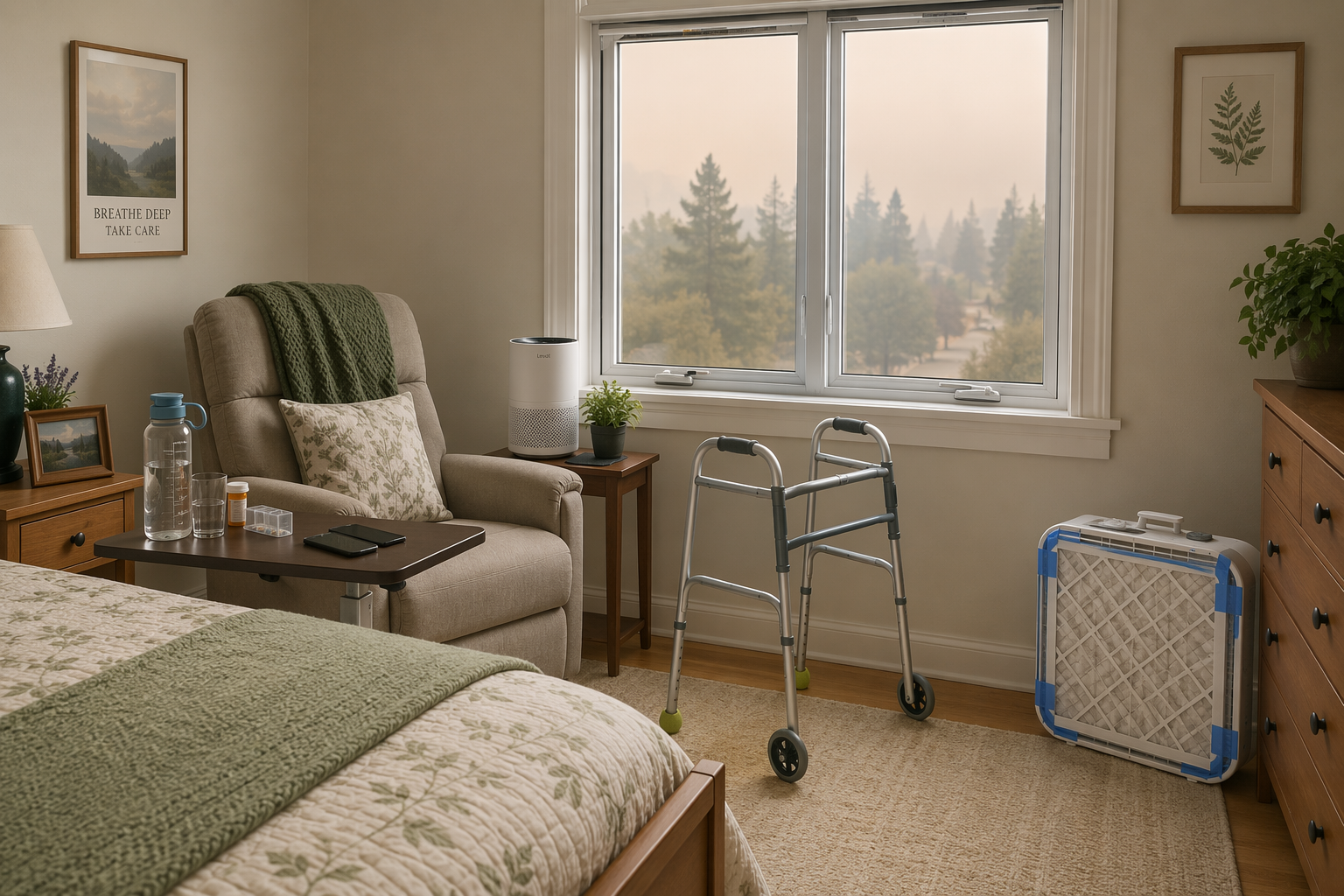
Start With the Room the Senior Can Actually Use
A clean room is a room where outside smoky air is kept out as much as possible and indoor air is filtered. EPA and AirNow guidance says a properly sized HEPA portable air cleaner can reduce indoor PM2.5 concentrations by up to 85% in a clean room.[3] That is a strong reason to focus effort here, but it is not a guarantee. The room still has to fit the person using it.
For an older adult, the best clean room is usually not the smallest room on paper. It is the room where they can sit, breathe, reach the bathroom, avoid stairs, and stay cool while doors and windows remain closed.
- Choose ground-floor access if the senior uses a cane, walker, rollator, wheelchair, or gets short of breath on stairs.
- Keep the room close to a bathroom, or set up a safe commode plan if walking through smoky parts of the house would happen often.
- Check the floor path before the alert worsens: no throw rugs, cords across the walking route, low ottomans, laundry baskets, or purifier cords where a foot or walker wheel can catch.
- Look for a door that closes well and windows that latch. A room with beautiful space but a warped window frame may lose to a plainer room with tighter closure.
- Confirm there are enough outlets for the air cleaner, phone charger, lamp, and medical equipment without stacking extension cords.
- Make sure the chair or bed is one the senior can get out of without straining. A deep sofa can become a trap during a long alert.
If the upstairs bedroom has the best windows but the person cannot reliably climb the stairs, use a downstairs room. If the den is closer to the bathroom but has a sliding door that leaks air badly, choose the bedroom and bring in a bedside commode only if that can be done safely. The clean-room decision is not about architectural neatness. It is about where the older adult can remain with the fewest unsafe interruptions.
Seal the Room Before You Turn on the Filter
Close windows and doors before running the air cleaner. If there are obvious gaps under the door or around a window, use what is already in the house: a rolled towel at the door bottom, painter’s tape around a drafty window edge, or weather stripping if it is available. Do not tape a door shut if the senior may need to leave quickly or if a caregiver is not present.
The most common failure here is assuming “closed” means sealed. In a home with older windows, a lever-style window air conditioner, or a door that does not latch cleanly, smoke can still come in. A quick smell check is useful: if the room smells smoky after the purifier has been running and the rest of the house smells smoky too, the room probably needs a better seal, a better filter, or a different location.
Choose the Air Cleaner: HEPA First, DIY Carefully When Money Is Tight
The clean room needs active filtration. A fan alone only moves smoky air around. A standard central HVAC filter may help if the system can safely use a higher-rated filter, but ordinary MERV 6–8 filters are not designed to capture fine smoke particles well; smoke guidance points to MERV 13 or higher where the system can handle it.[4]
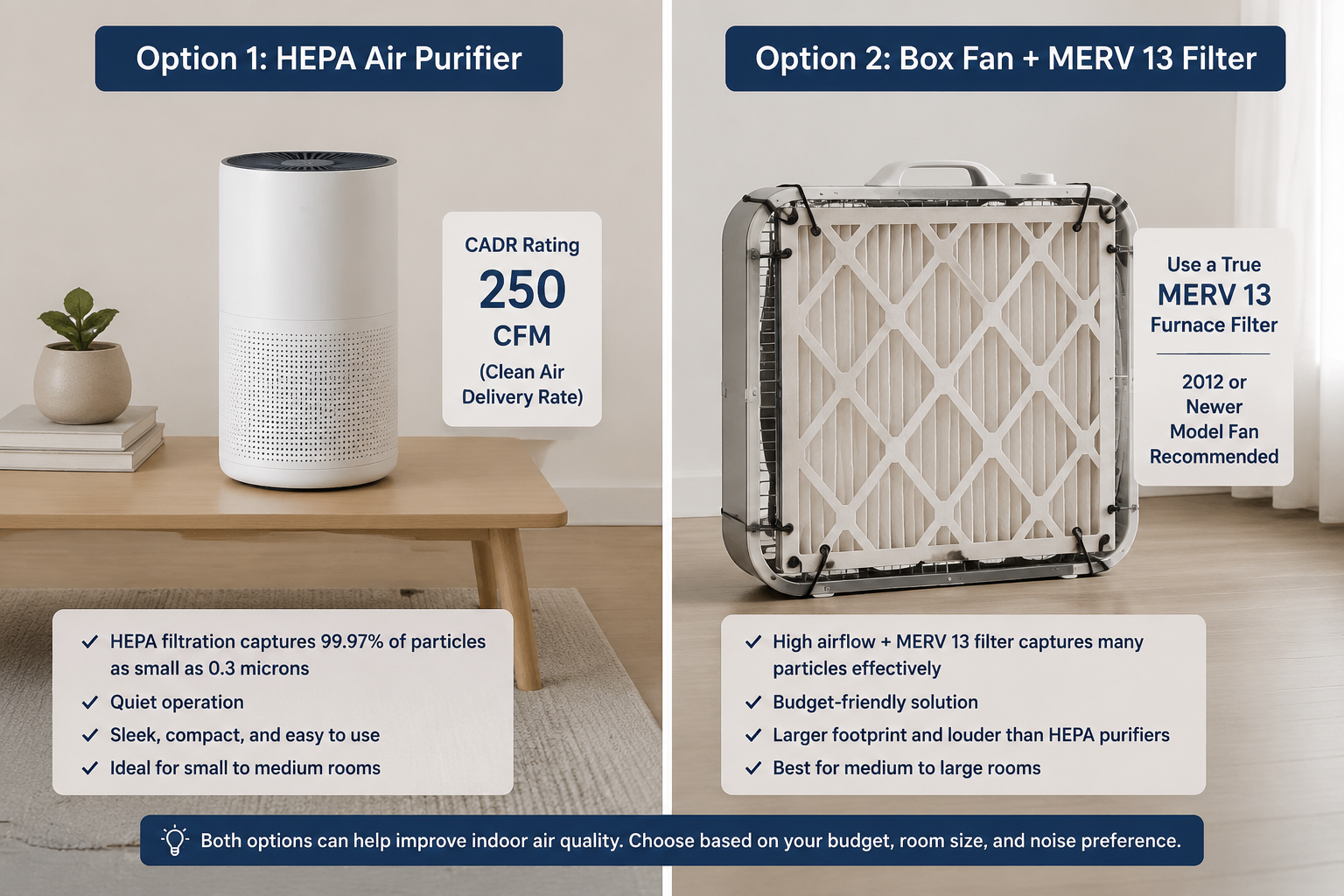
| Option | When it makes sense | What to watch |
|---|---|---|
| Portable HEPA air cleaner | Best first choice when one can be bought, borrowed, or moved into the clean room | It must be sized for the room; avoid ozone-generating devices |
| DIY box fan with MERV 13 filter | Lower-cost backup when a HEPA unit is not available | Use only a 2012-or-newer fan and never leave it unattended |
| Central HVAC with MERV 13 or higher | Helpful if the system can safely handle the filter and the home is reasonably sealed | Do not assume the existing filter is adequate; many homes use lower-rated filters |
Portable HEPA unit
A true HEPA portable air cleaner is the simplest setup for most seniors. Put it in the room, close the room, run it continuously during the alert, and keep the intake and outlet clear. EPA/AirNow clean-room guidance describes this as a way to reduce fine particle levels indoors when the unit is properly sized for the room.[3]
Do not buy an air cleaner because the box says “smoke” if it relies on ozone generation. EPA and lung-health guidance warn against ozone generators because ozone can harm lung health.[3][4] Look for mechanical filtration, not a device that claims to freshen, ionize, or sanitize the air with ozone.
Placement matters in a senior’s room. A purifier on the floor can become a tripping hazard if it sits beside the walker path. A heavy unit on a high dresser may be impossible for a spouse to move safely. The better spot is often along a wall near an outlet, away from curtains, bedding, oxygen tubing, and the route to the bathroom.
DIY box fan with MERV 13 filter
If a HEPA unit is not available or the cost is out of reach, a box fan with a MERV 13 filter can be a useful short-term option. EPA research on DIY air cleaners discusses this approach for reducing wildfire smoke indoors. The rough cost is about $30–50, compared with about $100–300 for many commercial HEPA units.[5]
The safety limits are not small print. EPA cautions that DIY air cleaners should use a newer box fan, specifically 2012 or later, and should never be left unattended.[5] That makes this option a poor fit for a senior who lives alone during the day, naps deeply, has cognitive impairment, or may forget that the fan is running. It can work better when a caregiver or another adult is in the home and can turn it off when leaving the room.
Keep the fan-filter unit out of corners where curtains, newspapers, blankets, or oxygen tubing can touch it. Do not run it with a damaged cord, a rattling motor, or a fan pulled from long storage with an unknown age. A bargain setup that creates a fire risk is not a senior-safe clean room.
Keep the Room Cool Without Pulling Smoke Inside
Closed windows help with smoke, but heat can make the room unsafe. This is where many clean-room instructions fall apart in real homes, especially for older adults who are heat-sensitive or who do not feel temperature changes quickly.
A window air conditioner can be used if it is set to recirculate indoor air and the fresh-air intake is closed. AirNow smoke guidance distinguishes this from bringing outdoor air inside and advises keeping indoor air clean by closing windows and using recirculation where applicable.[4] The hard part is not the concept; it is the little lever on the unit. Someone should physically check that it is on recirculate, not “fresh air,” “vent,” or an open outside-air setting.
- Use air conditioning on recirculate if available.
- Do not use whole-house fans that pull outdoor air through the home during smoke.
- Do not crack a window for “just a little air” unless the room has already failed because it is too hot and there is no safer cooling option.
- Use a room fan only to circulate indoor air, not as a substitute for filtration.
- Move the senior to a cleaner, cooler location if the room cannot stay at a safe temperature with windows closed.
CDC wildfire-smoke guidance also points people toward cleaner indoor air spaces when conditions at home are not safe.[6] For a caregiver, that can mean a relative’s home with better filtration, a public clean-air location if available locally, or medical guidance if symptoms are worsening.
Set the Room Up for a Long Sit, Not a Quick Visit
Once the room is chosen, sealed, filtered, and cooled, make it livable enough that the senior does not keep leaving it. Every unnecessary trip through the rest of the house means more smoke exposure and more chances to forget to close the door behind them.
- Place water, eyeglasses, hearing aids, phone, charger, tissues, and a trash bag within easy reach.
- Keep regular medications nearby only in the way the senior normally and safely uses them; do not rearrange pills during a crisis unless a clinician or existing care plan directs it.
- Park the walker, cane, or wheelchair where the senior naturally stands up, not across the room.
- Use a lamp or nightlight so the path to the bathroom or commode is visible if the alert continues into the evening.
- Put a simple note on the door or window: “Keep closed for smoke.” This helps visitors and can help a senior who forgets why the room is closed up.
For someone with memory loss or confusion, the setup has to assume that the window may be opened, the purifier may be turned off, or the door may be propped open because the room feels stuffy. That is not stubbornness; it is a predictable failure point. Build the room so it needs fewer decisions, then check it in person or by a trusted nearby helper when possible.
The Caregiver Verification Loop
A clean room should be checked at the start of the alert, after any meal or bathroom routine that disrupts the setup, and again if the senior reports smoke smell, dizziness, coughing, unusual fatigue, or the room feeling too hot. If the caregiver is not in the home, the check can be done by a spouse, neighbor, aide, or adult child who can physically see the room. A text saying “I’m fine” is reassuring, but it does not confirm that the window lever is closed or that the purifier is still on.
- Window closed and latched; window AC set to recirculate if used.
- Door closed except for necessary entry and exit.
- Air cleaner running, with airflow not blocked by furniture, curtains, bedding, or supplies.
- DIY fan-filter unit attended by an adult and turned off before the room is left unattended.
- Room temperature tolerable without opening windows.
- Walking path clear, mobility aid reachable, phone charged, and water within reach.
Filters also need attention. MERV 13 filters used during smoke events can load faster than they would in ordinary conditions, and the research brief notes that replacement may be needed roughly every 1–3 months during active use.[5] For a fixed-income household, that cost matters. If the filter is visibly dirty, airflow drops, or the unit sounds strained, it is not enough to say the room has a filter; the filter may no longer be doing the job well.
When the Clean Room Is No Longer Enough
The clean room has reached its limit if smoke smell persists after sealing and filtration, the room cannot stay cool without opening windows, no safe filter option is available, or the senior’s breathing, chest symptoms, confusion, weakness, or distress worsens. CDC guidance advises paying attention to health symptoms during wildfire smoke events and seeking medical help when needed.[6]
At that point, the safer action is not another towel under the door. It is a cleaner alternate location or medical guidance.
References
- Know The Code! — NC DEQ Air Quality Outreach to Older Adults
- Older Adults and Air Quality — AirNow.gov
- How to Create a Clean Room to Help Protect Against Wildfire Smoke — American Lung Association
- Be Smoke Ready — AirNow.gov
- Research on DIY Air Cleaners to Reduce Wildfire Smoke Indoors — EPA
- Safety Guidelines: Wildfires and Wildfire Smoke — CDC
Questions to bring to a clinician or OT
This is not medical, legal, or a family's final decision — only a framework. Bring these questions to a clinician, occupational therapist, or your local Area Agency on Aging.
Find Local HelpRelated reading
Noticed something outdated or inaccurate on this page? Flag a correction. We review every report against CDC, NIA, and AARP HomeFit guidance before updating a page.