
Caregiver decision guide
Choosing Tongue Cancer Treatment for an Elderly Parent
When an elderly parent is diagnosed with tongue cancer, caregivers face difficult treatment decisions. This guide explains why chronological age alone shouldn't drive the choice and provides a framework based on cancer stage, functional status, and quality of life to help you have an informed conversation with the oncology team.
When an elderly parent is diagnosed with tongue cancer, the first family meeting often gets pulled toward the wrong question: “Is my parent too old for treatment?” That question sounds practical, but it hides the information that actually matters. A better question is: “Is my parent healthy enough, and is this cancer treatable enough, for surgery, radiation, or another approach to serve the outcome my parent would still choose?”
Tongue cancer treatment in elderly patients should not begin or end with a birthday. It should begin with the tumor, the body it is in, and the person who has to live with the consequences. Some older adults are too frail for aggressive treatment. Some are not. Some want every reasonable chance at cure. Some would rather avoid a feeding tube, repeated hospital visits, or a recovery that threatens the parts of life they still value most. Those are clinical and personal distinctions, not age categories.

Age Alone Is a Poor Treatment Plan
The evidence does not support automatically withholding surgery because a patient is 75, 80, or older. In a study of patients aged 75 and above with oral tongue squamous cell carcinoma, those who had surgery had better overall survival and cancer-specific survival than those who did not; among patients aged 85 to 102, the hazard ratio for cancer-specific survival was 6.259 for no surgery compared with surgery.[1]
That does not mean every older patient should have surgery. Registry studies can show associations, not prove that surgery caused every survival difference. They may not fully capture frailty, social support, patient preference, nutrition, cognitive status, or the details of why one person was offered an operation and another was not. Still, the finding is important because it pushes against a lazy assumption: older adults are not automatically outside the group that can benefit from standard treatment.
The opposite problem is also documented. In a National Cancer Database analysis of oral cavity squamous cell carcinoma, patients aged 70 to 79 with early-stage disease had 3.87 times the odds of receiving palliative therapy compared with patients aged 40 to 59, even after controlling for comorbidity and stage. Patients aged 80 to 89 had 6.13 times the odds of receiving surgery alone instead of surgery plus radiation compared with the 40 to 59 group. In that same analysis, 20.5% of patients aged 80 to 89 and 38.3% of patients aged 90 and older received only palliative care.[2]
Those numbers do not prove that every palliative recommendation was wrong. Some patients had advanced disease, limited reserves, or preferences that made comfort-focused care the right choice. But the pattern is enough to justify a direct question in the consult room: “If my parent were younger but had the same cancer stage, same heart and lung health, same functional status, and same goals, would your recommendation be different?”
The Factors That Should Replace “At This Age”
A serious treatment discussion should sound more specific than “for someone your age.” It should include cancer stage, ECOG performance status, comorbidities, frailty, expected recovery, speech and swallowing effects, and the patient’s own priorities. Reviews of surgery in elderly patients with oral cancer identify comorbidities, ECOG performance status, Charlson Comorbidity Index, frailty, cancer stage, and patient and family wishes as factors that matter more than age alone.[3]
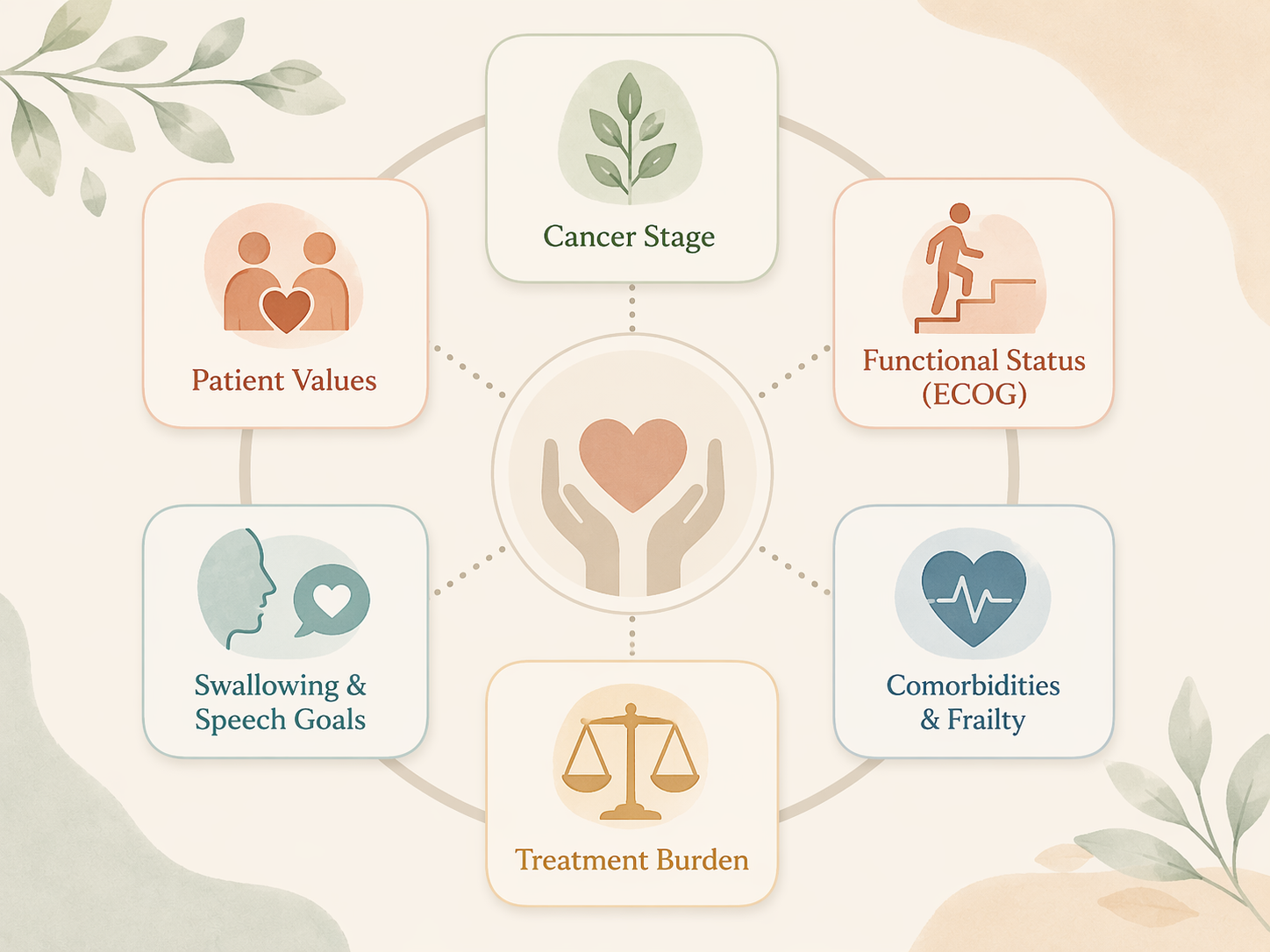
For a caregiver, those terms are not academic. They are the difference between accepting a vague reassurance and understanding what the team is actually weighing.
- Cancer stage: Ask whether the cancer is localized, regionally spread, or distant, and whether lymph nodes are involved. Stage affects whether surgery alone might be enough or whether radiation is likely to be recommended afterward.
- Functional status: Ask for the ECOG performance status. A parent who is up, eating, walking, managing daily routines, and clearly expressing preferences is in a different situation from a parent who is mostly bedbound.
- Comorbidities: Ask which conditions materially increase treatment risk: heart failure, lung disease, kidney disease, diabetes complications, prior strokes, dementia, malnutrition, or recurrent infections.
- Frailty: Ask whether the team has assessed frailty rather than assuming it. Weight loss, falls, slow walking speed, exhaustion, and low strength can change the risk of surgery and recovery.
- Treatment burden: Ask what the next 30 days and the next 12 months may look like, not just what the survival curve looks like.
- Patient goals: Ask your parent what outcome would still feel acceptable: cure at high short-term cost, preserving swallowing, staying home, avoiding hospitalization, living to a family event, or minimizing pain.
The goal is not to turn a daughter or son into an oncologist. It is to make sure the room does not slide from “elderly” to “less care” without showing its work.
Why Surgery May Still Be on the Table
For oral tongue cancer, surgery is often central because it removes the primary tumor and gives the team more precise information about margins, depth of invasion, lymph nodes, and other risk features. In selected older patients, that information can guide whether additional treatment is needed.
One study of patients older than 80 with oral squamous cell carcinoma who underwent surgery reported 5-year overall survival of 82% and disease-specific survival of 90%, even though 94.1% had comorbidities.[4]
That kind of result should be read carefully. These were selected patients who actually underwent surgery, not every patient over 80 with oral cancer. Selection matters. A fit 82-year-old with a treatable tumor and controlled medical problems is not the same as an 82-year-old with severe frailty, major organ disease, poor nutrition, and advanced cancer. But the study is still useful because it shows why age cutoffs can be misleading. Some very old patients tolerate and benefit from treatment when the rest of the clinical picture supports it.
The caregiver’s job in this part of the conversation is to ask what makes surgery reasonable or unreasonable for this parent. Useful questions include:
- What is the goal of surgery: cure, local control, symptom relief, or diagnosis?
- How much of the tongue would be removed, and what reconstruction would be needed?
- Would lymph nodes in the neck need to be removed or sampled?
- What are the main risks for this parent specifically, given their heart, lungs, nutrition, cognition, and medications?
- What would recovery require at home, in rehab, or with speech and swallow therapy?
- If surgery goes well, what function is realistically expected at 1 month, 3 months, and 12 months?
When Surgery Plus Radiation Enters the Discussion
Families are often startled when surgery is not the end of treatment. In some cases, the pathology report after surgery shows features that make recurrence more likely. The team may then recommend radiation, sometimes with additional therapy depending on the cancer’s risk profile and the patient’s ability to tolerate it.
This is where undertreatment concerns become concrete. The NCDB analysis found that patients aged 80 to 89 had much higher odds of receiving surgery alone instead of surgery plus radiation compared with younger adults, even after adjustment for stage and comorbidity.[2] That does not mean surgery plus radiation is always right. It means the reason for leaving radiation out should be explicit.
Ask the oncology team to separate three questions that can otherwise blur together:
- Would radiation be recommended for a younger patient with the same pathology?
- Is radiation being avoided because the expected benefit is small, because the burden is too high, or because my parent does not want it?
- Are there ways to reduce treatment burden without giving up the main goal of treatment?
Radiation can be exhausting, especially for a person already close to the edge physically. It may affect eating, saliva, mouth pain, taste, dental health, and daily stamina. Those effects are not minor simply because they are not surgery. If the recommendation is radiation after surgery, ask who will monitor nutrition, swallowing, pain control, hydration, and transportation. A treatment plan that requires daily visits is also a caregiving plan.
Quality of Life Is Not a Side Issue
Tongue cancer treatment can threaten the exact functions that make daily life feel intact: speaking clearly, swallowing comfortably, eating with family, managing saliva, and being understood. For many families, the decision is not simply treatment versus no treatment. It is whether the likely recovery path is something the parent would accept for the chance of cure or control.
A 12-month prospective study of 56 patients with tongue cancer after surgery found that quality of life was sharply impaired in the first month after surgery but typically returned close to baseline by 12 months. In that study, older patients aged 65 and above often reported better emotional function and less pain-related quality-of-life impact than younger patients.[5]
The limits matter: this was a single-hospital Greek study, so it may not predict every U.S. patient’s experience. But the time pattern is still helpful for families. The first month may be much harder than the one-year picture. If the team only says “recovery takes time,” ask them to make the timeline visible.
| Question for the team | Why it matters |
|---|---|
| What is the expected swallowing ability before treatment, during recovery, and at 12 months? | The parent may value eating and drinking normally as much as, or more than, a survival estimate. |
| Will speech therapy or swallow therapy start before treatment, after treatment, or only if problems appear? | Waiting until a crisis can leave the caregiver scrambling for help. |
| What are the signs that nutrition or hydration is failing? | Weight loss, dehydration, and aspiration risk can change the treatment plan quickly. |
| Will a feeding tube be likely, possible, or unlikely? | Families need to distinguish a temporary support from a long-term change in daily life. |
| Who should we call after hours for pain, bleeding, choking, fever, or inability to swallow? | The emergency plan should not be improvised at midnight. |
If your parent can participate, ask these questions in front of them rather than around them. A parent may be willing to endure a difficult month for a meaningful chance of cure. Another may accept a shorter life if it means less time in clinics and more time at home. The clinician’s job is to explain the likely tradeoffs. The family’s job is not to make the parent brave or compliant; it is to help the parent’s priorities survive the speed of the medical system.
Stage Still Matters
Age is not the deciding factor, but stage can be. Survival statistics are broad, and they do not tell one family what will happen, but they help explain why oncologists talk differently about a small localized tumor than about cancer that has spread far beyond the tongue. SEER-based data from 2013 to 2019 reported 5-year relative survival of 83% for localized tongue cancer, 69% for regional spread, and 41% for distant metastasis.[6]
Those figures have limitations. They are population estimates, not individualized predictions, and the 2013 to 2019 window may not fully reflect newer surgical, reconstructive, radiation, and supportive-care approaches. Still, they make one point clear: the same 82-year-old may face a very different decision depending on whether the cancer is localized, regionally spread, or distant.
Ask the team to draw the decision around stage in plain language:
- Is the cancer considered curable with treatment?
- If cure is possible, what treatment gives the best chance of cure?
- If cure is unlikely, what would treatment realistically improve: pain, bleeding, swallowing, speech, tumor growth, or time?
- What happens if treatment is delayed for a second opinion or geriatric assessment?
- What signs would mean the plan needs to change?
Bring a Geriatric Lens Into the Oncology Plan
A head and neck oncologist understands the cancer. A geriatrician or primary care clinician who knows the parent well may understand the reserves: falls, cognition, appetite, medication side effects, sleep, family support, and what the parent was like before the diagnosis. For older adults, both views matter.
If the oncology team has not already addressed it, ask whether a geriatric assessment would change the recommendation. This is especially useful when the parent is medically complicated, living alone, losing weight, having memory issues, or already needing help with bathing, dressing, meals, transportation, or medications. For help thinking through which clinician should coordinate which part of care, see this guide to geriatricians versus primary care physicians.
This is also the time to confirm who can legally receive information and make decisions if your parent cannot. If paperwork is incomplete, start with a practical power of attorney checklist. The medical plan can be excellent and still fall apart if the family is blocked from records, consent discussions, or urgent decisions.
When Comfort-Focused Care Is the Right Answer
Palliative care should not be treated as a synonym for giving up, and it should not be used as a quiet substitute for age-based undertreatment. Both can be true. Palliative care can help with pain, swallowing distress, nutrition decisions, anxiety, communication, family meetings, and planning. It can be appropriate alongside cancer-directed treatment, and it can also become the main approach when treatment would not serve the parent’s goals.
A comfort-focused plan may be the most respectful option when the cancer is not realistically controllable, when frailty or comorbidities make treatment danger outweigh benefit, when recovery would likely take away the functions the parent most wants to preserve, or when the parent clearly says they do not want aggressive treatment. The key is that the recommendation should be tied to the cancer, the body, and the parent’s wishes — not to a shrug about age.
If the conversation is moving toward palliative or hospice-oriented care, ask the same direct questions you would ask about surgery:
- What symptoms are we trying hardest to prevent or relieve?
- What would make eating, drinking, speaking, or sleeping safer and more comfortable?
- Who manages pain medication, mouth care, bleeding risk, and nutrition questions?
- When should we call the oncology team, palliative care team, hospice, or 911?
- What does my parent want family members to understand before decisions become urgent?
For families who need to organize these conversations, an end-of-life care planning roadmap can help turn a frightening phrase into concrete decisions.
What to Bring to the Next Oncology Visit
The next appointment will probably move fast. Bring one page that keeps the discussion anchored to your parent rather than to a general category of “elderly patient.”
- Current medication list, including blood thinners, diabetes medications, pain medications, supplements, and allergies.
- Major medical conditions and recent hospitalizations, falls, infections, weight loss, or confusion.
- Baseline function: walking, bathing, dressing, cooking, driving, finances, medication management, and whether help was already needed before diagnosis.
- Eating and swallowing status now: pain, choking, weight change, texture changes, hydration, and dental issues.
- Your parent’s priorities in their own words, even if they are simple: “I want to be able to eat,” “I want to stay home,” “I want the best chance at cure,” or “I do not want to spend the rest of my time in hospitals.”
- Family logistics: who can drive, who can stay overnight, who manages portal messages, who has legal authority, and who needs to be included in decisions.
If you are still in the first shock of diagnosis, a 72-hour caregiver checklist can help separate urgent tasks from tasks that can wait. If you are already becoming the family project manager, make room for your own limits too; a caregiver self-care checklist is not sentimental when the treatment plan depends on weeks of transportation, advocacy, meals, medication tracking, and follow-up.
Before the visit ends, ask the oncologist to say the recommendation in one sentence that includes the reason: “Because the cancer is ___, and your parent’s functional status is ___, and their main goal is ___, we recommend ___.” If the sentence cannot be completed without leaning on “at this age,” the discussion is not finished.
References
- Effects of surgery on survival of patients aged 75 years or older with oral tongue squamous cell carcinomas, Scientific Reports, 2021
- The Role of Age in Treatment Decisions for Oral Cavity Squamous Cell Carcinoma, 2021
- Factors to consider for surgical in elderly patients with oral cancer, 2021
- Treatment strategies for patients over 80 years of age with oral squamous cell carcinoma, ScienceDirect, 2024
- Quality of Life in Patients With Tongue Cancer After Surgical Treatment: A 12-Month Prospective Study, 2022
- Tongue cancer survival rate: What to know, Medical News Today
Questions to bring to a clinician or OT
This is not medical, legal, or a family's final decision — only a framework. Bring these questions to a clinician, occupational therapist, or your local Area Agency on Aging.
Find Local HelpRelated reading
Noticed something outdated or inaccurate on this page? Flag a correction. We review every report against CDC, NIA, and AARP HomeFit guidance before updating a page.