
Caregiver decision guide
How to Protect an Aging Parent During Wildfire Season
This guide helps family caregivers create a wildfire safety plan that accounts for an older adult's mobility limitations, medication needs, smoke sensitivity, and cognitive challenges — covering evacuation routes, go-bag essentials, and post-fire reentry precautions.
Wildfire preparedness for an older parent matters only when it changes what happens next: who gets the keys, whether the walker fits, whether the oxygen machine keeps running, and whether the parent can understand the evacuation order before smoke and confusion take over. Standard wildfire plans assume a quick exit and a clear head. Older adults often have neither.
That is not a niche problem. USFA/FEMA says adults 65 and older have 2.5 times the fire-death risk, and adults 85 and older have four times the risk [1]. A recent AARP review of wildfire-smoke harms cites a 2024 PNAS finding that wildfire smoke is roughly 10 times more toxic than ambient fossil-fuel pollution, plus evidence that asthma ER visits rose 17% on days when AQI topped 101 and that heart-attack death risk doubled when extreme heat and high PM2.5 hit together [2]. The CDC's smoke guidance turns that into a practical rule: watch AQI and move to cleaner air before symptoms start [3]. A scoping review of wildfires and older adults adds the part many plans miss: mobility limits, isolation, and cognitive decline can keep people from evacuating even after the warning arrives [4].
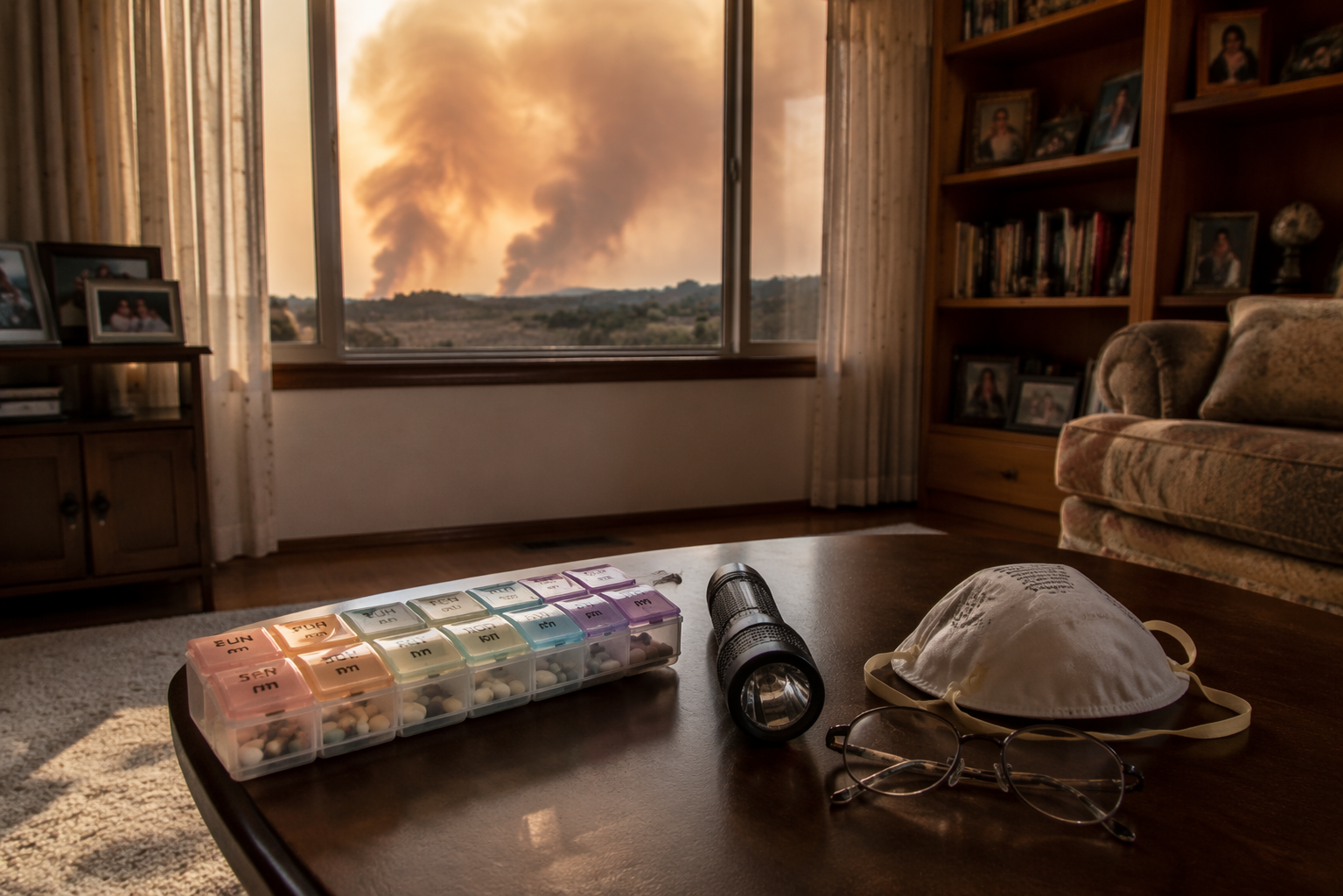
Why older adults need a separate wildfire plan
Packing is secondary. First decide how the parent actually leaves. Pick one primary destination and one backup, name who drives, name who holds the keys, and decide what event makes the family leave early instead of waiting for the order to feel official. If the parent lives in assisted living, ask who physically moves them, who handles medications, and whether the facility has a separate process for residents who use oxygen or need help standing.
- Put keys, car fob, charger, and a paper contact card in one agreed place.
- Choose a destination that works for stairs, walkers, wheelchairs, oxygen, and bathroom access.
- Write down the backup driver, the person who calls siblings or the facility, and the pharmacy number.
- Set an early-leave trigger tied to fire behavior, smoke, power loss, or any alert the parent may not process quickly.
- Keep one paper route and one digital route, because traffic shifts fast when fires move.
- If dementia is part of the picture, stage shoes, jacket, and the go-bag by the door, and do not leave the parent alone during evacuation [5].
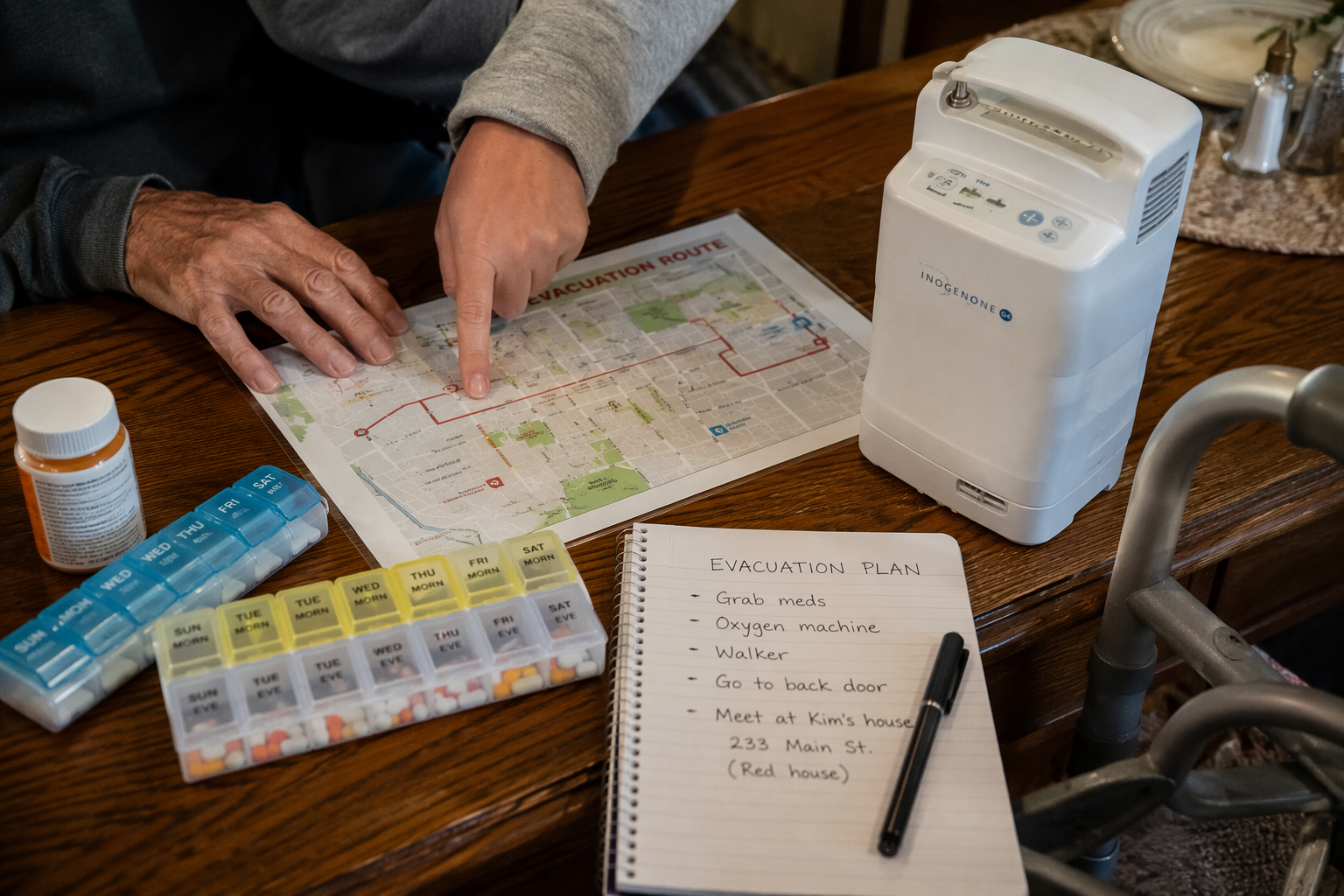
Pack for medication and device continuity
A senior go-bag should keep a day from turning into a scavenger hunt. Pack current medications, a 7- to 14-day medication buffer if the prescriber allows it, the prescription list, allergies, insurance cards, ID, spare glasses, hearing aids, dentures, a copy of the care plan, and the items needed to walk or communicate. FireHelpCenter's caregiver guide is useful here as a synthesis of the standard checklists [5].
If the parent uses oxygen, CPAP, a nebulizer, or a medical alert device, the bag is not complete until the power plan is complete. Test backup batteries, note the run time, pack chargers and spare cords, and assume the outage may last longer than one night.
Smoke safety and medical continuity
Wildfire smoke is not just unpleasant air; it is a PM2.5 exposure that can hit older adults with lung or heart disease hard and fast [3]. The CDC's basic playbook still matters: monitor AQI, keep windows closed, use cleaner indoor air when smoke is present, and wear a well-fitting respirator like an N95 if the parent must go outside or travel through smoke [3]. AARP's summary of recent studies makes the consequence plain: smoke can raise asthma and cardiac risk even when flames are nowhere near the house [2].
- Check AQI morning and evening.
- Move the parent to the cleanest room if the home does not have whole-house filtration.
- Keep rescue inhalers, nebulizer supplies, and physician instructions within reach.
- Do not wait for coughing to start before relocating if the air keeps getting worse.
- If the parent becomes short of breath, confused, or unusually tired, treat it as a medical warning, not just irritation.
Reentry is another hazard check
When containment improves, do not treat the first opening of the door as the all-clear. Ash, poor indoor air, power failures, spoiled medications, and tripping hazards can be just as hard on an older adult as the evacuation itself. Wait for local clearance, confirm that oxygen and other devices work again, and check whether the home is actually safe to sleep in before declaring the emergency over. For older adults, wildfire preparedness is continuity planning for frailty, dependence, and confusion under stress. The plan has to fit the parent's body and mind, keep supplies and backup power current, and treat post-fire return as another hazard check, not the end of the event.
References
- Older Adults - U.S. Fire Administration / FEMA - 2020
- 8 Ways Wildfire Smoke Affects Your Health - AARP - July 17, 2026
- Wildfire Smoke Risk Factors - CDC
- Wildfires and Older Adults: A Scoping Review - PubMed Central
- Wildfire Preparedness Guide for Seniors & Caregivers - FireHelpCenter - 2026
Questions to bring to a clinician or OT
This is not medical, legal, or a family's final decision — only a framework. Bring these questions to a clinician, occupational therapist, or your local Area Agency on Aging.
Find Local HelpRelated reading
Noticed something outdated or inaccurate on this page? Flag a correction. We review every report against CDC, NIA, and AARP HomeFit guidance before updating a page.