
Caregiver decision guide
When to Consider Senior Citizen Homes: Signs Your Parent Needs More Help
This guide helps adult children identify observable thresholds — medication mismanagement, weight loss, home neglect — that indicate a parent may need more support than home care can provide, and offers a framework for starting the conversation and researching options before a crisis.
Considering senior citizen homes does not mean you have decided to move your parent next month. It means the signs are serious enough that the family should stop relying on “we’ll know when it’s time” and start looking at what level of help your parent actually needs.
That distinction matters. Many older adults want to remain at home, and that wish deserves to be taken seriously. Pew Research Center found that 60% of older adults who live at home would prefer to stay there with a caregiver rather than move to a facility, while only 37% think that outcome is likely.[1] The gap between preference and expectation is where families get stuck: everyone wants to protect independence, but the daily evidence may already be showing that independence now requires more support than one daughter, one son, a neighbor, or a weekly aide can safely provide.

The signs that should move the family from watching to planning
One bad day is not the same as a care threshold. A missed dinner after a doctor’s appointment, a messy living room during a holiday week, or confusion during an illness may not mean your parent needs a different living arrangement. What changes the situation is repetition, increasing risk, and the amount of invisible labor required to keep everything from tipping over.
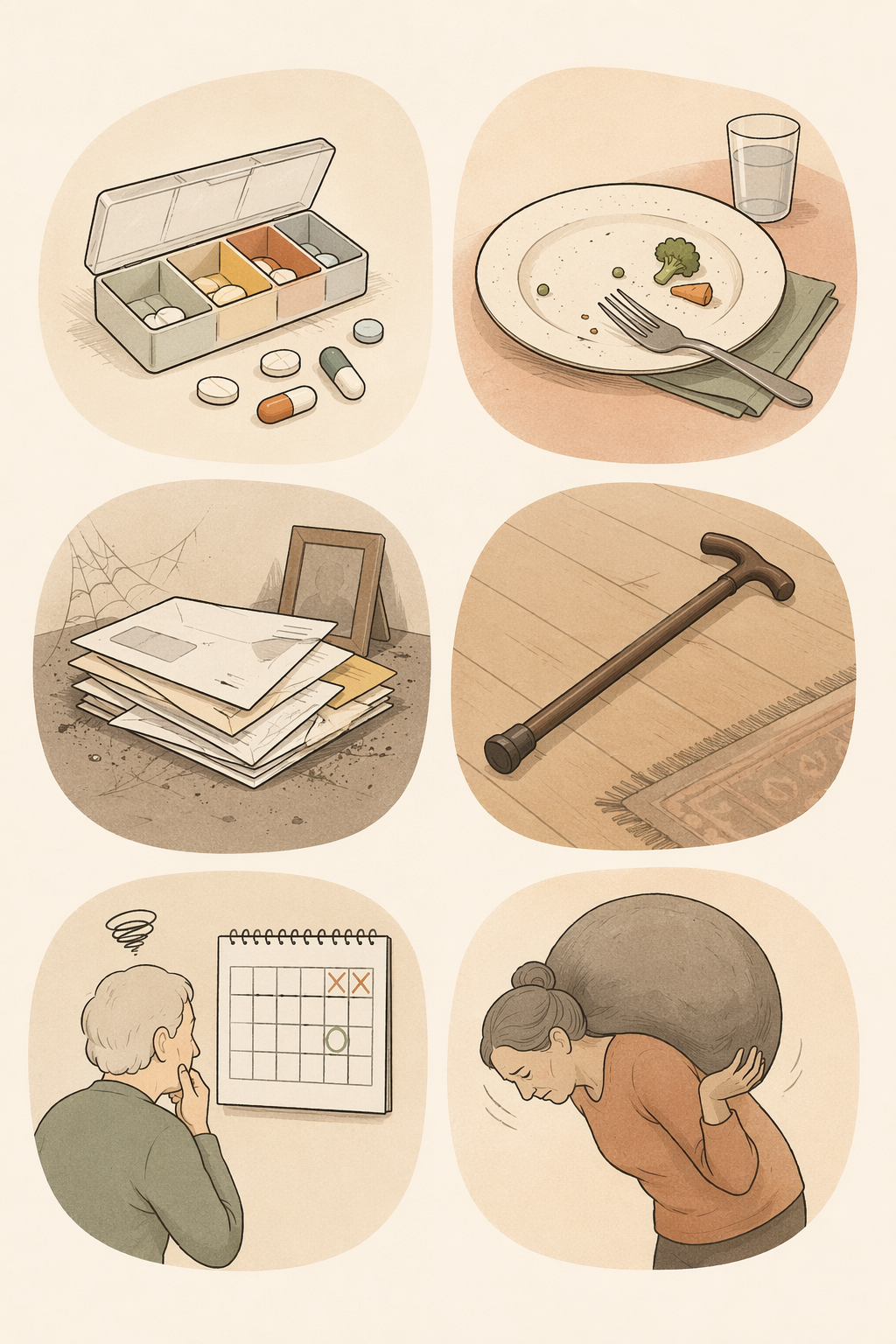
| Observable sign | What to look for | Why it matters |
|---|---|---|
| Medication mismanagement | Wrong pills left in the box, duplicate doses, skipped refills, uncertainty about what each medication is for | Medication mistakes can become medical emergencies quickly, especially when several prescriptions are involved. |
| Weight loss or poor eating | Little real food in the refrigerator, spoiled food, unopened meal deliveries, clothes fitting looser | Eating is a daily living task; when it starts failing, the rest of the care plan often has gaps too. |
| Home neglect | Unpaid bills, odors, laundry piling up, unsafe clutter, broken fixtures, mail unopened for weeks | The home may still be familiar, but it may no longer be functioning as a safe support system. |
| Falls, near misses, or fear of moving around | New bruises, furniture used as handholds, a cane left across the room, reluctance to bathe or use stairs | A fall risk is not only about the fall itself; it can shrink daily life until your parent stops doing necessary tasks. |
| Escalating confusion or unsafe behavior | Missed appointments, getting lost, leaving appliances on, mixing up days, calls at unusual hours | Confusion that affects safety or judgment usually needs a more reliable response than occasional check-ins. |
| Caregiver strain | One family member is managing medications, food, appointments, bills, transportation, and emergencies with no margin left | When the care system depends on one exhausted person, the system is already fragile. |
The question is not whether any one of these signs proves that a move is necessary. The better question is whether the current arrangement still works when nobody is improvising.
Medication problems deserve special attention
A pillbox tells the truth in a way family debates often do not. If Tuesday morning’s pills are still sitting there on Thursday, if blood pressure medication is gone too quickly, or if your parent says “the blue one” instead of knowing what the medication is for, that is not a small household detail. It is a safety issue.
CDC data notes that medication errors send more than 600,000 seniors to the emergency room each year.[2] That number should not be used to frighten families into a facility decision. It should make families less casual about repeated pill mistakes, especially when the parent is taking several prescriptions, has memory changes, or cannot explain the system they are using.
Look for patterns like these:
- The pill organizer is filled incorrectly more than once.
- Refills run out because nobody noticed the supply was low.
- Your parent stops a medication because it “didn’t seem necessary” or doubles a dose to make up for a missed one.
- Different doctors have prescribed medications, but no one is maintaining one current list.
- A family member has to call, text, or visit daily to make sure the right dose was taken.
At first, the answer may be a pharmacy blister pack, a locked dispenser, home health support, or a medication review with the clinician. But if the only thing preventing serious mistakes is constant family surveillance, the home plan is no longer as independent as everyone is calling it.
Poor eating is often easier to excuse than it should be
Families often explain away food problems because everyone’s appetite changes with age, and because parents can be convincing: “I had soup earlier,” “I’m just not hungry,” “I don’t cook much anymore.” Sometimes that is true. The concern is when the kitchen shows a different story.
Open the refrigerator, if your parent is comfortable with that. Notice whether there is food that can become a real meal, not just condiments, sweets, old leftovers, and nutritional drinks. Check whether the same groceries are still there from your last visit. Look at the trash: are meal containers actually being opened, or are they stacking up untouched? Clothes fitting looser, dizziness, weakness, or repeated “stomach bugs” may also point to eating or hydration problems that deserve medical attention.
This is one place where a parent’s pride can hide a practical limitation. They may still be able to describe balanced meals. They may no longer be able to shop, carry groceries, stand at the stove, remember what is safe to eat, or clean up afterward. If meals only happen when someone else shops, cooks, reminds, and checks, then the family is not deciding between independence and help. Help is already in place; the question is whether it is enough.
A neglected home may be showing a loss of capacity, not a change in standards
Some people have never cared about spotless counters. That is not the issue. The useful comparison is not your standard for housekeeping; it is your parent’s own baseline. A formerly careful parent who now has unopened bills, spoiled food, missed trash pickup, laundry in unsafe piles, or strong odors in the bathroom may be showing that daily tasks have become too much.
Home neglect can also reveal who is quietly holding the situation together. Maybe your brother pays the bills online but has not told anyone how often shutoff notices arrive. Maybe a neighbor brings in the mail because the front steps are difficult. Maybe your parent’s church friend has become the unofficial grocery backup. These arrangements can be kind, and they can buy time. They are not the same as a reliable care plan.
For families who need a more structured way to evaluate daily tasks, an ADL and IADL-based review can help separate “the house looks different” from “essential activities are failing.” A guide such as Elder Care Help: A Step-by-Step Guide to Figuring Out What Your Aging Parent Needs can be useful before the family starts arguing from memory and impressions.
Falls and near misses are not only about bones
A fall that causes injury will get attention. Near misses often do not, even though they change how a parent lives. After a scare, an older adult may stop showering unless someone is nearby, avoid the basement laundry, sleep in a recliner to avoid stairs, or stop going outside. The family may call that caution. Sometimes it is. But it can also mean the house is slowly becoming smaller than the person’s needs.
Look for new bruises with vague explanations, furniture arranged as a pathway of handholds, walkers left where they are not useful, throw rugs that remain despite repeated tripping, or a parent who will not bathe unless someone is in the house. A home safety assessment, physical therapy, grab bars, better lighting, or a different medication schedule may reduce the risk. If those changes are refused, forgotten, or still not enough, it is time to compare living arrangements with more supervision built in.
Confusion becomes a housing issue when it changes safety and judgment
Forgetting a name is not the same as leaving a burner on. Mixing up a date is not the same as missing three medical appointments and insisting they never existed. The line families should watch is the point where confusion affects safety, health, money, or the ability to respond to ordinary problems.
Concerning patterns include repeated calls about the same issue, getting lost on familiar routes, trouble following medication instructions, unpaid bills from confusion rather than lack of funds, spoiled food being treated as safe, or unsafe responses to strangers, scams, appliances, or driving. Any sudden confusion should be treated as a medical issue first, because infections, medication changes, dehydration, and other conditions can cause abrupt changes. But if the pattern continues after medical causes are addressed, the family needs a care plan that does not depend on the parent noticing every risk in time.
Caregiver strain is part of the evidence
Caregiver burnout is often treated like a private feeling, something the adult child should manage more gracefully. That is a mistake. If one person is now the medication checker, grocery rescuer, appointment scheduler, bill reminder, transportation plan, overnight worrier, and emotional shock absorber, the parent’s care needs have already expanded. The family may not have named it yet.
A Place for Mom’s expert guidance on signs it may be time for assisted living includes caregiver stress and burnout among the factors families should notice, though the source should be read as commercially situated rather than independent research.[3] The practical point is still sound: when a doctor, spouse, friend, or coworker tells the caregiver, “You can’t keep doing this,” that outside observation deserves weight.
Caregiver strain does not automatically mean senior citizen homes are the answer. It may mean respite care, adult day programs, paid in-home help, a different division of labor among siblings, or a short-term recovery plan after hospitalization. But if everyone’s solution is that one exhausted person should keep stretching, the plan is unsafe for both people.
If guilt is the main thing keeping respite or outside help off the table, Overcoming Guilt, Fear, and Trust Issues: Emotional Barriers to Respite Care may be a better next read than another late-night search for facility reviews.
What to do before deciding on a move
Once several signs are repeating, the next step is not to announce a decision. It is to gather enough reality that the family can discuss options without pretending, panicking, or relying on the loudest sibling’s memory of last Christmas.
Document patterns for two to four weeks when it is safe to wait
Write down what happened, when it happened, who noticed it, and what had to be done to fix it. Keep the notes plain: “Missed evening medication twice this week,” “No fresh food in refrigerator on Sunday,” “Neighbor called because front door was left open,” “Daughter left work early for appointment again.”
Do not document to build a case against your parent. Document because families are unreliable historians when they are tired, guilty, or defensive. Patterns help the parent’s clinician, help siblings understand the workload, and help you compare home care against residential options honestly.
If there is immediate danger — wandering, unsafe driving, repeated falls, serious medication mistakes, threats, fire risk, or sudden confusion — do not wait for a neat observation period. Call the appropriate clinician, emergency service, or local support agency.
Ask what your parent wants while the conversation can still include choices
The first conversation does not have to contain the words “assisted living.” It may go better if it starts with what your parent is finding hard, what they want to protect, and what they fear losing. Ask specific questions: “Which parts of the day feel hardest now?” “What help would feel acceptable?” “What would make you feel like home was no longer working?” “If you had a fall or needed more help after surgery, where would you want to recover?”
A resistant parent may hear any discussion of senior citizen homes as a threat. That is why the tone matters. The point is not “we are taking over.” The point is “we are seeing some things that could become unsafe, and we want to understand your wishes before other people have to decide quickly.” Families who need language for that conversation can use How to Have the Hard Conversations with Aging Parents as a preparation step rather than trying to improvise in the middle of a fight.
Compare home care with the actual need, not the preferred story
Aging at home can work well when the risks are understood and the support is reliable. Pew reported that 93% of adults 65 and older live in their own homes, so facility living is not the default experience for most older adults.[1] The question is whether the home plan can cover the specific problems you are seeing.
Make the comparison concrete:
- If medications are the problem, who fills the organizer, who verifies it, and what happens if that person is sick or away?
- If meals are the problem, is the issue shopping, cooking, appetite, swallowing, memory, depression, money, or transportation?
- If falls are the problem, can the home be modified quickly, and will your parent use the equipment?
- If confusion is the problem, are there unsafe hours when no one is present?
- If caregiver strain is the problem, how many hours of unpaid care are being provided, and by whom?
This is where families often discover that “a little help at home” means something very different to each person. One sibling may mean a housekeeper twice a month. Another may mean daily medication support, meals, bathing help, transportation, overnight monitoring, and emergency backup. Those are not the same care plan.
Bring in the clinician when health and safety are involved
A primary care clinician, pharmacist, neurologist, social worker, or discharge planner can help separate preference from medical risk. Ask for a medication review, cognitive screening when appropriate, fall-risk evaluation, nutrition assessment, or referral to home health or therapy. If your parent permits it, share the written observations rather than making a general statement like “Mom isn’t doing well.”
Clinicians may not be able to settle the housing question, and they may not see what happens at 8 p.m. in the kitchen. But they can identify reversible problems, document risks, and clarify whether the current support level matches the medical situation.
Start researching options before there is only one available bed
Researching senior citizen homes is not the same as choosing one. It is basic preparation. The National Institute on Aging recommends looking carefully at services, staffing, safety, quality, costs, resident rights, and whether a facility can meet the person’s needs before choosing a nursing home or other long-term care facility.[4] That kind of review is much harder when a hospital discharge planner is asking where your parent can go tomorrow.
Keep the first round practical. Identify local assisted living communities, memory care settings if cognition is a concern, skilled nursing facilities if medical care is needed, adult day programs, home care agencies, and respite options. Ask what level of help each can actually provide. Some assisted living communities can cue medications but not manage complex medical needs. Some homes are pleasant but not appropriate for wandering risk. Some home care schedules look good until you price the number of hours required.
The median assisted living resident is 87, according to NCAL data.[5] That does not mean everyone should move earlier. It does mean many families first confront residential care when frailty, illness, or caregiver fatigue is already advanced. Earlier research gives the parent more voice and gives the family more than a rushed tour and a stack of admissions forms.
Costs are another reason not to wait for crisis mode
Cost should not be tossed into the conversation as a vague threat, but it cannot be ignored. Pew found that only 21% of older adults have long-term care insurance, which means many families will face significant out-of-pocket decisions if home care, assisted living, or another long-term care option is needed.[1]
Published assisted living cost figures vary because sources measure different things. A Place for Mom reported a $5,419 monthly median based on actual 2025 move-in data, while SeniorLiving.org reported $6,313 based on community surveys. Those figures should be treated as planning signals, not guarantees for your parent’s city, care level, or contract terms.[3]
Early research lets you ask better financial questions: What is included in the base rate? What costs more as care needs increase? Is medication management extra? What happens after hospitalization? Does the community accept Medicaid now or later, if relevant? What home care hours would cost the same amount? Waiting does not make these questions kinder. It only makes them more rushed.
If the signs are repeating, you have crossed the threshold for planning
A parent does not need to be in obvious crisis before the family is allowed to plan. If medications are repeatedly wrong, food is unreliable, the home is becoming unsafe, falls or near misses are changing daily life, confusion is affecting judgment, or one caregiver is holding everything together with no backup, the family has enough evidence to begin a structured review.
That review may lead to more home care, respite, home modifications, adult day services, a move closer to family, assisted living, memory care, or skilled nursing. The answer depends on the pattern of need, the parent’s wishes, the family’s capacity, medical guidance, and money. For families who have just realized they are already doing more caregiving than they thought, You’ve Noticed Your Parent Needs Help — Here’s Exactly What to Do First can help turn the next week into manageable steps.
The useful goal is not to win an argument about whether your parent “needs a home.” It is to recognize when the current setup is no longer carrying the load. Planning early keeps more choices open, keeps your parent in the conversation longer, and reduces the chance that the decision will be made in an emergency room hallway after everyone is already frightened and exhausted.
References
- Most older adults who live at home want to age in place, but they aren’t entirely confident they’ll get to, Pew Research Center, February 26, 2026.
- CDC aging statistics source, Centers for Disease Control and Prevention.
- 11 Signs It Might Be Time for Assisted Living, A Place for Mom.
- How To Choose a Nursing Home or Other Long-Term Care Facility, National Institute on Aging.
- NCAL assisted living resident age data, National Center for Assisted Living.
Questions to bring to a clinician or OT
This is not medical, legal, or a family's final decision — only a framework. Bring these questions to a clinician, occupational therapist, or your local Area Agency on Aging.
Find Local HelpRelated reading
Noticed something outdated or inaccurate on this page? Flag a correction. We review every report against CDC, NIA, and AARP HomeFit guidance before updating a page.