
Caregiver decision guide
Caregiver Burnout: Patterns, Warning Signs, and What the Evidence Says About Recovery
Caregiver burnout affects the vast majority of family caregivers, yet many feel they are failing when they struggle. This article uses the latest survey data to help you recognize the emotional, physical, and social patterns, understand when common strain becomes burnout, and find strategies the evidence shows actually help.
A caregiver for an elderly parent can look perfectly functional from the outside and still be running on fumes. The calendar is full, the prescriptions are reordered, the parent gets to the appointment, the siblings receive updates, and the caregiver says, often automatically, "I'm fine." Then the same person describes sleeping badly, feeling resentful, missing work, avoiding friends, worrying about money, and dreading the next phone call.
That pattern is not rare. In the United States, about 63 million adults are family caregivers, roughly one in four adults.[1][2] In a 2025 commissioned survey of 1,029 caregivers ages 40 to 75 conducted for A Place for Mom, 78% reported experiencing burnout, 87% reported stress or anxiety, 84% reported overwhelm, and 42% experienced emotional strain at least weekly.[3] Because that survey comes from a senior living referral company, it should not be treated as the only word on caregiving strain. But it is useful when read beside independent work from Pew, the National Alliance for Caregiving, the National Council on Aging, Mayo Clinic, and the National Institute on Aging: the same broad picture keeps appearing. Caregiving is not simply a set of loving tasks. It is a sustained workload with emotional, physical, social, and financial consequences.
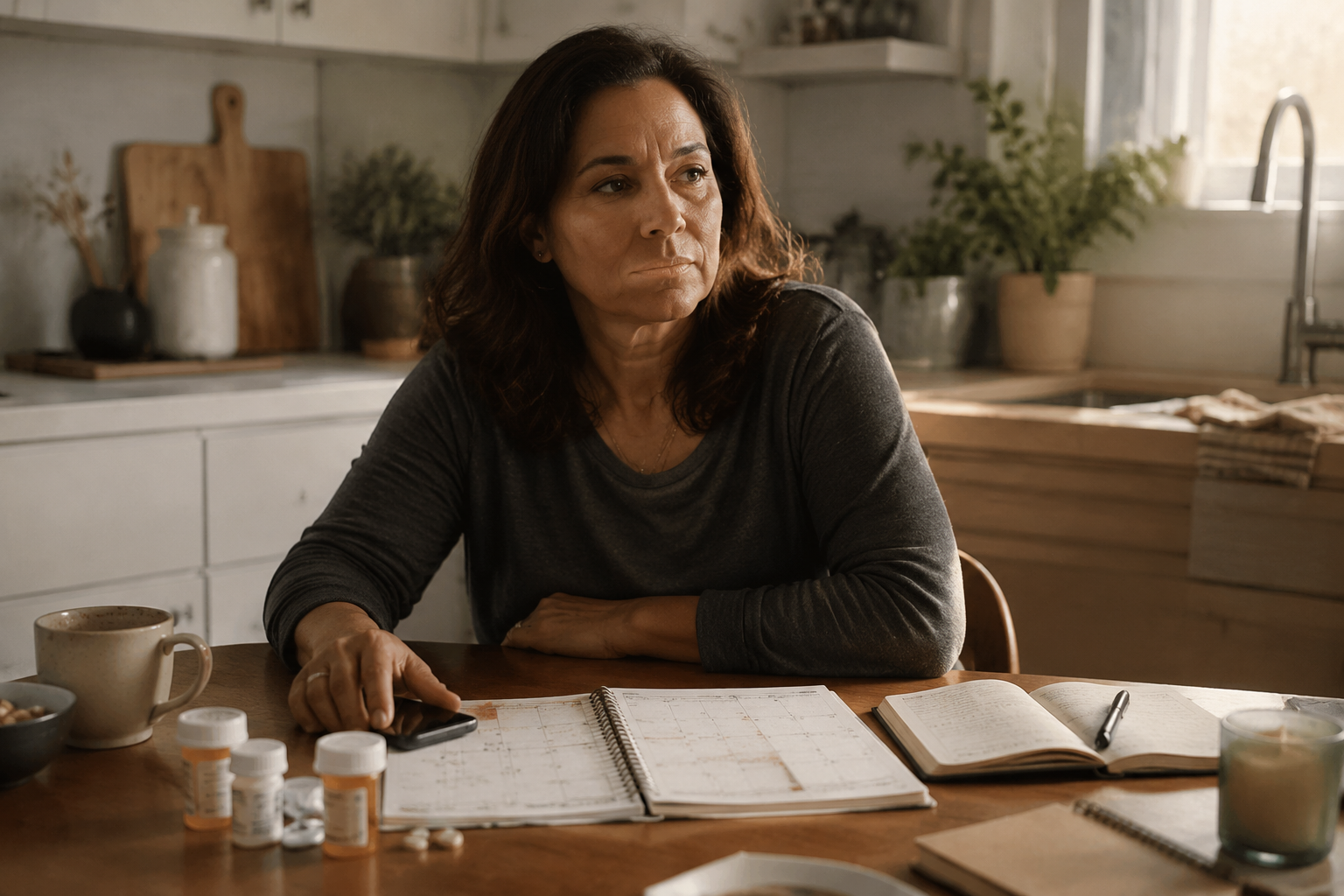
The most important permission in the data is this: feeling depleted does not automatically mean you are failing your parent. It may mean the arrangement has outgrown what one person can absorb.
When Ordinary Strain Starts Acting Like Burnout
Caregiving strain can be temporary. A bad week after a hospitalization, a tense medication change, or a difficult conversation with a parent may leave anyone exhausted. Burnout is different because it repeats. The emotional pressure returns even after a night's sleep. Physical symptoms show up before the next task begins. Social life narrows because there is no slack left for anything that is not urgent.
For many families, the first sign is not a dramatic collapse. It is a smaller change in tone. You become short with a parent you love. You feel irritated when the phone rings. You stop telling friends what is happening because the story is too long. You resent relatives who praise you but do not take a shift. You feel guilty about all of it, then use that guilt as proof that you should keep doing more.
A useful self-check is to separate pressure from pattern. Pressure says, "This week is hard." A pattern says, "Most weeks now have the same emotional cost." If the second sentence is closer to the truth, it is worth using a more structured tool such as a caregiver burnout self-assessment rather than waiting for a crisis to prove the strain is real.
The Pattern Usually Has More Than One Signal
Burnout rarely stays in one lane. A caregiver may first notice anxiety, then sleep trouble, then missed work, then isolation, then a bank account that keeps absorbing small expenses no one else sees. Looking at only one symptom can make the problem seem smaller than it is.
| Signal | What it can look like in daily caregiving | What to watch |
|---|---|---|
| Emotional strain | Irritability, guilt, dread, resentment, crying more easily, feeling unable to recover between tasks | Emotional strain that appears weekly or more often, especially when it changes how you speak, sleep, work, or make decisions |
| Physical depletion | Trouble sleeping, headaches, digestive changes, more frequent illness, worsening chronic symptoms | Symptoms that persist after the immediate caregiving task is over |
| Social withdrawal | Canceling plans, avoiding calls, losing the ability to talk about anything except care needs | Isolation that begins to feel protective because there is no energy left for explanation |
| Financial pressure | Paying for supplies, transportation, home modifications, missed work, or care gaps | Expenses that are treated as small one-offs but keep recurring |
| Time scarcity | Appointments, calls, medication tracking, paperwork, emergencies, sibling coordination, household tasks | A care schedule that depends on your constant availability |
The commissioned A Place for Mom survey found that 47% of caregivers said their physical health had declined since taking on caregiving, 50% had trouble sleeping at least once a week, 68% reported at least some financial strain, and 39% said their social life had worsened.[3] These are not separate inconveniences. They are connected pressures. Poor sleep makes emotional regulation harder. Financial strain reduces options. Isolation removes the people who might notice that the caregiver is no longer coping in the way they once did.

The emotional side also deserves more precision than the usual "caregiving is stressful" language. Caregivers can feel grief while the parent is still alive, anger at a disease rather than a person, embarrassment about thoughts they would never say aloud, and loyalty so strong that it keeps them from asking whether the current plan is sustainable. For a deeper look at that emotional layer, the hidden emotional toll of caring for aging parents is often the missing context.
Burned Out and Still Coping Can Both Be True
One of the more useful tensions in the 2025 survey is that 78% of caregivers reported burnout while 72% still made time for self-care at least weekly, including 58% who did so daily. The same survey found that 98% felt at least some degree of confidence in their caregiving.[3] That combination matters because it breaks a false split. Burnout does not always mean the caregiver has stopped functioning. It can exist inside a life where the caregiver is competent, organized, affectionate, and still making small efforts to stay well.
This is why generic self-care advice often lands badly. A caregiver may already be walking, praying, stretching, journaling, seeing a friend, or taking ten minutes in the car before going inside. Those actions can help. They may buffer the severity of strain. But they do not erase a workload that requires twenty or thirty hours a week, nor do they solve the problem of being the only person who knows which specialist changed which medication.
The question is not whether you have tried hard enough to cope. The question is whether the care plan depends on your private endurance. If it does, burnout is not a surprising outcome. It is a predictable signal that the plan needs more support, fewer hidden assumptions, or both.
The Workload Is Often Bigger Than Families Admit
The phrase "helping Mom" can hide the size of the job. Family caregivers average 22.8 hours a week on caregiving, 28% spend more than 30 hours a week, and 25% have been providing care for at least five years.[3] That is not an occasional favor. For many households, it is a second part-time job layered over paid work, parenting, marriage, health needs, and ordinary life administration.
The day-to-day work is also more fragmented than outsiders realize. A caregiver may spend one hour sorting insurance paperwork, another calling the pharmacy, another calming a parent after a confusing bill arrives, another arranging transportation, and another texting siblings who disagree about what should happen next. None of those tasks look heroic. Together, they consume attention in a way that makes rest difficult even when the caregiver is technically off duty. For a concrete breakdown of those tasks, see what caring for an aging parent actually looks like day to day.
Preparedness is another quiet risk factor. Only about one quarter of caregivers in the A Place for Mom survey felt completely prepared when caregiving began, 54% wished they had started planning sooner, and 24% of those who found care in the past year needed it immediately.[3] That helps explain why so many adult children feel behind from the beginning. They are not only learning tasks. They are building a care system while the need is already active.
Employment and sandwich-generation pressure add another layer. In the same survey, 64% of caregivers were also employed, and 48% were caring for both a parent and a child.[3] The consequence is not merely busyness. It is competing accountability. A parent waits for transportation, a supervisor waits for a project, a child waits for pickup, and the caregiver becomes the place where all delays are absorbed.
Physical Warning Signs Deserve Earlier Attention
Physical decline is sometimes treated as the cost of being dependable. That is a dangerous bargain. The National Council on Aging, citing Medline, notes that caregivers face elevated risks for heart disease, weakened immune function, diabetes, and chronic conditions.[4] Those risks do not mean every caregiver will become ill. They do mean that persistent sleep disruption, worsening chronic symptoms, and repeated illness should not be brushed aside as the price of family responsibility.
Older spousal caregivers under strain carry a particular warning from the medical literature: a JAMA study identified caregiving strain as an independent mortality risk factor for elderly spousal caregivers.[5] That finding should be handled carefully. It does not mean caregiving itself is fatal, and it does not apply in the same way to every adult child caring for a parent. But it does make one point plain: severe, sustained caregiving strain can become a health issue in its own right.
Gender differences show up in the newer demographic data as well. Pew's 2026 study of caregivers of parents or spouses age 65 and older found that women caregivers were more likely than men to report negative impacts on physical health, 38% versus 26%.[2] The study does not settle why that gap exists. It may reflect differences in care tasks, other household responsibilities, reporting patterns, or some combination. The practical takeaway is narrower and still important: physical strain should be asked about directly, not assumed away.
Emotional Strain Is Not the Same as Clinical Depression, but It Can Become Serious
Many caregivers move through sadness, anger, guilt, and fear without having a clinical mental health condition. Those emotions may be understandable responses to a hard role. Still, the line deserves respect. APA-linked summaries of multiple studies have reported that 40% to 70% of caregivers have clinically significant depressive symptoms compared with non-caregivers.[6] Because that range comes through branded secondary coverage, it should be read as a signal of elevated risk rather than a precise rate for every caregiving situation.
Professional support is not only for the moment when someone cannot get out of bed. It is appropriate when anxiety is interfering with sleep or work, when hopelessness persists, when guilt drives unsafe levels of responsibility, when anger feels frightening, or when caregiving has narrowed life so much that the caregiver no longer recognizes their own baseline. A more focused discussion of depression and anxiety in this role is available in the mental health toll of caring for an elderly parent.
What Actually Helps Before Crisis
The right intervention depends on the dominant strain. A caregiver whose main problem is sleep loss does not need the same first step as a caregiver drowning in sibling conflict or paying out of pocket for supplies. This is where many families lose time: they ask for vague help, receive vague sympathy, and return to the same overloaded system.
- If the dominant strain is time, redistribute tasks by category rather than asking someone to "help more." Transportation, medication pickup, bill review, meal coverage, appointment notes, and respite blocks are easier to assign than general responsibility.
- If the dominant strain is emotional, add a place where the caregiver can speak without managing the listener's reaction. That may be therapy, a caregiver support group, clergy, or a trusted person who can tolerate the full story.
- If the dominant strain is physical, treat sleep disruption, pain, worsening chronic symptoms, and frequent illness as care-plan problems, not private inconveniences.
- If the dominant strain is financial, make recurring costs visible. Small expenses are easier for families to ignore until they are listed together.
- If the dominant strain is decision fatigue, move information out of one person's head and into a shared document, calendar, medication list, or care notebook.
Mayo Clinic and the National Institute on Aging both emphasize practical stress-management steps for caregivers, including asking for and accepting help, setting realistic limits, staying connected, attending to personal health care, and using respite or community resources when available.[7][8] Those recommendations are not glamorous, and they are often harder to implement than they sound. Their value is that they move the care arrangement away from a single point of failure.
Self-care belongs here, but in the right size. It is a buffer, not a cure for an impossible workload. A walk, a medical appointment, a quiet breakfast, or an evening off can help the nervous system recover. It cannot substitute for respite if the caregiver is providing care every day, nor can it fix a family system where everyone agrees the caregiver is overwhelmed but no one takes a defined task. A practical framework for making self-care less decorative and more usable is available in from overwhelmed to sustainable.

When Support Is No Longer Optional
Some thresholds should change the plan, not merely raise concern. Weekly emotional strain, repeated sleep trouble, worsening health, unsafe anger, missed work that threatens employment, financial strain that keeps expanding, or social withdrawal that has become normal are all signs that the current arrangement needs more than encouragement.
Respite becomes necessary when the caregiver cannot recover between care episodes. Task redistribution becomes necessary when one person is the default for every urgent and nonurgent need. Licensed clinical support becomes necessary when depression, anxiety, panic, hopelessness, or health decline is present. Medical review becomes necessary when the caregiver's body is showing the cost of the role.
Recovery is not always a clean break from caregiving. Often it begins with a more honest map: what is emotional, what is physical, what is financial, what is social, and what is simply too much time for one person. From there, the next step should match the heaviest pressure. For caregivers already near the edge, caregiver burnout warning signs and recovery stages can help distinguish ordinary fatigue from a pattern that needs immediate support.
Burnout is measurable, common, and often recurring. It can coexist with competence, love, confidence, and real attempts at self-care. Recognizing it earlier gives families more choices than waiting until the caregiver's body, work, relationships, or mental health finally forces the issue.
References
- Caregiving in the US 2025 — National Alliance for Caregiving, 2025.
- Family Caregiving in an Aging America — Pew Research Center, Feb 2026.
- 2026 Caregiver Burnout and Stress Statistics — A Place for Mom.
- Caregiver Stress: The Impact on Physical Health — National Council on Aging.
- Caregiving as a Risk Factor for Mortality: The Caregiver Health Effects Study — JAMA.
- Caregiving's Mental Health Crisis — Forbes/Otsuka.
- Caregiver stress: Tips for taking care of yourself — Mayo Clinic.
- Taking Care of Yourself: Tips for Caregivers — National Institute on Aging.
Questions to bring to a clinician or OT
This is not medical, legal, or a family's final decision — only a framework. Bring these questions to a clinician, occupational therapist, or your local Area Agency on Aging.
Find Local HelpRelated reading
Noticed something outdated or inaccurate on this page? Flag a correction. We review every report against CDC, NIA, and AARP HomeFit guidance before updating a page.