
A Caregiver Self-Care Checklist That Starts with Why You Keep Avoiding It
This checklist helps family caregivers move past the guilt, obligation, and self-doubt that prevent them from using self-care advice—by pairing each action with the psychological reframe needed to take it.
- Last Reviewed
- 2026-06-29

- caregiver burnout
- respite care
- caregiver guilt
- emotional support
- working caregiver
- driving cessation conversation
- accepting help
- role reversal
- caregiver stress
- self-care
- difficult conversations
- caregiver identity
If you are looking for a caregiver self care checklist, there is a good chance you already know the usual advice. Sleep when you can. Eat something with protein. Keep your own medical appointments. Ask for help. Take breaks.
The harder question is why those reasonable suggestions become so difficult the moment real caregiving enters the room. Your mother needs clean clothes before tomorrow’s appointment. Your spouse refuses help from anyone else. Your sibling says, “Just tell me what to do,” and suddenly explaining the task feels like more work than doing it yourself. You think, “I can wait.” You think, “No one does it the way I do.” You think, “Our family takes care of our own.”
Those thoughts are not small. Family Caregiver Alliance names beliefs such as “I am responsible for my parent’s health,” “If I don’t do it, no one will,” and “Our family always takes care of their own” as common personal barriers that can keep caregivers from caring for themselves.[1] They sound like devotion. Sometimes they are devotion. But when they become rules you are not allowed to question, they can quietly remove every opening for rest, medical care, and help.

The problem is not that caregivers have never heard of self-care
Self-neglect in caregiving is often treated as a planning problem. It is also a permission problem. A caregiver may know exactly what would help and still be unable to do it without feeling disloyal, lazy, selfish, or replaceable.
That distinction matters because the consequences are not minor. Family Caregiver Alliance reports that 46% to 59% of caregivers are clinically depressed, and that family caregivers are less likely than non-caregivers to practice preventive healthcare regardless of age, sex, or race.[2] Those numbers do not prove that every caregiver who skips an appointment is depressed. They do show that caregiver health neglect is not a private character flaw. It is a recognizable pattern.
Healthcare systems do not always fill the gap. In a 2021 study of relatives caring for people with advanced cancer in the Netherlands, 44% of caregivers with high burden felt poorly informed by healthcare professionals about the importance of self-care.[3] In that same study, caregivers who felt well informed about self-care had significantly lower odds of high burden, with an odds ratio of 0.39.[3] The context is specific: advanced cancer caregiving, in the Netherlands. It should not be stretched into a universal promise for every family caregiver in the United States. But it does support a plain, practical point: being helped to understand and protect self-care is not sentimental advice. It can be part of reducing burden.
This checklist is not a diagnostic scale, a treatment plan, or a validated clinical instrument. It is a self-orientation tool. Its job is to help you notice the thought that blocks the action, then choose one defensible next step anyway.
Start by naming the barrier, not the task
A normal checklist starts with the action: call the doctor, take a walk, ask for respite. For many caregivers, that skips the moment where the action gets stopped.
The stopping point may be guilt. It may be the fear of being judged by family. It may be the belief that accepting help means admitting you cannot cope. It may be a long family habit of praising the person who absorbs the most work and asks for the least. If that emotional knot is familiar, you may also find it helpful to read more about why guilt, resentment, and grief are normal in caregiving or the broader emotional realities of caring for aging parents. Those emotions do not mean you are doing caregiving wrong. They are often part of the work.
Before choosing an action, ask one quieter question: “What sentence in my head is making this feel impossible?”
- “I can wait.”
- “I am burdening them.”
- “No one else can do it right.”
- “If I need help, I am failing.”
- “Self-care is selfish.”
Those sentences are the working material. The checklist below pairs each one with a replacement belief and a small action, because the action usually becomes possible only after the belief loosens.
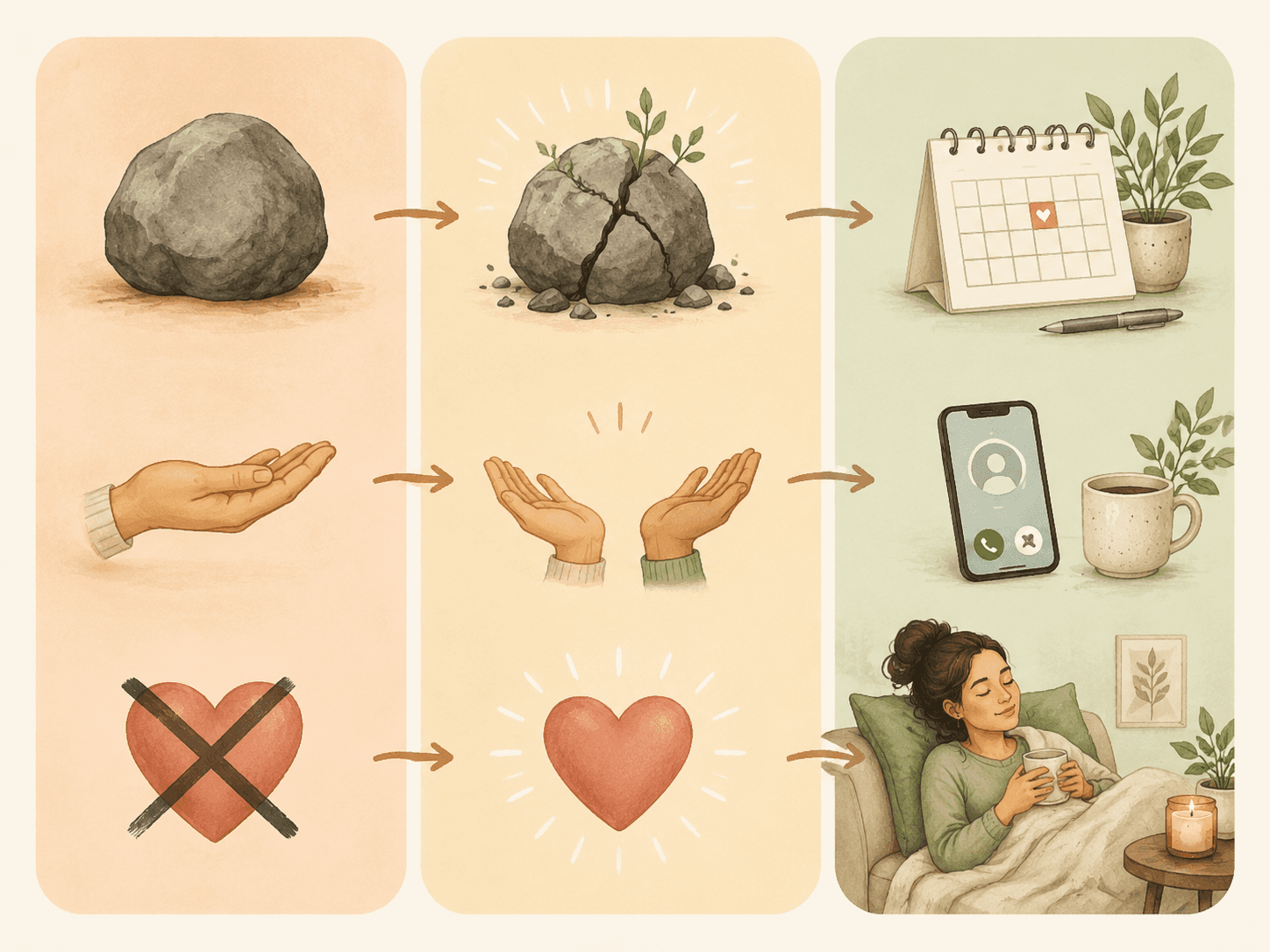
A barrier-based caregiver self-care checklist
| Self-care action | The thought that blocks it | Reframe to practice | Small next step |
|---|---|---|---|
| Schedule or keep one medical appointment for yourself | “I can wait.” | Waiting is not neutral if your health is what keeps the care arrangement standing. | Call, message, or use the patient portal to request one appointment before choosing a less urgent household task. |
| Ask one person for one specific task | “I’m burdening them.” | A clear request gives another person a real chance to help; silence decides for them. | Ask for a concrete task such as a pharmacy pickup, one meal, one ride, or one hour of sitting with your loved one. |
| Try one form of respite or outside care | “No one else can do it.” | Someone else may not do it exactly your way and still provide safe, useful relief. | Choose a low-risk trial: one short visit, one adult day program inquiry, or one paid or family helper shadowing you. |
| Name negative self-talk when it appears | “I’m failing.” | Needing limits is not the same as failing; it is information about load. | Write the exact sentence down, then rewrite it as a care fact instead of a verdict. |
| Set a minimum rest boundary | “Self-care is selfish.” | Rest is part of maintaining care capacity, not a reward for finishing everything. | Protect one non-negotiable minimum: a shower, a meal, a short walk, a quiet 20 minutes, or a full night in bed when coverage allows. |
When the block is “I can wait”
Caregivers often postpone their own care because the older adult’s needs have deadlines and theirs do not. A prescription runs out. A wound dressing has to be changed. Transportation has to be arranged. Your blood pressure check, mammogram, dental pain, therapy appointment, or sleep problem seems easier to move because no one is waiting at the door.
The reframe is not “put yourself first” in some sweeping way. That phrase can feel unusable when someone depends on you. The more honest reframe is: your health is part of the care system. If your body is the transportation system, medication reminder system, emergency response system, and emotional regulation system, then neglecting it is not a harmless delay.
The next step should be small enough to survive a difficult week. Do not reorganize your whole life. Make one call. Send one portal message. Put one overdue appointment back on the calendar. If you must cancel something to make room, cancel a task that can safely wait rather than canceling your own care by default.
When the block is “I’m burdening them”
Many caregivers ask for help in a way that almost guarantees disappointment. They say, “I’m fine.” They say, “Don’t worry about it.” Or they wait until they are desperate and then need someone to understand the whole situation at once.
A better request is smaller and less emotional: “Can you pick up the prescription Thursday?” “Can you sit with Dad from 2 to 4 on Saturday while I go to my appointment?” “Can you handle dinner once this week?” A specific request does not force another person to become the primary caregiver. It gives them a defined job.
If coordinating relatives, neighbors, appointments, and backup plans has become its own exhausting job, the next step may be less about one favor and more about a system. A practical care calendar, shared task list, and role agreement can reduce the number of times you have to personally renegotiate help. For that level of organizing, see how to build a care coordination system for aging parents.
When the block is “no one else can do it”
This belief often contains some truth. You may know the medication routine, the preferred breakfast, the warning signs before agitation, the way to speak during a transfer, the doctor’s history, and the family landmines. It is not imaginary that you carry knowledge other people do not have.
The trap is turning “I know the most” into “I am the only one allowed to provide care.” Those are different statements. A substitute caregiver may need written instructions, a trial run, and limits on what they handle. They may do some things awkwardly. That does not automatically mean the break failed.
Respite does not have to begin with a full day away. It can begin with someone sitting in the next room while you shower without listening for every sound. It can begin with a sibling taking over one recurring errand. It can begin with asking an adult day program what a first visit looks like. If that last option raises practical questions, common answers about senior citizen day care can help you understand what to ask before deciding.
When the block is “I’m failing”
Negative self-talk is not always loud. Sometimes it is a private running commentary: “I should be more patient.” “Other people handle worse.” “I snapped again.” “I am not a good daughter.” “I promised I would never put him through this.”
The first action is not to argue yourself into cheerfulness. It is to separate facts from verdicts. “I yelled this morning” is a fact. “I am a terrible caregiver” is a verdict. “I need coverage for two hours because I am losing patience by evening” is a care fact. Care facts can be acted on. Verdicts usually just make you hide.
- Verdict: “I can’t handle this.” Care fact: “The evening routine is too much for one person right now.”
- Verdict: “I’m selfish for wanting a break.” Care fact: “I have not had protected rest, and my patience is thinning.”
- Verdict: “No one helps because they know I should do it.” Care fact: “I have not made a specific request with a date, task, and time.”
This is not wordplay. The wording changes what is possible next. A verdict asks you to feel ashamed. A care fact points toward an adjustment.
When the block is “self-care is selfish”
Some caregivers hear “self-care” and picture indulgence: spa days, vacations, long stretches of solitude they cannot possibly take. That image makes the whole idea easy to reject.
For a strained caregiver, self-care may be much plainer. It may mean eating before 3 p.m. It may mean taking medication on time. It may mean sleeping in a bed instead of a recliner when another adult can be on call. It may mean sitting in the car for 10 quiet minutes before walking back into the house.
Set a minimum rest boundary that is almost embarrassingly basic. The point is not to design an ideal wellness routine. The point is to stop treating your own most basic needs as optional until every caregiving task is finished. Every caregiver knows that list is never truly finished.
If you prefer categories, keep them simple
There is nothing wrong with a more traditional checklist. Some people think more clearly by domain than by emotional barrier. If that is you, a basic caregiver self-care review can include sleep, meals, movement, medical appointments, social contact, respite, emotional support, and safety planning.
The danger is turning those categories into another list of ways you are falling short. If a domain-based approach feels easier, use one. If it starts to feel like a report card, return to the barrier question: “What thought is stopping me from taking the next small action?” You can also use a five-domain caregiver self-care checklist if you prefer to choose by area of life rather than by belief.
Choose one item for this week
Do not use this checklist to assign yourself five more jobs. That is how self-care becomes one more thing caregivers are told to do without being given time, coverage, money, cooperation, or emotional permission.
Choose one item by asking three questions:
- Which neglected need is most likely to create a real consequence if I keep postponing it?
- Which action can be made specific enough to do this week?
- Which belief will try to stop me, and what will I say back to it?
A usable answer might sound like this: “I will call my doctor on Tuesday morning. The thought that will stop me is ‘I can wait.’ The replacement thought is ‘My health is part of the care plan.’”
Or: “I will ask my brother to sit with Mom for one hour on Saturday. The thought that will stop me is ‘I am burdening him.’ The replacement thought is ‘A specific request gives him a real chance to help.’”
That is enough for one week. Not because your needs are small, but because a small kept promise often teaches more than an ambitious plan abandoned by Wednesday.
When guilt may be covering burnout or depression
Guilt is common in caregiving, but it should not be used to explain away everything. A checklist can help with avoidance, self-talk, and small decisions. It is not enough when exhaustion becomes unsafe, depression deepens, anxiety takes over, or you feel unable to keep going.
Consider reaching out to a healthcare professional, therapist, crisis line, clergy member, social worker, or trusted support person if you notice any of the following:
- You feel hopeless, numb, trapped, or persistently tearful.
- You are sleeping very little or sleeping much more than usual.
- You are missing your own medical needs because caregiving feels impossible to step away from.
- You are using alcohol, medication, food, or isolation to get through the day in ways that worry you.
- You are afraid you might harm yourself, neglect the person you care for, or lose control.
If there is immediate danger, use emergency services or a crisis resource in your area. If the concern is building rather than immediate, it may help to compare what you are experiencing with common caregiver burnout patterns and warning signs, or to read more about the mental health toll of caring for an elderly parent. These are not signs that you are weak. They are signs that the load needs more support than a private pep talk can provide.
For now, choose one action. Name the thought that argues against it. Write the replacement belief where you can see it. Then take the smallest step that protects your health without pretending caregiving is easy.
References
- Taking Care of YOU: Self-Care for Family Caregivers — Family Caregiver Alliance
- Caregiver Statistics: Demographics — Family Caregiver Alliance
- Self-care, resilience, and caregiver burden in relatives of patients with advanced cancer — Supportive Care in Cancer, 2021
Continue Your Caregiving Journey
When you are ready, these resources can help with specific caregiving tasks.
- The 4 Stages of Caregiver Burnout: A Self-Recognition Framework
Recognize which stage of caregiver burnout you're in—Warning, Control, Survival, or Burnout—using concrete behavioral and emotional signals, and take stage-specific action to recover before reaching crisis.
- Having the Hard Conversations: A Guide for Adult Children on Talking to Aging Parents About Driving, Finances, Memory, and Moving
A practical, script-based guide for adult children who need to initiate emotionally charged conversations with aging parents about driving, memory, finances, and moving. Learn a collaborative framework and specific approaches for eight common difficult topics.
- The First 90 Days of Caring for an Aging Parent: A Step-by-Step Roadmap for Adult Children
Starting caregiving for a parent can feel overwhelming. This article provides a structured, week-by-week plan for the first 90 days, covering medical visits, legal paperwork, home safety, and building a support team to help you move from panic to a sustainable care routine.
Comments
Join the discussion with an anonymous comment.