
Caregiver decision guide
How to Talk to Your Parent About Stopping Driving
A step-by-step conversation guide for adult children navigating one of caregiving's hardest discussions — helping an aging parent transition away from driving while honoring their independence, preparing for refusal, and ensuring they have a real plan for getting around.
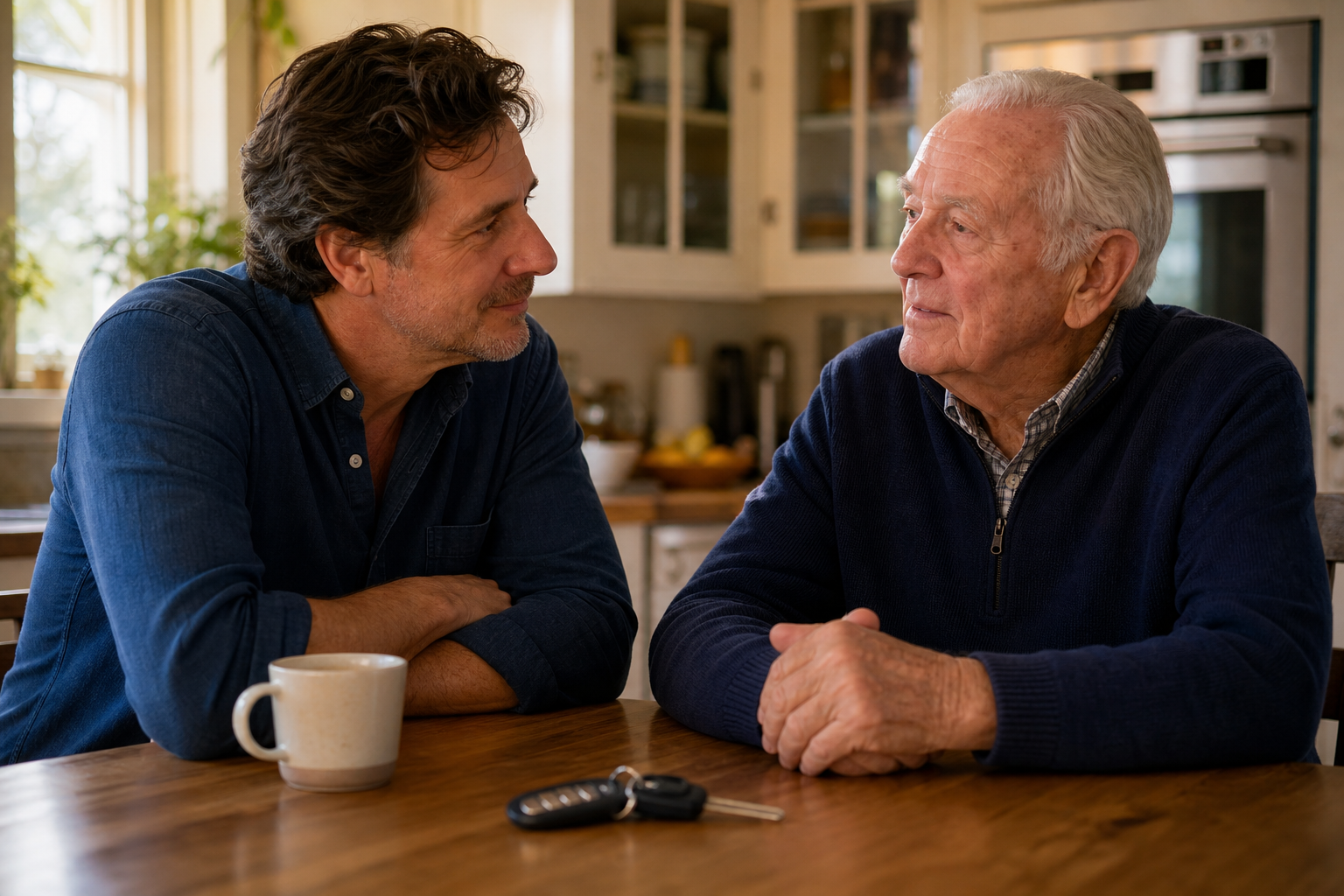
Why This Conversation Is So Hard — and Why It Matters
For most older adults, a driver's license is not just a card in a wallet. It represents decades of self-sufficiency — the ability to get to a doctor's appointment without asking anyone, to pick up groceries on a Tuesday, to visit a friend across town without coordinating a ride. When you raise the subject of stopping driving, your parent does not hear a safety concern. They hear: You are losing your independence.
That is why this conversation fails so often. Adult children approach it as a practical problem — there have been incidents, the risk is real, something has to change — and their parents experience it as a threat to who they are. Both things are true at the same time, and any conversation that ignores the second will struggle to move the first.
The stakes of getting this right extend well beyond the conversation itself. A 2024 systematic review published in PMC found that older adults who voluntarily ceased driving tended to cope significantly better with the transition than those who stopped involuntarily. Abrupt, forced cessation — keys taken without discussion, license surrendered under pressure — is associated with worse psychological outcomes, greater social isolation, and higher rates of depression. How the transition happens matters, not just whether it happens.
The same review found that older adults who stop driving without a transportation plan in place face elevated risks of loneliness and reduced quality of life. This is not a hypothetical concern: according to the University of Michigan National Poll on Healthy Aging, 54% of drivers age 65 and older have no plan for how they will get around if they can no longer drive. And only 6% of older adults have ever discussed their driving with a healthcare provider.
Recognizing the Warning Signs: What to Watch and Document
Before you can have this conversation effectively, you need specific, concrete observations — not a general sense of unease, and not a conclusion based on your parent's age. Fitness to drive is determined by functional and cognitive changes, not by how old someone is. A 78-year-old with excellent reflexes and spatial awareness may be a safer driver than a 68-year-old with early cognitive decline or poorly managed medications. Age-based framing will put your parent on the defensive immediately and for good reason.
What you are looking for are specific, observable behaviors that indicate a change in driving ability. The National Institute on Aging and the National Highway Traffic Safety Administration both identify a consistent set of red-flag behaviors worth documenting. If you have the opportunity to ride as a passenger, observe without commenting during the drive — the American Geriatrics Society advises waiting until you are both out of the car before discussing anything you noticed, and then doing so calmly and specifically, not judgmentally.
- Two or more minor collisions, scrapes, or near-misses within the past year or two — including incidents in parking lots
- Two or more traffic violations or citations within the past two years
- Getting lost on routes that have been familiar for years
- Difficulty judging gaps in traffic, merging safely, or maintaining lane position
- Delayed reaction to pedestrians, cyclists, or other vehicles
- Difficulty with left turns across oncoming traffic — a common early indicator of spatial processing changes
- Driving significantly below the speed limit without apparent reason, or stopping unexpectedly
- Increased anxiety, agitation, or confusion while driving — including reports from your parent themselves
- A recommendation from their physician to modify or stop driving
- New diagnoses or medication changes that affect alertness, vision, or reaction time
When you observe something concerning, write it down the same day: the date, what happened, and where. A log of three specific incidents over four months is far more persuasive — and far more useful if you later need to involve a physician or a driving rehabilitation specialist — than a general sense that things have been getting worse.
How to Prepare Before the Conversation
The single most common mistake in this conversation is having it before you are ready. A reactive conversation — triggered by a fender-bender last Tuesday, held at the kitchen table that evening — almost always goes badly. Your parent is shaken or defensive, you are frightened, and neither of you has anything concrete to offer beyond the incident itself.
Evidence-informed practice in this area consistently points toward a proactive approach — one that begins before an incident, is grounded in specific documented observations, and arrives at the conversation with a real transportation plan already in hand. Here is what that preparation looks like.
- Gather your documented observations. Review your incident log. Select the two or three most specific, recent examples you will share. Avoid presenting a long list — it reads as an indictment rather than a concern.
- Research local transportation alternatives before you sit down. Look into what is actually available in your parent's area: rideshare services, local paratransit programs, senior center transportation, and resources through the local Area Agency on Aging. Know the specifics — how to access them, rough costs, and what they cover — so you can present real options, not a vague promise that 'we'll figure something out.'
- Choose the right person to lead the conversation. NHTSA advises identifying the person your parent is most likely to hear — which is not always the adult child who is most worried. It might be a sibling, a trusted friend, a clergy member, or a long-standing family physician. If you are the right person, lead it. If someone else would be more effective, involve them.
- Consider engaging the physician before the conversation, not just as an escalation step. Physicians are the most trusted third-party voice in this process for most older adults. Yet only 6% of older adults have ever discussed their driving with a healthcare provider. You can write a brief letter to your parent's doctor before their next appointment, describing the specific behaviors you have observed. Most physicians will raise the topic during the visit. This is not going behind your parent's back — it is making sure the person they trust most has the information they need.
| Preparation Step | Why It Matters | Common Mistake to Avoid |
|---|---|---|
| Document specific incidents with dates | Moves the conversation from 'I'm worried' to 'here's what I've observed' | Relying on a general sense of decline without concrete examples |
| Research local transportation options in advance | Shows your parent there is a real plan, not just a loss | Promising alternatives without knowing what's actually available |
| Identify the right conversation leader | The most trusted voice is the most effective voice | Assuming you must lead it alone if someone else would be better heard |
| Contact the physician proactively | Physicians are the most credible third-party ally in this process | Saving the physician as a last resort rather than a proactive partner |
Having the Conversation: Language, Setting, and What to Avoid
Even with solid preparation, the conversation itself requires care. The goal is a shared decision — one your parent has genuine ownership of — not a verdict delivered by their children. Research consistently shows that a collaborative approach, where the older adult participates in the decision rather than receiving it, produces better outcomes for everyone.
Timing and Setting
Choose a private, calm moment — not immediately after an incident, not during a family gathering, and not when either of you is rushed or emotionally activated. A quiet afternoon at home, with enough time to let the conversation breathe, is the right context. If your parent becomes agitated and the conversation is not moving forward, the American Geriatrics Society advises scheduling a follow-up rather than pushing through. One difficult conversation that ends without resolution is not a failure — it is often the first of several necessary conversations.
Language That Works
Both the NIA and NHTSA emphasize the same communication principle: use 'I' statements rather than 'you' accusations. The difference is significant in practice.
| Instead of this | Try this |
|---|---|
| "You're not a safe driver anymore." | "I've been worried about your safety when you're driving, and I'd like to talk about it." |
| "You're going to hurt someone." | "I noticed a few things recently that concerned me, and I want to share them with you." |
| "You need to stop driving." | "I'd like us to think together about what driving looks like going forward and what other options might work for you." |
| "At your age, you shouldn't be driving." | "This isn't about your age — it's about some specific things I've observed that I think are worth taking seriously." |
Acknowledge the real losses your parent is facing. Driving cessation is genuinely difficult — it affects social connection, daily independence, and a person's sense of self. Saying "I know how much driving means to you" is not a rhetorical strategy. It is an honest recognition of what is at stake, and your parent will know whether you mean it.
Present transportation alternatives as part of this same conversation — not as a separate topic to address later. Arriving with a real plan (specific services, how they work, what they cost) communicates that you are not trying to strand your parent. It also shifts the conversation from "will you stop driving" to "how will you stay mobile."
What to Avoid
- Ultimatums — "Either you stop driving or we're taking the car" — which produce resistance and damage trust without producing safety
- Age-based framing — "People your age shouldn't be driving" — which is both inaccurate and immediately alienating
- Blame for past incidents — relitigating specific crashes or violations as evidence of fault rather than as observations about changing function
- Pushing through when your parent becomes visibly distressed or angry — this rarely leads to productive outcomes and can set back future conversations
- Treating the conversation as a one-time event that must end in agreement — most families need several conversations over time
When Your Parent Refuses: A Structured Escalation Path
Refusal is common, and it does not mean the conversation has failed permanently. It means you are at the beginning of a longer process. There are legitimate escalation steps available to families — each one depersonalizes the safety determination a little more, moving it from "my child thinks I shouldn't drive" toward "an objective professional has evaluated this."
Step 1: Involve the Physician
The family physician is consistently identified as the most trusted and effective third-party voice in driving cessation conversations. Your parent may dismiss your concerns as overprotectiveness. They are far less likely to dismiss a recommendation from a doctor they have seen for fifteen years.
Before your parent's next appointment, write a brief letter to the physician describing the specific behaviors you have observed — with dates where possible. Explain that you are concerned about driving safety and ask the physician to raise the topic during the visit. Most physicians will do so, and many can order formal assessments or refer to driving rehabilitation specialists. This is not a betrayal of your parent's trust — it is making sure their doctor has the clinical information needed to provide complete care.
Step 2: Request a Driver Rehabilitation Specialist Evaluation
A driver rehabilitation specialist — often an occupational therapist with specialized training — provides an objective, professional evaluation of a person's actual driving ability. This is not a written test or a DMV road test. It typically includes an in-depth clinical assessment of vision, cognition, and physical function, followed by an on-road evaluation in real traffic conditions.
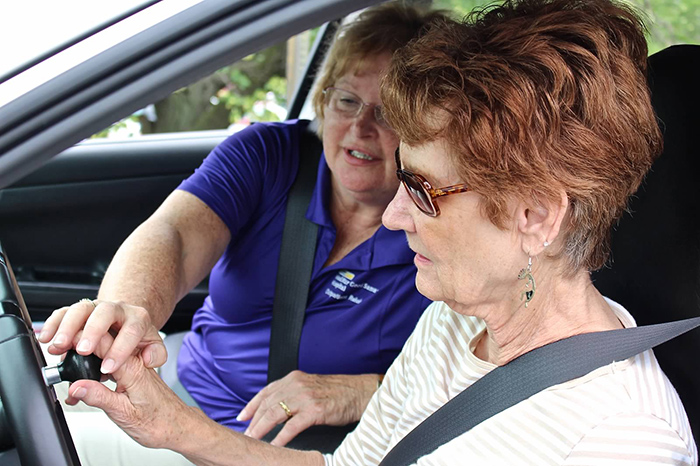
The value of this evaluation is that it removes the family from the center of the safety judgment. If a trained professional conducts an in-car evaluation and concludes that driving is no longer safe, that finding carries weight that a family member's concern cannot. The American Occupational Therapy Association maintains a national database of driver rehabilitation specialists. Your parent's physician can also provide a referral.
Step 3: Request a DMV Re-Examination
In nearly every state, a family member can write a letter to the state DMV requesting that a driver be re-examined. NHTSA describes this process: the letter should describe specific examples of unsafe driving behavior and any medical conditions you believe place the driver at risk. The DMV is required to examine those claims carefully.
A Note on Dementia and Anosognosia
If your parent has a dementia diagnosis, refusal takes on a different character. Anosognosia — a neurological condition common in Alzheimer's disease and other dementias — causes a person to be genuinely unable to recognize their own cognitive impairment. This is not denial or stubbornness. Their brain is not processing the information about their own decline accurately. This means that logical arguments, evidence, and appeals to safety will often be ineffective, because the person cannot perceive the impairment you are describing.
In this situation, physician involvement and a formal driving evaluation become even more important — and the DMV re-examination path may be necessary earlier in the process. If your parent has a dementia diagnosis, consult with their neurologist or geriatrician specifically about driving safety, as this is a clinical question that goes beyond a standard family conversation.
Last Resort: Vehicle Disabling
Disabling or removing the vehicle should be considered only after the physician, driving rehabilitation specialist, and DMV paths have been exhausted — and even then, with full awareness of the legal and relational complexities involved.
After the Conversation: Transportation Planning and What Comes Next
Whether the first conversation ends in agreement, partial agreement, or a commitment to continue talking, the practical work begins immediately afterward. Transportation planning is not a follow-up task — it is the immediate next step, and it is what makes the difference between a parent who adapts successfully and one who becomes isolated.
Building a Real Transportation Plan
Start by mapping your parent's actual transportation needs — not a generic list of alternatives, but a specific answer to the question: how will they get to their doctor on Tuesday, to the grocery store on Thursday, and to their weekly lunch with a friend?
- Rideshare services — available in most urban and suburban areas; some older adults adapt well with support from a family member in setting up an account and practicing a few trips together
- Paratransit programs — federally required in areas with public transit systems for individuals who cannot use fixed-route buses or trains; eligibility and scheduling vary by region
- Senior center transportation — many local senior centers operate shuttle services for members for medical appointments, errands, and social events
- Area Agency on Aging (AAA) transportation resources — your local AAA (not the automobile association) can connect you with volunteer driver programs, subsidized transportation, and other community mobility resources specific to your parent's area; find your local AAA through the Eldercare Locator at eldercare.acl.gov
- Family and friend networks — a structured schedule of who provides which rides, rather than an informal assumption that "someone will help," prevents the plan from collapsing within a few weeks
Revisiting the Topic Over Time
Do not expect a single conversation to produce a final resolution. Most families navigate this over multiple conversations across weeks or months. If your parent agreed to stop driving long distances but not locally, that is a meaningful step. If they agreed to a driving evaluation but not to stopping, that is a meaningful step. Acknowledge progress rather than treating anything short of full cessation as failure.
If your parent has agreed to limit their driving but you remain concerned about safety, continue to monitor. Ride with them periodically. Stay in contact with their physician. If the situation deteriorates, you have the documented observations and the escalation path to return to.
Managing Your Own Emotional Response
This conversation asks a great deal of adult children. You are managing your own fear about your parent's safety, your parent's grief about what they are losing, and the complicated emotional territory of a relationship that is changing in ways neither of you chose. It is normal to feel guilt — about pushing the conversation, about not pushing it sooner, about the anger or sadness your parent expresses.
What you are doing, when you do it carefully and with genuine respect for your parent's dignity, is an act of care. The research is clear that driving cessation handled with planning, collaboration, and attention to continued mobility produces far better outcomes than the alternative. That does not make the conversation easy. But it does mean the effort is worth it.
Questions to bring to a clinician or OT
This is not medical, legal, or a family's final decision — only a framework. Bring these questions to a clinician, occupational therapist, or your local Area Agency on Aging.
Find Local HelpRelated reading
Noticed something outdated or inaccurate on this page? Flag a correction. We review every report against CDC, NIA, and AARP HomeFit guidance before updating a page.