
Clinical term
Hospice and Palliative Care Glossary: Key Terms for Family Caregivers

How to Use This Glossary
When a physician first mentions hospice or palliative care, most families encounter a wave of unfamiliar terms — prognosis, election of hospice, IDT, POLST, GIP — at exactly the moment when clear thinking matters most. Misunderstanding even one of these terms can delay enrollment, produce a document that doesn't reflect a loved one's wishes, or leave a caregiver uncertain about who to call during a crisis.
This glossary is organized around the sequence of decisions families actually face — not alphabetical order. Start with Section 1 if you're still sorting out what kind of care is being recommended. Jump to Section 3 if you're being asked to sign legal documents. Go directly to Section 5 if you're already in the home and need to recognize what you're seeing. Each section links to deeper guides on this site when a term warrants more than a definition.
Section 1 — Care Types
These are the terms you'll hear first — often in a single conversation with a physician or social worker. Getting them straight early prevents the most common source of confusion: believing that choosing hospice means giving up, or that palliative care is only for people who are dying.
- Palliative care: Medical care focused on relieving pain, symptoms, and the stress of a serious illness — at any stage of that illness and alongside any treatment, including curative treatment. Palliative care is based on need, not prognosis. A person receiving chemotherapy can also receive palliative care at the same time.
- Hospice: A specialized form of palliative care for people with a physician-certified life expectancy of six months or less, if the illness runs its expected course. Hospice is a Medicare benefit (Part A) that requires the patient — or their authorized representative — to sign an election form accepting comfort-focused care and forgoing Medicare coverage for curative treatment of the terminal diagnosis. Hospice covers nursing, medications, equipment, social work, spiritual care, and bereavement support.
- Comfort care: A broad term for any care whose primary goal is relieving suffering rather than curing disease. Hospice is one form of comfort care, but comfort care can also be provided outside of a formal hospice program.
- Curative care: Treatment intended to cure a disease or significantly extend life — such as chemotherapy, surgery, or dialysis. When a patient elects hospice, Medicare stops covering curative treatment for the terminal diagnosis, though it continues to cover unrelated conditions.
- End-of-life care: A general term for care provided in the final weeks or months of life, regardless of the setting or program. Hospice is the most structured form of end-of-life care, but the term is used more broadly in clinical conversations.
- Goals of care: A conversation — often led by a physician or social worker — that clarifies what a patient and family most want from medical care at a given point in the illness. Goals of care discussions explore priorities: Is the goal to cure? To extend life as long as possible? To maintain quality of life and function? To be comfortable and at home? The answers shape the care plan.
- Supportive care: Care that addresses the physical, emotional, social, and spiritual needs of patients and families — often used interchangeably with palliative care in cancer settings, though some institutions distinguish them by intensity or timing.
Section 2 — Medicare Eligibility and Coverage
The Medicare hospice benefit is one of the most comprehensive benefits in the program — and one of the most misunderstood. Families often delay enrollment because they believe hospice is only for the final days of life, or that the six-month prognosis is a hard cutoff. Neither is true.
- Medicare hospice benefit (Part A): The federal health insurance benefit that covers hospice services for Medicare beneficiaries with a terminal prognosis. It covers nursing visits, physician services, medications related to the terminal diagnosis, medical equipment, home health aide visits, social work, spiritual care, and bereavement support. Room and board (except for short-term inpatient and respite stays) and curative treatment for the terminal diagnosis are not covered.
- Hospice eligibility: To qualify for the Medicare hospice benefit, two physicians must certify that the patient has a life expectancy of six months or less if the illness follows its expected course. One certifying physician may be the patient's own doctor; the other is typically the hospice medical director.
- Prognosis: A physician's clinical estimate of the likely course and outcome of a disease, including life expectancy. A prognosis of six months or less is required for hospice eligibility — but a prognosis is an estimate, not a guarantee. Patients who live longer than expected can remain on hospice as long as they continue to meet clinical eligibility criteria.
- Election of hospice: The formal process by which a patient (or their authorized representative) chooses to receive hospice care under the Medicare benefit. Signing the election statement means accepting that Medicare will cover comfort-focused hospice care rather than curative treatment for the terminal diagnosis. A patient can revoke the election at any time and return to standard Medicare coverage.
- Benefit periods and recertification: The Medicare hospice benefit begins with two 90-day periods, followed by an unlimited number of 60-day periods. At the start of each period, a physician must recertify that the patient still meets eligibility criteria. For 60-day periods, the hospice medical director must also conduct a face-to-face visit. This means patients can remain on hospice well beyond six months — recertification every 60–90 days is not a discharge, it is a renewal.
- Aggregate cap: A limit on the total Medicare reimbursement a hospice agency can receive per patient per benefit year. For FY 2026, the aggregate cap is $35,361.44 per patient. This is a provider-level financial limit, not a limit on what an individual patient can receive. Verify current figures at CMS.gov before relying on them.
The four Medicare-mandated levels of hospice care have different clinical triggers, settings, and cost structures. Understanding them helps families advocate for the right level of care when a patient's condition changes.
| Level of Care | Where Provided | Clinical Trigger | FY 2026 Rate (verify at CMS.gov) |
|---|---|---|---|
| Routine Home Care | Patient's home or assisted living | Standard day-to-day hospice care | $230.83/day (days 1–60); $181.94/day (days 61+) |
| Continuous Home Care | Patient's home | Medical crisis requiring 8+ hours/day of skilled nursing | $1,674.29/day (~$69.76/hour) |
| General Inpatient Care (GIP) | Hospital, inpatient hospice facility, or skilled nursing facility | Uncontrolled pain, delirium, or symptoms that can't be managed at home | $1,199.86/day |
| Inpatient Respite Care | Medicare-approved facility (up to 5 consecutive days) | Temporary caregiver relief | $532.48/day |
Out-of-pocket costs under the Medicare hospice benefit are minimal: up to a $5 copay for symptom-management medications, and a 5% cost-share for respite care. Most hospice services have no patient cost-share.
Section 3 — Legal and Planning Documents
The documents in this section are legally distinct instruments with different scopes, signatories, portability across care settings, and activation conditions. Conflating them — treating a living will as a POLST, or assuming a healthcare proxy has the same authority as a durable power of attorney — can result in care decisions that don't reflect the patient's wishes.
- Advance care planning: The ongoing process of clarifying a person's values, goals, and preferences for medical care — and documenting those preferences in legally recognized forms. Advance care planning is not a single document; it is a series of conversations and decisions that can begin at any time and be revisited as circumstances change.
- Advance directive: A written legal document that expresses a person's wishes for medical care if they become unable to speak for themselves. An advance directive typically has two components: a living will (instructions about specific treatments) and a durable power of attorney for healthcare (designation of a decision-maker). State law governs the format and requirements.
- Living will: The portion of an advance directive that specifies which life-sustaining treatments a person does or does not want under defined circumstances — such as if they are in a persistent vegetative state or have a terminal illness with no reasonable chance of recovery. Also called a directive to physicians, health care declaration, or medical directive in some states. A living will is a statement of preferences, not a physician's order.
- POLST / MOLST: Physician Orders for Life-Sustaining Treatment (POLST) — or Medical Orders for Life-Sustaining Treatment (MOLST) in some states — is a medical order signed by both the patient (or their representative) and a licensed clinician. Because it is an actual physician's order, emergency personnel and other clinicians are legally required to follow it. POLST is intended for people with a serious illness or advanced age and is valid across care settings. It is not the same as an advance directive. Form names vary by state (POST, MOST, DMOST); find your state's current form at polst.org.
- DNR order (Do Not Resuscitate): A physician's order instructing medical personnel not to perform cardiopulmonary resuscitation (CPR) if the patient's heart stops or they stop breathing. Separate versions exist for hospital and home settings. In some facilities, a DNR is called a DNAR (Do Not Attempt Resuscitation).
- AND (Allow Natural Death): An alternative term used in some healthcare settings instead of DNR. AND emphasizes the intention — permitting the natural dying process — rather than the prohibition of a specific intervention. The clinical effect is the same as a DNR order, but many families and clinicians find the framing more aligned with comfort-focused care goals.
- Durable power of attorney for healthcare (DPAHC): A legal document in which a person designates another individual to make healthcare decisions on their behalf if they become unable to do so. The "durable" designation means the authority remains valid even if the person loses decision-making capacity. This is distinct from a general power of attorney (which covers financial and legal matters) and from a POLST (which is a physician's order, not a delegation of authority). For a full explanation of POA types and how they differ, see Power of Attorney for Elderly Parents: Types Defined and What Caregivers Need to Know.
- Healthcare proxy / healthcare agent: The person designated in a durable power of attorney for healthcare to make medical decisions when the patient cannot. Also called a representative, health care agent, or attorney-in-fact depending on the state. The healthcare proxy has authority only over healthcare decisions, not financial or legal matters.
- Surrogate: A person who becomes the default medical decision-maker for a patient who has not designated a healthcare proxy and lacks decision-making capacity. State law determines who qualifies as a surrogate and in what order (typically spouse, adult children, parents, siblings). A surrogate has less formal legal standing than a designated healthcare proxy.
- Plan of care (POC): The individualized written document developed by the hospice interdisciplinary team that outlines the patient's diagnoses, goals, specific services to be provided, medications, and care schedule. The POC is reviewed and updated at each IDT meeting. Families have the right to participate in care planning and to request changes to the POC.
Section 4 — The Hospice Care Team
Medicare requires every hospice program to provide care through an interdisciplinary team. Knowing who is on the team — and who to call for which needs — prevents families from either going without help or calling the wrong person during a crisis.
- Interdisciplinary team (IDT / IDG): The full care team required by Medicare that meets regularly — typically every two weeks — to review and update each patient's plan of care. Core IDT members include the physician, registered nurse, social worker, and chaplain. The IDT meeting is where care goals are reassessed, symptoms are reviewed, and family concerns are addressed. Families can request to participate or submit concerns in advance.
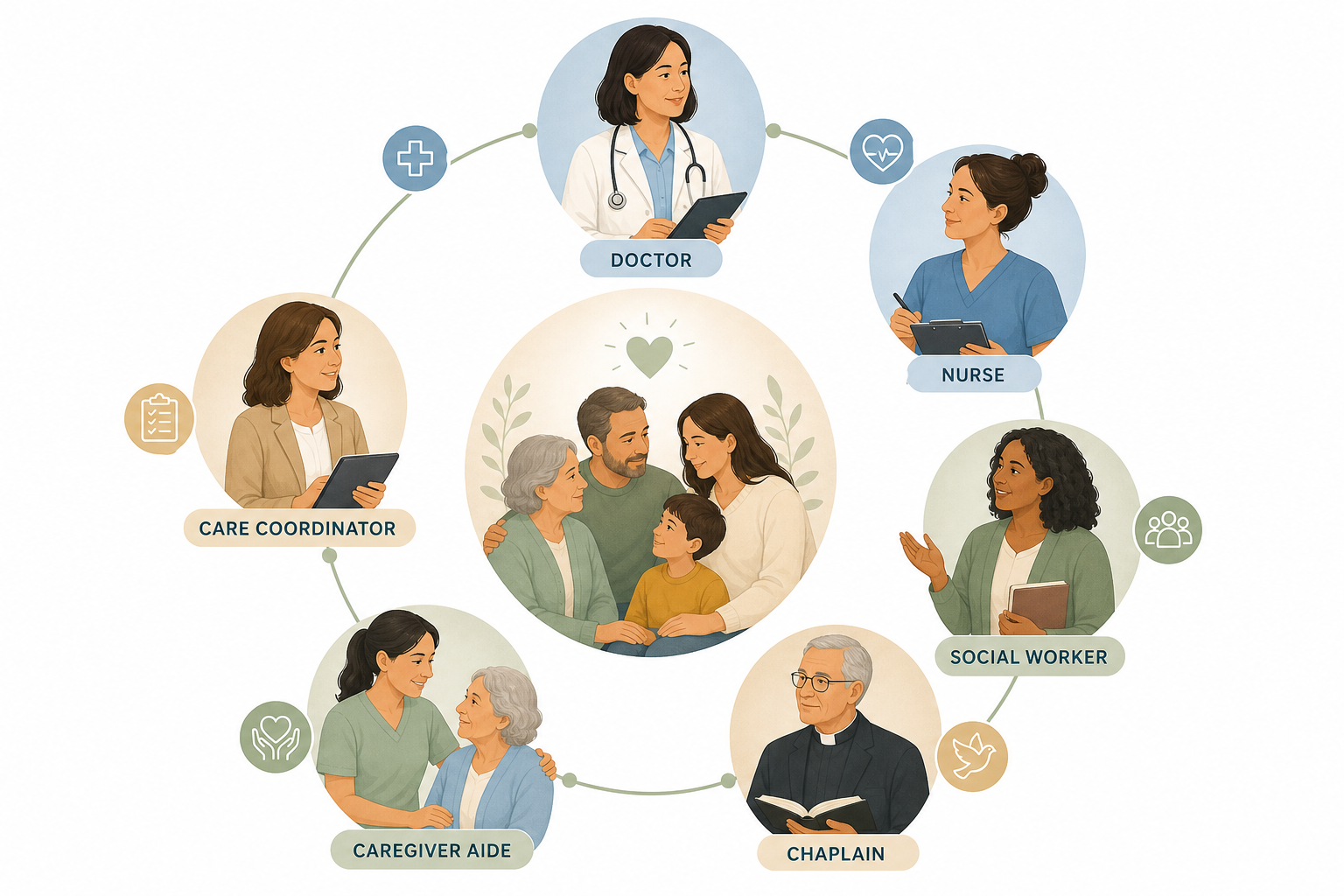
| Team Member | Primary Role | When to Contact |
|---|---|---|
| Hospice medical director | Certifies and recertifies terminal illness; reviews and updates the plan of care; oversees clinical decisions | When there are questions about the prognosis, eligibility, or a major change in the medical plan |
| RN case manager | Conducts regular nursing visits; assesses symptoms; coordinates the care plan; primary clinical contact for the family | For any change in symptoms, pain management concerns, or questions about medications and equipment |
| Consulting physician | The patient's own physician who may remain involved in care alongside the hospice medical director | For questions about the underlying illness or treatment history |
| Social worker | Addresses emotional, social, and practical needs; assists with advance care planning, financial concerns, and family communication | For help navigating family dynamics, community resources, financial questions, or emotional support |
| Chaplain / spiritual support counselor | Provides spiritual care and emotional support to patient and family, regardless of religious affiliation | When the patient or family is struggling with meaning, fear, guilt, or spiritual distress |
| Hospice aide | Assists with personal care — bathing, grooming, dressing — under the nurse's supervision | When personal care needs change or scheduling adjustments are needed |
| Bereavement coordinator | Provides grief support to the family for up to 13 months after the patient's death | During the hospice stay for anticipatory grief support; after death for bereavement follow-up |
| Hospice volunteer | Provides companionship, respite for caregivers, and practical assistance (errands, sitting with the patient) | When a caregiver needs a break or the patient would benefit from companionship |
Section 5 — End-of-Life Signs and Symptoms
The physical changes that occur near the end of life are predictable, and naming them in advance reduces fear. Families who recognize these signs are less likely to call 911 in a moment of panic — a call that can result in unwanted interventions that directly conflict with comfort care goals. The hospice 24/7 line exists precisely for these moments.
- Terminal illness: A disease or condition that cannot be cured and is expected to cause death within a limited time frame. Terminal illness is the foundational clinical criterion for hospice eligibility.
- Actively dying: The final hours to days of life, characterized by a cluster of observable physical changes including decreased consciousness, changes in breathing, mottled skin, and reduced or absent urine output. This is a distinct clinical phase from the broader dying process, which may unfold over weeks or months.
- Terminal restlessness: A common sign near the end of life that can include agitation, confusion, repetitive movements, or an inability to settle. It is caused by physiological changes in the brain and body as organ systems begin to fail — not by psychological distress alone. The hospice team can provide medications and non-pharmacological comfort measures to reduce restlessness. For families whose loved one also has dementia, see Agitation in Dementia: A BPSD Behavior Reference for Caregivers for guidance on distinguishing end-of-life agitation from dementia-related behavioral symptoms.
- Mottled skin: A blotchy, purplish or reddish discoloration of the skin — most commonly appearing on the hands, feet, and knees — that indicates slowing circulation as the body begins to shut down. Mottling is a sign that the actively dying phase has begun. It is not painful and does not require treatment.
- Dyspnea: Difficult, labored, or uncomfortable breathing. Dyspnea is one of the most distressing symptoms for both patients and families to witness. The hospice team can address it with positioning, airflow (a fan directed at the face), and medications when appropriate. Dyspnea near the end of life does not always indicate that the patient is in pain — it is a physiological response to changing oxygen levels.
- Death rattle / Cheyne-Stokes breathing: Two distinct but related breathing patterns seen near death. A "death rattle" refers to the gurgling or rattling sound caused by secretions in the throat and upper airway as the swallowing reflex diminishes — the patient is typically unconscious and not distressed by it, though it is difficult for families to hear. Cheyne-Stokes breathing is a pattern of irregular breathing — cycles of increasing then decreasing breath depth, followed by periods of no breathing (apnea) — caused by changes in the brain's respiratory control. Both are signs that death is near.
- Edema: Swelling caused by excess fluid accumulating in body tissues or cavities. Near the end of life, edema commonly appears in the legs, feet, and ankles as the circulatory system slows. It can cause discomfort and skin fragility. The hospice team can recommend positioning and skin care to reduce complications.
- Dysphagia: Difficulty swallowing. As the body weakens near the end of life, swallowing becomes unsafe — food, liquid, and medications can enter the airway rather than the stomach. The hospice team will adjust the medication route (often to sublingual or transdermal delivery) and may recommend thickened liquids or stopping oral intake. Forcing food or fluids on a person who cannot swallow safely can cause aspiration and distress.
Section 6 — Emotional and Grief Terms
The emotional experience of the hospice journey has its own vocabulary — and understanding these terms helps caregivers recognize what they are going through, seek support, and access the services they are entitled to.
- Anticipatory grief: Grief that begins before a death occurs — in response to the expected loss of a loved one, as well as the losses already experienced (independence, communication, the relationship as it once was). Anticipatory grief is a normal and valid response, not a sign of giving up. It can coexist with hope, love, and continued engagement in caregiving.
- Bereavement: The period of grief and mourning following a death. Bereavement encompasses the emotional, physical, social, and spiritual dimensions of loss. There is no standard timeline for bereavement — its duration and intensity vary widely by individual, relationship, and circumstances of the death.
- Bereavement care: Support services provided to the family after a patient's death. Under the Medicare hospice benefit, bereavement care for up to 13 months following the death is a required component — not an optional extra. This may include phone calls, visits, support groups, and referrals to counseling. Families are entitled to ask about and access this support.
- Caregiver burnout: A state of physical, emotional, and mental exhaustion resulting from the sustained demands of caregiving — often compounded by grief, disrupted sleep, social isolation, and the suspension of the caregiver's own needs. Burnout is not a personal failing; it is a predictable consequence of an unsupported caregiving role. Recognizing it early allows caregivers to ask for respite care, delegate tasks, and access support before reaching a crisis point.
When to Call the Hospice Team — and What to Ask at Your First IDT Meeting
Two of the most practical things a family can know: when to reach for the phone, and what to say when they get there.
Call the hospice 24/7 line — not 911 — when:
- Your loved one's pain or breathing suddenly worsens and is not controlled by current medications.
- You observe mottled skin, Cheyne-Stokes breathing, or other signs of the actively dying phase for the first time.
- Terminal restlessness begins — agitation, confusion, or picking at bedclothes — and you are not sure how to respond.
- Your loved one stops swallowing and you are unsure how to give medications.
- You are not sure whether what you are seeing is an emergency or an expected part of the dying process.
- You need guidance, reassurance, or just a calm voice at 2 a.m.
Questions to ask at your first IDT meeting:
- What is the current plan of care, and what are the goals we are working toward?
- Who is our primary contact for each type of concern — pain, emotional support, equipment, medications?
- What symptoms should we expect as the illness progresses, and how will you help us manage them?
- What signs indicate that the level of care should change — for example, from routine home care to continuous home care or GIP?
- How do we request respite care if we need a break?
- What does the recertification process look like, and what happens if my loved one's condition stabilizes?
- What bereavement support is available to our family, and when does it begin?
- Are there advance directive or POLST forms we should have in place, and can someone help us complete them?
Browse more in the Glossary.