
How Daylight Saving Time Affects Elderly Sleep Health
Explains why daylight saving time causes more severe sleep disruption in older adults than in younger people, covering age-related circadian changes, sleep fragmentation, and the added risks for those with dementia — so caregivers can understand why adjustment takes weeks and what to expect.
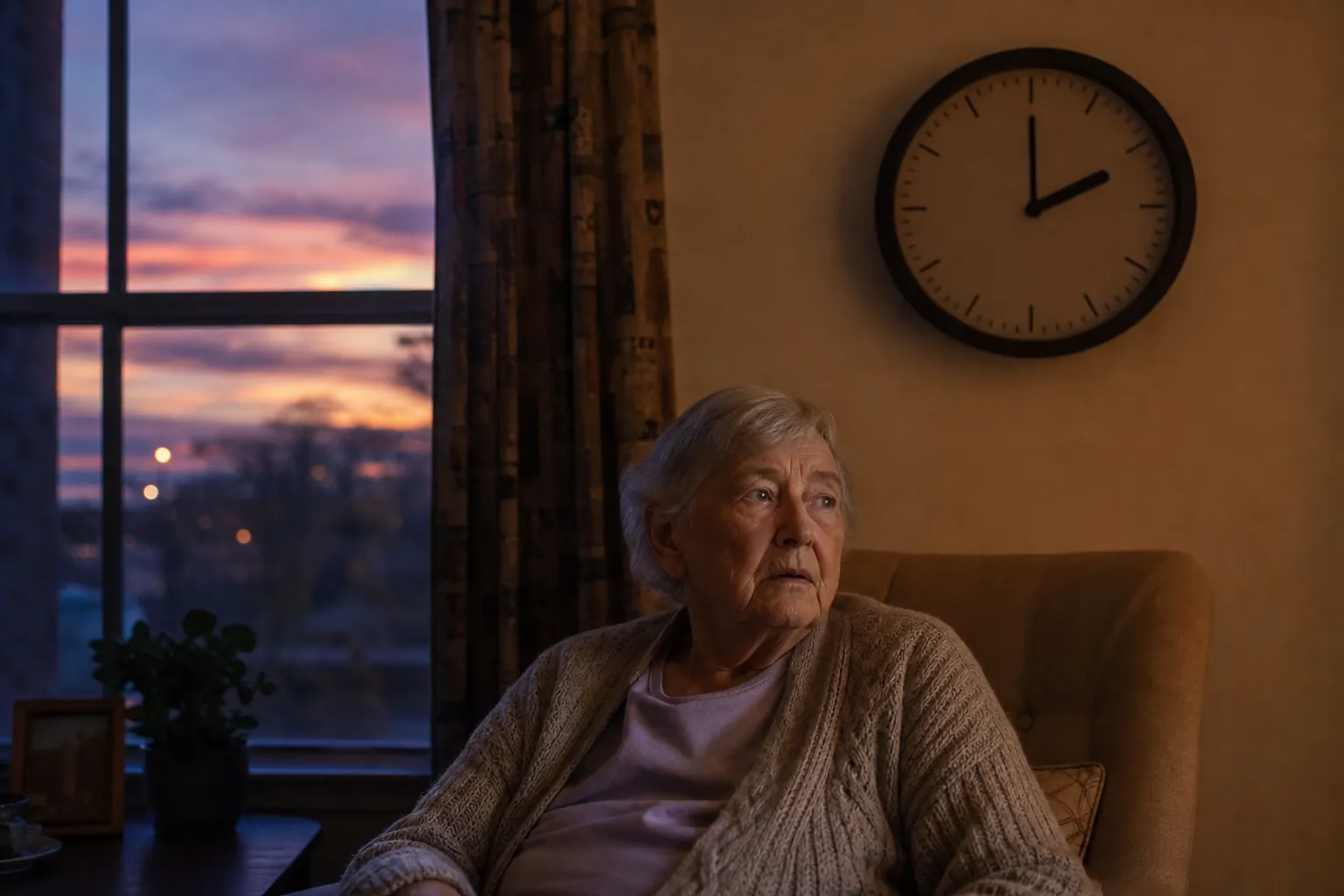
The first time daylight saving time really announces itself in an older household, it may not look like a sleep problem. It may look like a parent standing in the hallway before dawn, dressed for breakfast. It may look like a sharper temper at dusk, a missed medication, a shaky walk to the bathroom, or three nights of everyone in the house sleeping lightly because no one trusts the night to stay quiet.
That is why the question of how daylight saving time affects elderly sleep health cannot be answered with “it is only one hour.” For many older adults, the clock change lands on a sleep system that has already shifted earlier, wakes more often, and depends on light signals that may no longer arrive as strongly. In dementia, the same change can press on brain systems that are already damaged.
The Clock Changes by One Hour; the Body Does Not
A younger adult may complain after the spring transition, drink more coffee, and feel close to normal after a few days. An older adult may be starting from a different place. With age, circadian rhythms often move earlier. Sleep Foundation describes a common pattern in which older adults may feel ready for sleep around 7 or 8 p.m. and wake around 3 or 4 a.m.; it also notes that older adults commonly wake three to four times during the night.[1]
Those details matter because daylight saving time is not just a bookkeeping change. The spring shift asks the body to act as if morning and evening have moved. If someone already becomes sleepy early and wakes early, forcing the household schedule forward can widen the gap between the clock on the wall and the timing signals inside the body.
Sleep fragmentation makes the same lost hour cost more. If a person normally sleeps in one solid block, a shorter night is unpleasant. If a person already wakes several times, needs help getting back to bed, uses the bathroom at night, or dozes unpredictably during the day, even a modest additional disruption can show up as confusion, poor balance, daytime sleepiness, irritability, or a caregiver’s second bad night becoming the one that breaks the routine.
Why Older Circadian Systems Re-Sync More Slowly
The body clock is not reset by willpower. It is trained, day after day, by light, darkness, meals, movement, social timing, and sleep pressure. Morning light is especially important because it tells the brain that the day has begun. Evening darkness helps the body move toward sleep.
The American Academy of Sleep Medicine has argued that permanent standard time is better aligned with human circadian biology than daylight saving time, and its position statement notes that the body clock may not fully adjust to daylight saving time even after several months of exposure.[2] That point is easy to miss when the public conversation focuses only on the first Monday after the spring change. The acute lost sleep is real, but the deeper issue is living by a clock that can remain out of step with solar time.
Modeling work reported by Stanford researchers similarly supports standard time as the better fit for circadian alignment. The study is not an elderly-only trial, so it should not be used as direct proof of senior-specific outcomes. Its relevance to older adults comes through the mechanism: the researchers note that older adults spend less than 5% of the day outdoors and that aging eyes transmit less blue light, both of which can weaken the light signal used to set the circadian clock.[3]

That is the part many families are not told. If a parent’s eyes admit a weaker light signal, if the parent spends much of the day indoors, and if sleep is already broken, then “just keep the same schedule” may not be enough to make the brain re-time itself quickly. The caregiver can do many things right and still see a slow adjustment.
Dementia Adds a Second Hit
In Alzheimer’s disease and related dementias, daylight saving time can be harder for a more specific reason: the systems that interpret light and organize daily rhythm may be impaired. A review of circadian rhythm sleep-wake disorders in older adults describes degeneration of the suprachiasmatic nucleus in Alzheimer’s disease and impairment of melanopsin-containing retinal ganglion cells in neurodegenerative disease.[4]
The suprachiasmatic nucleus, often shortened to SCN, is a small brain region that helps coordinate the body’s daily timing. Melanopsin cells in the eye help carry information about environmental light to that clock. When those pathways are weakened, the problem is not that the person with dementia is being difficult or refusing to understand the new time. The equipment used to read and respond to the light-dark cycle is less reliable.
This is where sundowning becomes especially important. The Alzheimer’s Association says up to 20% of people with Alzheimer’s experience sundowning, and it specifically warns that daylight saving time can worsen symptoms by disrupting light and dark cues.[5] In the home, that can mean more agitation, pacing, suspicion, wakefulness, or distress in the late afternoon and evening, just when the caregiver is also tired.
The phrase “sundowning” can sound tidy from a distance. Up close, it is not tidy. It is the hour when explanation stops working. A first-person AgingCare account describes daylight saving time triggering disorientation in a loved one with dementia, with repeated clock explanations failing because short-term memory loss kept the person from retaining the reason for the change.[6] That account is one family’s experience, not a rule for every person with dementia. But it captures why ordinary reassurance may collapse under dementia: the person may not be able to hold the explanation long enough for it to soothe the fear.
Why the Fallout Often Shows Up Outside the Bedroom
Caregivers often notice the consequence before they name the cause. A parent sleeps at the wrong time, then resists a shower. A nap pushes dinner later. The evening medication gets delayed. Someone wakes in darkness and walks without turning on the light. By the time the family calls it a sleep issue, the disruption has already moved through appetite, mood, balance, and supervision.
Large-scale epidemiological evidence makes that concern less abstract. A PLOS Computational Biology study using data from more than 150 million patients found that injuries significantly increased after the spring daylight saving time transition; in its age-related injury patterns, older adults in the 41–60 and 60+ groups were more likely to injure the lower torso or thorax.[7] The data do not say that every older adult will fall after the clock change. They do support a practical warning: when sleep and circadian timing are disrupted, the downstream risks are not confined to feeling tired.
For an older adult, the vulnerable moments are often ordinary ones: getting out of bed before the room is bright, reaching for a walker while half awake, taking medication when the day feels out of order, or becoming more confused when evening light fades before the body feels settled. The clock change can make those moments more crowded.
What Caregivers Can Realistically Expect
The most useful expectation is not that every household can prevent disruption. It is that recovery may take longer than the calendar makes it seem. A parent without dementia may still need more than a weekend to settle because the older circadian system is earlier, sleep is more fragmented, and light signals may be weaker. A parent with dementia may need even longer because the brain’s timing machinery is compromised.
A simple framework is usually more useful than a long list of sleep rules:
- Protect morning light when feasible, especially after the spring change, because the brain needs a strong daytime cue.
- Watch the late afternoon and evening for increased agitation, pacing, fearfulness, or resistance to care.
- Treat daytime sleepiness, new imbalance, missed medications, and unusual confusion as safety signals, not merely annoyances.
- Avoid assuming the problem should resolve in two nights; for some older adults, especially those with dementia, a several-week adjustment window is more realistic.
- Ask a clinician for guidance when sleep disruption creates fall risk, severe behavioral symptoms, medication problems, or caregiver exhaustion.
There is a certain mercy in understanding the mechanism. The older adult is not simply being stubborn. The caregiver is not failing because the house does not reset neatly by Monday. Daylight saving time asks an aging or impaired circadian system to move on command, and some bodies need weeks of steady light, routine, supervision, and patience before the household feels anchored again.
References
- How Circadian Rhythms Change as We Age, Sleep Foundation
- Daylight saving time: an American Academy of Sleep Medicine position statement, Journal of Clinical Sleep Medicine, 2020
- Permanent standard time is better for health than daylight saving time, Stanford researchers say, Stanford Medicine, 2025
- Circadian Rhythm Sleep-Wake Disorders in Older Adults, PMC, 2022
- Daylight Saving Time and Alzheimer’s, Alzheimer’s Association
- Daylight Saving Time Can Trigger Sundowning, AgingCare
- Daylight saving time is associated with higher number of injuries, PLOS Computational Biology
Related reading
Noticed something outdated or inaccurate on this page? Flag a correction. We review every report against CDC, NIA, and AARP HomeFit guidance before updating a page.
Part of the Fall Prevention section.