
Does Florida's Purple Alert Apply to Missing Seniors with Dementia?
Florida's Purple Alert explicitly excludes people with Alzheimer's disease and other dementias. This article explains the critical difference between the Purple Alert and Silver Alert systems, what to do if a loved one wanders, and why relying on the wrong alert can delay a rescue.
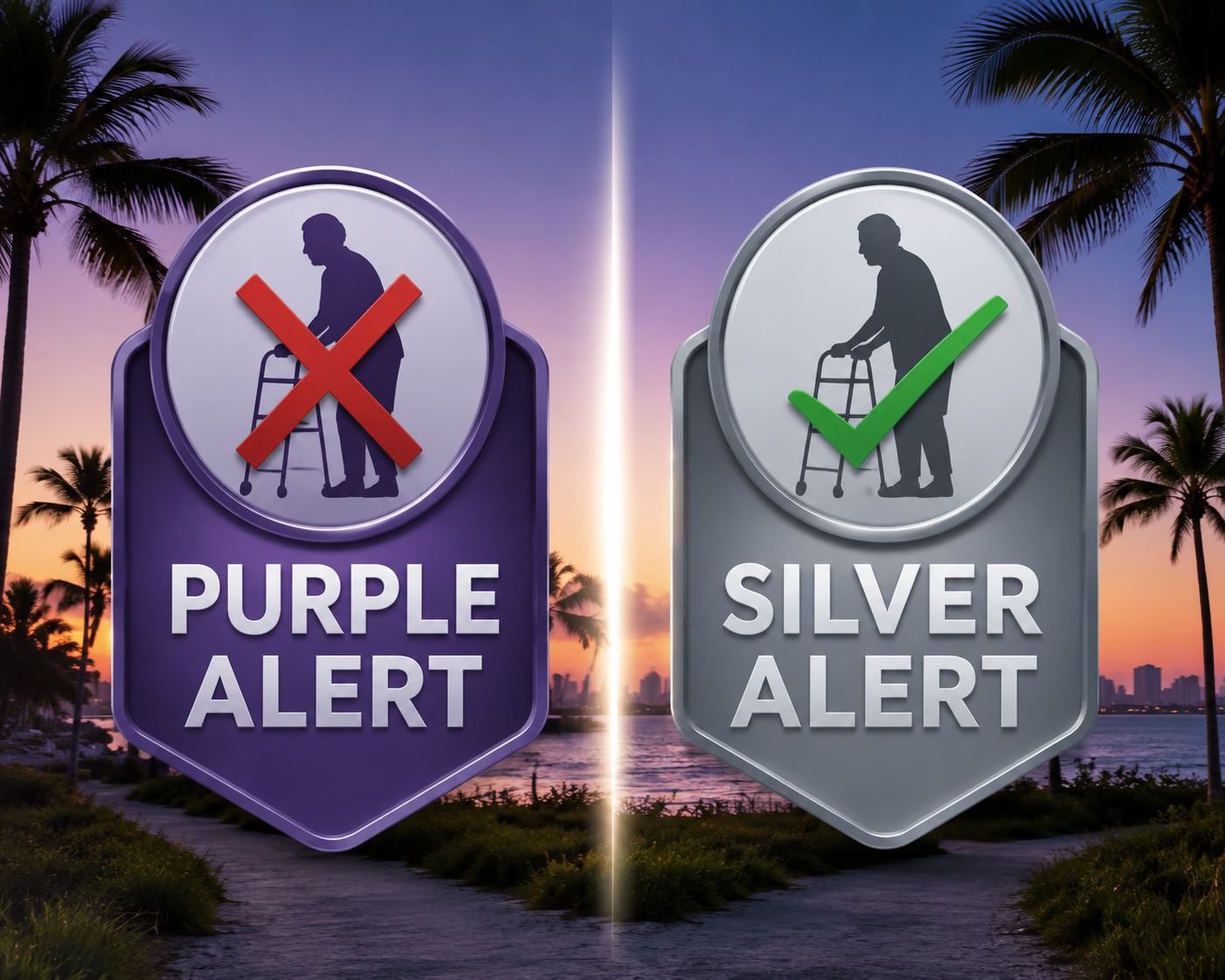
If you searched for “Florida purple alert for missing seniors with dementia,” the most important answer is also the one nobody should soften: Florida’s Purple Alert does not apply to a missing person with Alzheimer’s disease or another dementia-related disorder. The Purple Alert statute explicitly excludes “Alzheimer’s disease,” “a dementia-related disorder,” and cognitive impairment caused by substance abuse from the people who can qualify for that alert.[1]
For a missing parent, spouse, or other adult with dementia in Florida, the alert system to ask law enforcement about is the Silver Alert. Florida’s Silver Alert criteria cover people with an “irreversible deterioration of intellectual faculties,” including Alzheimer’s disease and dementia, and the system can apply to people age 60 or older, or to adults ages 18 to 59 who lack the capacity to consent.[2]
The Legal Difference Is Not a Technicality
Purple Alert and Silver Alert can sound like neighboring labels in the same emergency-alert drawer. They are not interchangeable when the missing person has dementia. Florida’s Purple Alert law is aimed at a missing adult with certain mental, cognitive, intellectual, or developmental disabilities, but the statute draws a hard boundary around dementia and Alzheimer’s disease.[1]
That boundary matters when someone is gone from the house, the car is missing, or a neighbor says they saw him walking toward a road half an hour ago. A family that calls asking for the wrong alert may not mean any harm, but the minutes spent sorting out the wrong system are minutes the missing person does not have.
| Question | Purple Alert | Silver Alert |
|---|---|---|
| Does it cover Alzheimer’s disease? | No. Florida’s Purple Alert statute excludes Alzheimer’s disease. | Yes. Silver Alert criteria include Alzheimer’s disease. |
| Does it cover dementia-related disorders? | No. Florida’s Purple Alert statute excludes dementia-related disorders. | Yes. Silver Alert criteria include dementia. |
| Who coordinates state-level activation? | FDLE is involved when the case qualifies for state-level Purple Alert activation. | FDLE coordinates state-level Silver Alert activation. |
| What should a caregiver of a missing person with dementia ask about? | Not Purple Alert. | The Silver Alert process. |
Florida has an estimated 580,000 people living with Alzheimer’s disease, and those people are not Purple Alert candidates under the statute; they belong on the Silver Alert side of this question.[2] That is not a small paperwork distinction. It is the difference between asking for an alert that can legally fit the case and asking for one that starts from the wrong premise.
Why Caregivers Cannot Wait to Sort This Out
Wandering is common enough that dementia families should treat it as a safety issue, not as a rare emergency that only happens to someone else. The Alzheimer’s Association says 6 in 10 people with dementia will wander at least once.[3] Once it happens, the family’s job is not to debate alert names. The job is to get the right facts to law enforcement quickly.
Silver Alert also has a Florida track record. In the program’s first 14 years, FDLE issued more than 3,000 Silver Alerts, and the program was directly responsible for 286 recoveries, according to reporting summarized by the Florida Sheriffs Association.[4] That does not mean every missing person is found because of an alert, and it does not mean an alert replaces a ground search. It means the Silver Alert system is the one Florida already uses for this kind of dementia-related missing-person emergency.
What to Do When a Loved One with Dementia Is Missing
Start with the emergency, not the terminology. If a person with dementia is missing and you cannot quickly account for where they are, call 911. Tell the dispatcher the person has Alzheimer’s disease, dementia, or suspected cognitive impairment; say when and where they were last seen; describe what they were wearing; and say whether they may be on foot, in a vehicle, or using public transportation.
Then use the words that point law enforcement in the right direction: ask about the Silver Alert process. If the person has dementia, do not ask for a Purple Alert first and hope the agency will translate what you meant. Give them the condition, the risk, and the last-known details clearly enough that the correct missing-person procedure can start.
- Call 911 as soon as the person is missing and at risk.
- Say plainly: “They have dementia” or “They have Alzheimer’s disease.”
- Give the last known location, last seen time, clothing, height, weight, hair, glasses, mobility issues, and any medical needs.
- Tell officers whether a car, golf cart, bicycle, transit card, phone, GPS device, or tracking tag may be involved.
- Provide a recent photo and the person’s full legal name, date of birth, and home address.
- Ask whether the case meets local or state Silver Alert activation criteria.
Florida’s alert mechanics can depend on how the person disappeared. For Silver Alerts, local activation is used for cases that stay local, such as a person believed to be on foot; state-level activation is used in vehicle cases when the vehicle and tag information are available for broader broadcast.[2][5] Purple Alert has a similar local-versus-state structure, but that similarity is exactly why families get tripped up: the activation path may sound parallel, while the qualifying population is different.[6]
While officers are responding, do the practical search tasks that do not interfere with law enforcement: check immediate danger zones, look around water, roads, parked vehicles, sheds, garages, and familiar walking routes, and keep one person available by phone. AARP’s caregiver guidance emphasizes contacting 911, giving a clear description, and searching places the person may be drawn to, including former homes, workplaces, or favorite locations.[7]
For a fuller crisis sequence, including what to do in the first minutes before and after calling 911, use the Alzheimer’s wandering at night crisis response guide. The alert request is one part of the response. The home search, the call, the photo, the vehicle information, and the person who stays reachable all matter too.
The Three Confusing Cases Families Ask About
If there is no formal dementia diagnosis yet
Families often know something is wrong before a doctor has finished naming it. Maybe the person repeats the same question every few minutes, gets lost driving to a familiar store, or no longer understands danger. If there is no formal diagnosis, do not pretend certainty you do not have, but do not stay vague either.
Tell law enforcement exactly what you know: “He has memory loss and gets disoriented,” “She has been evaluated for cognitive decline,” or “We suspect dementia, but the diagnosis is not complete.” The agency, not the family, determines whether the case meets alert criteria. Your job is to give them the facts that show risk and impaired capacity.
If the person has dementia plus another disability
This is where the Purple Alert name can become dangerous shorthand. A person may have an intellectual or developmental disability that sounds like it belongs under Purple Alert, while also having Alzheimer’s disease or another dementia-related disorder. The Purple Alert statute still expressly excludes Alzheimer’s disease and dementia-related disorders.[1]
In that mixed situation, do not try to diagnose the legal category yourself on the phone. State every relevant condition and ask the responding agency which alert process applies. If dementia is part of the reason the person is missing and unsafe, make sure that fact is not buried behind a more general phrase like “cognitive issues.”
If you heard “Purple Alert” on the news and assumed it covered seniors
That assumption is understandable. Purple Alert stories often involve vulnerable adults, and the phrase can sound broad enough to cover any missing adult with cognitive impairment. Florida’s public explanations of Purple Alert describe it as an alert for certain missing adults with mental or developmental disabilities, while also noting exclusions for Alzheimer’s disease and dementia.[6]
For dementia caregivers, the safer shortcut is simple: Purple Alert may be relevant to some missing adults, but dementia points to Silver Alert. If the person missing is your parent with Alzheimer’s, do not let the word “purple” be the thing you remember under stress.
Before the Next Emergency
Once a person with dementia has wandered, most families stop thinking of prevention as optional. The point is not to turn a home into a locked-down facility overnight. The point is to make the next disappearance harder to start and faster to resolve.
A written wandering plan should include a current photo, medical conditions, medications, common destinations, former addresses, favorite places, vehicle information, tracking-device details, and emergency contacts. Keep that information where another family member can find it at 2 a.m., not buried in one person’s phone.
For planning before a crisis, start with understanding wandering in dementia. For technology that may help locate someone faster, review dementia monitoring systems. For reducing exit risk at home, use the dementia-friendly home modification guide.
If the person missing has dementia, do not wait on Purple Alert. Call 911, state the dementia risk plainly, provide the last-known details, and ask about the Silver Alert process.
References
- Florida Statutes § 937.0205 — Purple Alert (2025). Florida Legislature. 2025. https://www.leg.state.fl.us/Statutes/index.cfm?App_mode=Display_Statute&Search_String=&URL=0900-0999/0937/Sections/0937.0205.html
- What is a Florida Silver Alert and how can you help? USA TODAY Network-Florida. March 10, 2026. https://www.news-journalonline.com/story/news/2026/03/10/florida-silver-alert-missing-person-alzheimers-demenita/89079375007/
- Wandering — Alzheimer's Association. Alzheimer's Association. https://www.alz.org/help-support/caregiving/stages-behaviors/wandering
- Emergency Phone Alerts: What You Need to Know. Florida Sheriffs Association. https://flsheriffs.org/blog/entry/emergency-phone-alerts-what-you-need-to-know/
- FDLE Silver Alert steps. Florida Department of Law Enforcement. https://www.fdle.state.fl.us/silver-alert-plan/activation-steps
- 8 things to know about Florida's Purple Alert program. Herald-Tribune/USA TODAY. June 7, 2023. https://www.heraldtribune.com/story/news/state/2023/06/07/florida-purple-alert-fdle-definition-get-alerts/70293013007/
- Dementia Wandering: What to Do if an Older Person Is Missing. AARP. https://www.aarp.org/caregiving/basics/dementia-wandering-finding-missing-person/
Related reading
Noticed something outdated or inaccurate on this page? Flag a correction. We review every report against CDC, NIA, and AARP HomeFit guidance before updating a page.
Part of the Fall Prevention section.