
Live-In Companion for Elderly: Complete Guide to Costs, Hiring, and Payment Options (2026)
This comprehensive guide helps adult children understand the three distinct live-in care models, what they cost in 2026, how to find and vet a caregiver, and how to pay for care through private funds, insurance, VA benefits, and Medicaid waivers.

What Is Live-In Companion Care and How Is It Different From Other Home Care Options?
Live-in companion care is a specific home care arrangement where a caregiver resides in the senior's home and provides non-medical support, supervision, and companionship. It is designed for older adults who need 24-hour oversight or assistance but do not require the skilled nursing care provided in a facility. The core distinction from other home care models lies in the caregiver's living arrangement and the structure of their work hours.
Unlike hourly home care, where a caregiver visits for a set number of hours per day or week, a live-in caregiver is present around the clock. This model is fundamentally different from 24/7 awake shift care, where two or three caregivers rotate in 8-12 hour awake shifts. In a true live-in arrangement, the caregiver is provided a private room and an 8-hour uninterrupted sleep period each night, plus daytime breaks. This structure is what makes live-in care a distinct, often more affordable option compared to round-the-clock awake care.
The need for this type of care is driven by a strong preference among older adults to remain at home. According to an AARP survey, 77% of adults ages 50 and older want to stay in their own homes for the long term. Live-in companion care directly supports this goal for seniors who need supervision for safety, help with daily routines, or relief from social isolation but do not require the medical infrastructure of a nursing home or the constant awake monitoring of shift care.
The Three Live-In Care Models: Live-In With Sleep Break, 24-Hour Shift Care, and Overnight Care
Understanding the three distinct live-in care models is the most important step in planning. Families often assume that '24-hour care' means one person is awake and working all the time, but that is rarely the case with a single live-in caregiver. Each model has a different cost structure, caregiver availability, and level of supervision. Choosing the wrong model can lead to caregiver burnout, unmet needs, or unexpected costs.
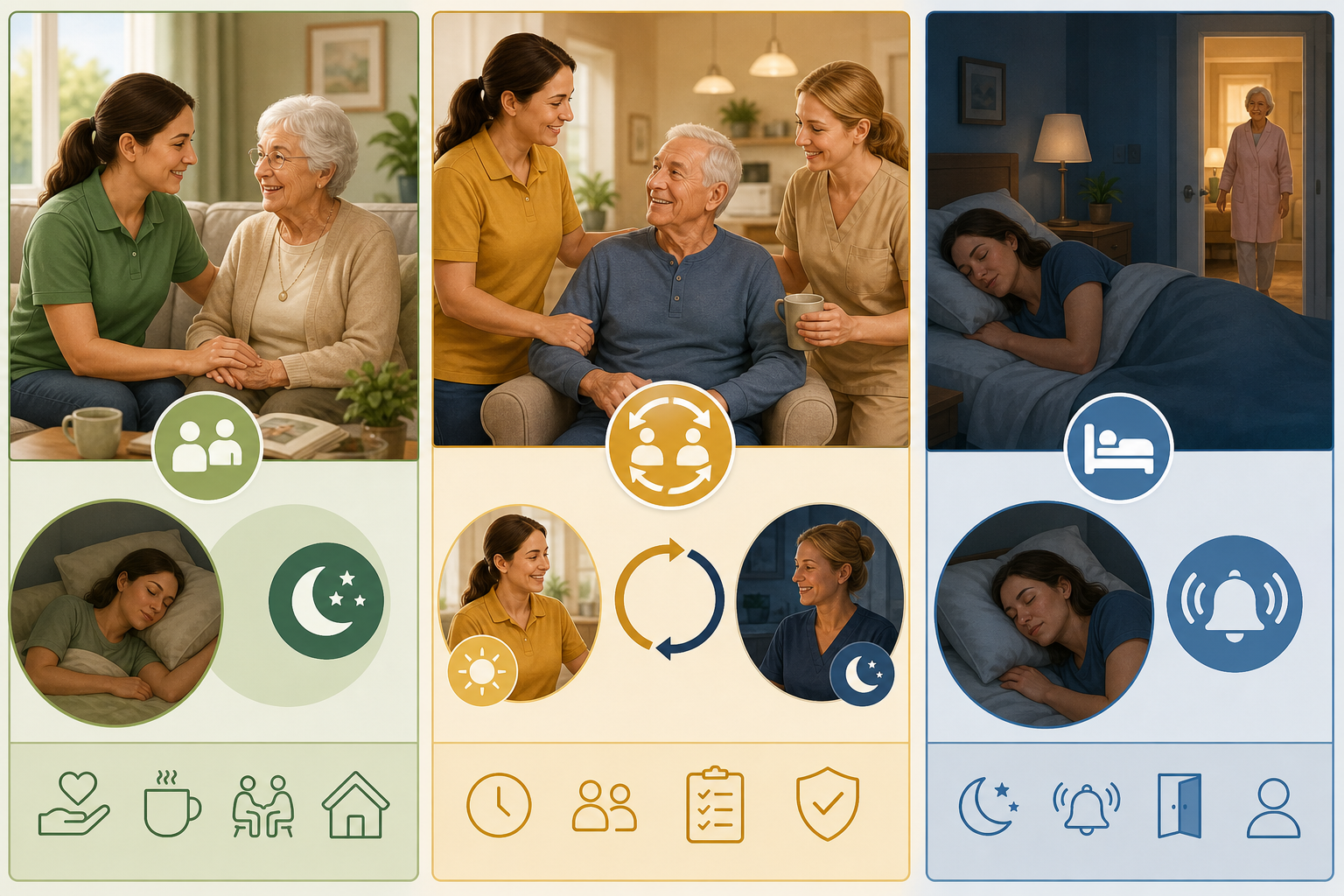
| Model | Caregiver Structure | Sleep / Break Policy | Best For | Typical Cost (2026) |
|---|---|---|---|---|
| Live-In With Sleep Break | 1 primary caregiver lives in; works 4-5 days/week | 8-hour uninterrupted sleep period; 4-hour daytime break | Seniors who need supervision and help during the day but are stable and safe overnight | $300–$400+/day; $9,000–$12,000+/month |
| 24-Hour Shift Care | 2-3 caregivers rotating 8-12 hour awake shifts | No sleep break; all caregivers are awake and working during their shift | Seniors who need active care or monitoring throughout the night (e.g., frequent wandering, fall risk, medical needs) | $816/day national median; ~$24,733/month |
| Overnight Care | 1 caregiver provides care from bedtime to morning wake-up | Caregiver sleeps but is available for nighttime needs | Seniors who are independent during the day but need help with nighttime bathroom trips, medication, or reassurance | Varies widely; often a flat nightly rate or included in a daily live-in rate |
The live-in with sleep break model is the most common and cost-effective option for families who want 24-hour presence without paying for three shifts of awake caregivers. However, it is critical to understand that this model assumes the senior can be left alone for the caregiver's sleep and break periods. If the senior has dementia with wandering behavior, is at high risk for falls at night, or needs frequent repositioning or medication, the 24-hour shift care model may be the safer choice.
What Services Are Included — and Not Included — in Live-In Companion Care
Live-in companion care covers a broad range of non-medical services designed to support daily living and reduce social isolation. The companionship aspect is clinically meaningful: the Merck Manual reports that nearly 25% of adults age 65 and older are socially isolated, a condition linked to higher risks of depression, cognitive decline, and mortality. A live-in companion provides consistent human interaction that directly addresses this risk.
Services Typically Included
- Companionship and conversation, including reading, playing games, or looking at photos
- Meal planning and preparation according to dietary needs
- Light housekeeping, such as laundry, dishes, and tidying common areas
- Transportation to medical appointments, grocery shopping, and social outings
- Grooming assistance, including help with bathing, dressing, and oral hygiene
- Medication reminders (not administration of medications)
- Mobility assistance, such as help getting in and out of bed or a chair
- Toileting and incontinence care
Services Not Included
- Skilled nursing care, such as wound care, IV management, or catheter changes
- Physical, occupational, or speech therapy
- Medication administration (injections, IV medications)
- Medical diagnosis or treatment planning
Complete Cost Breakdown for 2026: Hourly, Daily, and Monthly Ranges
The cost of live-in companion care in 2026 varies significantly based on the care model, geographic location, and whether you hire through an agency or directly. Understanding the difference between hourly rates and daily rates is essential for accurate budgeting.
The national median cost for nonmedical home care in 2026 is $34 per hour, according to A Place for Mom's 2026 Cost of Long-Term Care and Senior Living Report. CareScout's 2025 data puts the national median for a home health aide at $35 per hour. However, live-in care is almost never billed at an hourly rate for 24 hours. Instead, agencies and private caregivers use a daily or shift rate that accounts for the caregiver's sleep and break time.
| Cost Metric | National Median (2026) | Low Range | High Range |
|---|---|---|---|
| Hourly (nonmedical home care) | $34–$35/hr | $23/hr (MS, LA) | $42/hr (WA) |
| Daily (live-in with sleep break) | $300–$400/day | $250/day (low-cost areas, private hire) | $500+/day (high-cost areas, agency) |
| Monthly (live-in with sleep break) | $9,000–$12,000/month | $6,000/month (low-cost areas, private hire) | $15,000+/month (high-cost areas, agency) |
| Monthly (24/7 awake shift care) | $24,733/month | $20,000/month | $30,000+/month |
| Monthly (assisted living) | $5,419/month | $3,500/month | $8,000+/month |
Related reading
Noticed something outdated or inaccurate on this page? Flag a correction. We review every report against CDC, NIA, and AARP HomeFit guidance before updating a page.
Part of the Fall Prevention section.