
Physical Symptoms of Dementia in Older Adults
Dementia affects far more than memory. This guide covers the physical symptoms at every stage — from early gait changes to late-stage swallowing problems — and explains what caregivers can do to maintain safety, dignity, and quality of life.
A parent starts taking smaller steps across the kitchen. A spouse stops swinging one arm when walking to the mailbox. Someone who could always get out of a chair now rocks forward twice before standing. These changes can look like ordinary aging, medication side effects, arthritis, or fatigue. Sometimes they are. But in older adults with dementia, physical symptoms can be part of the disease process itself, and they often begin before families expect anything visibly “physical” to happen.
The physical symptoms of dementia in older adults can include slower gait, reduced balance, weaker grip, muscle loss, falls, swallowing trouble, incontinence, posture changes, and eventually immobility. Memory loss may be the symptom that gets named first, but the work of caregiving often changes when the body changes: bathing takes longer, stairs become questionable, meals need watching, and one fall can rearrange the whole household.

A stage map for the physical side of dementia
Dementia does not follow the same timetable in every person. Alzheimer’s disease, Lewy body dementia, vascular dementia, and frontotemporal dementia can look different, and other medical problems may speed up or blur the pattern. Still, a stage map helps caregivers notice what is changing and ask for help before the next crisis.
| Stage | Physical changes families may notice | Why it matters |
|---|---|---|
| Early dementia or preclinical change | Slower walking, shorter steps, reduced arm swing, weaker handgrip, subtle balance problems, hesitation with complex movement | These may be mistaken for normal aging, but they can signal rising fall risk and declining reserve. |
| Middle-stage dementia | More falls, cautious gait, wider stance, difficulty rising from chairs, transfer problems, wandering-related safety risks, weight loss, more help needed with bathing, dressing, and toileting | This is often when independence changes most sharply and home routines need redesign. |
| Late-stage dementia | Swallowing problems, aspiration risk, urinary or fecal incontinence, muscle wasting, contractures or fixed postures, limited mobility, bed or chair dependence | Care becomes more hands-on, comfort-focused, and clinically supported. |
Early signs: when walking, balance, and strength start to change
Early dementia is not always physically obvious, but research on motor impairment has found that slower gait, reduced handgrip strength, and balance impairment can be detected in preclinical and early dementia stages, not only in late disease.[1] That matters because families often wait for a dramatic fall or a clear loss of independence before treating movement changes as part of the dementia picture.
A slower gait may first appear as taking longer to cross a parking lot, drifting behind on walks, or becoming less able to walk and talk at the same time. Reduced arm swing can make a person look stiff or guarded. Shorter steps and a wider base of support may be the body’s attempt to stay upright. These changes do not prove dementia is worsening on their own, but in a person already showing cognitive decline, they deserve attention rather than dismissal.
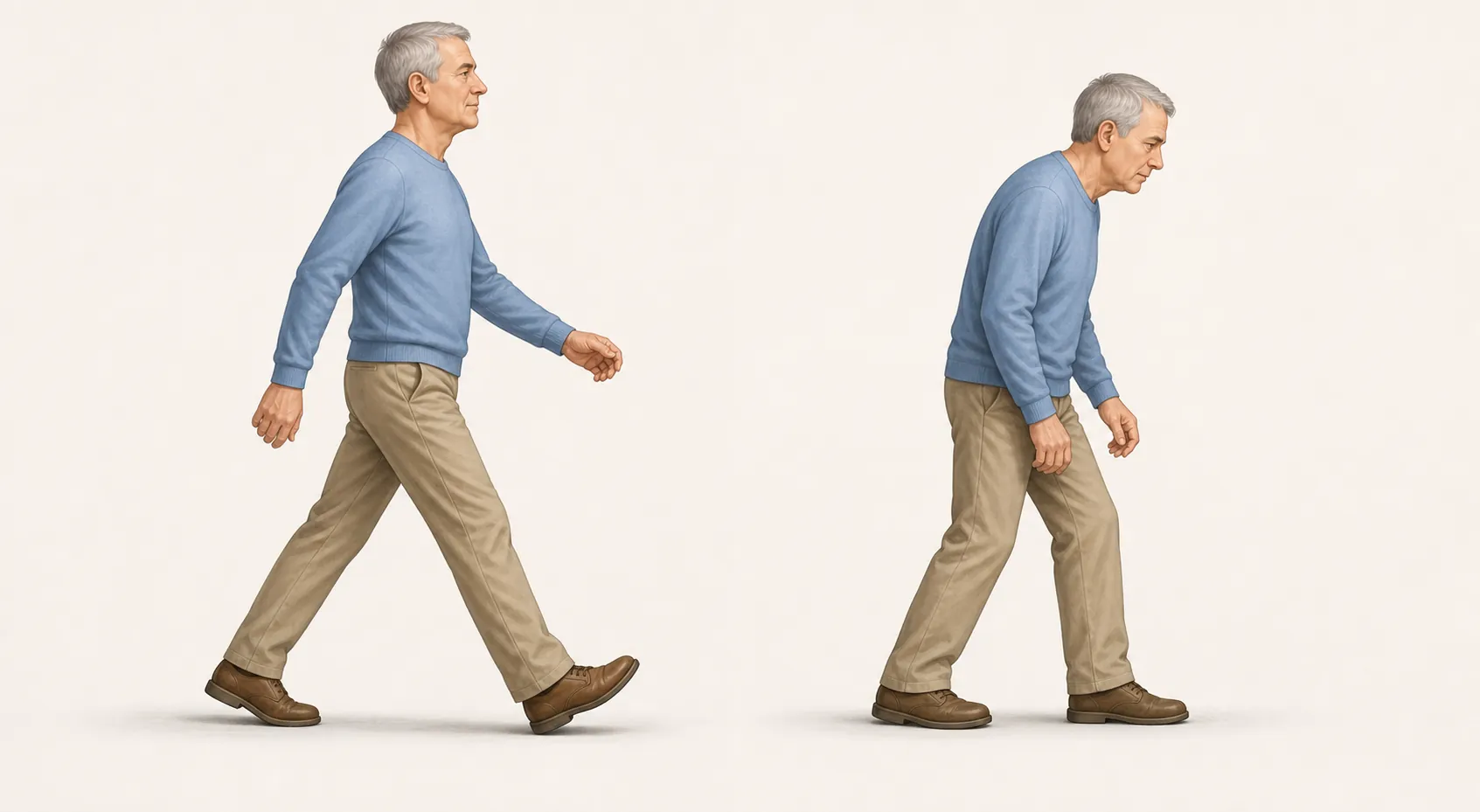
The typical Alzheimer’s gait pattern is often described as a cautious gait: slower walking speed, shorter step length, more step-to-step variability, a wider support base, and longer time with both feet on the ground.[1] In daily life, that can look like shuffling through doorways, pausing at floor transitions, avoiding curbs, or gripping furniture while moving from room to room.
Strength changes can be just as important as gait. A cited 2018 study in a motor-impairment review reported that people with dementia had a sarcopenia rate 3 to 5 times higher than older adults without dementia.[1] That finding should not be treated as a universal rule for every household, but it gives caregivers a useful warning: muscle loss and weakness are not side issues. They affect standing, bathing, getting into a car, rising from the toilet, and recovering after illness.
This is the stage where observation helps. Write down what changed, when it started, whether it is worse at certain times of day, and whether there was a recent medication change, infection, fall, dehydration, pain flare, or hospitalization. Dementia can affect movement, but sudden physical decline should not be automatically blamed on dementia.
What to bring up early
- A new shuffle, shorter stride, or reduced arm swing
- Trouble rising from a chair, toilet, bed, or car seat
- New need to hold walls, furniture, or another person while walking
- Weaker grip, dropping objects, or difficulty using utensils
- Any fall, near-fall, dizziness episode, or sudden change in balance
A primary care clinician, neurologist, physical therapist, or occupational therapist can help sort out what is likely dementia-related and what may be treatable, such as pain, neuropathy, vision problems, medication side effects, low blood pressure, infection, or unsafe footwear.
Middle-stage dementia: falls, transfers, weight loss, and the shrinking safe zone
Middle-stage dementia is where many families first feel the physical burden clearly. A person may still walk, dress partly, feed themselves, or use the bathroom with reminders, but each task has more failure points. The walk to the toilet can involve poor judgment, weak legs, urgency, dim lighting, and a throw rug. A shower can involve slippery surfaces, fear, sequencing problems, and resistance to help.
Falls deserve serious attention here. A 2024 meta-analysis cited in a motor-impairment review found that people with Alzheimer’s disease had a 44% higher risk of falls compared with controls.[1] The same review reported that postural stability performance decreases by about 32% in older adults with cognitive impairment.[1] Those figures do not mean every person with dementia will fall, and the 44% estimate is Alzheimer’s-specific. They do mean that fall risk should be treated as part of dementia care, not as an unrelated household accident.
The danger is not only weak balance. Dementia can make it harder to judge distance, remember to use a walker, slow down on stairs, recognize a wet floor, or wait for help. A person may stand too quickly, turn without moving their feet, forget that the dog is beside them, or try to leave the house at night. When wandering or nighttime confusion is part of the picture, movement risk and sleep disruption become connected; a dementia sleep and sundowning safety plan can be as important as a grab bar.
Transfers are another middle-stage pressure point. Getting out of bed, rising from a low couch, stepping into a tub, moving from wheelchair to toilet, or getting into a car can become unpredictable. The person may understand the instruction one day and not the next. They may sit down too soon, resist being touched, or freeze in place. Caregivers often compensate with their own backs and shoulders until someone gets hurt.
Weight loss can also appear in this stretch of the disease. It may come from reduced appetite, trouble shopping or cooking, forgetting meals, pacing, depression, medication effects, dental problems, swallowing changes, or simply needing more cueing to finish food. Weight loss should be reported rather than normalized, especially if clothing loosens quickly, dentures fit poorly, or meals take much longer than before.
The practical response is usually environmental, clinical, and relational
A home safety review should happen before the second or third fall, not after. The goal is not to strip the home of dignity; it is to remove the traps that dementia makes harder to compensate for. Good changes are often boring: brighter lighting, fewer rugs, clear walking paths, a raised toilet seat, grab bars, a shower chair, shoes that stay on, and frequently used items placed where bending and reaching are reduced.
- Ask for a mobility assessment if walking speed, balance, transfers, or endurance changes.
- Request a medication review after falls, dizziness, new sedation, or sudden weakness.
- Consider physical therapy for strength, gait, and balance work when the person can still participate.
- Consider occupational therapy for bathing, dressing, toileting, transfers, and equipment choices.
- Increase supervision at the riskiest moments rather than hovering all day without a plan.
Dignity matters in the mechanics. A person who resists a shower may be reacting to cold, fear, pain, modesty, poor sequencing, or the feeling of being rushed. A person who will not use a walker may not remember why it is there. The caregiver’s job becomes partly physical and partly interpretive: make the safer action easier to understand, easier to reach, and less humiliating.
Late-stage dementia: swallowing, continence, posture, and immobility
Late-stage dementia brings more direct body care. The person may need help with nearly all activities of daily living: eating, drinking, toileting, bathing, dressing, turning, sitting upright, and staying comfortable. Alzheimer’s Society UK describes the later stage of dementia as lasting about 1 to 2 years on average, though individual courses vary widely.[2]
Swallowing trouble, or dysphagia, is one of the most consequential late-stage symptoms. A systematic review reported dysphagia in an estimated 84% to 93% of people with moderate to severe Alzheimer’s disease, while also noting the lack of recent epidemiological prevalence studies.[3] That estimate should not be stretched to all dementia types or all stages, but it is high enough that caregivers should take coughing, choking, wet-sounding voice, pocketing food, drooling, repeated throat-clearing, or unexplained chest infections seriously.
Aspiration is the fear behind many swallowing conversations. Food, liquid, or saliva can enter the airway instead of the esophagus, raising the risk of pneumonia. The same dysphagia review states that 70% of Alzheimer’s deaths are related to pneumonia, much of it aspiration-related.[3] This is not a reason to panic at every cough, but it is a reason to ask for clinical guidance when eating or drinking changes.
A speech-language pathologist may assess swallowing and suggest changes such as posture adjustments, pacing, texture changes, smaller bites, supervision during meals, or safer drinking strategies. Families should avoid making major diet restrictions on their own unless there is an immediate safety issue; overly restrictive changes can reduce pleasure, hydration, and intake.
Incontinence also becomes more common as dementia progresses. A review on urinary incontinence in people with dementia reports prevalence above 50%.[4] A 2024 JAMDA study found that people with dementia were 4 times more likely to have fecal incontinence.[5] Continence loss may come from brain changes, mobility limits, constipation, medications, urinary tract infections, not recognizing the urge, not finding the bathroom, or not being able to manage clothing in time.
The least helpful response is shame. The most helpful response is usually a routine: visible bathroom cues, easy-off clothing, scheduled toileting, constipation management, skin care, mattress protection, and calm cleanup. New incontinence, especially if sudden, painful, bloody, accompanied by fever, or paired with confusion or weakness, should be brought to a clinician rather than assumed to be the next dementia stage.
Muscle wasting, stiffness, fixed postures, and contractures can appear as mobility narrows. A person may lean to one side, keep the hands clenched, resist straightening a limb, or become unable to reposition without help. Medical News Today describes dementia-related posturing as abnormal body positioning that can occur as dementia affects movement and muscle control.[6] Care teams may recommend positioning, range-of-motion support, pressure-injury prevention, pain assessment, and equipment such as cushions, hospital beds, or specialized chairs.
At this stage, comfort and safety begin to outweigh independence training. That does not mean giving up. It means asking different questions: Is the person upright enough to swallow safely? Is pain being missed? Is skin protected? Are transfers safe for both the person and the caregiver? Is the meal still calm? Are we forcing a task that no longer gives benefit?
When the dementia type changes the physical picture
Most families first need the stage map. After that, dementia type matters because some diagnoses carry physical symptoms earlier or more prominently than others.
Lewy body dementia
Lewy body dementia can put movement symptoms near the center of the disease. The Alzheimer’s Association lists parkinsonian movement symptoms such as rigidity, bradykinesia, shuffling, stooped posture, and tremor, along with repeated falls and autonomic dysfunction.[7] These physical changes may appear before memory loss is the main complaint.[7]
There is also an important medication warning. Antipsychotic drugs can cause serious side effects in up to 50% of people with Lewy body dementia.[7] Families should make sure clinicians know about a Lewy body diagnosis or suspicion before medications are started for hallucinations, agitation, or sleep-related behaviors.
Vascular dementia
Vascular dementia may involve stepwise or sudden physical changes, especially when strokes or reduced blood flow affect movement pathways. The NHS lists stroke-like symptoms such as muscle weakness or paralysis on one side of the body among possible dementia symptoms.[8] Sudden one-sided weakness, facial droop, speech change, severe dizziness, or abrupt gait change should be treated as an emergency, not watched at home as routine dementia progression.
Alzheimer’s disease
In Alzheimer’s disease, families may first expect memory problems, but movement changes still matter. The cautious gait pattern described earlier can emerge early, and balance decline often becomes more obvious as the disease progresses.[1] A caregiver who notices smaller steps, more hesitation, or more furniture-walking is not overreacting by asking for a fall-risk and mobility review.
Frontotemporal dementia
Frontotemporal dementia is often discussed in terms of behavior, language, and personality change, but later physical symptoms can include motor neuron-like problems. The NHS notes that frontotemporal dementia may cause movement symptoms such as stiffness, slow movement, loss of balance, weakness, and swallowing difficulty.[8] When weakness, spasticity, or dysphagia appears, families need clinical assessment rather than assuming these are simply behavioral refusal or poor cooperation.
Physical changes that should not wait
Some physical symptoms belong on the “call and ask” list, and some belong on the “seek urgent help” list. The line depends on the person’s baseline, medical conditions, and care plan, but waiting too long often leaves caregivers managing an avoidable crisis.
- Report any fall, even without obvious injury, especially if the person hit their head, takes blood thinners, or seems sleepier or more confused afterward.
- Ask for assessment after choking, repeated coughing with meals, wet voice after drinking, food pocketing, or unexplained chest infections.
- Bring up unplanned weight loss, dehydration signs, poor intake, or meals that suddenly take much longer.
- Report new urinary or fecal incontinence, especially if sudden or paired with pain, fever, constipation, or behavior change.
- Treat sudden weakness, one-sided changes, facial droop, severe dizziness, or abrupt walking change as urgent.
Documentation helps clinicians see the pattern. A short note is enough: date, symptom, what was happening before it occurred, medications recently changed, food or fluid intake, fall details, and whether the person returned to baseline. Video can be useful for gait, tremor, posture, or transfer problems if it can be captured respectfully.
Preparing the home before dementia makes the decision for you
The best time to adapt the home is when the person can still learn a routine and the caregiver is not yet exhausted. Physical symptoms tend to narrow the safe zone: fewer safe rooms, fewer safe hours alone, fewer safe ways to bathe, fewer safe exits. Planning early protects the person with dementia and the caregiver who may otherwise become the lifting device, fall cushion, night watch, and emergency planner.
Start with the routes that matter most: bed to bathroom, favorite chair to kitchen, entryway to car, bedroom to exit, and bathroom to shower. Remove tripping hazards, improve lighting, simplify furniture placement, and place support where the body already reaches. If mobility aids are introduced, make sure the person is trained and supervised long enough to use them correctly; a walker parked across the room is furniture, not fall prevention.
Emergency planning also becomes more physical as dementia progresses. Evacuation, power outages, heat, storms, and disrupted routines are harder when someone cannot walk far, transfer easily, toilet independently, or explain pain. Families in storm-prone areas may need a dementia-specific emergency plan, such as a hurricane plan for seniors with dementia, before the forecast turns urgent.
Recognizing physical symptoms by stage does not give a family control over dementia. It does give them a better chance to reduce preventable harm and preserve dignity as abilities change. Document the new shuffle. Report the fall. Ask about swallowing. Do not ignore weight loss. Bring up new incontinence. Adapt the stairs, bathroom, bedroom, and nighttime routine before a crisis forces the change. For ongoing planning, keep this guide with other Memory Care resources so the physical work of dementia is seen early, named clearly, and shared with the right clinical support.
References
- Alzheimer's Disease: Understanding Motor Impairments — PMC — https://pmc.ncbi.nlm.nih.gov/articles/PMC11592238/
- The later stage of dementia — Alzheimer's Society UK — https://www.alzheimers.org.uk/about-dementia/symptoms-and-diagnosis/how-dementia-progresses/later-stages-dementia
- Dysphagia in Alzheimer's disease: a systematic review — PMC — https://pmc.ncbi.nlm.nih.gov/articles/PMC9762388/
- Understanding the Impact of Urinary Incontinence in Persons With Dementia — PMC — https://pmc.ncbi.nlm.nih.gov/articles/PMC8238624/
- Incidence, Prevalence, and Risk for Urinary Incontinence for People With Dementia — JAMDA — 2024 — https://www.sciencedirect.com/
- What is dementia posturing? — Medical News Today — https://www.medicalnewstoday.com/
- Dementia with Lewy bodies (DLB) — Alzheimer's Association — https://www.alz.org/
- Symptoms of dementia — NHS — https://www.nhs.uk/conditions/dementia/symptoms/
Related reading
Noticed something outdated or inaccurate on this page? Flag a correction. We review every report against CDC, NIA, and AARP HomeFit guidance before updating a page.
Part of the Fall Prevention section.