
Can Dementia Be a Cause of Death in the Elderly?
Dementia is a terminal neurodegenerative disease, not just a cognitive decline condition. This article explains the biological mechanisms and most common fatal complications—aspiration pneumonia, infections, falls, and malnutrition—helping caregivers understand why and how dementia progresses toward death.
Yes. Dementia can be a cause of death in elderly people. It is not only a condition that changes memory, judgment, or personality. In Alzheimer’s disease and other dementias, the disease process damages the brain over time, and that damage can eventually interfere with swallowing, movement, breathing, heart regulation, infection resistance, and the body’s ability to recover from ordinary stress.
That answer matters because many families are prepared for forgetfulness long before they are prepared for coughing after water, repeated pneumonias, weight loss, dehydration, falls, or a final infection that seems to arrive “out of nowhere.” In clinical terms, dementia can be the underlying terminal disease even when the last event written on a hospital form is pneumonia, sepsis, a fall injury, or malnutrition.
The public understanding has not caught up with that reality. Alzheimer’s Research UK reported that only 6 in 10 UK adults knew dementia can be fatal, a UK-specific finding but a useful warning about why late-stage changes so often blindside families [1].
How a Brain Disease Becomes a Body Disease
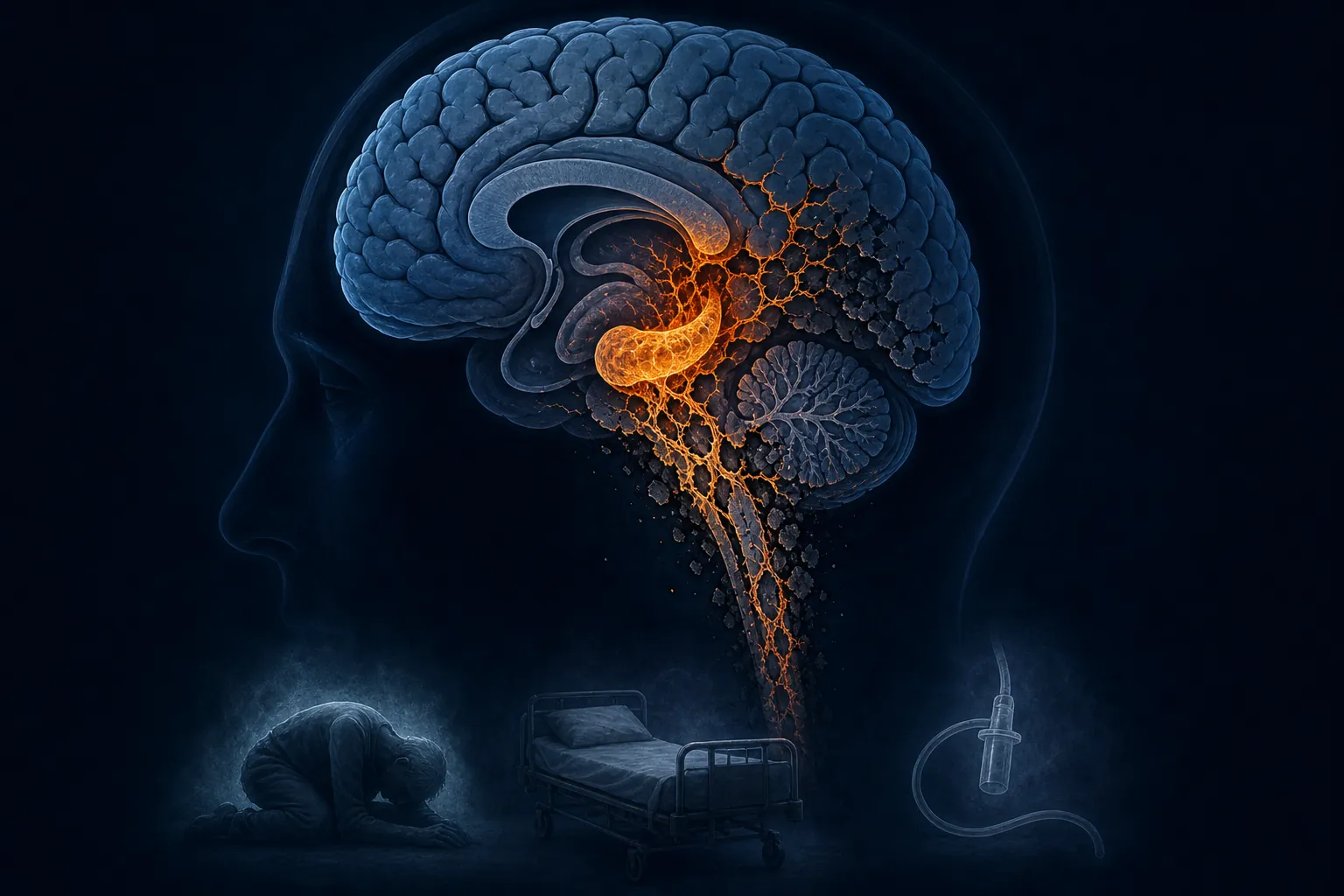
In Alzheimer’s disease, the damage often begins in areas involved in memory, including the hippocampus. As the disease advances, it spreads into wider brain networks and can eventually affect deeper structures, including regions involved in swallowing, breathing, heart rate, and other automatic functions the body normally manages without conscious effort [2][3].
That progression is why late-stage dementia does not look like “worse memory” alone. A person may stop recognizing food as food. They may pocket food in the cheek, forget how to coordinate chewing and swallowing, cough when drinking thin liquids, or breathe food particles and saliva into the airway. They may lose balance, become less able to report pain or burning with urination, or sleep through signs of infection that would have prompted an earlier response years before.
Caregivers often notice these changes as separate chores: thicker drinks, more laundry after incontinence, another call about a urinary tract infection, a new walker, smaller meals, more time spent coaxing sips. Medically, they are often connected. The brain is losing the ability to coordinate functions that keep the person nourished, upright, protected from aspiration, and resilient against infection.
Dying From Dementia and Dying With Dementia Are Not Always Easy to Separate
Families are often told that an older adult “died of pneumonia” or “died of sepsis,” even after years of dementia. That statement may be true about the final medical event. It may also leave out the disease that made the final event likely.
| Phrase | What it usually means |
|---|---|
| Died with dementia | The person had dementia, but another condition may have been the main cause of death. |
| Died from dementia | The dementia was the underlying disease that led to fatal complications or direct neurological decline. |
| Died after a dementia complication | The immediate cause may have been pneumonia, sepsis, dehydration, malnutrition, or injury, while dementia set the chain in motion. |
Death certificates can blur this distinction. The immediate cause of death may be listed as bronchopneumonia, aspiration pneumonia, urinary tract infection, sepsis, or a fall-related injury. Dementia may appear elsewhere on the certificate, or not at all. Verywell Health, discussing research by James and colleagues, reports that Alzheimer’s disease may be listed on death certificates far less often than it contributes to death, by about a sixfold difference in that analysis [4].
This undercounting affects how families understand the illness. If every final complication is treated as separate, dementia can seem like background information instead of the condition that weakened swallowing, mobility, appetite, communication, and recovery.
The Scale Is Large, Even When the Counting Is Imperfect
In the United States, CDC data show 288,436 deaths involving dementia among adults age 65 and older in 2022. That report covers data only through 2022, so it should not be stretched into a claim about 2023 through 2026 trends [5].
The Alzheimer’s Association’s 2026 Facts & Figures report gives another way to see the burden: 1 in 3 older Americans dies with Alzheimer’s or another dementia, and deaths from Alzheimer’s disease increased 134% between 2000 and 2022 [6]. Globally, the World Health Organization identifies dementia as the seventh leading cause of death [7].
Those numbers are not meant to frighten someone into thinking every diagnosis means death is near. Many people live for years with dementia. The point is narrower and more important: dementia belongs among the major life-limiting diseases of older age, and its fatal role is often hidden behind the complication that happens last.
Swallowing Failure Is Often the Turning Point Families Can See
One of the clearest ways dementia becomes fatal is through dysphagia, the medical term for swallowing difficulty. Swallowing looks simple from the outside. Inside the body, it requires timing: the mouth prepares food, the tongue moves it back, the airway closes, the esophagus receives it, and breathing resumes. Advanced dementia can disrupt that sequence.
At home or in a facility, the signs may be quiet at first. A person coughs after water. Meals take much longer. Pills are held in the mouth. Food is pocketed in the cheek. The voice sounds wet after drinking. The person eats less because eating has become tiring, confusing, or frightening. Sometimes there is no dramatic choking episode at all; tiny amounts of saliva, liquid, or food slip into the airway repeatedly.
When material enters the lungs instead of the stomach, bacteria can follow. The result may be aspiration pneumonia, a lung infection caused by inhaled food, fluid, saliva, or vomit. This is one reason pneumonia appears so often near the end of dementia: the disease has damaged the protective coordination that normally keeps the airway clear.
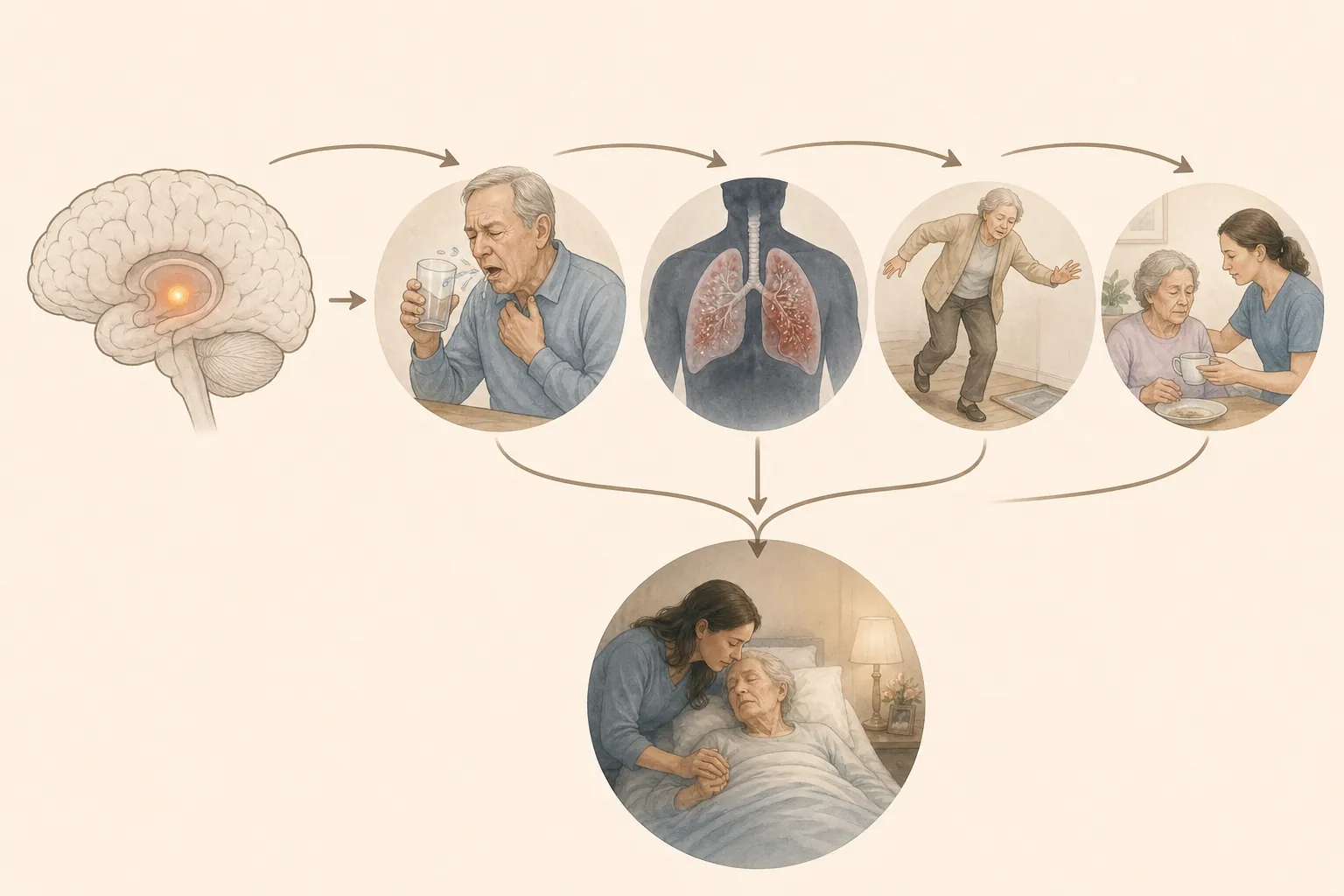
A 2009 study reported bronchopneumonia as the cause of death in 38.4% of patients with dementia disorders in its sample [8]. That figure should not be treated as a timeless rate for every current care setting; treatment practices, documentation, vaccination patterns, and patient populations can change. Still, the pattern it names is familiar and clinically important: lung infection is a common final pathway when dementia has impaired swallowing, coughing, mobility, and immune resilience.
Why Aspiration Pneumonia Can Become Hard to Survive
Aspiration pneumonia is not only dangerous because bacteria enter the lungs. It is dangerous because advanced dementia reduces the person’s reserve. They may not cough strongly. They may not be able to follow instructions for deep breathing. They may be too weak to eat enough during the infection. They may become delirious, bedbound, or dehydrated. Antibiotics may treat bacteria, but they do not restore the brain coordination that allowed the aspiration to happen.
This is the part many caregivers misread as personal failure. They wonder whether they gave the wrong food, missed the first cough, or should have pushed more fluids. Sometimes a technique or diet change helps reduce risk. But in late-stage dementia, swallowing decline can continue despite careful feeding, upright positioning, speech-language evaluation, modified textures, and attentive care. The disease is changing the machinery of swallowing, not merely the menu.
Infections Can Start Small and End Quickly
Pneumonia is not the only infection that becomes more dangerous as dementia advances. Urinary tract infections, skin infections, and bloodstream infections can become harder to detect and harder to recover from. A person who once said, “It burns when I urinate,” may now become sleepier, more agitated, weaker, or less hungry. The symptom has changed because the person’s ability to report it has changed.
Sepsis can develop when the body’s response to infection becomes overwhelming. In advanced dementia, the risk is not only the germ itself. The risk is the surrounding frailty: reduced mobility, incontinence, poor intake, trouble clearing secretions, difficulty cooperating with treatment, and delayed recognition because symptoms are nonspecific.
This is why repeated infections often mark a change in the stage of the illness. One infection may be treated and pass. A pattern of infections, weaker recovery, and less return to the previous baseline tells a different story.
Falls Are Not Just Accidents in Late Dementia
Falls are another way dementia contributes to death, though the chain can be less obvious than with pneumonia. Dementia can affect depth perception, judgment, reaction time, gait, sleep, continence, medication safety, and the ability to use a cane or walker correctly. A person may stand because they need the bathroom but cannot plan the steps to get there safely.
People with dementia are reported to be three times more likely to suffer serious injury from falls. That kind of injury can lead to surgery, immobility, delirium, pain, pressure injuries, pneumonia, or a level of decline from which the person does not regain their former strength.
For caregivers, the practical lesson is not that every fall can be prevented. It is that falls in dementia are often part of the disease’s effect on the brain and body. Supervision, safer layouts, medication review, vision correction, and mobility support can reduce risk, but they cannot always overcome the neurological decline driving unsafe movement.
Malnutrition and Dehydration May Look Like Refusal
Late-stage dementia often changes eating and drinking in ways that are easy to misunderstand. A person may turn away from food, clamp the mouth shut, chew without swallowing, forget what to do with a cup, or sleep through meals. It can look like stubbornness, depression, or a family conflict at the table. Sometimes those factors play a part. Often, the disease itself is reducing appetite, recognition, coordination, alertness, and endurance.
Weight loss can follow even when caregivers offer favorite foods. Dehydration can develop even when a cup is always nearby. The person may no longer experience thirst normally, may not be able to ask, or may cough on thin liquids. As intake falls, weakness increases. Weakness then makes eating, sitting upright, coughing, and recovering from infection even harder.
This is one of the cruel loops of advanced dementia: the body needs calories and fluid to resist infection and maintain strength, while the brain disease is making eating and drinking less possible.
The Disease Itself Can Also Contribute Directly
For many years, families heard dementia described mostly through its complications: pneumonia, infection, falls, dehydration. Those complications remain central. At the same time, neurological decline itself is increasingly recognized as part of the fatal process, especially as the disease reaches brain regions involved in basic regulation [2][3].
Breathing rhythm, heart rate, arousal, swallowing reflexes, and the stress response are not separate from the brain. When a neurodegenerative disease damages the networks that support those functions, the body has less ability to maintain stability. The final decline may not come from one dramatic event; it may come from the loss of several small supports at once.
This helps explain why some people with advanced dementia become bedbound, stop eating and drinking enough, sleep most of the time, and gradually lose the ability to interact. The absence of a single sudden crisis does not mean dementia is uninvolved. It may mean the terminal neurological decline is expressing itself through frailty, reduced intake, and loss of basic regulation.
What This Means for Caregivers Watching the Decline
Understanding dementia as a possible cause of death does not mean giving up on care. It means naming the scale of the illness honestly. A caregiver can still treat pain, prevent avoidable infections, adjust food textures, support mobility, offer companionship, and ask clinicians about comfort-focused choices. But those efforts sit inside a disease process that may continue despite good care.
For someone early in the diagnosis, it may be more useful to start with a practical first month plan, such as the adult child caregiver first-30-days action plan. Families already seeing functional changes may need the middle-stage dementia caregiving guide or the middle-stage Alzheimer’s planning guide. When the question becomes whether home care, assisted living, or memory care can meet the person’s needs, the home care, assisted living, and memory care continuum guide can help frame that decision.
Not every dementia follows the same pattern. Lewy body dementia, vascular dementia, frontotemporal dementia, and mixed dementias can bring different symptoms and risks. Families comparing patterns can continue with an overview of Lewy body dementia in seniors, while still holding onto the larger point: progressive dementia can become fatal through the body systems the damaged brain can no longer protect.
When the final diagnosis is pneumonia, sepsis, a fall injury, dehydration, or malnutrition, it is reasonable to ask what made that event so hard to survive. In many elderly people, the answer is dementia. Recognizing that does not erase the care that was given. It often helps families understand that the coughing, infections, weight loss, falls, and fading strength were not separate failures. They were part of the disease reaching the body.
References
- How does dementia cause death? Alzheimer’s Research UK.
- Understanding How Dementia Causes Death Columbia University Department of Neurology.
- Ask the Doctors: What is the cause of death in Alzheimer’s disease? UCLA Health.
- What Causes Death in People With Alzheimer’s Disease? Verywell Health.
- Mortality in Adults Age 65 and Older With Dementia: United States, 2018–2022 CDC National Center for Health Statistics, 2024.
- 2026 Alzheimer’s Disease Facts and Figures Alzheimer’s Association, 2026.
- Dementia World Health Organization.
- Causes of death in patients with dementia disorders PubMed, 2009.
Related reading
Noticed something outdated or inaccurate on this page? Flag a correction. We review every report against CDC, NIA, and AARP HomeFit guidance before updating a page.
Part of the Fall Prevention section.