
Managing Your Health While Caring for a Spouse with Dementia
Spousal dementia caregivers are at high risk for worsening health. This article provides evidence-based strategies to manage your own chronic conditions while caring for your partner.
Caregiving for a spouse with dementia changes the household, but it should also change the way the caregiver is treated medically. If you are the one filling the pillbox, answering the same question for the eighth time, driving to appointments, cooking around swallowing problems, and sleeping lightly because your husband or wife may get up at night, you are not only a caregiver. You are also a patient with your own risks, symptoms, refills, test results, and appointments.
That distinction matters because the health decline among spousal dementia caregivers is not just a vague story about stress. In a longitudinal study of 977 spousal caregivers in Great Britain, 73.2% already had at least one chronic health condition at the start of the study. After 24 months, that figure rose to 82.3%. The average number of chronic conditions increased from 1.5 to 2.1 over the same period.[1]

Those numbers put plain language around a pattern many families recognize too late. Blood pressure checks slide. Arthritis pain is explained away as “just age.” Shortness of breath is postponed until after the next neurology visit. Depression is mistaken for irritability, weakness, or a bad attitude. Meanwhile, the spouse with dementia has a chart full of notes, while the caregiver’s own diagnoses become background noise.
The caregiver’s medical chart still matters
The IDEAL programme data are useful because they follow caregivers over time rather than taking a single snapshot. Hypertension affected about one in three spousal caregivers. Joint inflammation affected about one in four. A cancer history was reported by about 12%.[1] These are not small inconveniences when a person is also lifting laundry, helping with bathing, managing agitation, driving, shopping, sorting mail, and keeping another adult safe.
The same study found that spousal caregivers providing 10 or more hours of care each day reported significantly more health conditions than those providing less than one hour per day. It also documented a downward pattern: as caregiver health conditions increased, stress rose and social networks shrank.[1] That is the part families need to take seriously before a fall, hospitalization, medication error, or blood pressure crisis forces everyone to take it seriously.

The study was conducted in Great Britain and involved a predominantly white sample, so it cannot speak perfectly for every U.S. household, especially families facing racial, economic, transportation, or access barriers not fully reflected in the data. It may also underrepresent younger spousal caregivers in their 50s and early 60s. Still, the main pattern is not fragile: many spousal dementia caregivers begin caregiving with chronic illness already present, and more illness accumulates during the caregiving years.[1]
Other research points in the same direction. In the Caregiving Transitions Study, 27% of spousal caregivers reported fair or poor health, compared with 15% of non-spousal caregivers. Dementia caregivers were also about twice as likely as non-dementia caregivers to say caregiving worsened their health, 33.9% compared with 15.4%.[2] The CDC reports that about 40% of dementia caregivers experience depression, compared with 5% to 17% of non-caregivers of the same age.[3] The Family Caregiver Alliance reports that 45% of those caring for a spouse or parent report high stress, compared with 35% for other relatives and 18% for non-relatives.[4]
Self-care is too small a plan
A cup of tea, a walk, prayer, music, or quiet time may help a hard day feel survivable. None of that replaces a health-management system. For an older spouse with hypertension, joint disease, heart disease, diabetes, depression, or a cancer history, “take care of yourself” is too vague to be useful.
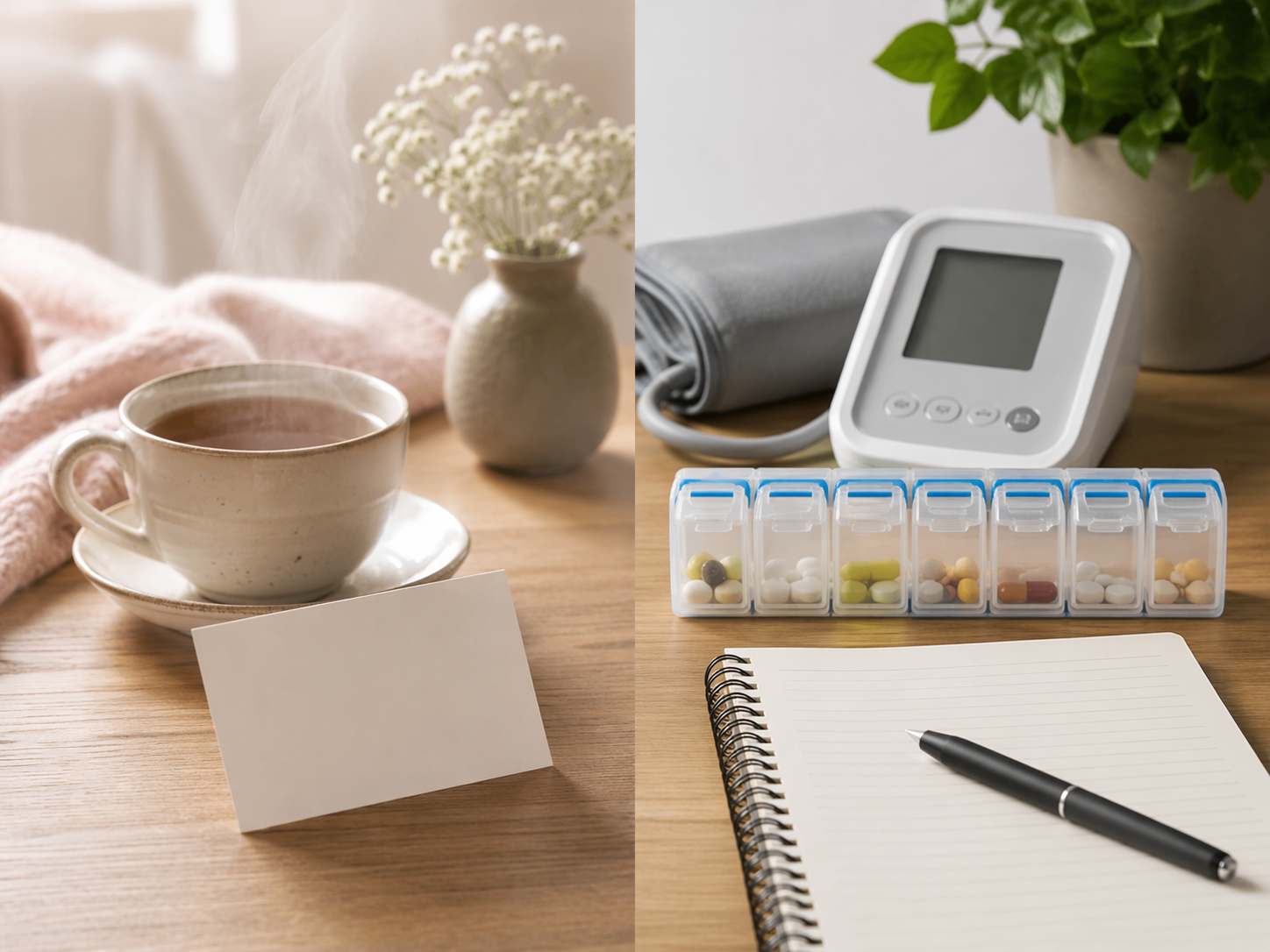
Self-management is more concrete. It means your refill date is visible. Your appointment is on the same calendar as your spouse’s memory clinic visit. Your blood pressure readings, chest symptoms, pain flares, sleep loss, and mood changes are written down often enough that a clinician can act on them. It means the household routine protects two patients, not one.
| If the usual advice says | A health-management version sounds like |
|---|---|
| Take a break when you can. | Arrange coverage so you can keep your cardiology, primary care, therapy, or lab appointment. |
| Eat better and rest. | Plan meals and medication timing around your own diagnoses, not only your spouse’s preferences. |
| Ask for help. | Ask someone to sit with your spouse during the exact hour needed for a blood pressure check, refill pickup, physical therapy visit, or sleep recovery. |
| Watch your stress. | Track symptoms that stress can worsen: blood pressure, chest discomfort, pain, dizziness, missed doses, crying spells, or loss of interest. |
That difference may sound fussy until a caregiver misses three of their own doses in a week because the spouse’s evening agitation takes over the house. A routine that is too delicate for an ordinary Tuesday is not a routine. It has to work when the spouse refuses a shower, the pharmacy line is long, and nobody else is coming until Saturday.
Keep your own appointments on the protected list
A spouse with dementia can have frequent medical, dental, therapy, and care-planning needs. Those appointments can swallow the calendar. The caregiver’s appointments need a different status: not optional, not “if things calm down,” and not automatically sacrificed when there is a conflict.
Start by putting your own standing medical needs into one visible place: primary care visits, blood work, blood pressure checks, cardiology follow-ups, physical therapy, counseling, eye exams if you drive, and medication reviews. If your spouse’s care calendar is electronic, yours belongs there too. If the household uses a paper calendar on the refrigerator, use that. The tool matters less than the rule: your medical care is not kept in your head.
When an appointment is scheduled, decide the coverage plan immediately. That may mean asking an adult child, neighbor, church member, paid aide, senior center program, or respite service for a specific block of time. A general “I may need help sometime” is easy for everyone to forget. “I need someone here from 9:30 to 11:30 on Tuesday so I can see my doctor” is harder to misunderstand.
Not every caregiver has reliable family, paid help, or affordable respite. That reality should not be brushed aside. If coverage is thin, tell your clinician plainly: “I am caring for my spouse with dementia, and I am missing my own care because I cannot leave safely.” That statement belongs in your medical record. It may open practical options, such as telehealth when appropriate, home blood pressure logs, combined lab orders, longer prescription fills, social work referrals, or timing appointments around an aide’s visit.
Make medication adherence harder to disrupt
Many caregivers manage their spouse’s medicines with care and precision while their own bottles sit wherever they last landed. That is not neglect in the moral sense. It is what happens when one person’s routine has become the household’s emergency system.
Your medicines need the same engineering as your spouse’s. Use a weekly organizer if it is safe for your medications. Keep your organizer separate enough to avoid mix-ups, but close enough to the daily routine that it is not forgotten. If you give your spouse morning pills with breakfast, place your own medication step beside that habit unless a clinician has told you to take it at another time. If evenings are the worst part of the dementia day, do not depend on memory alone for an evening dose. Use a phone alarm, a written checklist, or a pharmacy blister pack.
- Keep an updated medication list for yourself, not only for your spouse.
- Ask the pharmacist whether refill dates can be synchronized.
- Mark missed doses instead of guessing later.
- Tell your clinician if caregiving tasks are causing missed doses.
- Store your spouse’s medications and your own in a way that prevents accidental swapping.
Medication adherence is not a character test. It is a design problem. The more exhausted the caregiver, the more the system has to carry.
For hypertension and heart disease, track what a clinician can use
Hypertension was one of the most common chronic conditions in the IDEAL spousal caregiver group, affecting about one in three caregivers.[1] That matters in dementia care because the caregiver’s day can be full of triggers: interrupted sleep, rushed meals, lifting or steadying a spouse, missed medication, conflict around bathing, and long stretches without sitting down.
If you have high blood pressure, heart disease, a history of stroke, rhythm problems, or heart failure, ask your clinician what to monitor at home and what readings or symptoms require a call. Do not build your own danger thresholds from memory or from someone else’s numbers. The useful habit is not constant checking; it is consistent checking at the interval your clinician recommends, with readings recorded clearly enough to guide care.
A simple log can include the date, time, blood pressure if relevant, pulse if requested, missed medication, poor sleep, dizziness, swelling, chest discomfort, unusual shortness of breath, and what was happening that day. The point is not to prove that caregiving caused a symptom. The point is to stop symptoms from floating around unreported until they become urgent.
If transportation is the weak link, say so early. A clinician cannot fix every access problem, but they can sometimes adjust follow-up timing, use home readings, order labs closer to home, or connect you with care management. Silence makes missed visits look like personal choice when they may be a caregiving constraint.
For arthritis and joint pain, change the task before the joint pays for it
Joint inflammation affected about one in four spousal caregivers in the IDEAL data.[1] In the home, joint pain often gets treated as the price of devotion. That is poor planning. Pain changes gait, grip, sleep, patience, and fall risk. It can also make a caregiver delay the very activities that keep them functioning, such as physical therapy or appropriate movement.
The first adjustment is to stop turning every care task into a test of strength. Sit for dressing tasks when possible. Use clothing that reduces tugging and twisting. Keep frequently used items between shoulder and knee height. Use a shower chair or grab bars when recommended, not as symbols of decline but as tools that protect both people. If your spouse resists help, simplify the task rather than wrestling through it.
Pain tracking should be plain and short: where it hurts, what task worsens it, what helps, whether it interferes with sleep, and whether it makes caregiving unsafe. Bring that information to your clinician. “My hands hurt” is true. “Buttoning his shirt and opening pill bottles are making my hand pain worse, and I am dropping things” gives the care team something to work with.
Depression is a medical signal, not a personality change
Depression in dementia caregiving deserves direct attention, but it should not be allowed to crowd out the rest of the caregiver’s medical needs. The CDC reports that about 40% of dementia caregivers experience depression, compared with 5% to 17% of non-caregivers of the same age.[3] That is not a small mood dip. It is a common medical problem in this caregiving population.
Older spouses may describe depression without using the word. They may say they have no patience left, no appetite, no interest in church or friends, no sleep, no reason to get dressed, or no ability to make one more phone call. Some become tearful. Some become flat. Some become angry. None of those signs should be dismissed as a normal part of being married to someone with dementia.
The practical step is to report symptoms in medical language. Tell your primary care clinician if you have persistent sadness, loss of interest, changes in sleep or appetite, hopelessness, panic, thoughts of self-harm, or the feeling that you cannot safely continue. If you already take medication for depression or anxiety, missed doses, side effects, and worsening symptoms need review. If counseling is not reachable in person, ask about telehealth, caregiver-focused services, or local programs that understand dementia care.
If thoughts of self-harm or harm to someone else are present, that is urgent. In the U.S., call or text 988 for immediate crisis support, or call emergency services if there is immediate danger.
Use help to protect medical follow-through, not just to feel less alone
Social support is often presented as comfort, and sometimes it is. For a spousal caregiver with chronic illness, it also has a medical purpose. The IDEAL study linked increasing caregiver health conditions with shrinking social networks and higher stress.[1] When the circle gets smaller, there are fewer people to notice the caregiver limping, coughing, forgetting words from exhaustion, skipping meals, or missing appointments.
Ask for help in units that match the health task. Someone who cannot manage a whole afternoon may still be able to sit in the house during a telehealth visit. A neighbor may pick up a refill. An adult child may handle insurance calls once a month. A friend may drive you to physical therapy. A faith community volunteer may stay for one hour while you get blood work. These are not grand rescues. They are small supports placed where the medical routine breaks.
When family members ask what you need, avoid answering only with “I’m fine” if you are not fine. Try one concrete sentence: “I need help keeping my own doctor’s appointments.” Or: “I need someone else to take over groceries because my knees are getting worse.” Or: “I need one person to learn his evening routine so I can sleep before my cardiology visit.” Specific requests do not guarantee help, but they give others a real job instead of a feeling.
Bring your caregiving workload into your own medical visits
A clinician treating your blood pressure, arthritis, heart disease, sleep, or depression needs to know what your day actually requires. “I am under stress” is less useful than “I provide care more than 10 hours a day,” “I cannot leave my spouse alone,” “I am getting up three times a night,” or “I missed two doses this week because evening care became unmanageable.” The IDEAL findings make clear that longer daily care is associated with more caregiver health conditions, so the amount of care is medically relevant information, not family background.[1]
- How many hours a day you provide hands-on or supervisory care.
- Whether your spouse can be left alone safely.
- How often your sleep is interrupted.
- Which of your appointments, medications, or therapies caregiving has disrupted.
- Which symptoms you are ignoring because your spouse’s needs feel more urgent.
This is also the place to ask whether your own care plan can be simplified. That might mean reviewing medications for side effects, consolidating appointments when safe, ordering needed labs together, using home monitoring, updating vaccines, arranging physical therapy around caregiving demands, or documenting caregiver strain so referrals are easier to justify. The answer will differ by diagnosis. The important part is that your clinician is not treating an imaginary patient with free afternoons and steady sleep.
Know when the home plan is exceeding one person’s body
There is a point where better organization is not enough. If your spouse needs constant supervision, resists essential care, wanders, becomes physically unsafe, or requires lifting you cannot do, your own medical vulnerability becomes part of the safety calculation. A caregiver with worsening heart symptoms, uncontrolled blood pressure, severe joint pain, untreated depression, or repeated missed medications cannot safely be treated as an unlimited resource.
That does not automatically mean a move out of the home is required. It does mean the care team should discuss added home care, adult day services, respite, equipment, transportation support, family scheduling, or a higher level of care if the spouse’s needs have outgrown what one medically vulnerable person can carry. Waiting until the caregiver collapses is not a care plan.
The health plan belongs inside the dementia plan
The pattern in the evidence is plain enough to act on: chronic conditions become more common among spousal dementia caregivers over time, the average number of conditions rises, longer daily care is associated with more health problems, and worsening caregiver health is tied to higher stress and smaller social networks.[1] That is not a prediction that every caregiver must decline. It is a warning about a trajectory that should be interrupted early.
Monitoring, appointments, medication routines, symptom tracking, and specific requests for help are not extras added after the “real” dementia care is done. They are part of the dementia care plan because the spouse with dementia depends on a caregiver whose body and mind are also under medical strain. The caregiver’s chart still matters. The caregiver’s refills still matter. The caregiver’s pain, breathlessness, blood pressure, sleep, and depression symptoms still matter.
Bring that fact to your clinician, your family, and anyone helping with care: there are two patients in this household, and one of them has been doing the paperwork for both.
References
- Health conditions and their relationship with the caregiver stress process in spousal caregivers of people with dementia: findings from the IDEAL programme, BMC Geriatrics, 2024
- Caregiving Transitions and Health Outcomes in Older Adults, National Library of Medicine
- About Caregiving, CDC
- Caregiver Statistics: Health, Technology, and Caregiving Resources, Family Caregiver Alliance
Related reading
Noticed something outdated or inaccurate on this page? Flag a correction. We review every report against CDC, NIA, and AARP HomeFit guidance before updating a page.
Part of the Fall Prevention section.