
What is tau protein and how does it drive memory loss in aging?
Tau protein tangles follow a predictable pattern through the brain that directly mirrors the memory loss families witness in Alzheimer's disease. This guide explains the biology, new blood tests that detect tau years early, and what recent drug trial results mean for your family.
A family usually meets the word tau at an uncomfortable moment. A parent is repeating a question that was answered ten minutes ago. A familiar recipe suddenly has missing steps. A neurology report mentions Alzheimer’s biomarkers, or a headline says a blood test can find tau years before symptoms. Then everyone around the kitchen table wants the same thing: a clear explanation that does not turn fear into either false comfort or false certainty.
Tau protein matters because it sits close to the kind of memory loss families actually see. It is not the whole Alzheimer’s story, and it is not simply a “bad protein.” In healthy neurons, tau helps hold the cell’s internal transport system together. In Alzheimer’s disease, some tau becomes abnormally changed, detaches, clumps into tangles, and spreads through brain regions in a pattern that often matches the movement from subtle memory trouble to broader cognitive decline.
Tau starts as part of the brain’s support system
Inside a neuron, tau’s normal job is structural. Neurons are long, delicate cells, and they need an internal transport network to move nutrients and other materials from one end of the cell to the other. A helpful way to picture this is a rail line inside the nerve cell. The microtubules are the tracks; tau helps stabilize them so cargo can keep moving.
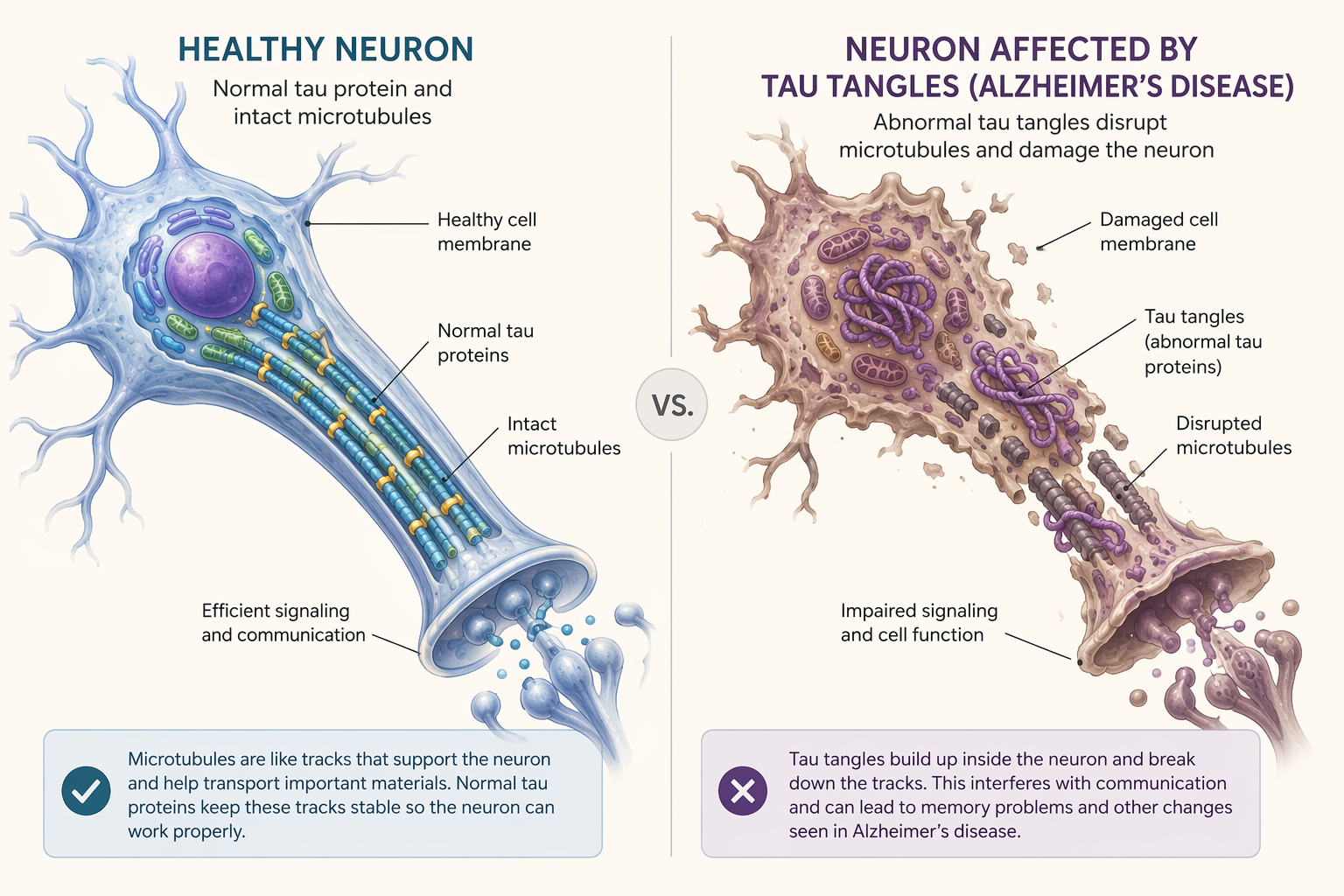
The problem begins when tau is chemically altered in ways that make it detach from that support structure. One of the most important changes is phosphorylation, a normal cellular process that becomes excessive in Alzheimer’s disease. A review in Cell Death & Disease describes tau phosphorylation as elevated about 3- to 4-fold in Alzheimer’s brains compared with healthy brains, while activity of PP2A, an enzyme that helps remove phosphate groups from tau, is decreased by about 50% in Alzheimer’s brains.[1]
Those numbers do not mean a family should memorize enzyme names. They mean the Alzheimer’s brain is not dealing with ordinary tau doing ordinary work. It is dealing with tau that has shifted out of its stabilizing role and into a form more likely to misfold, aggregate, and damage the neuron’s ability to survive.
Why tau is so closely tied to memory loss
The most useful thing to know about tau protein and memory loss in aging is that tau tangles do not appear randomly across the brain. In Alzheimer’s disease, they tend to move through a recognizable sequence. The Braak staging framework describes tau pathology spreading from early regions that include the brainstem and then into the entorhinal cortex, the hippocampus, and eventually wider areas of the cerebral cortex.[2]
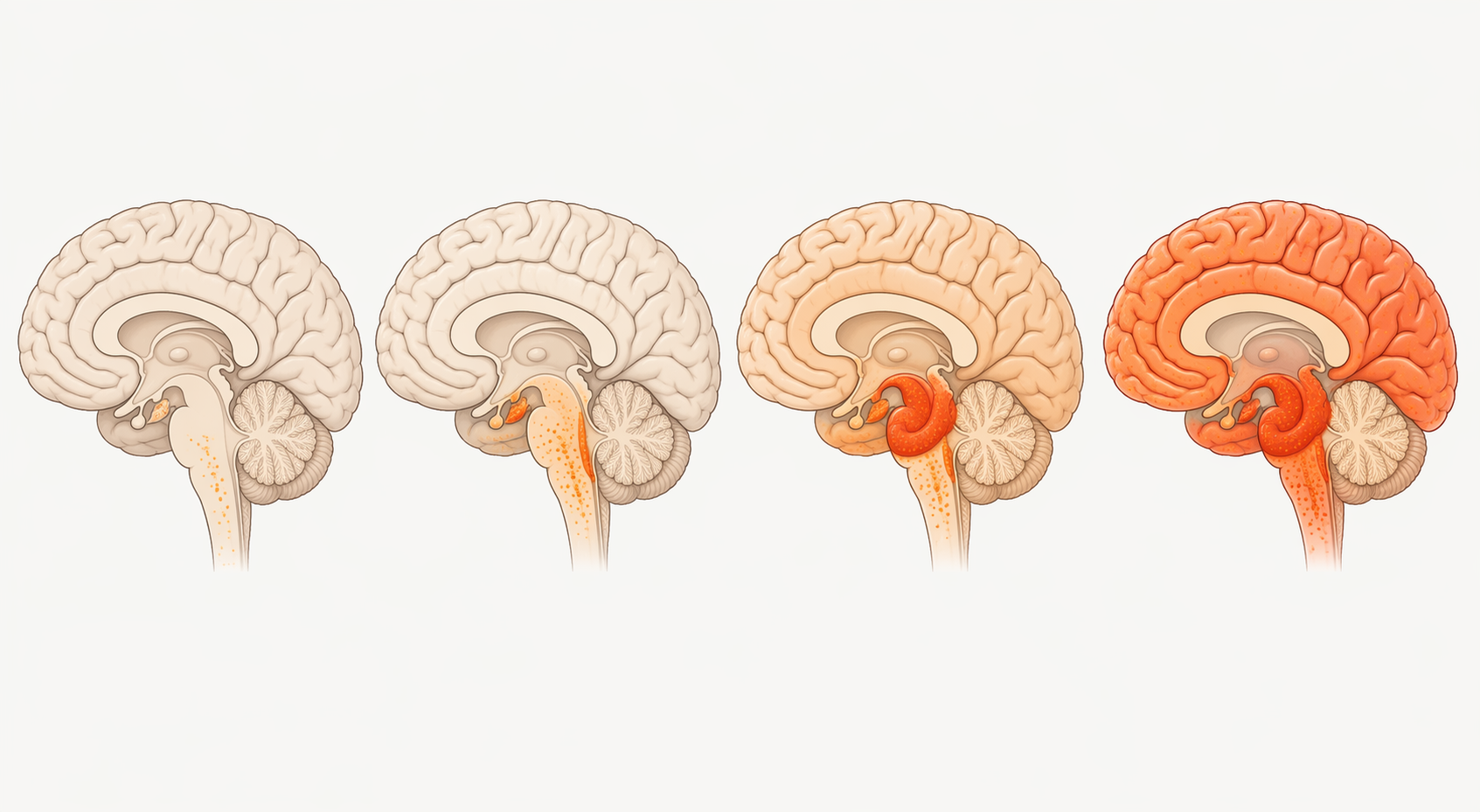
That route matters because the entorhinal cortex and hippocampus are deeply involved in forming and retrieving new memories. The hippocampus is not a filing cabinet in the simple sense, but families can think of it as one of the brain’s key systems for making today’s experiences available tomorrow. When tau tangles reach this network, the first obvious losses often involve recent conversations, appointments, names, directions, and newly learned routines.
This is why early Alzheimer’s can look so uneven. A parent may still tell old family stories with confidence but forget that the same grandchild called that morning. Older memories may have been laid down and reinforced over many years. Newer memories depend heavily on systems that tau pathology often reaches early.
As tau pathology spreads beyond the memory network into broader parts of the cerebral cortex, the difficulties can widen. Families may notice trouble with planning, word finding, judgment, visual-spatial tasks, or completing a sequence of steps. The biology does not make every person’s symptoms identical, but it helps explain the painful pattern many families recognize: memory problems first, then a gradual expansion into the skills that make independent life possible.
| Where tau tangles are moving | What families may notice |
|---|---|
| Early affected regions before clear memory symptoms | A person may seem mostly like themselves, or changes may be too subtle to separate from stress, sleep problems, medication effects, or normal aging. |
| Entorhinal cortex and hippocampus | New information becomes harder to store and retrieve: repeated questions, missed recent events, getting turned around in familiar routines. |
| Wider cerebral cortex | Problems may broaden into language, planning, judgment, visual-spatial skills, and daily task sequencing. |
This is also where families need a careful distinction. Normal aging can bring slower recall, occasional misplaced items, or needing more time to remember a name. Some tau accumulation can occur with aging. Alzheimer’s disease involves pathological changes such as hyperphosphorylated tau tangles, along with other disease processes, and those changes are interpreted in the context of symptoms, exam findings, imaging, fluid or blood biomarkers, and the person’s overall medical picture.
Amyloid may start the fire, but tau is closer to the burned tissue
For years, Alzheimer’s public discussion has often centered on amyloid plaques. Amyloid matters. It can appear early and is still considered part of the disease cascade. But amyloid does not explain symptoms as directly as families might assume. Stanford Medicine put the distinction plainly: “some people have plenty of amyloid but normal cognition.”[2]
Tau tends to track more closely with the damage families witness. Washington University researchers have described the relationship in stark terms: “where tau tangles appear, brain tissue dies.”[3] That does not mean tau acts alone. It means that when a family is trying to understand why memory and thinking are changing now, tau often sits nearer to the visible clinical problem than amyloid plaque burden does.
One bridge between amyloid and tau may involve microglia, the brain’s immune cells. Washington University research reported that faltering microglia, connected with the Alzheimer’s risk gene TREM2, may help explain how amyloid buildup tips into tau tangle formation and brain decline.[3] This is not a reason for families to start chasing immune explanations on their own. It is a reminder that Alzheimer’s biology is a network, not a one-protein courtroom where amyloid and tau compete for blame.
What tau blood tests can and cannot tell a family in 2026
The reason tau is suddenly showing up in ordinary medical conversations is not only because scientists understand it better. It is because newer blood tests can measure forms of phosphorylated tau, especially p-tau217, that are associated with Alzheimer’s pathology. A 2024 JAMA Neurology study reported that p-tau217 blood testing could detect Alzheimer’s pathology with performance comparable to established biomarker methods such as PET imaging, and the FDA cleared an Alzheimer’s blood test in 2025.[4]
That is a major practical change, but it is not the same thing as a home diagnosis. A blood test result is one piece of evidence. It must be interpreted with the person’s symptoms, age, medical history, medications, neurological exam, and sometimes imaging or spinal fluid testing. A positive biomarker in someone without symptoms does not carry the same meaning as the same biomarker in someone with progressive memory loss.
For families, the useful question is not “Can we order this ourselves?” It is: “Would a p-tau217 or other Alzheimer’s biomarker test clarify what is causing these symptoms, and would the result change what we do next?” That question belongs in a clinician’s office, especially because treatable causes of memory problems—sleep disorders, depression, medication side effects, thyroid disease, vitamin deficiencies, infections, and others—can mimic or worsen cognitive decline.
The 2026 tau drug result is important, but it is not a cure
In May 2026, Biogen reported phase 2 CELIA trial results for diranersen, also known as BIIB080, an antisense oligonucleotide designed to lower tau production. Gladstone Institute described the result as the first randomized human study showing that lowering tau can slow cognitive decline in Alzheimer’s disease.[5]
That is why researchers are paying attention. Until now, tau has been an attractive target with a frustrating treatment record. A human randomized study that moves cognition in the right direction is a proof of concept: it supports the idea that tau is not just a marker of damage but a target worth trying to change.
Families should hold that hope with both hands open. The reported result was still phase 2, not routine care. The research community still needs full data, dose details, effect sizes, safety information, longer follow-up, and confirmation in larger studies before anyone can treat it as an available answer. The most honest version is neither “a cure is here” nor “nothing matters until a cure arrives.” It is that lowering tau in people has now shown a signal researchers had been waiting for.
Tau is not always harmful, and Alzheimer’s is not the only tau disease
The simplest story says tau is good until it turns bad. Even that is a little too simple. Research published in 2026 reported that phosphorylation at a specific tau site, T205, was important for encoding long-term memories in mice. Mice without that phosphorylation had normal short-term memory but impaired long-term memory; the memories appeared to be present but inaccessible.[6]
That mouse finding should not change a family’s decisions today. It does, however, protect us from a childish version of the biology. The goal is not to erase tau from the brain. Tau has normal jobs. The problem in Alzheimer’s is pathological tau behavior: abnormal modification, misfolding, aggregation, spread, and the damage that follows.
Tau pathology also appears outside Alzheimer’s disease, including chronic traumatic encephalopathy and some forms of frontotemporal dementia. That is one reason symptoms and biomarkers have to be interpreted by clinicians rather than matched to a single internet explanation. The same protein family can be involved in different diseases, with different patterns and consequences.
Other tau-related findings are worth watching without over-reading. Temple University researchers reported in 2025 that tau can weaken the brain’s vascular defenses, adding another possible route by which tau contributes to Alzheimer’s-related injury.[7] In July 2026, researchers reported that SORLA, a natural brain protein, could block toxic tau tangle formation in mouse models; mice with extra SORLA had less brain atrophy.[8] These findings point toward possible treatment directions, but they are not clinical tools for families yet.
Questions worth bringing to the next appointment
A family does not need to become fluent in molecular neurology to use this information well. The useful work is more practical: connect the biology to the symptoms, understand what a test can add, and avoid making one biomarker carry more meaning than it can bear.
- Do these symptoms look like normal age-related forgetfulness, mild cognitive impairment, Alzheimer’s disease, or another cause of cognitive change?
- Would Alzheimer’s biomarker testing, including p-tau217 blood testing if appropriate, change diagnosis, treatment options, or planning?
- Are there reversible or contributing problems that should be checked before assuming a neurodegenerative disease is the main explanation?
- If amyloid or tau biomarkers are abnormal, how do they fit with the person’s actual symptoms and daily function?
- Are any clinical trials or approved treatments relevant for this person’s stage of disease and overall health?
Understanding tau will not make a frightening memory evaluation easy. It can make it less foggy. Tau helps explain why new memories are often affected early, why amyloid and tau tests are not interchangeable, why a blood test is a clinical clue rather than a stand-alone diagnosis, and why the 2026 treatment news matters without settling the future. Families can carry that understanding into the appointment room without pretending to be neurologists, and without letting headlines do the thinking for them.
References
- Role of tau phosphorylation in Alzheimer’s disease and related tauopathies, Cell Death & Disease
- Rethinking Alzheimer’s: The case for targeting tau protein, Stanford Medicine, September 2025
- Alzheimer’s missing link ID’d, answering what tips brain’s decline, Washington University School of Medicine
- Plasma Phosphorylated Tau 217 in Alzheimer Disease, JAMA Neurology, 2024
- Turning the Tide on Tau: A Q&A With Gladstone’s Lennart Mucke, Gladstone Institutes, July 2026
- Tau Protein Is Crucial for Encoding Long-Term Memory, Lifespan.io, May 2026
- Scientists uncover how tau protein weakens the brain’s vascular defenses in Alzheimer’s disease, Temple University, April 2025
- Natural brain protein blocks toxic tau tangles in Alzheimer’s disease, ScienceDaily, July 18, 2026
Related reading
Noticed something outdated or inaccurate on this page? Flag a correction. We review every report against CDC, NIA, and AARP HomeFit guidance before updating a page.
Part of the Fall Prevention section.