
Tropical Storm Preparedness Checklist for Seniors at Home
Most storm checklists ignore fall risks, and most fall-prevention checklists assume normal conditions. This room-by-room guide combines both so seniors can shelter safely without creating new hazards from darkness, clutter, wet floors, or disrupted medications.
A tropical storm preparedness checklist for seniors at home has to do more than put water, batteries, and paperwork in one place. For an older adult sheltering in place, the same hallway that needs to hold emergency supplies also has to stay clear enough for a walker at 2 a.m. The same bathroom that needs towels for leaks becomes more dangerous if those towels slide underfoot. The same bedroom that feels familiar in daylight can become a fall zone when the power goes out.
Tropical storms and hurricanes are different wind categories, but the home-preparation work overlaps enough that most household safety steps are the same: protect against wind, rain, flooding, outage, heat, medication disruption, and delayed help. CDC hurricane and tropical storm guidance puts the emphasis on preparing before conditions deteriorate, staying safe during the storm, and avoiding hazards afterward.[1] For seniors, that preparation should start with one rule: do not move a single supply box into the house until the walking routes are protected.
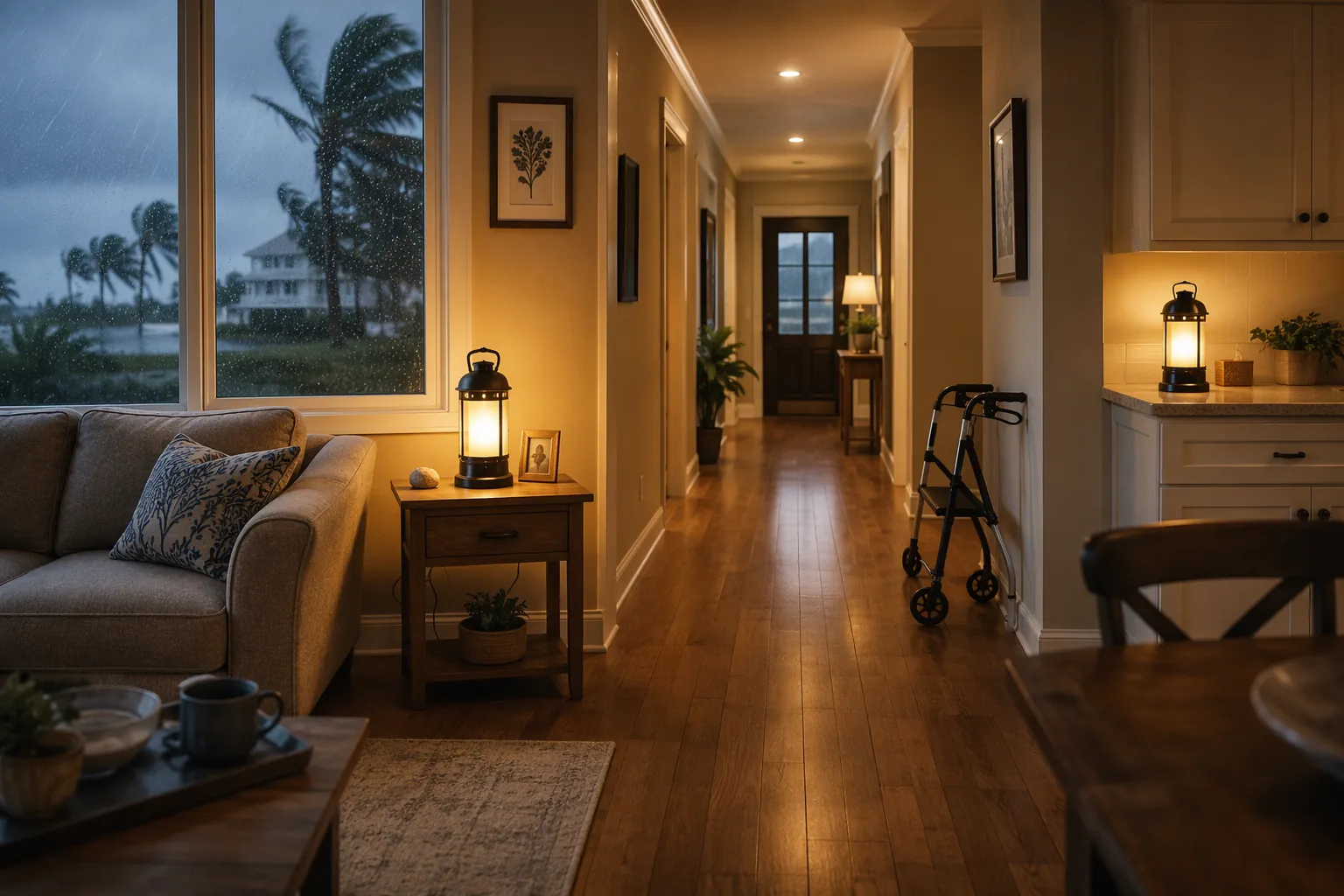
The reason is not fussy housekeeping. Falls are the leading cause of injury death among adults 65 and older; CDC reports more than 38,000 fall deaths in 2021 and nearly 3 million emergency department visits each year among older adults.[2] Storm conditions add the exact triggers fall-prevention work tries to remove: darkness, wet floors, extension cords, loose rugs, shifted furniture, debris, and rushed movement.
The medical side matters just as much. Ready.gov advises older adults to plan for medicines, medical devices, assistive equipment, and support networks before an emergency.[3] That is not a side note when about 80% of older adults have at least one chronic condition.[4] A storm plan that protects the pantry but leaves oxygen equipment, a CPAP machine, insulin, mobility aids, or morning medications stranded across a dark room is not finished.
Start With the Three Fixes That Change Every Room
Before the room-by-room pass, make three decisions that will keep the rest of the checklist honest. They are simple, but they prevent many of the mistakes that happen when families prepare in a hurry.
- Put battery-powered lighting where the fall risk is, not just where the supply kit is. At minimum, place lights at the bedside, bathroom, hallway route, kitchen, and main exit. Ready.gov specifically recommends keeping a flashlight by the bed in case the power goes out.[5]
- Clear pathways before supplies come inside. If a case of water, cooler, generator cord, or evacuation bag narrows the path from bed to toilet, it belongs somewhere else.
- Make a backup-power and temperature plan for anything medical. That includes powered devices, refrigerated or temperature-sensitive medications, hearing aids, phone charging, and medical alert equipment.
This is where many tidy emergency kits fail. A box stored in the garage may be organized, labeled, and useless if the older adult has to cross a dark, wet, or cluttered path to reach it. The better question is not, “Do we have it?” It is, “Can the person who needs it reach it safely when the lights are out?”
A Printable Room-by-Room Checklist
| Area | Storm preparation | Fall-prevention check |
|---|---|---|
| Bedroom | Place a charged phone, flashlight or lantern, glasses, hearing aids, medications, water, and mobility aid within reach of the bed. | Keep the path from bed to bathroom completely clear; remove loose rugs, cords, low baskets, and supply boxes. |
| Bathroom | Set a battery light on the counter before the outage; store towels and cleanup supplies within reach but off the walking path. | Use non-slip surfaces; do not leave towels on the floor unless they are secured and necessary for an active leak. |
| Kitchen | Stage drinking water, shelf-stable food, manual can opener, medication cooler, and appliance thermometer where they can be reached safely. | Keep water cases, coolers, pet food, and trash bags out of the main walking lane. |
| Medication area | Group routine medicines, backup lists, dosing instructions, and emergency contacts in one reachable place. | Avoid moving daily medications to a high shelf, deep cabinet, garage, or dark room during storm prep. |
| Hallways and stairs | Add battery lighting at both ends; secure handrails; keep shoes or sturdy slippers nearby. | Remove extension cords, boxes, loose runners, folding chairs, and stored storm supplies from the route. |
| Entryway | Keep keys, ID, insurance papers, phone charger, mobility aids, and go-bag near the exit without blocking it. | Check that the door can open fully and that the threshold will not become slick or cluttered. |
| Garage, shed, and outdoor storage | Secure outdoor furniture, fuel, tools, and storm panels before winds arrive. | Do not make the older adult retrieve heavy items from wet, dark, or uneven storage areas during the storm. |
Bedroom: Protect the First Steps Out of Bed
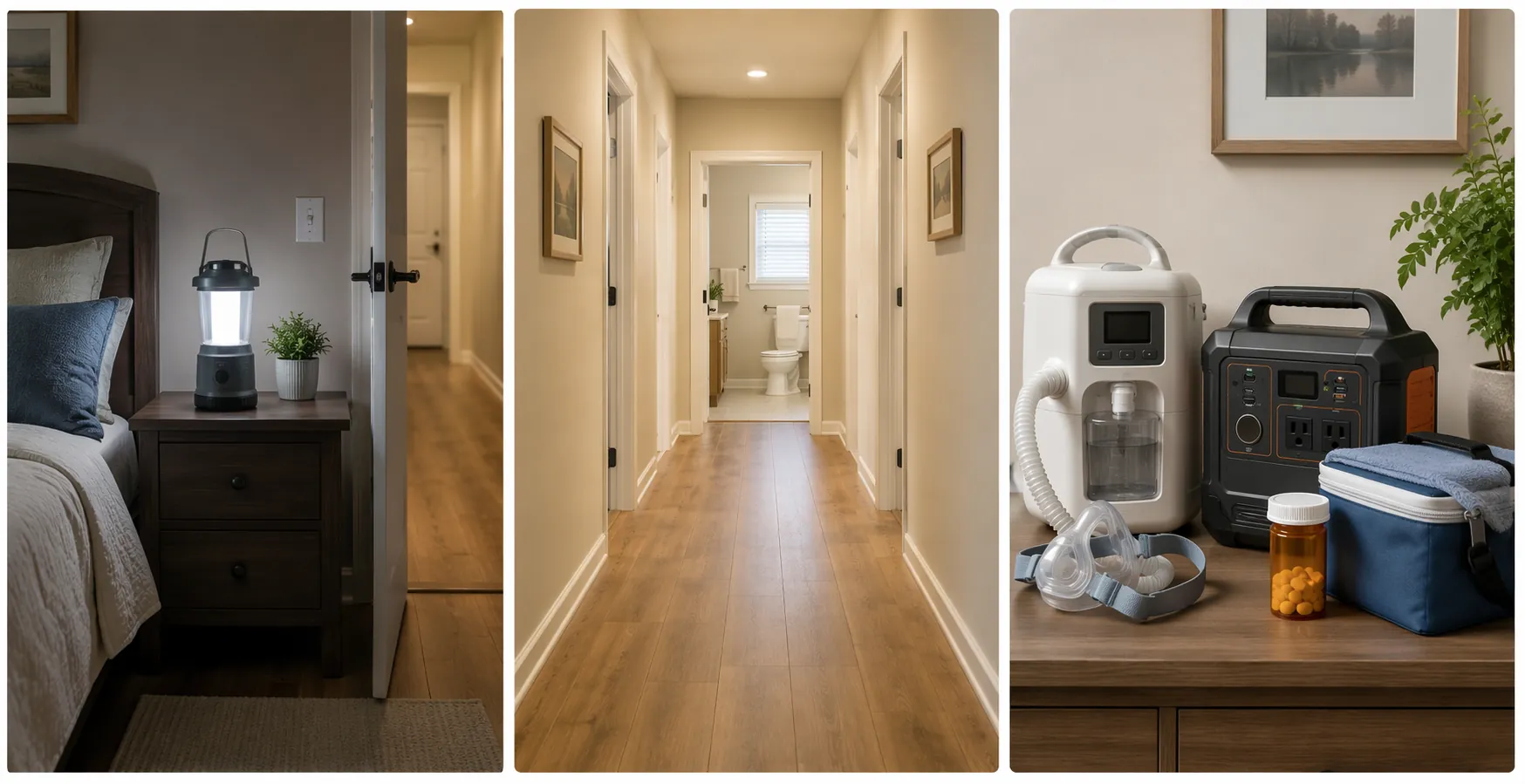
The bedroom deserves more attention than a typical storm checklist gives it, because many serious home problems start with a half-awake person trying to stand, find glasses, locate a cane, and walk toward the bathroom in the dark. The bed-to-door and bed-to-bathroom route should be treated like a protected lane.
- Put a battery lantern or flashlight on the nightstand before the weather arrives, not in a drawer and not in the emergency bin.
- Place glasses, hearing aids, phone, charger, water, and needed overnight medications within easy reach.
- Park the cane, walker, or rollator in the same place every night, close enough to reach without leaning.
- Remove throw rugs, laundry baskets, low stools, pet beds, decorative trunks, and stacked supplies from the walking route.
- Close dresser drawers fully and keep closet doors from swinging into the path.
If supplies must be stored in the bedroom because the person can reach them there, choose a wall space that does not narrow the route to the bathroom or exit. A case of bottled water beside the bed may feel reassuring until it becomes the thing a foot catches in the dark.
Bathroom: Plan for Darkness, Urgency, and Wet Floors
Bathrooms are already high-risk rooms for older adults. During a tropical storm, they gain three more hazards: poor lighting, wet surfaces, and rushed toileting. The fix starts before the first outage.
- Set a battery-powered light on the bathroom counter or a stable shelf.
- Keep toilet paper, wipes, incontinence supplies, and needed hygiene items reachable without bending deeply or stepping onto a wet floor.
- Use non-slip mats that lie flat; remove curled, loose, or decorative rugs.
- Keep towels available for leaks, but do not leave loose towels in the walking path after the immediate cleanup.
- Check that grab bars are secure if present; do not rely on towel bars, sliding shower doors, or sink edges for support.
Ready.gov’s fall-prevention guidance emphasizes removing hazards such as clutter and unsafe rugs, improving lighting, and keeping frequently used items within reach.[5] Those basics become more important, not less, once rain, stress, and outages enter the room.
Kitchen and Water: Store Supplies Without Building an Obstacle Course
The kitchen is where families often create new hazards while trying to be responsible. Water cases land on the floor. Coolers block cabinet doors. Extension cords run to appliances. Trash bags, pet food, and paper goods creep into the walking lane. In daylight, everyone steps around them. During an outage, the older adult pays for that arrangement.
- Store drinking water at waist height when possible, or in smaller containers that do not require lifting a heavy case from the floor.
- Keep a manual can opener, shelf-stable foods, utensils, and paper goods in reachable drawers or on a stable counter.
- Place a battery light where food and medications will actually be handled.
- Keep refrigerator and freezer doors closed as much as possible during an outage, and follow food-safety instructions from public health officials.
- Do not run cords across the kitchen floor. If temporary power is used, route cords away from walking paths and wet areas.
Hydration also has a fall-prevention side. Dehydration, missed meals, and skipped medications can leave a person dizzy or weak. Keep the first day’s water and simple foods where the older adult can reach them without opening a crowded pantry, climbing, or bending into a low cabinet.
Medications and Medical Devices Need Their Own Storm Route
Medication access is where storm planning and fall prevention meet quietly. A missed dose may not look like a fall hazard, but dizziness, pain, confusion, blood sugar swings, and poor sleep can all change how safely a person moves through the house. Red Cross guidance for older adults includes planning for medications, medical equipment, and a support network before emergencies occur.[6]
- Keep a current medication list with drug names, doses, prescribing clinicians, pharmacy information, allergies, and emergency contacts.
- Group routine medications in a place the senior can reach without crossing a dark room or stepping over stored supplies.
- Ask the pharmacist or clinician ahead of storm season how to handle temperature-sensitive medications during an outage.
- Plan charging or backup power for CPAP machines, oxygen concentrators, nebulizers, mobility equipment, hearing aids, and medical alert systems.
- Register with the utility company’s medical baseline or medical needs program if the household depends on powered medical equipment.
PowerOutage.us notes that many utilities maintain medical baseline registries that may provide advance notice of planned outages and may help prioritize restoration for medically dependent customers.[7] That is not a guarantee of uninterrupted power, so the home still needs a device-by-device plan: how long each device can run, who knows how to connect backup power, and where the equipment sits so cords do not cross a walking route.
PowerOutage.us notes that insulin kept above 77°F begins to degrade; if a senior uses less-effective insulin after a long outage, blood sugar changes may increase weakness or dizziness.[7] The safe move is to ask the prescribing clinician or pharmacist what temperature range applies, what cooler setup is acceptable, and when medication should be replaced.
Hallways, Stairs, and Living Areas: Keep the Main Route Boring
A hallway prepared for a storm should look almost too plain. No decorative table jutting out. No folded walker waiting in the path. No flashlight box on the floor. No charging cord stretched from one wall to the other. A boring hallway is a good hallway when the lights fail.
- Place lanterns at both ends of long hallways and near stair landings.
- Check that handrails are secure and usable on all stairs.
- Move supply boxes, folding chairs, fans, portable chargers, and coolers out of walking paths.
- Tape down or remove cords; do not rely on everyone remembering to step over them.
- Keep sturdy shoes or non-slip slippers available, especially if floors may become wet.
Darkness adds a sensory burden. PowerOutage.us, citing NIH data, reports disabling hearing loss in 22% of adults ages 65 to 74 and 55% of adults 75 and older, which can make alarms, warnings, and household sounds easier to miss during an outage.[7] That does not prove a specific blackout fall rate in private homes, but it does explain why lighting, clear routes, and visible cues should be in place before the storm.
Entryways, Porches, and Exits: Do Not Block the Door You May Need
The entryway often becomes a staging area because it feels convenient: go-bag by the door, shoes by the door, rain gear by the door, pet carrier by the door, flashlight by the door. Some of that belongs there. Too much of it turns the exit into a narrow channel at the exact moment people may need to move quickly.
- Keep ID, keys, phone, charger, emergency contacts, glasses, hearing aids, and essential documents easy to grab.
- Place the go-bag beside the route, not in front of the door.
- Check that mobility aids can pass through the doorway without turning sideways around supplies.
- Dry wet thresholds promptly when it is safe to do so.
- Keep the porch, ramp, and first few steps free of planters, mats that curl, loose boards, and storm debris.
If evacuation becomes necessary, follow local instructions and leave before conditions make movement dangerous. That point does not need a long debate inside a home checklist. The important household detail is that the exit route should already be open if the decision comes.
Garage, Shed, and Outdoor Items: Finish the Heavy Work Early
Outdoor preparation is usually treated as a wind-damage issue: bring in furniture, secure loose objects, protect windows, store fuel safely. For a senior at home, timing is the safety issue. The heavy, awkward, wet, uneven work should not be left for the older adult to do once rainbands arrive.
- Move patio furniture, trash cans, hoses, tools, and loose planters before winds increase.
- Store fuel and generator equipment according to safety instructions, away from living spaces and never inside the home.
- Do not store essential medical or lighting supplies only in a garage or shed if the senior cannot reach them safely during bad weather.
- Keep the path from the interior door to the car, breaker panel, or generator area clear if a caregiver may need access.
- After the storm, assume wet leaves, branches, sand, mud, and loose boards can behave like trip hazards until cleared.
Post-storm hazards can last for days. Ready.gov warns people to avoid downed power lines and other dangers after severe weather, and senior-focused hurricane guidance commonly emphasizes debris, wet surfaces, and delayed cleanup as continuing risks.[1][8]
Power Outages Are a Medical Problem, Not Just an Inconvenience
A power outage changes the whole house at once. Lights go out, phones drain, cooling or heating may fail, refrigerated medications may warm, powered devices may stop, and the safest route through the house may no longer be obvious. For older adults with chronic conditions or limited mobility, those problems compound.
One Florida nursing-home study after Hurricane Irma found that power loss was associated with 25% higher odds of mortality within 7 days among nursing home residents.[9] That finding should not be stretched into a prediction for every private home. Nursing homes have different residents, staffing, and medical complexity. Still, it is a serious warning about what happens when heat, medical dependence, disrupted care, and delayed response stack up after a storm.
For a private home, the useful response is specific: identify every item that depends on electricity, decide how long it must operate, and place backup power where it does not create a cord hazard. A backup battery that keeps a device running but stretches a cable across the bedroom floor has solved one problem by making another.
The Caregiver Walkthrough
The most useful walkthrough happens before supplies are moved, then again after the house is “prepared.” The second pass is where the hidden hazards show up.
- Walk from the bed to the bathroom with the lights off or dimmed, using the same cane, walker, glasses, and shoes the senior would use at night.
- Walk from the bedroom to the medication area, kitchen, and main exit.
- Check whether every emergency item added to the house has narrowed a path, blocked a door, hidden a cord, or forced a reach.
- Ask what the older adult would do first if the power went out while they were in bed, in the bathroom, or in the kitchen.
- Move supplies until the answer is safe without needing perfect memory, balance, or daylight.
This is also the time to check communication. Ready.gov recommends building a support network for older adults, including people who can help with transportation, equipment, communication, and daily needs during emergencies.[3] The plan should say who calls, who comes by if phones fail, who knows about medical devices, and who has a key or access instructions.
Before, During, and After the Storm
A room-by-room checklist works best when it is tied to timing. Some tasks belong days ahead, some belong during the outage, and some should wait until conditions are safe.
| Time | What to verify |
|---|---|
| Before the storm | Lights are placed, paths are clear, medications are reachable, devices are charged, backup power is ready, support contacts know the plan, outdoor items are secured. |
| During the outage | Use lanterns before walking, keep cords out of paths, avoid wet floors when possible, keep phone and medical devices charged, take medications on schedule, ask for help before moving heavy items. |
| After weather clears | Do not rush outside; watch for debris, downed lines, slick steps, heat or cold exposure, spoiled food, medication temperature problems, and new clutter created during cleanup. |
CDC advises staying alert to hazards after a hurricane or tropical storm, including floodwater, carbon monoxide risk, unsafe food and water, and damaged buildings or utilities.[1] For an older adult, the first clear morning after a storm is not automatically safe. It is just the moment when the hazards change shape.
A safe storm plan is not the biggest pile of supplies. It is the safest route through the house when normal conditions disappear.
References
- Preparing for Hurricanes or Other Tropical Storms, CDC, link
- Facts About Falls — Older Adult Fall Prevention, CDC, link
- Older Adults, Ready.gov, link
- Disaster Preparedness and the Chronic Disease Needs of Vulnerable Older Adults, PMC, 2008, link
- Preventing Falls at Home, Ready.gov, link
- Older Adults Emergency Preparedness, American Red Cross, link
- Power Outage Preparedness for Seniors & Elderly, PowerOutage.us, link
- Hurricane Preparedness for Seniors, Happier at Home, link
- Association of Power Outage With Mortality Among Florida Nursing Home Residents After Hurricane Irma, JAMA Health Forum, 2021, link
Related reading
Noticed something outdated or inaccurate on this page? Flag a correction. We review every report against CDC, NIA, and AARP HomeFit guidance before updating a page.
Part of the Fall Prevention section.