
Caregiver decision guide
What Is Companion Care for Seniors? Services, Costs, and When to Start
This guide explains what companion care is, how it differs from home health aides and personal care, and how to recognize when your aging parent might need it. Use the four-sign framework to assess their situation and understand typical costs and payment options.
Companion services for seniors are often the first kind of help a family should look at when an older parent is still mostly independent, but the house is getting quieter, errands are getting harder, and small routines are starting to slip. This is not the same as hiring someone to bathe, dress, or medically treat a parent. Companion care is non-medical support: regular social connection plus light help with everyday tasks such as conversation, simple meals, housekeeping, transportation, reminders, hobbies, and check-ins.
That distinction matters. Families often wait until care looks “serious” enough to count. A fall counts. A diagnosis counts. A parent who says “I’m fine” while eating less, going out less, and talking mostly to the television may not. Companion care belongs in that earlier space, where the goal is to preserve independence before the household has quietly become too small.

What companion care includes — and what it does not
Companion care is for social engagement and light daily support. A companion might sit and talk over coffee, take a parent to the grocery store, help prepare lunch, walk with them around the block, sort mail, play cards, help them keep a calendar, or notice that the refrigerator is empty again. The care is personal in the human sense, but it is not hands-on personal care.
The hard boundary is activities of daily living. Companion care does not include hands-on help with bathing, dressing, toileting, transferring, or incontinence care. It also is not clinical home health care, which may involve skilled nursing, therapy, wound care, or medical monitoring ordered or overseen by health professionals. TheKey and SeniorLiving.org both describe companion care as non-medical support and separate it from hands-on personal care or clinical home health services.[1][2]
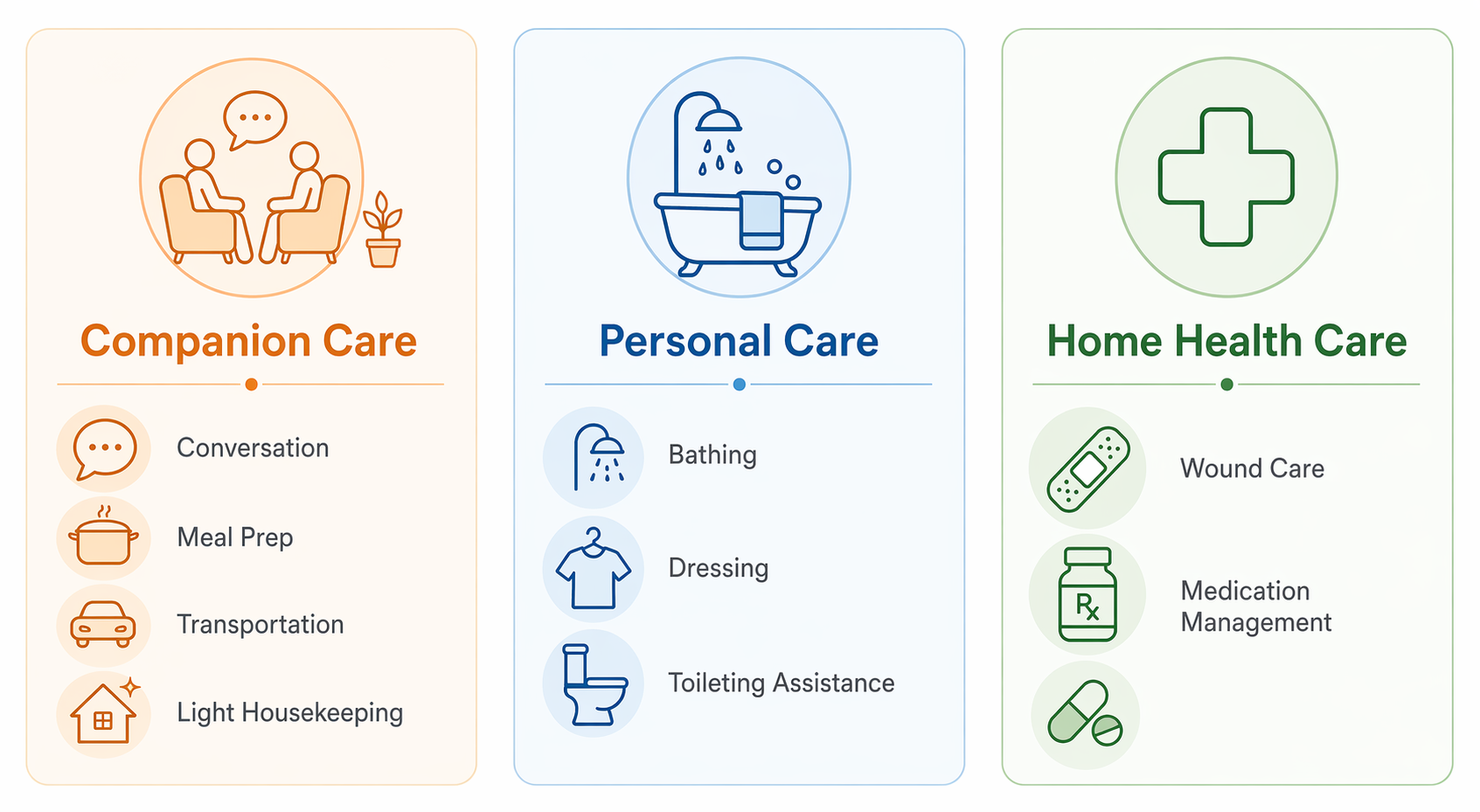
| Type of help | Best fit | Common tasks | Important boundary |
|---|---|---|---|
| Companion care | An older adult who is mostly independent but isolated or losing routine | Conversation, errands, transportation, light housekeeping, meal preparation, hobbies, medication reminders | Non-medical; no hands-on bathing, dressing, toileting, or clinical care |
| Personal care | An older adult who needs hands-on help with daily self-care | Bathing, dressing, toileting, grooming, transferring, mobility support | More intimate assistance; may require a different caregiver skill set and care plan |
| Home health care | An older adult with medical or rehabilitative needs at home | Skilled nursing, therapy, wound care, medication management, monitoring | Clinical category; typically tied to medical need and professional oversight |
This is where families can save themselves a painful mismatch. If a parent needs help getting safely in and out of the shower, companion care is not enough. If they are physically managing but no longer cook, drive, socialize, or keep up the house, companion care may be exactly the category to consider.
Why loneliness is a care issue, not just a mood
Living alone is not automatically unsafe, and solitude is not the same as loneliness. Many older adults enjoy their own space and would bristle, rightly, at being treated as fragile because they like a quiet house. The concern starts when being alone becomes being cut off: fewer meals with other people, fewer reasons to leave the house, fewer conversations that are not medical appointments or family check-ins.
RetirementLiving.com’s 2026 elderly loneliness statistics report that 1 in 4 seniors lives alone, 43% report feeling lonely, and 37% report a lack of companionship. The same report connects loneliness and social isolation with higher health risks, including 50% higher dementia risk, 32% higher stroke risk, 29% higher heart disease risk, and 45% higher mortality risk.[3]
Those numbers do not mean every older adult who lives alone needs a paid companion. They do mean loneliness deserves more respect than families often give it. A parent does not have to be medically unstable before connection becomes part of care.
There is also some evidence that structured companionship can reduce loneliness, though it should be read carefully. A 2022 peer-reviewed study of a Papa Inc. companion program reported a 60% improvement in severe loneliness among participants.[4] That is worth noticing, but it is not proof that every companion care agency, volunteer program, or app-based service will produce the same result. The useful takeaway is narrower: regular companion contact can be a serious intervention for loneliness when the program fits the person and is actually used.
Four signs companion care may belong on the table
The National Council on Aging describes four signs that a loved one might need a companion: repeated loneliness comments, lack of nutritious food, neglected housekeeping, and transportation isolation.[5] These are not a diagnosis. They are a way to organize the little things adult children often notice and then talk themselves out of noticing.
1. Loneliness keeps coming up
One sad day after a friend moves away is not a care plan. A repeated pattern is different. Pay attention when a parent frequently says no one visits, the days feel long, the house is too quiet, or there is “nothing to do,” especially if they also decline invitations because leaving the house feels like too much work.
A companion can give the week a dependable point of contact that is not a rushed family call squeezed between work and dinner. That may mean conversation, a shared walk, help getting to a senior center, or simply someone who notices whether the parent seems brighter after getting out of the house.
2. Nutritious food is disappearing from the routine
An empty fridge can mean many things: appetite changes, grief, money worries, trouble driving, fatigue, or the plain discouragement of cooking for one. Companion care does not replace medical evaluation if weight loss, swallowing problems, or appetite changes are present. But when the problem is access, motivation, or routine, a companion can help with grocery trips, simple meal preparation, and the social nudge that makes lunch feel worth making.
3. Housekeeping is no longer ordinary clutter
A messy room is not a crisis. The pattern to watch is when small household tasks stop recovering: dishes stack up for days, laundry is never folded, mail becomes a pile no one opens, trash waits too long, or the path through the house narrows. Companion care can cover light housekeeping, but it is not deep cleaning, hoarding treatment, or home repair.
The most useful companion in this situation is often not someone who “takes over,” but someone who helps the parent keep ownership of the home. That may look like starting a load of laundry together, clearing the kitchen counter, or putting bills in one visible place before an adult child reviews them.
4. Transportation has become social isolation
Driving less can be wise. It can also quietly erase a parent’s world. When an older adult stops driving at night, then avoids highways, then gives up church, hair appointments, card group, the library, and routine shopping, transportation becomes more than a logistics problem.
Many companion care arrangements include transportation or accompaniment, depending on the provider’s policies and the caregiver’s role. For some families, this is the first relief they feel: an adult child is no longer the only person who can get Mom to the pharmacy or Dad to lunch with an old friend.
What a companion might actually do in a week
Companion care works best when the visits are ordinary enough that a parent does not feel managed. A two- or three-hour visit might include coffee and conversation, checking the calendar, preparing soup, taking a short walk, watering plants, folding towels, and driving to the grocery store. Another visit might be mostly social: puzzles, music, a hobby, reading aloud, looking through photos, or attending a community event.
- Conversation and regular social check-ins
- Meal preparation or help planning simple meals
- Light housekeeping such as dishes, laundry, tidying, and taking out trash
- Transportation to errands, appointments, social visits, or community activities
- Medication reminders, without medical management
- Hobby engagement, walks, games, reading, or faith and community activities
- Noticing changes and reporting concerns to the family or care coordinator
The reporting piece can be delicate. A companion should not become a spy in the house. But for adult children who live across town or across the country, a steady set of eyes can reveal patterns a weekly phone call misses: food untouched, mail unopened, a parent more withdrawn than usual, or a favorite routine abandoned.
Companion care can also protect the family caregiver
Companion care is usually described as a service for the older adult, and it is. But it also changes the load on the adult child who has become the default driver, grocery checker, appointment reminder, technology helper, and emotional backup system.
A few companion hours a week may not sound like much until those hours are the difference between visiting as a daughter or son and arriving as the entire support department. If the family caregiver is already exhausted, resentful, or unable to recover between crises, it may be time to read more directly about caregiver burnout warning signs rather than treating companion care as the only fix.
Types of companion care arrangements
SeniorLiving.org describes several companion care delivery models, including live-in companion care, in-home visits, hospice companion support, and religious or community-based companion services.[2] Most families begin with scheduled in-home visits because they are easier to start, adjust, and stop if the fit is wrong.
| Model | When families may encounter it |
|---|---|
| In-home companion visits | A companion comes for scheduled blocks of time during the week. |
| Live-in companion care | A companion is present for longer stretches, though rules, sleeping arrangements, and duties vary by provider. |
| Hospice companion support | Companionship is offered alongside end-of-life support, usually within a hospice context. |
| Religious or community-based support | Volunteers or community members provide visits, rides, or social connection. |
Provider types vary too. Families may see certified agencies, non-certified agencies, independent contractors, volunteer programs, and app-based platforms. That choice affects screening, backup coverage, scheduling, cost, liability, and consistency. It is a separate hiring decision, not something to solve before the family is clear that companion care is the right kind of help.
What companion care costs in 2026
Companion care is usually billed by the hour. SeniorLiving.org’s 2026 companion care cost guide places the national median around $34 per hour, and A Place for Mom’s 2026 home care cost data shows state-level hourly rates commonly ranging from about $25 to $44.[6][7] Actual rates can shift by city, agency, minimum visit length, caregiver experience, scheduling needs, and whether transportation is included.
| Weekly companion care | Approximate monthly cost at $34/hour | What that schedule might cover |
|---|---|---|
| 7 hours per week | About $1,031 per month | Two short visits, one longer visit, or light weekly routine support |
| 30 hours per week | About $4,416 per month | Regular weekday support, frequent transportation, meals, errands, and social engagement |
Those examples are not a quote from any one agency. They are a planning estimate using the $34 hourly benchmark and average weeks per month. Families comparing care categories may also want a broader look at senior care options and the real costs families pay, because a lower hourly service can still become expensive when hours increase.
The practical way to think about cost is to start with the problem, not the package. If the parent is lonely and missing errands, a few hours a week may be enough to test whether companionship changes the rhythm of the week. If the adult child is covering daily transportation, meals, and check-ins, the needed hours may be much higher. At that point, companion care may still be useful, but the family should compare it honestly against other in-home support options.
Will Medicare pay for companion care?
Original Medicare does not cover companion care. That is one of the most important payment boundaries for families to know before they start calling providers.[8]
Medicare Advantage is more complicated. Some plans may offer supplemental benefits that include limited in-home support or companionship, but coverage varies by plan, location, and year.[8] A benefit that existed last year may not be available this year, and a benefit available in one county may not exist in another. Families need to confirm directly with the plan, not assume “Medicare” means the same thing in every situation.
Long-term care insurance, Medicaid waiver programs, veterans benefits, local nonprofits, and private pay may also come up depending on the parent’s situation, but eligibility rules vary. Companion care is often paid out of pocket unless a specific program or policy says otherwise.
No-cost and lower-cost companion options
For families who cannot afford paid companion care, volunteer programs are worth checking before giving up. AmeriCorps Seniors’ Senior Companion Program uses volunteers age 55 and older to provide companionship and assistance to older adults who need support remaining independent, and the program is offered at no cost to recipients where available.[9]
The limitation is built into the model. Volunteer availability is not universal, and hours, consistency, and matching may differ from paid agency care. A volunteer companion may be a wonderful fit for conversation and social connection, but a family that needs guaranteed transportation every Tuesday morning may need a paid provider or another backup plan.
When to start: before the word “care” feels obvious
The best time to consider companion care is often before a parent would agree that they “need care.” That wording can feel insulting to someone who still pays bills, locks the door, makes coffee, and knows exactly how they like their home. A better opening may be more specific: help with errands, someone to walk with, a weekly lunch companion, a ride to church, or a person who can come by while the family caregiver is at work.
Start small if the parent is resistant. A trial visit framed around a practical task is often less threatening than announcing a new care arrangement. The family can watch for concrete outcomes: Did the parent eat better that day? Did they leave the house? Did they seem less anxious in the evening? Did the adult child get a real break instead of another assignment?
Companion care is not the answer to every aging-at-home problem. It cannot make an unsafe bathroom safe, replace hands-on personal care, or treat depression, dementia, mobility decline, or medical instability. For families building a wider plan, companion care may sit alongside home modifications, transportation planning, medical follow-up, and a clearer division of family responsibilities. A broader aging-in-place guide can help connect those pieces.
Still, it deserves a place on the table earlier than many families put it there. Its value is not only in preventing a crisis. It is in keeping a parent’s week recognizable: food in the refrigerator, mail under control, a reason to get dressed, someone expected at the door, and enough connection that independence does not become isolation.
If the signs fit and the budget may work, the next decision is not whether companionship matters. It is how to choose a trustworthy provider, set boundaries, and introduce help without making a parent feel handled. That belongs in a dedicated hiring guide.
References
- Companion Care for Seniors, TheKey.com.
- 2026 Guide to Senior Companion Care Services, SeniorLiving.org.
- Elderly Loneliness Statistics 2026, RetirementLiving.com.
- The Impact of a Companionship Program on Loneliness Among Older Adults: A Longitudinal Study, PMC, 2022.
- 4 Signs Your Loved One Might Need a Companion, NCOA.org.
- Companion Care Costs, SeniorLiving.org.
- Home Care Costs 2026, A Place for Mom.
- Medicare and Medicaid Coverage for Companion Care, SeniorLiving.org.
- AmeriCorps Seniors Senior Companion Program, AmeriCorps.
Questions to bring to a clinician or OT
This is not medical, legal, or a family's final decision — only a framework. Bring these questions to a clinician, occupational therapist, or your local Area Agency on Aging.
Find Local HelpRelated reading
Noticed something outdated or inaccurate on this page? Flag a correction. We review every report against CDC, NIA, and AARP HomeFit guidance before updating a page.