
Clinical term
How Cyclospora Diarrhea Raises Fall Risk for Older Adults
Last verified 2026-07-24
If an older adult has watery diarrhea during the 2026 Cyclospora outbreak, the fall risk can begin before anyone uses the word “severe.” Repeated bathroom trips drain fluid, dehydration can bring dizziness and weakness, and standing up too fast can trigger orthostatic hypotension — a blood-pressure drop after standing. Dr. Luis Marcos of Stony Brook Medicine, quoted by AARP, warns that dehydration from Cyclospora-related diarrhea can lead to dizziness, orthostatic hypotension, weakness, falls, and worsening chronic conditions in older adults.[1]
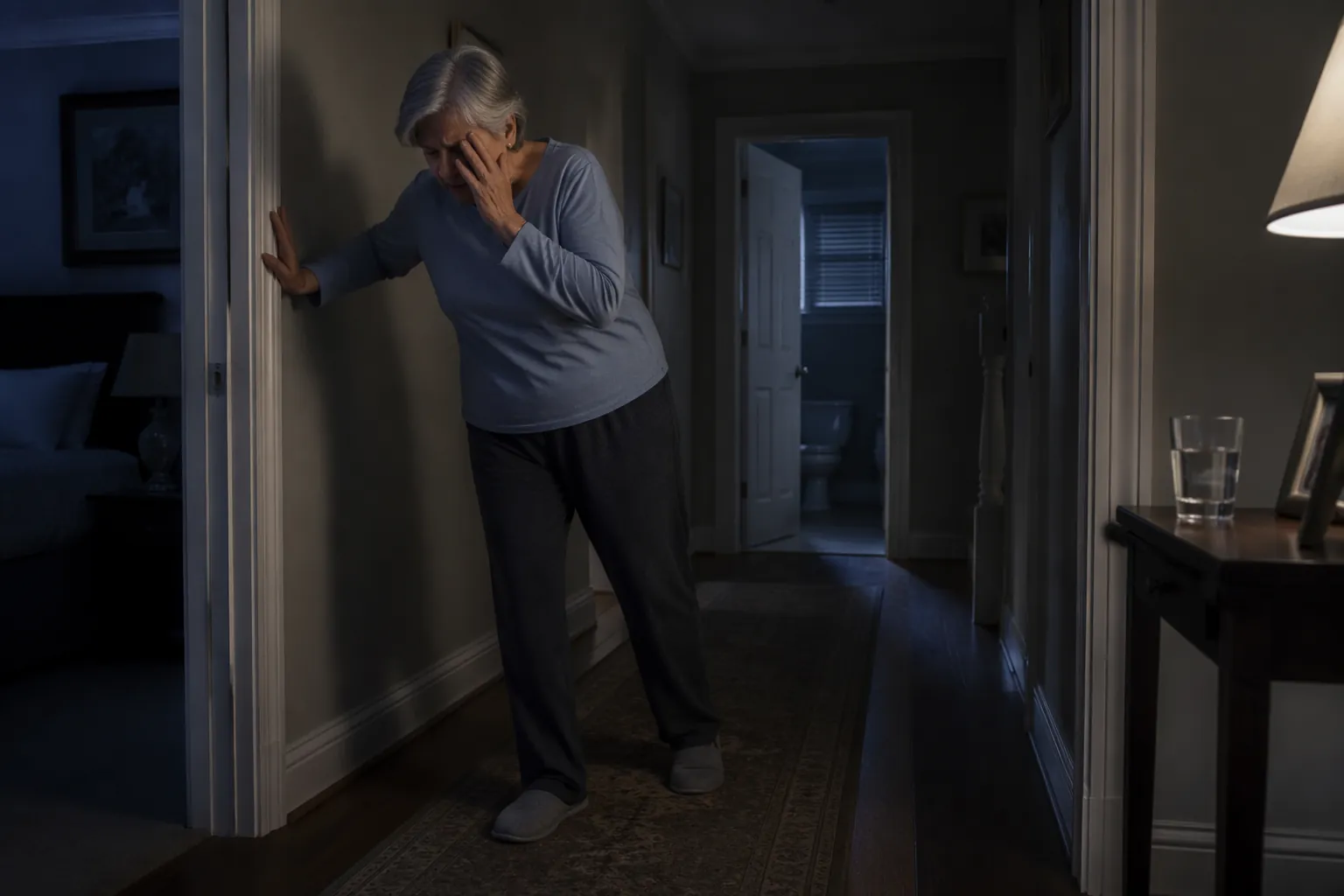
That is the caregiver problem hiding inside the phrase “stomach bug.” A parent may be embarrassed, tired, and still trying to get to the bathroom alone at 2 a.m. The infection may be intestinal, but the immediate safety issue may be the walk from the bed to the toilet.
This is timely because the current outbreak is large and still active. In a July 24, 2026 Health Alert Network notice, the CDC reported 4,173 confirmed U.S. cases of cyclosporiasis, with more than 7,400 additional cases under investigation, calling it the largest U.S. Cyclospora outbreak reported to date.[2] The CDC described a nine-state outbreak cluster — Indiana, Kentucky, Michigan, Ohio, West Virginia, Illinois, Kansas, Oklahoma, and Pennsylvania — linked to Taylor Farms shredded iceberg lettuce served at Taco Bell, while also noting that this was only one of several concurrent investigations.[2]
The same CDC alert reported that case-patients ranged in age from 2 to 95 years, with a median age of 44, and that 9% were hospitalized.[2] Those numbers do not prove that older adults are hospitalized at a specific rate; CDC has not published a senior-only hospitalization breakdown in the materials used here. They do show that older adults are included among affected patients, and they make the household fall-prevention question more than theoretical.
For prevention before illness, see Why Cyclosporiasis Prevention Belongs in Your Fall Prevention Plan. This article is the crisis-path companion: what to do when diarrhea has already started.
Why Diarrhea Becomes a Fall Problem
Cyclospora infection commonly causes watery diarrhea. Without treatment, symptoms can last from days to weeks, according to the CDC.[3] Johns Hopkins Medicine also describes a relapsing-remitting pattern: a person may feel better for a day, then worsen again.[4] That pattern matters at home because the first “better day” may not mean the fall-risk window has closed.
The fall chain is not a CDC-labeled Cyclospora fall syndrome. It is a practical synthesis from several supported facts: Cyclospora can cause prolonged watery diarrhea; diarrhea can cause dehydration; dehydration in older adults can cause dizziness, weakness, orthostatic hypotension, confusion, and falls.[1][3][4] In a younger adult, that may mean a miserable day near the bathroom. In an older adult with slower balance reactions, lower reserve, or a walker parked across the room, the same sequence can become dangerous quickly.
The riskiest moment is often a transition: lying down to sitting, sitting to standing, or turning in a small bathroom after another urgent trip. Dizziness does not need to be dramatic to matter. A few seconds of lightheadedness can be enough for someone to grab a towel bar, miss the walker, or sit down too late.
The same dehydration-balance connection shows up in other fall-prevention situations, including heat and sleep disruption. If summer heat is also in the home, the risk can stack; see Can Hot Weather Sleep Loss Make Seniors More Likely to Fall? for a related look at dehydration, fatigue, and balance.
The First Home Check: Frequency, Duration, and Change
A caregiver does not need a medical chart to start useful monitoring. A notebook on the kitchen table or a note on a phone is enough. Track what changes the fall risk: how often diarrhea happens, whether fluids stay down, whether the person is urinating, and whether standing looks safe.

| What to Check | Why It Matters for Falls |
|---|---|
| Number of diarrheal episodes since waking | More episodes mean more fluid loss and more urgent bathroom trips. |
| Whether symptoms are improving, unchanged, or worse | Cyclospora can relapse after a better day, so improvement should be watched, not assumed permanent. |
| Fluid intake and ability to keep fluids down | Fall danger rises when dehydration and weakness start to show. |
| Urination amount and urine color | Decreased urination or dark urine can signal dehydration. |
| Dizziness, confusion, weakness, or rapid heartbeat | These suggest the illness has moved into the balance-and-safety zone. |
| How the person stands and walks to the bathroom | Unsteadiness during transfers is where the fall often begins. |
The call-the-doctor threshold should be visible, not buried. Dr. Cory Fisher of Cleveland Clinic, quoted by AARP, advises calling a doctor when diarrhea occurs more than 6 to 8 times per day or when symptoms last more than 2 to 3 days without improvement.[1] For an older adult, those are not just digestive thresholds. They are fall-prevention thresholds, because each additional episode may mean another urgent stand, another walk, and more fluid loss.
Dehydration Signs That Should Change the Plan
AARP’s clinician guidance lists dizziness, confusion, decreased urination, dry mouth, dark urine, and rapid heartbeat as dehydration warning signs for older adults with Cyclospora.[1] When any of these appear, the plan should shift from “keep an eye on the diarrhea” to “supervise standing, reduce walking, and call for medical guidance if symptoms are not clearly improving.”
- Dizziness: have the person sit before standing, pause at the bedside, and avoid walking alone until steadier.
- Confusion: treat this as urgent because confusion can make a person forget the walker, rush to the bathroom, or misjudge distance.
- Decreased urination or dark urine: increase attention to fluid intake and contact a clinician if the pattern continues.
- Dry mouth or rapid heartbeat: look at the whole picture — diarrhea frequency, fluid intake, medications, and walking safety.
- Weakness: temporarily assume the normal route to the bathroom is no longer normal.
Older adults with diabetes, kidney disease, or heart disease may be more vulnerable to dehydration complications, and medications that affect fluid balance can add to the problem.[5] That does not mean every older adult with Cyclospora will dehydrate severely. It means caregivers should take mild early signs seriously, especially when chronic illness or fluid-sensitive medications are already part of daily life.
Make the Bathroom Route Safer Before the Next Urgent Trip
During watery diarrhea, treat the home as temporarily higher-risk for falls. The goal is not to remodel the bathroom overnight. It is to remove the small delays and hazards that turn urgency into a fall.
- Keep the walker, cane, or rollator within arm’s reach of the bed or chair — not across the room.
- Turn on nightlights from bed to bathroom, including the doorway and toilet area.
- Clear shoes, cords, rugs, hampers, and pet bowls from the route.
- Place toilet paper, wipes, clean clothing, and a trash bag within easy reach so the person does not twist or hurry.
- Use non-slip footwear or bare feet with good traction; avoid loose slippers.
- Consider a bedside commode for the worst night or two if the bathroom is far away, the person is dizzy, or urgency is high.
A towel bar is not a grab bar. If the person is already reaching for doorframes or towel racks, the setup is asking weak hardware to do a safety job. For longer-term bathroom changes, use proper grab bars and non-slip surfaces; related bathroom modification guidance is a better match than improvising under pressure.
The most protective instruction may be the least dramatic: sit first, pause, then stand. If dizziness appears, sit back down. If the person insists they are fine, stay close anyway. Illness changes reaction time, and pride does not steady anyone’s blood pressure.
Do Not Drop Precautions After One Better Day
Cyclospora can fool a household because symptoms may ease and then return. The CDC notes that untreated illness can last days to weeks, and Johns Hopkins describes the relapsing-remitting pattern clearly enough that caregivers should plan for it.[3][4] A better morning is welcome, but it should not automatically mean the walker moves back to the hallway closet or the nightlight comes out of the outlet.
Keep the safer setup in place until diarrhea is clearly improving, hydration signs are stable, and standing no longer brings dizziness or weakness. If symptoms return after a quiet day, restart the monitoring rhythm rather than treating the relapse as a surprise.
Medication Review Matters Before TMP-SMX
The standard treatment for cyclosporiasis is typically trimethoprim-sulfamethoxazole, often shortened to TMP-SMX, but older adults should not treat the antibiotic as a stand-alone fix. AARP’s clinician guidance notes that TMP-SMX can interact with warfarin, sulfonylureas used for diabetes, and drugs that affect potassium or kidney function.[1]
Before starting treatment, the prescriber or pharmacist needs the current medication list, including blood thinners, diabetes medications, blood pressure pills, diuretics, kidney-related medications, potassium supplements, and over-the-counter products. The point is not to delay care; it is to prevent the treatment from creating a second safety problem.
Medication review is also a fall-prevention habit. If your household already tracks sedating allergy medicines, blood pressure medications, or dizziness-related side effects, the same discipline belongs here. For a related medication-safety example, see Cetirizine and Fall Risk in Older Adults.
When Home Monitoring Is No Longer Enough
Some signs should stop the home-monitoring approach. AARP’s clinician guidance lists bloody stool, persistent vomiting, high fever with chills, severe abdominal pain, inability to keep fluids down, fainting, or confusion as reasons to seek emergency care.[1]
- Bloody stool
- Persistent vomiting
- High fever with chills
- Severe abdominal pain
- Inability to keep fluids down
- Fainting
- Confusion
For a non-emergency call, use the practical thresholds: more than 6 to 8 diarrheal episodes per day, or symptoms lasting more than 2 to 3 days without improvement.[1] If the older adult is frail, lives alone, has kidney disease or heart disease, uses diuretics, or is already dizzy, it is reasonable to call earlier. The threshold is a floor, not a test of toughness.
A Few Outbreak Details Worth Keeping Straight
The outbreak numbers are a snapshot, last verified here against the CDC’s July 24, 2026 alert. The CDC expected case counts to rise through late August 2026, so published totals may change after this article appears.[2]
The Taco Bell lettuce investigation is important for readers in the affected states, but it does not explain every case. CDC identified the Taylor Farms shredded iceberg lettuce served at Taco Bell as one nine-state cluster and also stated that multiple outbreak investigations were occurring at the same time.[2] State totals can also look different from CDC totals when states include probable cases and CDC reports confirmed lab-tested cases.
For a caregiver at home, those distinctions matter mainly because they keep the response honest. A person does not need to have eaten at a specific restaurant to deserve attention if they have persistent watery diarrhea, dizziness, weakness, or dehydration signs during an active outbreak.
What to Do Tonight
Cyclospora is usually temporary, but in an older adult it should temporarily change the home’s fall-risk status. Antibiotics may treat the infection, but caregivers can reduce danger before the medication fully takes effect.
- Track diarrhea frequency, fluid intake, urination, dizziness, weakness, and confusion every few hours while symptoms are active.
- Call a doctor for more than 6 to 8 diarrheal episodes per day or symptoms lasting more than 2 to 3 days without improvement.
- Keep fluids, the phone, lights, and mobility aids within reach.
- Slow every bathroom trip: sit, pause, stand, pause, then walk with support.
- Use emergency care for bloody stool, persistent vomiting, high fever with chills, severe abdominal pain, inability to keep fluids down, fainting, or confusion.
The dangerous moment may be quiet: an older adult stands too quickly, reaches for something that was never meant to hold body weight, and falls before anyone thinks the illness has become serious. Treat the diarrhea, but also treat the route to the bathroom as part of the care plan.
References
- What Older Adults Should Know About Cyclospora — AARP
- HAN Archive - 00531 — Centers for Disease Control and Prevention, July 24, 2026
- About Cyclosporiasis — Centers for Disease Control and Prevention
- Cyclosporiasis Outbreak — Johns Hopkins Medicine
- Cyclospora Outbreaks: What Seniors and Their Families Need to Know — Seniors Blue Book
Browse more in the Glossary.