
Clinical term
The Subtle Early Signs of Parkinson's Disease in Elderly Parents
Last verified 2026-07-27
The first clue may not look medical. Your father’s thank-you note is still polite, but the letters are smaller and crowded together. Your mother still answers the phone, but her voice sounds thinner than it did last year. A parent who used to walk straight through a doorway now pauses, gathers their feet, and steps carefully over the threshold.
Those moments are easy to explain away. Everyone slows down. Everyone has stiff mornings. Everyone misplaces a word or has a bad night’s sleep. But the early signs of Parkinson’s disease in elderly parents often arrive as small changes that repeat, cluster, or affect one side of the body more than the other. Tremor is the sign most people know, yet the Parkinson’s Foundation notes that up to 25% of people with Parkinson’s never develop tremor at all.[1] Some early clues, including smell loss and REM sleep behavior disorder, can appear years before the movement changes families expect to see.[2][3]

This checklist is not a diagnostic test, and it is not medical advice. It is a way to organize what you are already noticing so you can have a calmer, more useful conversation with your parent and, when needed, with a clinician. The most important questions are simple: Is this new for them? Is it persistent? Is it one-sided? Is more than one change showing up? Is daily life becoming harder or less safe?
A 10-sign checklist for watching patterns, not diagnosing
If you see your parent often, you may have an advantage a clinician does not: months of comparison. You know how loudly they used to speak, how quickly they walked to the mailbox, whether their handwriting has always been small, and whether they have always been prone to constipation or low moods. Use that history carefully. The goal is not to monitor every movement, but to notice changes that are persistent enough to deserve a medical evaluation.
| Sign | What to compare it against | Typical timing |
|---|---|---|
| Loss of smell | Longstanding allergies, sinus disease, recent infection, or medication effects | Can appear years before motor symptoms |
| Acting out dreams | Occasional restless sleep or nightmares without physical enactment | Can appear years before diagnosis |
| Chronic constipation | Short-term constipation from diet, dehydration, travel, or medication | Often early and non-motor |
| Depression or anxiety | A mood reaction to a clear life stressor | May precede diagnosis by several years |
| Softer voice | Normal voice changes that do not affect being heard | Often subtle near early motor changes |
| Masked face | Ordinary tiredness or a naturally reserved expression | Often noticed by family before the parent does |
| Smaller handwriting | Messier writing from haste, arthritis pain, or poor vision | Often near early motor symptom onset |
| Rest tremor | Shaking after exertion, caffeine, anxiety, or medication changes | Classic early motor sign, but not universal |
| One-sided stiffness, slowness, posture, or shuffling | Symmetric age-related stiffness or arthritis centered in joints | Common early motor pattern |
| Dizziness or fainting when standing | Brief lightheadedness from dehydration or a known medication effect | Can be an early non-motor marker |
1. Loss of smell that is not explained by a cold or allergies
What you might observe: A parent stops noticing that coffee is brewing, says food tastes bland, uses more salt or sauce than usual, or cannot smell something obvious in the kitchen. They may describe it as a taste problem because flavor depends so much on smell.
Normal aging can dull smell somewhat, and smell can be affected by sinus disease, smoking history, allergies, some medications, and respiratory infections. The more concerning version is a persistent loss of smell that does not fit a temporary illness and seems out of proportion to the usual explanations. Mass General Brigham reports that loss of smell affects over 90% of people with early-stage Parkinson’s and can precede motor symptoms by up to 20 years.[2]
Timeline: This is one of the signs that can appear long before diagnosis. That does not mean smell loss equals Parkinson’s. It means persistent smell loss belongs on the list when it appears alongside other changes, especially sleep, constipation, mood, handwriting, voice, or one-sided movement changes.
A practical step: The Michael J. Fox Foundation offers a free scratch-and-sniff smell test for adults 40 and older in the United States and Canada as a way to help identify smell loss linked to Parkinson’s risk.[3] It is not a diagnosis, but it can turn a vague impression into something worth discussing with a doctor.
2. Acting out dreams during sleep
What you might observe: This sign is usually noticed by a spouse, partner, or anyone who shares a wall. A parent may punch, kick, shout, flail, fall out of bed, or seem to be physically responding to a dream. The next morning, they may remember being chased, attacked, or needing to defend themselves.
Normal restless sleep is not the same thing. Many people mutter, shift, or have nightmares. The warning sign is repeated physical dream enactment, especially if someone is injured, a bed partner starts sleeping elsewhere, or the parent has no history of this behavior. In people aged 50 and older, REM sleep behavior disorder is associated with a 130-times greater likelihood of developing Parkinson’s; up to 80% of people with idiopathic REM sleep behavior disorder eventually develop Parkinson’s or another neurodegenerative disease.[3]
Those numbers are serious, but they should be handled with care. Absolute individual risk remains low, and a single vivid dream, one rough night, or sleep movement during an illness does not predict Parkinson’s. The concern rises when dream enactment is recurrent, unexplained, and unsafe. The first practical issue is injury prevention: moving sharp bedside objects, padding corners, lowering fall risk around the bed, and asking a doctor whether a sleep evaluation is appropriate.
Timeline: This can appear years before the movement symptoms of Parkinson’s. If you ask about it, avoid making it sound like an accusation. “Have you been having dreams where your body moves with the dream?” will usually land better than “You were thrashing around last night.”
3. Chronic constipation that becomes the new normal
What you might observe: A parent starts talking about laxatives, bloating, straining, or “not going like I used to.” Or you notice the signs indirectly: less appetite, more discomfort after meals, canceled outings, or a new routine built around bathroom uncertainty.
Constipation is common in older adults and has many ordinary causes, including dehydration, low fiber intake, reduced activity, pain medications, travel, and changes in routine. The concerning version is persistent constipation that is new for the person, not easily explained, and appears with other possible Parkinson’s signs. The Parkinson’s Foundation reports that chronic constipation affects about two-thirds of people with Parkinson’s.[4] APDA notes that a meta-analysis found people with chronic constipation were twice as likely to develop Parkinson’s, with a possible link to alpha-synuclein accumulation in gut nerves.[5]
Timeline: Constipation can be an early non-motor sign. On its own, it is far too common to be treated as a Parkinson’s clue. In a pattern with smell loss, sleep changes, mood changes, or one-sided stiffness, it becomes worth documenting instead of waving away.
4. Depression or anxiety that does not fit the circumstances
What you might observe: A parent seems flatter, more worried, less interested in plans, or more reluctant to leave home. They may call more often for reassurance, stop enjoying regular activities, or describe a sense of dread they cannot quite explain.
Mood changes in later life deserve respect on their own terms. Grief, loneliness, caregiving strain, pain, financial stress, medication effects, and sleep problems can all cause depression or anxiety. The possible Parkinson’s-related concern is a new or worsening mood change that seems biologically “out of nowhere,” especially when it appears with non-motor changes such as constipation or smell loss, or with subtle movement changes. The Parkinson’s Foundation notes that depression and anxiety can precede a Parkinson’s diagnosis by 2 to 5 years.[4]
Timeline: Mood symptoms can appear before diagnosis. They are also treatable and worth discussing with a primary care clinician whether or not Parkinson’s is involved. This is one place where families should be especially careful not to reduce a parent to a symptom list; the parent may be suffering, not “acting different.”
5. A softer, quieter voice
What you might observe: Phone calls get harder. You keep asking your parent to repeat themselves. In a restaurant, their voice disappears under background noise. They may insist they are speaking normally because, to them, it feels normal.
Aging can change the voice, and hearing problems can make family conversations more difficult from both sides. The warning sign is a persistent reduction in volume or vocal strength that is new for the person and not fully explained by a sore throat, hearing loss, or fatigue. The Parkinson’s Foundation says speech and voice changes, including a softer voice, affect 89% of people with Parkinson’s and often begin subtly.[1]
Timeline: A quieter voice often shows up around early motor changes, though families may notice it before they notice gait or hand movement. If you want to document it, write down the situation rather than your interpretation: “I had trouble hearing Mom on three phone calls this month,” or “Dad’s voice was too soft for the server to hear twice at lunch.”
6. Less facial expression or reduced blinking
What you might observe: A parent looks serious, tired, sad, or annoyed even when they say they feel fine. Their face may seem less animated in conversation. Photos show fewer spontaneous smiles. Grandchildren may ask, “Is Grandpa mad?” when he is not.
Normal aging does not erase facial expression. People can become more reserved, tired, or self-conscious, but a persistent “masked” facial expression is different. APDA describes masked face, including reduced facial expression and less blinking, as specific to Parkinson’s and not part of normal aging.[5]
Timeline: This often appears near other early motor signs, but it may be misread as mood, personality, or hearing trouble. It is worth pairing with what your parent says internally. If they feel cheerful but look flat, that mismatch matters more than any single family member’s impression.
7. Smaller, cramped handwriting
What you might observe: Birthday cards, grocery lists, checks, recipe notes, or envelope addresses look different. The letters may start at a familiar size and then get smaller across the line. Words may crowd together. A parent who once wrote clearly may now avoid writing by hand.
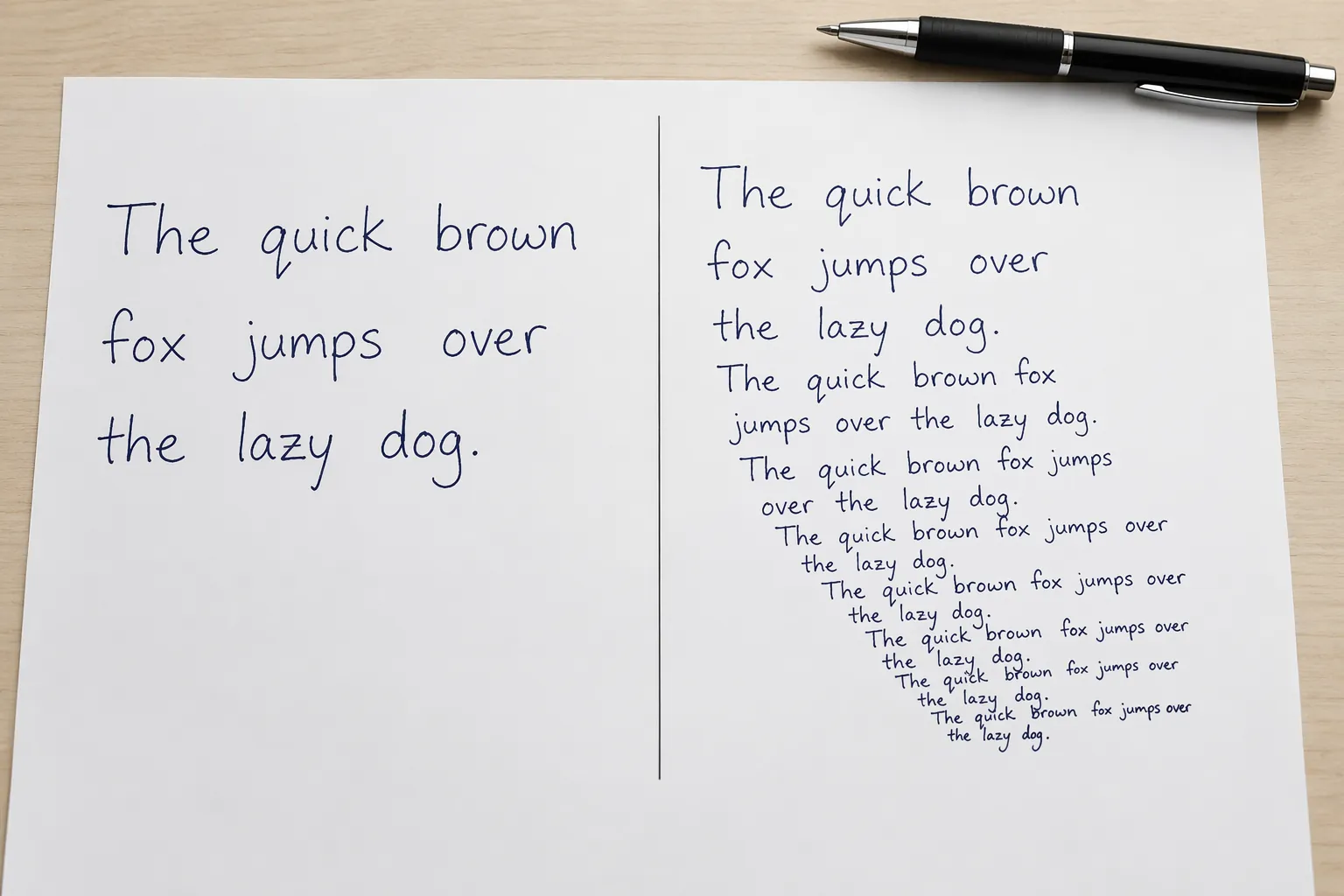
Normal handwriting can get messier because of arthritis, poor vision, rushing, weakness, or an uncomfortable pen. Parkinson’s-related micrographia is more specific: writing becomes smaller, cramped, and crowded because fine motor control is changing. The Parkinson’s Foundation lists small handwriting as one of its 10 early signs and links it to changes in movement control.[1]
Timeline: Micrographia often appears close to early motor symptom onset. It is also one of the easier signs for an adult child to check respectfully. Compare an old card or note with a recent one. You are not trying to prove a diagnosis; you are looking for a clear change from that parent’s own baseline.
8. A tremor when the hand is at rest
What you might observe: A hand trembles while resting in a lap, on an armchair, or beside the body. It may lessen when the parent reaches for a cup or uses the hand. Often the family first notices it when the parent is relaxed and not trying to do anything.
Not every shaky hand points toward Parkinson’s. Tremor can be related to medications, thyroid disease, caffeine, anxiety, essential tremor, weakness after exertion, or other neurologic conditions. The Parkinson’s Foundation describes a slight tremor or shaking in a finger, thumb, hand, or chin at rest as a common early sign, while also noting that up to 25% of people with Parkinson’s never develop tremor.[1]
Timeline: Rest tremor is a classic early motor sign, but it should not be treated as the gatekeeper symptom. A parent can have Parkinson’s-like changes without tremor, and a parent can have tremor for reasons unrelated to Parkinson’s. The detail to document is when the tremor appears: at rest, during action, after stress, after medication changes, or only when tired.
9. One-sided stiffness, slowness, reduced arm swing, or shuffling
What you might observe: One arm does not swing as much when your parent walks. One shoulder sits higher. One foot seems to drag. They take shorter steps, hesitate before starting, or need more time to turn around in a hallway. They may describe stiffness, but not in the same way they talk about arthritis pain.

This is one of the most useful normal-aging comparisons. Arthritis is usually felt in joints. Ordinary age-related stiffness often affects both sides in a fairly even way. APDA explains that Parkinson’s stiffness originates in muscles rather than joints and typically starts asymmetrically on one side of the body.[5] Mayo Clinic also describes Parkinson’s symptoms as often beginning on one side and usually remaining worse on that side even after symptoms affect both sides.[6]
Timeline: One-sided stiffness, slowness, and reduced arm swing are often early motor signs. A good observation is specific: “Left arm not swinging on walks,” “right foot scuffs the floor,” or “takes several small steps to turn.” A vague label such as “getting frail” is less helpful and easier for everyone to dismiss.
10. Dizziness or fainting when standing
What you might observe: A parent stands from a chair and pauses with a hand on the table. They say they feel lightheaded after getting out of bed. They avoid showering when alone because they feel unsteady. Or they have a near-fall that starts with “I just got dizzy.”
Lightheadedness can come from dehydration, blood pressure medication, heart rhythm problems, anemia, infection, and many other causes that need medical attention in their own right. The Parkinson’s-related concern is orthostatic hypotension — a blood pressure drop on standing — appearing as a recurrent pattern. APDA and Mass General Brigham describe orthostatic hypotension as an early marker that is not simply a routine part of general aging.[5][2]
Timeline: This can be an early non-motor sign, but it is also a safety issue regardless of cause. Document when it happens: after meals, after medication, first thing in the morning, after standing quickly, or during heat. If there is fainting, injury, chest pain, shortness of breath, or repeated near-falls, the question is no longer whether it “might be Parkinson’s.” The question is how soon a clinician can evaluate the cause.
When the pattern is enough to encourage a doctor visit
Families often wait for a single unmistakable sign. Parkinson’s rarely cooperates that neatly. A more sensible threshold is a pattern that persists, clusters, affects safety, or shows one-sided motor change.
It is reasonable to encourage a primary care visit or neurology referral when you notice any of the following:
- Two or more persistent changes from the checklist, especially if they are new for your parent.
- One-sided stiffness, reduced arm swing, foot dragging, rest tremor, or slowing that lasts beyond a temporary injury.
- Repeated dream enactment, especially if someone has been injured or the bed area is becoming unsafe.
- New falls, near-falls, freezing at thresholds, shuffling, or trouble turning.
- Fainting or recurrent dizziness when standing.
- Changes that are starting to affect daily life: handwriting, dressing, walking outside, cooking, phone conversations, sleep, or confidence leaving home.
A primary care clinician can review medications, blood pressure, sleep, mood, constipation, thyroid or vitamin issues, and other explanations. If Parkinson’s or another movement disorder remains possible, a neurologist can perform a detailed history and movement exam. The visit may include watching your parent walk, checking arm swing, looking for rigidity, asking about non-motor symptoms, reviewing medications, and deciding whether further testing or referral is needed. Diagnosis is clinical in many cases, which is another reason your examples from home can matter.
How to bring it up without making your parent feel studied
The conversation usually goes better when it is small, factual, and attached to a next step. Avoid opening with “I think you have Parkinson’s.” That puts your parent in the position of defending themselves against a diagnosis no one has made.
Try a narrower sentence:
- “I’ve noticed your voice has been much softer on the phone, and you mentioned feeling dizzy when you stand. I’d feel better if your doctor checked it.”
- “Your handwriting looks a lot smaller than it did in last year’s cards. It may be nothing, but can we ask about it at your next visit?”
- “You’ve had two near-falls this month. I’m not trying to make a big thing of it, but I do think we should get ahead of it.”
- “I don’t want to guess. I want a doctor to help rule things out.”
Bring notes, not a verdict. Dates help. So do examples: a recent handwriting sample, a short description of sleep behavior, a list of falls or near-falls, and the names and doses of current medications. If your parent is open to it, ask whether you can join the appointment or send observations ahead of time. If they are not open to it, you can still encourage them to mention the specific changes.
Why early recognition also belongs in a safety plan
Early recognition is not only about naming a disease. It is also about preventing the practical problems that gather quietly: a fall in the bathroom, a missed step at the garage entry, a parent who stops walking outside because turning feels uncertain. The Parkinson’s Foundation reports that about 60% of people with Parkinson’s fall each year.[7] That figure is enough reason to take gait, balance, dizziness, and freezing seriously even before a family feels ready to call the situation serious.
If your parent is showing gait or balance changes, the next useful step may be a home safety review rather than a dramatic overhaul. Start with the places where falls have the highest consequences: bathroom entries, stairs, bedroom-to-bathroom routes, kitchen flooring, thresholds, lighting, and outdoor steps. For a practical order of operations, see home modification priorities for aging in place. If cost is the barrier, compare the likely expenses in an aging-in-place cost guide or a home modification budget guide before assuming everything has to be done at once.
If a diagnosis eventually leads to more care coordination, families may also need to understand ways to pay for senior home healthcare and revisit a broader retirement planning checklist for seniors. Those planning steps do not have to happen on the day you first notice smaller handwriting or a quieter voice. But they are easier when the family starts from documented facts instead of a crisis.
No single sign proves Parkinson’s. Smell loss, constipation, low mood, tremor, dizziness, and slower walking all have other possible causes. What deserves attention is the pattern: persistent change from your parent’s baseline, signs that quietly multiply, one-sided movement changes, and anything that begins to threaten safety. A careful adult child does not need to diagnose. You can notice, document, speak respectfully, and help your parent get evaluated before the problems pile up.
References
- 10 Early Signs, Parkinson’s Foundation
- Early Signs of Parkinson’s Disease, Mass General Brigham
- Washington Post: 4 Parkinson’s Disease Symptoms Can Show Up Decades Before Diagnosis, The Michael J. Fox Foundation
- Non-Movement Symptoms, Parkinson’s Foundation
- Understanding the Difference Between Parkinson’s Symptoms and Aging, APDA
- Parkinson's Disease - Symptoms and Causes, Mayo Clinic
- Fall Prevention, Parkinson’s Foundation
Browse more in the Glossary.