
Glossary entry
What the Flat-Rate Social Security COLA Means for Your Check
Last verified 2026-08
This is not financial or legal advice. Medicare/Medicaid and benefits rules vary by state and change over time — verify current rules with your state Medicaid office or Area Agency on Aging.
Status check, last verified August 2026: the proposed flat-rate Social Security COLA is not in effect and is not changing your current payment. The official 2026 Social Security COLA is 2.8%, and SSA says that increase applies to about 71 million beneficiaries beginning with January 2026 payments for Social Security beneficiaries and late-December 2025 payments for SSI recipients.[1]
Reviewed for benefits-literacy accuracy by Marisol Vega, CFP®. This explainer is for general education only and is not financial, tax, or legal advice.
If you opened a headline about “what proposed flat-rate Social Security COLA means for retirees,” the first practical answer is simple: nothing about that proposal lowers the check you are receiving now. Congress would have to enact a change before a flat-rate COLA formula could apply. Until then, the current-law percentage COLA is the rule.

What “flat-rate COLA” means
Today’s Social Security COLA gives every affected beneficiary the same percentage increase. SSA calculates the COLA by comparing the average CPI-W for the third quarter of the current year with the average CPI-W for the third quarter of the last year in which a COLA was determined.[1] For more detail on that inflation measure and the annual announcement timing, see How Is the 2027 Social Security COLA Calculated?.
A proposed flat-rate COLA would change the shape of the raise. Instead of giving everyone the same percentage, it would give everyone the same dollar amount. The Committee for a Responsible Federal Budget describes the design as a COLA pegged to the benefit received by a retired worker at the 20th percentile, an idea with lineage going back to a 1987 proposal from then-Rep. Tim Penny.[2]
| COLA design | What grows | What that means at the kitchen table |
|---|---|---|
| Current law | Each benefit grows by the same percentage | A larger starting benefit receives a larger dollar raise. |
| Proposed flat-rate COLA | Each benefit receives the same dollar increase | A smaller benefit can receive a larger percentage boost, while a larger benefit receives a smaller percentage boost. |
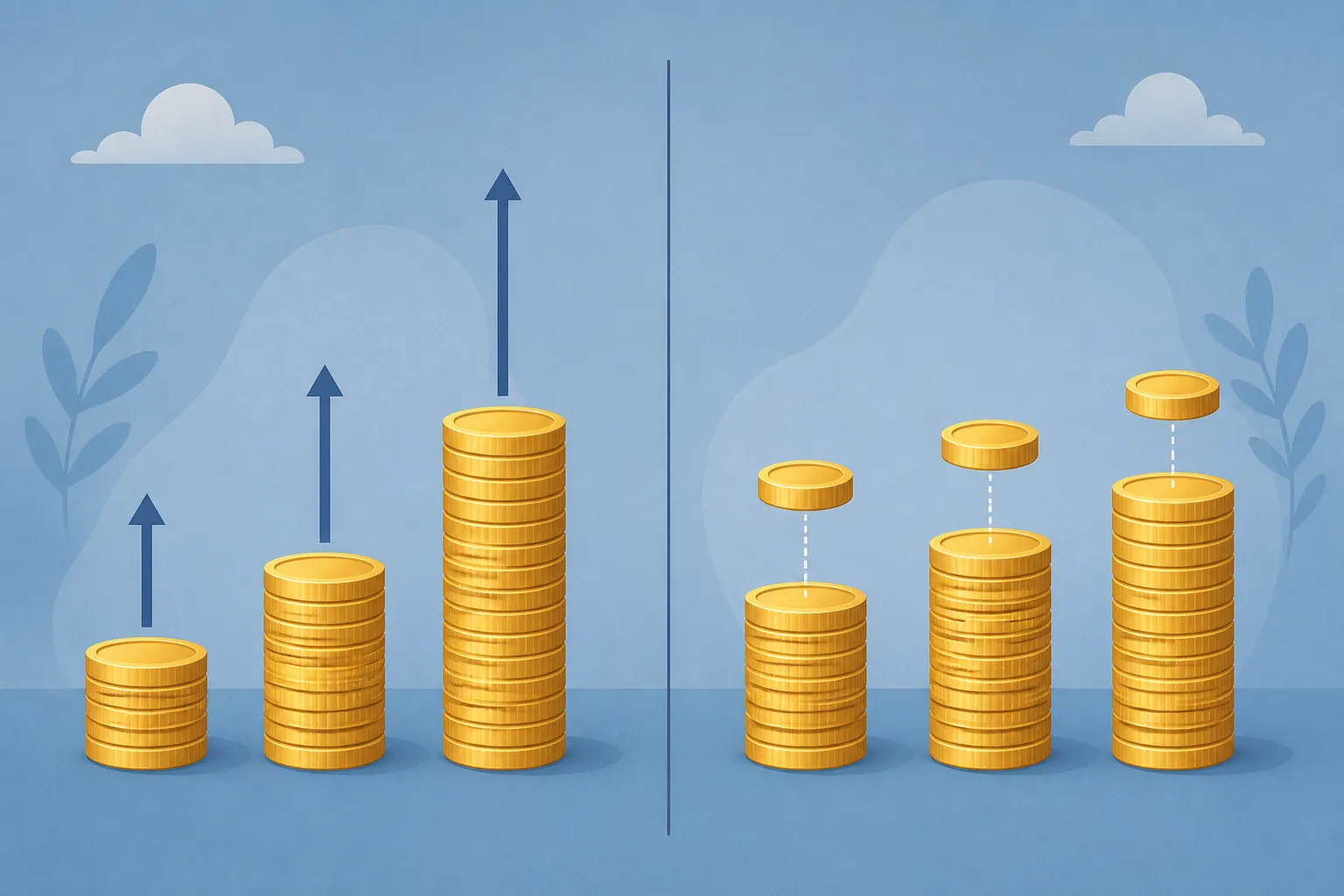
That distinction is why the phrase “benefit cut” can mislead unless it is defined. A flat-rate COLA would not, by itself, mean SSA subtracts money from this month’s check. For many beneficiaries, it would mean a smaller future raise than current law would have provided, and that smaller raise would carry forward into later years.
The 2026 example: $34.20 makes the proposal visible
The clearest way to understand the proposal is to put the 2026 COLA into dollars. AARP Public Policy Institute estimated that if the 2026 COLA had been a flat-rate COLA, the increase would have been $34.20 per month — 2.8% of a $1,223 monthly benefit at the 20th percentile. AARP’s estimate compares that with $57.90 per month for the average retired worker under current law and says roughly 80% of beneficiaries would receive smaller increases under the flat-rate design.[3] IBTimes UK reported the same AARP figures.[4]
You may see small differences in average-dollar examples because outlets round differently. The Hill described the 2.8% COLA as about $56 per month for the average retired worker and about $145 at the $5,181 maximum benefit.[5] The direction of the comparison is the important part: the percentage formula gives bigger dollar raises to bigger checks; the flat-rate formula would not.
| Retiree position in the example | Starting monthly benefit used by source | Current-law 2026 COLA dollar raise | Flat-rate COLA dollar raise if proposal had applied | Practical effect |
|---|---|---|---|---|
| 20th-percentile retired-worker benefit | $1,223 | $34.20 under AARP’s 2.8% example [3] | $34.20 [3] | About the same, because this is the benchmark. |
| Average retired worker | Not stated in the cited AARP estimate | $57.90 in AARP’s estimate [3]; The Hill describes roughly $56 [5] | $34.20 [3] | Smaller monthly raise than current law. |
| Maximum-benefit retiree | $5,181 maximum benefit in The Hill’s illustration | About $145 [5] | $34.20 [3] | Much smaller monthly raise than current law. |
For the person receiving a very small benefit, the equal-dollar design can be helpful. A $34.20 increase on a benefit below the 20th-percentile benchmark would be more than a 2.8% increase. For the person receiving an average or high benefit, the same $34.20 would be less than the current-law dollar increase.
Who gets more, and who gets smaller raises over time
The winners in a flat-rate COLA are beneficiaries whose checks are below the benchmark used to set the equal-dollar increase. They would receive a larger COLA than they would under the same-percentage formula. The beneficiaries above that benchmark would receive smaller increases, and AARP’s estimate says that group is roughly 80% of beneficiaries.[3]
The part that matters most is not just one January deposit. COLAs build on the benefit amount already in place, so a smaller raise in one year becomes part of the base for later years. AARP illustrates that compounding with a hypothetical retiree who starts benefits at 65 in 1998: by age 93, the retiree would receive about $22,600 per year under current law versus about $18,000 under a flat-rate COLA, with a cumulative difference of about $77,900 in 2026 dollars.[3][4]
That AARP example is not a scheduled loss for today’s retirees. It is an illustration of how smaller annual increases can accumulate when repeated over decades.

Why policy analysts discuss the idea
The flat-rate COLA is discussed because it would slow the growth of total scheduled benefits while shielding the lowest-benefit retirees from the largest percentage reductions. CRFB estimated that the proposal would close about half of Social Security’s 75-year shortfall. In its modeling, benefits by 2065 would be about 3% lower than current law for the bottom fifth of lifetime earners and about 19% lower for the top fifth.[2]
Those CRFB figures are reductions relative to scheduled current-law benefits in a long-range model. They should not be read as an enacted cut to this year’s payment, and they should not be mixed casually with separate Trustees projections about trust-fund depletion and payable benefits.
What this means for your check right now
For 2026, your Social Security COLA remains the current-law 2.8% increase. The flat-rate COLA is a proposal, not a payment rule. It does not change your benefit notice, your January 2026 COLA, or the formula SSA is using for this year’s increase.[1]
If Congress ever advances a flat-rate COLA bill, the personal question to ask will be where your current benefit sits compared with the 20th-percentile benchmark. Below that line, the equal-dollar COLA could be larger than your current-law percentage increase. Near that line, the difference could be small. Above that line, the raise would likely be smaller than current law, and the gap would grow if the formula stayed in place for many years.
For the separate question of whether Social Security COLAs keep up with senior costs, see Does Social Security COLA keep up with inflation for seniors?. For the next annual calculation, see How Is the 2027 Social Security COLA Calculated?. And for the different question of what can actually reduce the amount that lands in a bank account, including premium withholding and trust-fund issues, see Can the 2027 Social Security COLA Be Cut? Your Check Can.
References
- Cost-of-Living Adjustment (COLA) Information, Social Security Administration.
- A Flat-Rate COLA for Social Security, Committee for a Responsible Federal Budget, July 21, 2026.
- Flat-Rate Social Security COLA Cuts, AARP Public Policy Institute.
- Impact Of Flat-Rate COLA On Social Security Benefits, IBTimes UK.
- Flat-rate cost-of-living adjustment Social Security funding analysis, The Hill.
Browse more in the Glossary.