
Clinical term
Are GLP-1 Weight Loss Drugs Safe for Seniors?
Last verified 2026-07-28
Last verified: July 28, 2026. This article is educational and is not a substitute for medical advice, diagnosis, or treatment. GLP-1 prescribing for an older adult should be reviewed with the person’s clinician and pharmacist, especially if they are frail, losing strength, taking several medications, or having trouble eating or drinking.
The short answer is: GLP-1 weight loss drugs can be safe for some seniors, but “safe” depends less on age alone than on frailty, nutrition, hydration, kidney function, and the rest of the medication list. A sturdy 68-year-old with obesity, diabetes, and good protein intake is not in the same situation as an 84-year-old who already has a poor appetite, uses a walker, and gets lightheaded when standing.
That distinction matters because the side effects that are merely unpleasant for a younger adult can become household safety problems for an older one. Nausea can mean missed meals. Vomiting or diarrhea can mean dehydration. Appetite suppression can mean less protein. Dizziness can mean a fall in the hallway before anyone realizes the medication has changed the risk at home.

GLP-1 medicines include drugs such as semaglutide and tirzepatide. They can reduce appetite and improve blood sugar control, and in some patients they also support meaningful weight loss. For seniors, the practical question is not whether these drugs “work.” It is whether the benefit is worth the added strain on eating, drinking, strength, balance, and medication timing.
Which seniors are most likely to do well on a GLP-1?
The safest candidates are usually older adults who have a clear metabolic reason for treatment, enough reserve to tolerate appetite changes, and a plan for monitoring side effects before they become emergencies. The riskiest candidates are not simply “old.” They are undernourished, already losing muscle, frequently dizzy, dehydrated, socially isolated, or taking medications where a small change in absorption or fluid balance could matter.
| Senior’s situation | How the safety question changes |
|---|---|
| Healthy older adult with obesity and good function | A GLP-1 may be reasonable if weight loss goals are medically appropriate and muscle, hydration, and side effects are monitored. |
| Older adult with type 2 diabetes or cardiovascular risk | The benefit case may be stronger, especially when blood sugar, kidney, or cardiovascular outcomes are part of the goal. |
| Frail, undernourished, or already losing strength | The threshold for prescribing should be higher, and baseline nutrition and function should be assessed before starting. |
| Older adult taking many oral medications | A pharmacist review is important because delayed stomach emptying may affect timing or absorption of some medicines. |
In pooled SUSTAIN 1-5 trial data, semaglutide showed comparable blood sugar and weight-loss efficacy in adults 65 and older compared with younger adults, but older adults had higher rates of treatment discontinuation because of gastrointestinal adverse events. The same analysis also shows why caution is still needed for the oldest adults: only 3% of SUSTAIN participants were 75 or older.[1]
That is a useful but limited reassurance. Trial evidence in older adults with type 2 diabetes does not automatically answer the question for an 82-year-old using a GLP-1 only for weight loss, especially if that person is already frail or eating poorly.
The muscle question should come before the scale
Weight loss in later life is not all the same kind of weight. Some loss may be fat, which can improve health. Some may be lean mass, which includes muscle. For an older adult, losing muscle can mean standing up from a chair more slowly, walking less confidently, needing help with stairs, or losing the margin that kept them independent.

Natural aging is already associated with a 12-16% reduction in skeletal muscle mass, and up to half of adults over 80 experience sarcopenia. Reviews of GLP-1-associated weight loss have reported that lean mass may account for a wide range of lost weight, from 15% to 60%, depending on the study and population.[2]
That range should not be read as a prediction for one individual. It does mean that an older adult should not start treatment with only a starting weight and a target weight written down. Baseline strength and function deserve the same attention as the number on the scale.
Before prescribing, the clinician should know whether the person has recently lost weight without trying, has trouble rising from a chair, has stopped walking as far as usual, has had falls or near-falls, or is eating less protein than they used to. An Annals of Internal Medicine editorial by Kakkar and colleagues recommends assessing baseline muscle mass, physical function, and nutrition before prescribing these medications to older adults.[3]
The home version of that assessment is plain but important: watch whether pants are looser at the waist only, or whether the person’s arms, thighs, grip, and walking confidence are shrinking too. If a parent is losing weight but also stops carrying groceries, avoids stairs, or needs both arms to push up from a chair, that is not a small detail to save for the next annual visit.
Practical muscle safeguards
- Ask for a baseline frailty or function check before starting, especially after age 75 or after any recent fall, hospitalization, or unplanned weight loss.
- Discuss a protein goal. The National Resource Center on Nutrition & Aging cites a target of 1.0-1.2 grams of protein per kilogram of body weight per day for many older adults, though kidney disease or other conditions may change that goal.[4]
- Pair the medication plan with resistance exercise if it is medically safe. The CDC recommends muscle-strengthening activities at least 2 days per week for older adults.[5]
- Track function, not just pounds: chair stands, usual walking distance, stair tolerance, grip, and whether the person is avoiding activities they used to do.
Nausea, dehydration, dizziness, and falls belong in the same conversation
The fall risk discussion around GLP-1s is easy to overstate and easy to miss. Current evidence does not prove that GLP-1 medicines broadly increase falls in seniors. But the pathway from gastrointestinal side effects to dehydration, then to orthostatic dizziness and falls, is very real in everyday care.
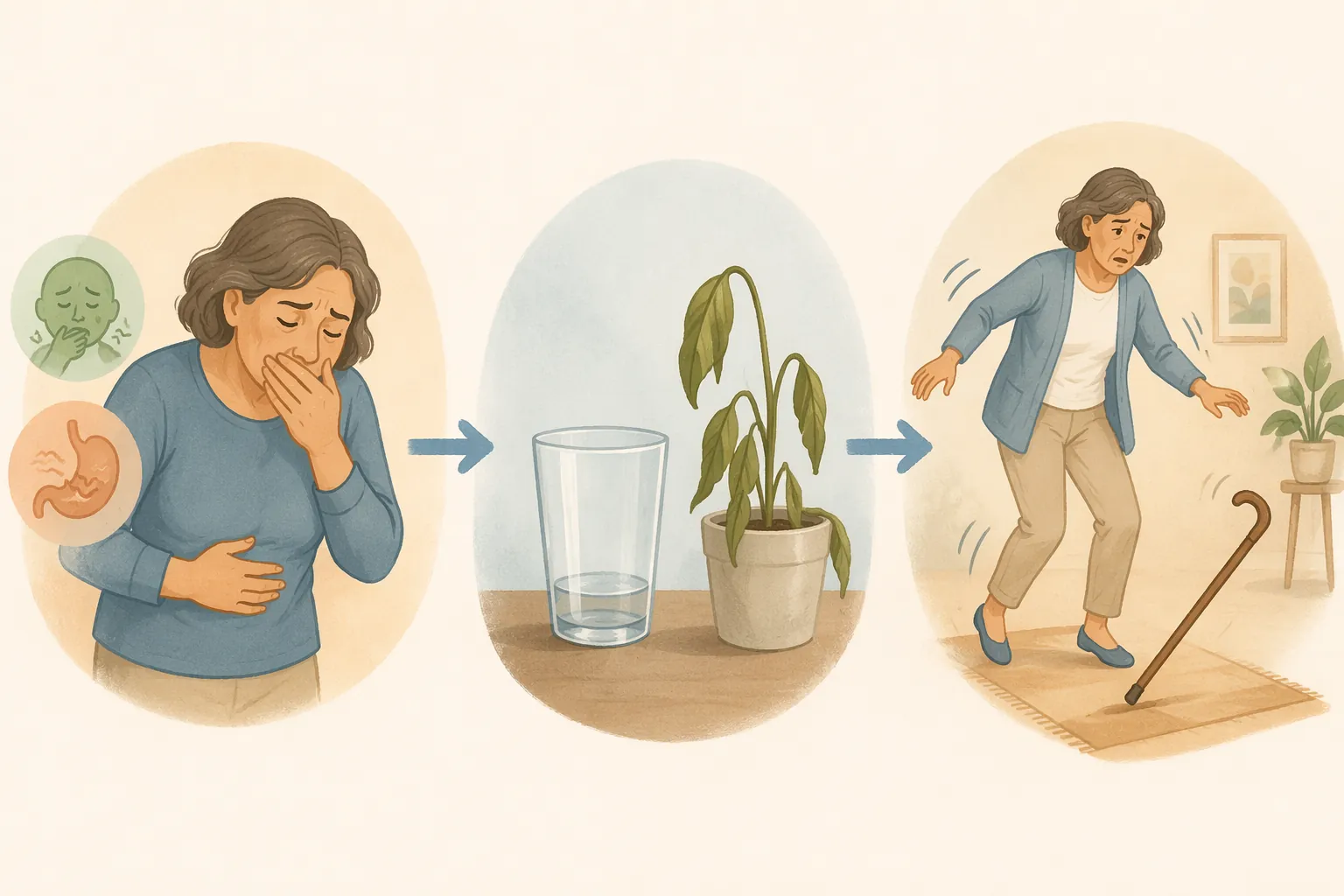
Yale Medicine researchers have flagged that nausea, vomiting, and diarrhea can cause dehydration, which may lead to orthostatic dizziness and falls in older adults.[6] Dr. John Batsis of UNC Geriatrics put the home-safety concern plainly: “Severe gastrointestinal side effects from these drugs may lead to dehydration, which can lead to falls.”[7]
For a younger person, a day of poor intake may mean feeling washed out. For an older adult on blood pressure medicines, diuretics, diabetes medicines, or kidney-sensitive medications, the same day can change balance, blood pressure, and alertness. If they are also trying not to drink because bathroom trips are difficult, the risk rises quietly.
This is the same dehydration-to-fall pathway families should already watch during hot weather. If that pattern is familiar in your household, review how to protect an elderly person during a heatwave and prevent falls before the first injection, not after the first dizzy spell.
What to monitor during dose changes
- Fluid intake: whether the person is drinking less than usual, avoiding fluids, or skipping drinks to reduce bathroom trips.
- Standing symptoms: dizziness, wobbliness, black spots in vision, or needing to sit back down after rising.
- GI symptoms: vomiting, diarrhea, persistent nausea, or inability to keep food and fluids down.
- Bathroom changes: much less urination than usual, very dark urine, constipation, or new urgency that makes rushing more likely.
- Walking changes: new use of furniture for support, cane slipping, shorter steps, or avoiding the hallway at night.
If a fall happens while a senior is taking a GLP-1, do not treat it as an unrelated accident until medication timing, hydration, blood pressure, blood sugar, and recent GI symptoms have been reviewed. For the immediate home response, see Your Parent Just Fell: A Caregiver’s Guide to the First 72 Hours.
Medication timing matters when someone already takes several prescriptions
Many seniors do not start a GLP-1 with an empty medicine cabinet. Older adults average 4.5 prescription medications, and that does not include over-the-counter sleep aids, antacids, supplements, pain relievers, or “only when needed” pills that may not make it into the chart.[8]
GLP-1 medicines slow gastric emptying. That can change how quickly some oral medications are absorbed, which may matter more for drugs where timing or blood levels are important.[9] The right response is not panic; it is a pharmacist-level medication review before the first dose and again after dose increases if symptoms change.
The review should include diabetes medicines, blood pressure medicines, diuretics, anticoagulants, thyroid medication, seizure medication, pain medicines, constipation treatments, and any drug that must be taken at a specific time or separated from food. If nausea leads to skipped meals, diabetes medicines may also need closer attention because the meal pattern has changed.
What does the benefit evidence show for older adults?
The benefit side should not be brushed aside. For some older adults, especially those with type 2 diabetes, obesity, kidney risk, or cardiovascular risk, a GLP-1 may reduce more than weight. The better question is whether the person in front of the clinician resembles the patients in the evidence.
A 2026 Journal of the American Geriatrics Society study of patients 80 and older with type 2 diabetes found GLP-1 receptor agonists were associated with 14% lower major adverse cardiovascular event risk, 14% lower major adverse kidney event risk, and 18% lower all-cause mortality compared with DPP-4 inhibitors. Gastrointestinal side effects were slightly higher, with a hazard ratio of 1.07, but the study did not find increased fracture or fall risk.[10]
That is reassuring for appropriately selected very old adults with type 2 diabetes. It does not erase the need for caution in a frail older adult using the drug only for weight loss. It also does not prove that every senior will tolerate the medication well at home. It does show that age 80 by itself should not be treated as an automatic “no.”
What if a senior stops the GLP-1?
Stopping is common enough that it should be part of the first conversation, not an afterthought. In a 2025 JAMA Network Open study, 46-65% of adults on GLP-1 receptor agonists discontinued within 12 months, and 36-47% reinitiated treatment.[11]
For older adults, repeated loss and regain may be more concerning if fat returns faster than muscle. That is a body-composition concern, not a guaranteed outcome for every person. Still, it is a good reason to ask what the long-term plan is: how long treatment is expected to continue, what happens if side effects become too much, and how nutrition and strength will be protected during any pause or stop.
Questions to take to the prescriber before starting
A useful appointment does not end with “Call if you have side effects.” The plan should say which side effects matter, who to call, and whether the next dose should wait if eating or drinking has gone badly.
- Frailty and strength: Should we check baseline muscle, walking speed, chair stands, grip, or recent falls before starting?
- Nutrition: What daily protein target is appropriate for this person, and does kidney disease change that target?
- Hydration: How much fluid is reasonable, and what should we do if nausea, vomiting, diarrhea, heat, or poor intake begins?
- Kidney function: Should labs be checked before starting or after side effects, especially if dehydration occurs?
- Medication list: Which oral medicines could be affected by delayed stomach emptying, skipped meals, or dehydration?
- Dose schedule: Will titration be slower than usual because of age, frailty, prior GI problems, or fall risk?
- Stop rules: Which symptoms mean calling before the next injection rather than waiting for the next visit?
Families also need permission to talk about goals honestly. If the main goal is better diabetes or cardiovascular risk control, the benefit-risk balance may look different than if the main goal is a smaller clothing size. If the older adult already has poor appetite, visible muscle loss, or unstable walking, the first medical goal may be rebuilding reserve before pursuing weight loss.
Red flags before the next dose
Call the prescribing clinician, pharmacist, or the appropriate urgent care line before the next dose if any of these occur:
- Repeated vomiting, diarrhea, or inability to keep fluids down.
- New dizziness, fainting, near-fainting, or a fall.
- Noticeably less urination, very dark urine, confusion, or unusual sleepiness.
- Rapid decline in walking, stair climbing, chair rising, or grip strength.
- Skipped meals while still taking diabetes medicines or other medications that depend on food intake.
- Any symptom that makes the person avoid drinking, walking, or getting up normally.
The safest GLP-1 plan for a senior is not just a prescription. It is a prescription plus a nutrition plan, a hydration plan, a medication review, a strength-preservation plan, and clear instructions for what to do when side effects start at home.
References
- Semaglutide as a therapeutic option for elderly patients with type 2 diabetes: pooled analysis of the SUSTAIN 1-5 trials, PMC, 2018.
- GLP-1s and the Older Patient: Weighing Benefits and Risks, Endocrine News, 2025.
- Clinical Considerations for Obesity Pharmacotherapy in Older Adults, Annals of Internal Medicine, 2025.
- Protein Needs for Older Adults, National Resource Center on Nutrition & Aging.
- Physical Activity Guidelines for Older Adults, CDC.
- What Older Adults Should Know About Taking GLP-1 Medications, Yale Medicine, 2025.
- GLP-1 Medications and Older Adults, UNC School of Medicine.
- Older Adults and Polypharmacy, Hebrew SeniorLife, 2025.
- GLP-1 Receptor Agonists and Oral Medication Absorption, PlexusDx.
- GLP-1 Receptor Agonists and Outcomes in Adults 80 Years and Older With Type 2 Diabetes, Journal of the American Geriatrics Society, October 2025.
- Discontinuation and Reinitiation of GLP-1 Receptor Agonists Among US Adults, JAMA Network Open, 2025.
Browse more in the Glossary.