
STEADI: Intervene
How to protect elderly during heatwave and prevent falls
Heatwaves increase fall risk in older adults through dehydration and orthostatic hypotension. This guide goes beyond cooling tips to show you how to protect older adults by addressing hydration routines, medication timing, and early dizziness warning signs.
During a heatwave, the frightening image is often heat stroke: a person flushed, confused, dangerously overheated. That danger is real. But in an older adult at home, trouble can start earlier and look much quieter. A half-finished glass sits by the chair. The morning pills are already taken. The room is warm. Someone stands up, feels “just a little wobbly,” reaches for the counter, and does not get there in time.
That is why protecting an older adult during a heatwave should include fall prevention, not only cooling advice. In a large study of 30,634 older adults, dehydration was present in 37.9% of participants and was associated with 13% higher odds of falling. The study does not prove that dehydration alone caused the falls, but it gives weight to a household pattern many caregivers recognize: balance often gets worse when heat, low fluid intake, and standing up quickly meet in the same few seconds. [1]
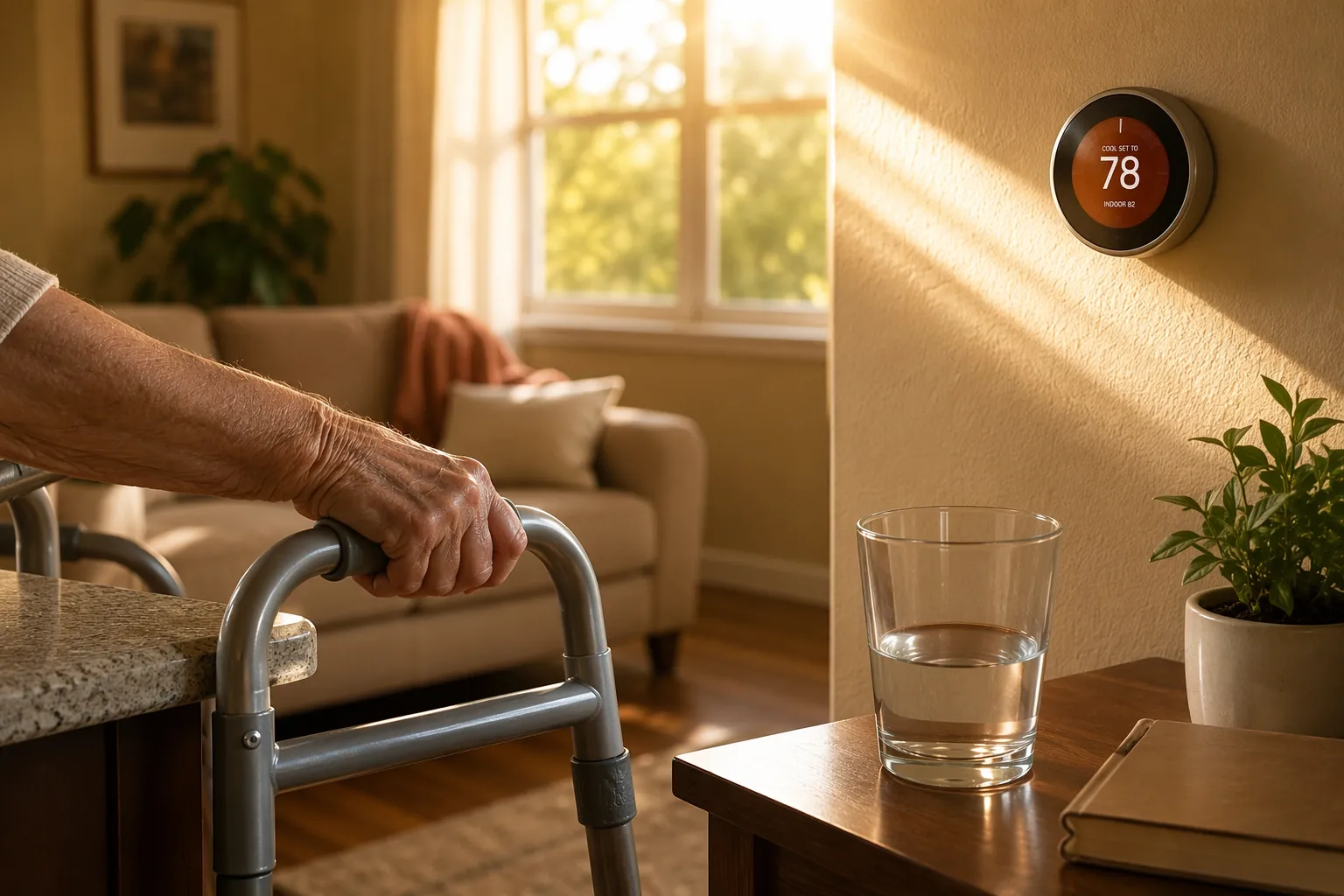
Older adults are more vulnerable to heat for several reasons at once: the body’s thirst response can be less reliable, chronic conditions may interfere with heat regulation, medications can change sweating or fluid balance, and some people have limited access to air conditioning or cooler spaces. [2] At the population level, a Harvard Chan School study estimated 9 extra deaths per 10,000 older adults per heat wave, a reminder that heat exposure is not a minor inconvenience for this age group. [3] Inside the home, though, the first preventable emergency may be a fall.
The fall pathway that heat safety advice often misses
Heat changes circulation before anyone looks dramatically ill. Blood vessels widen to help the body release heat. Sweating and low fluid intake can reduce circulating volume. When an older adult stands, gravity pulls blood toward the legs; the body has to tighten blood vessels and raise heart rate quickly enough to keep blood flowing to the brain. If that adjustment lags, blood pressure can drop and the person may feel lightheaded, weak, blurry, or suddenly unsteady.
That standing moment is the dangerous interval. It may happen after getting out of bed, rising from the toilet, standing from a recliner, stepping out of a warm shower, or walking to the kitchen after sitting through the hottest part of the afternoon. The older adult may not say “I’m dehydrated.” They may say, “I’m fine,” “I’m just a little dizzy,” or “My legs feel funny.” Those phrases deserve attention during a heatwave.
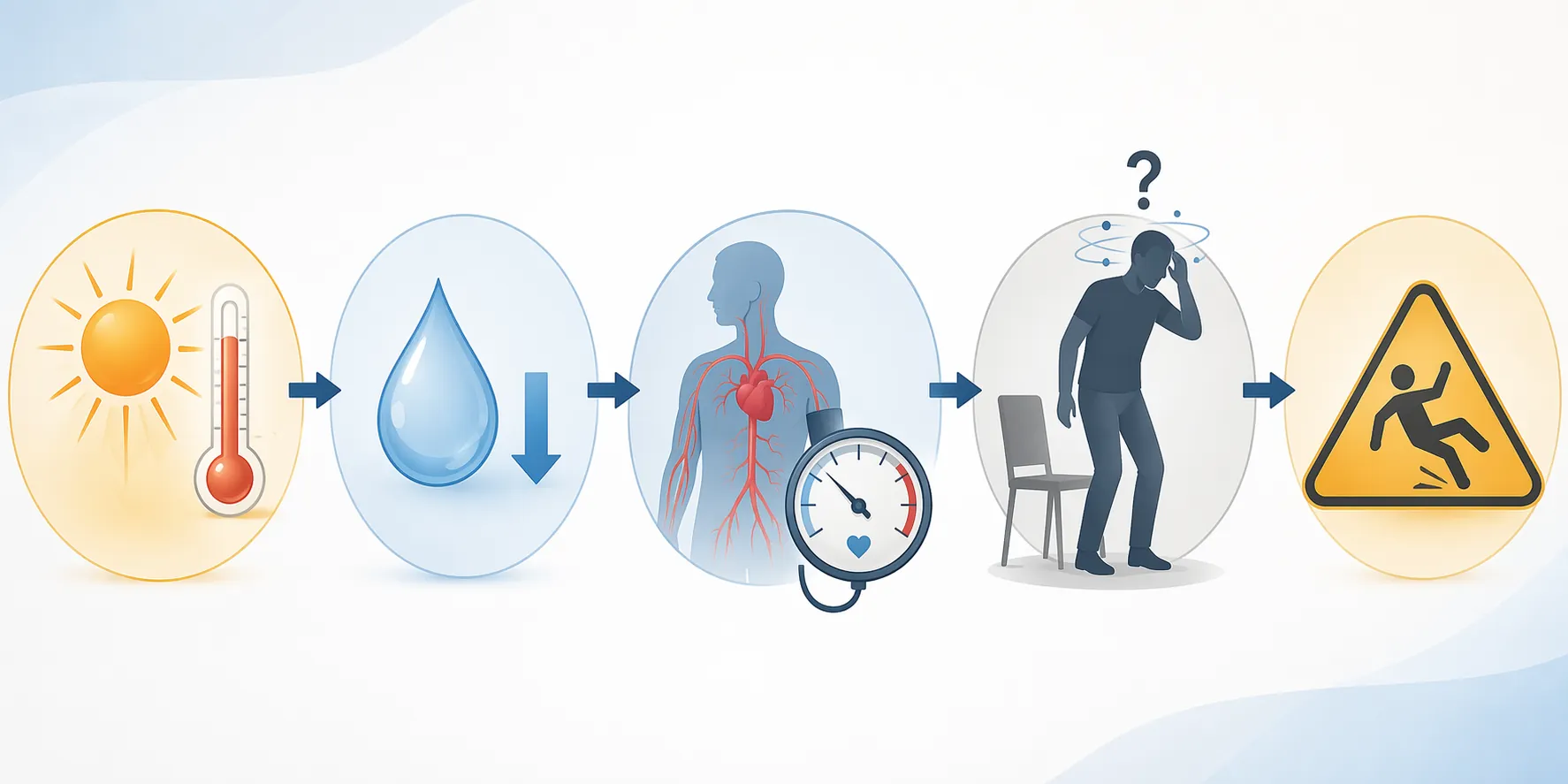
The problem is not only that older adults may forget to drink. A geriatrician quoted by Brown Health notes that older adults have about 10–15% less total body water than younger adults, and heat illness in seniors may present atypically rather than with obvious thirst or classic symptoms. [4] That matters because a person can be sliding toward unsafe fluid balance before they feel thirsty enough to ask for water.
The Mayo Clinic Proceedings study is useful here because it connects dehydration with falls in a large older-adult sample. It should not be read as a promise that drinking more water will erase fall risk. Falls also involve vision, strength, footwear, flooring, sleep, cognition, blood pressure, medications, and hazards in the room. But dehydration is one of the few heat-related factors that can be noticed early and built into a daily routine. [1]
Medications can make a hot day less forgiving
Medication is where casual heat advice becomes too thin. The CDC’s clinical guidance on heat and medications lists several drug classes that can raise heat-related risk, including diuretics, beta-blockers, anticholinergics, antipsychotics, SSRIs, and GLP-1 agonists. The risks can include dehydration, impaired sweating, low blood pressure, fainting, and falls. [5]
In the dehydration-and-falls study, loop diuretics were associated with a 26% higher fall-or-death risk, and antidepressants were associated with a 58% higher fall-or-death risk. [1] Those figures should not send anyone to change a dose on their own. They should prompt a practical question before the worst heat arrives: does this person’s medication list deserve a heatwave review by a clinician or pharmacist?
That review is especially important when an older adult takes a water pill, has heart or kidney disease, has had fainting or near-fainting before, has recently started a new medication, or already reports lightheadedness when standing. The useful request is specific: “During this heatwave, are any of these medicines more likely to cause dehydration, low blood pressure, dizziness, or falls, and what symptoms should make us call you?”
Build the hot-day routine around the moments when falls happen
A good heatwave plan for an older adult at home should feel less like surveillance and more like removing traps from the day. The goal is not to force constant sipping or hover at every doorway. It is to make hydration visible, reduce unnecessary walking during the hottest hours, and slow down the stand-up moments that commonly produce dizziness.
| Hot-day moment | Fall-prevention move |
|---|---|
| Waking up | Place water within reach before getting out of bed; sit at the edge of the bed before standing. |
| Breakfast and morning pills | Pair medication time with a full, clinician-appropriate drink rather than a small sip. |
| Late morning | Check whether the living area is actually staying cool; move to the coolest room before the home heats up. |
| Afternoon heat | Keep walking routes short; avoid optional chores, laundry trips, outdoor errands, and long standing tasks. |
| Bathroom trips | Use night lights, grab bars if available, stable footwear, and a pause before walking away from the toilet. |
| Evening | Look back for warning signs: dizziness, unusual fatigue, confusion, poor intake, or near-falls. |
Tie fluids to anchors that already exist
“Drink more water” is easy advice to give and easy to fail. A better routine attaches fluids to events that already happen: waking, breakfast, taking pills, lunch, an afternoon snack, dinner, and brushing teeth. If the person has been told to restrict fluids because of heart failure, kidney disease, or another condition, the clinician’s instructions come first. For everyone else, the practical question is whether the day has enough built-in prompts before thirst becomes the only reminder.
Visible cues help. A glass by the favorite chair works only if it is easy to reach and actually gets refilled. A lightweight bottle may be easier for weak hands than a heavy glass. Water-rich foods can be useful when plain water is unappealing, but they should supplement—not replace—a hydration plan that fits the person’s medical conditions.
Make standing up slower than usual
On hot days, the first step after standing should not be automatic. Ask the older adult to pause after sitting up, place both feet on the floor, stand with support, and wait a few seconds before walking. This is especially important after lying down, using the bathroom, bathing, eating, or sitting for a long time in a warm room.
Caregivers can make that pause easier without making the home feel medical. Put the walker where the person stands, not across the room. Clear the path from chair to bathroom. Move the phone, water, tissues, remote, and medications within reach so that fewer trips begin with a sudden stand-and-turn movement. If the person tends to rush to answer the door or phone, make a plan for letting it ring.
Use cooling measures as the baseline, not the whole plan
Air conditioning, cooler indoor spaces, light clothing, cool showers or baths, and attention to indoor temperature are still essential. The CDC identifies access to cooling, health conditions, medications, and reduced thirst response as major heat-risk issues for older adults. [2] If the home cannot be kept cool, the safer plan may be spending part of the day with family, in a cooling center, library, senior center, or another air-conditioned place.
Cooling also reduces fall risk indirectly. A cooler person sweats less, loses less fluid, and is less likely to become weak or lightheaded from heat strain. The mistake is treating cooling as separate from mobility. During a heatwave, the home should be arranged so the older adult can stay cool without repeatedly walking long distances for water, fans, clothing changes, or the bathroom.
Warning signs to treat as early fall risks, not vague complaints
Dizziness on standing is one of the most important heatwave warnings because it sits directly on the path to a fall. The response should be immediate and ordinary: sit back down, cool the room or move to a cooler place, offer appropriate fluids if allowed, and do not resume walking until the feeling has passed. If it keeps happening, the clinician needs to know, especially if medications or poor intake are involved.
Older adults may not show heat illness in the same obvious way younger people do. Jefferson Health notes that delayed thirst, lack of perspiration, and behavioral changes can be important signs in older adults. [6] A parent who is suddenly more irritable, sleepy, withdrawn, confused, or “not themselves” during a heatwave should not be brushed off as having a bad afternoon.
- Sit or lie down right away if there is dizziness, faintness, blurred vision, sudden weakness, or a near-fall.
- Call a clinician promptly if lightheadedness on standing repeats, fluid intake has been poor, urination is much less than usual, or a new medication may be involved.
- Seek urgent medical help for fainting, serious confusion, unusual behavior change, signs of heat stroke, or any fall with injury, head impact, or inability to get up safely.
It is also worth asking about the near-misses. Many older adults will not volunteer that they grabbed the counter, sat back down quickly, or felt the room tilt for a moment. A calm question works better than an alarmed one: “When you stood up today, did you feel steady?” The answer can reveal the problem before the fall does.
A practical heatwave check-in that preserves independence
For an older adult who dislikes being fussed over, a check-in can be framed around comfort and convenience rather than fragility. Ask whether the room is cool enough, whether the water is easy to reach, whether standing feels steady, and whether any errands can wait until the heat breaks. The point is not to take over the day. It is to remove the few conditions that make a normal day suddenly unsafe.
For the adult child, the most useful pattern is predictable contact before the hottest part of the day and again afterward. Morning is the time to confirm fluids, cooling, medications, and plans. Late afternoon is the time to ask about dizziness, confusion, appetite, bathroom trips, and whether the person stayed mostly in cooler areas. If the answers sound off, that is a reason to visit, arrange help, or call a clinician rather than waiting for a dramatic emergency.
Protecting an older adult during a heatwave is not only about preventing heat stroke. It is also about preventing the quiet dizziness that arrives when a warm room, low fluids, medication effects, and standing up collide. That is the moment a fall can happen before anyone thinks to call it heat-related.
References
- Association Between Dehydration and Falls in Older Adults, Mayo Clinic Proceedings
- Heat and Older Adults (Aged 65+), CDC
- Heat waves and annual death rates in older adults in the United States, Harvard T.H. Chan School of Public Health
- How Seniors Can Stay Safe This Summer, Brown Health
- Heat and Medications – Guidance for Clinicians, CDC
- How to Recognize the Signs of Heatstroke in Older Adults, Jefferson Health
Related reading
Noticed something outdated or inaccurate on this page? Flag a correction. We review every report against CDC, NIA, and AARP HomeFit guidance before updating a page.
Part of the Fall Prevention section.