
Clinical term
How Golf Helps Seniors Prevent Falls and Stay Safe
Last verified 2026-07-27
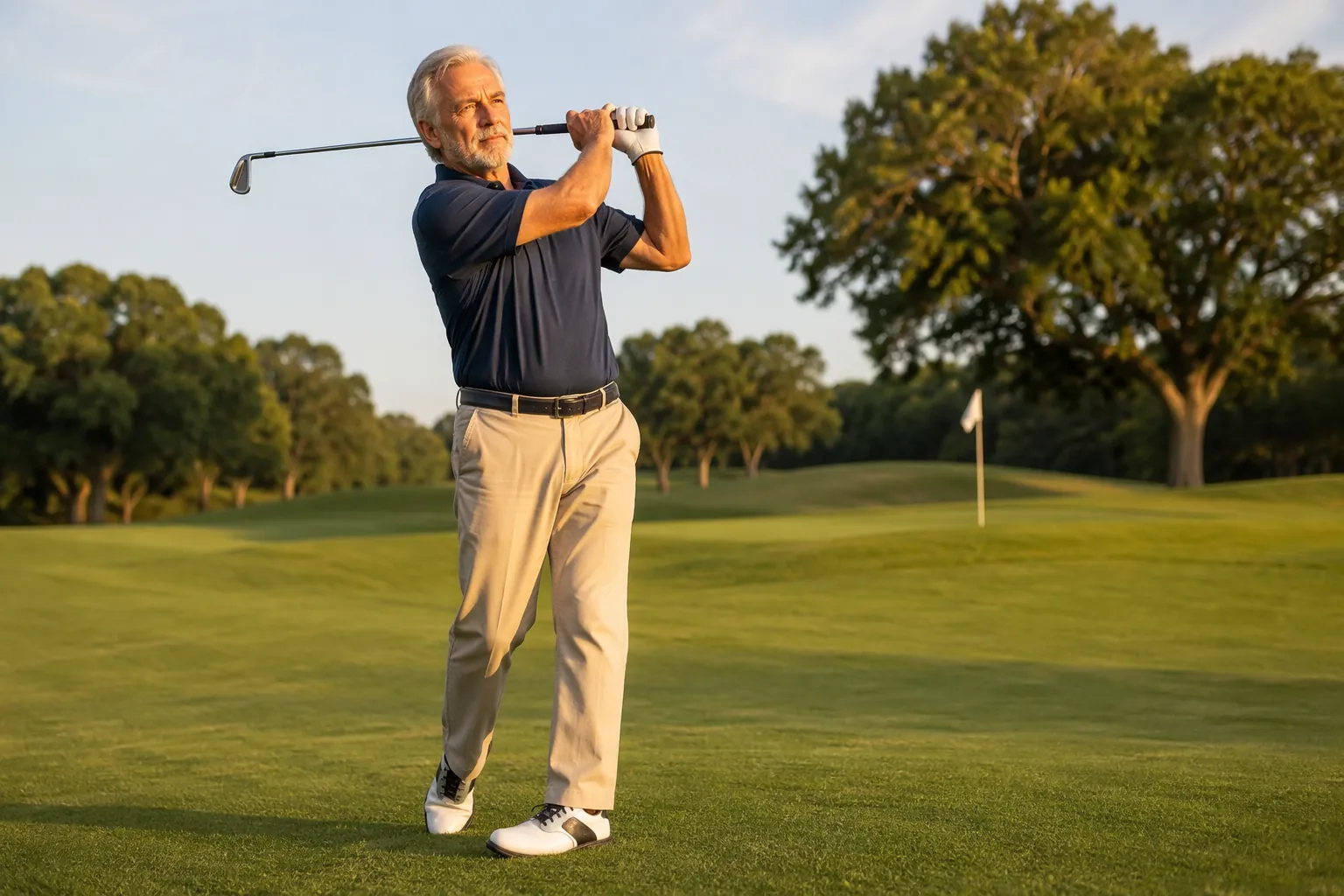
If balance exercises feel like homework, golf can count as serious fall-prevention work—but with a careful answer. Regular golf asks an older adult to walk, shift weight, rotate the trunk, bend, rise, stand on uneven grass, and finish a swing without losing position. Those are not decorative movements. They are the same kinds of balance, leg strength, and confidence demands that matter when someone catches a toe on a rug or steps off a curb.
The evidence is strongest when we talk about balance and staying with the activity. Studies summarized by Banner Health reported that golfers ages 65 to 79 had better static and dynamic balance than non-golfers of the same age, and one study also found better balance confidence among older golfers.[1] That does not prove golf prevents falls in every healthy senior. It does make golf worth taking seriously as a fall-prevention-friendly activity, especially for someone who will not do a printed balance routine more than twice.
What Golf Trains That Matters for Falls
A fall rarely comes from one weak muscle. More often, the problem is a chain: the person cannot shift weight quickly enough, the feet are uncertain on uneven ground, the trunk is stiff, the legs are slow to respond, and confidence has already dropped. Golf touches several links in that chain during an ordinary round.
Start before the swing. Walking from the parking lot, stepping over curbs, standing near the cart path, and moving across grass all ask the feet and ankles to read changing surfaces. Even golfers who ride a cart still have to get in and out, walk to the ball, approach bunkers or slopes, and stand with one foot slightly higher than the other. That is more useful than it may look from a distance.
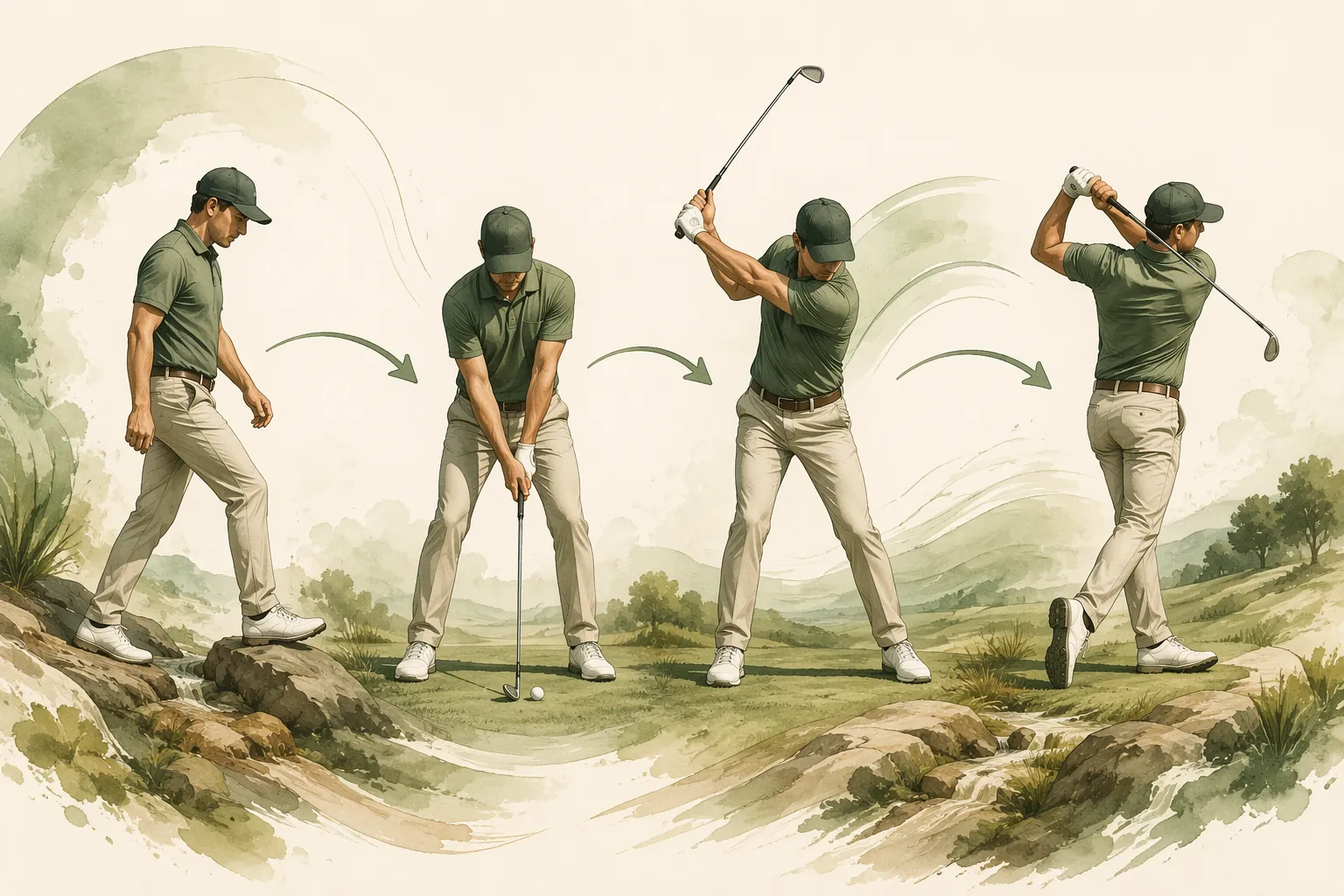
Then comes the address position: knees slightly bent, hips hinged, weight shared between the feet. Holding that position is a quiet leg-strength task. The swing adds rotation through the trunk and hips, a controlled weight shift, and a finish that requires the golfer to stop without stepping out of balance. A good fall-prevention program does not only strengthen muscles; it teaches the body to move and then settle again.
That helps explain why the older-golfer balance findings are meaningful. Tsang and Hui-Chan reported significantly better static and dynamic balance in older golfers than same-age non-golfers; Gao and colleagues reported better balance confidence and dynamic balance among older golfers as well, as summarized by Banner Health.[1] These studies do not tell us that every senior who takes up golf will fall less. They do show that people who regularly play golf may carry measurable balance advantages.
The Evidence Is Promising, but It Has Edges
The cleanest wording is this: golf has plausible fall-prevention mechanisms and supportive balance data in older adults, while direct fall-reduction evidence is stronger in Parkinson’s disease research than in large trials of generally healthy seniors.
A 2021 narrative review focused on older adults with Parkinson’s disease concluded that golf may lower fall risk in community-ambulating older adults and may improve quality of life.[2] Parkinson’s matters here because balance impairment, gait changes, and fall risk are central concerns. But it also means we should not pretend the findings automatically apply in the same way to every 72-year-old who is simply deconditioned or nervous after a near-miss.
There is also broader evidence that golf is real physical activity, not just a pleasant walk interrupted by swings. A scoping review of 301 studies described golf as moderate-intensity physical activity, reporting 4.5 METs, 531 to 2,467 kilocalories expended per 18 holes, and 4 to 8 miles walked per round.[3] Those numbers are useful because they remind us not to dismiss golf as sitting in a cart with a club in hand. Still, calories and mileage are not the same thing as fall prevention. The fall-prevention argument depends more on balance, weight shifting, lower-body work, and repeated practice.
Mortality research belongs in the background, not the driver’s seat. A Swedish cohort study of 300,818 golfers found 40% lower mortality among golfers, but the authors noted that lifestyle and socioeconomic differences may help explain the association.[4] That is a reason to be interested, not a reason to tell a worried daughter that golf itself is a proven life-extending prescription.
Why Enjoyment Is Not a Soft Detail
In fall prevention, the best exercise is not the one with the prettiest handout. It is the one that gets repeated. This is where golf deserves more attention than it usually gets in senior health conversations.
The 2021 review described Johnson and colleagues’ adherence data in people with Parkinson’s disease: 86% of participants assigned to golf stayed with it, compared with 33% assigned to Tai Chi.[2] That gap is too large to wave away as a personality preference. Tai Chi has a respectable place in balance training, but an exercise cannot help much from the kitchen counter, the closet, or the class someone stops attending.
Golf has a few built-in advantages for adherence. It has a start time. Someone may be waiting. There is a skill to improve without calling it rehabilitation. There is enough conversation to make the effort feel adult rather than supervised. For a senior who resists anything that “looks like exercise,” those details can be the difference between moving three mornings a week and agreeing in theory that balance is important.
The adherence number should not be turned into a universal promise. It came from Parkinson’s participants, not from every older adult with every health profile. But it points to something caregivers often learn the hard way: willingness is part of the intervention.
Where Golf Fits in a Fall-Prevention Week
For many seniors, golf works best as a regular movement anchor rather than the whole plan. A nine-hole morning can train walking tolerance, balance on varied ground, trunk rotation, and sit-to-stand-like movements from the cart or bench. Non-course days can fill in the pieces golf does not reliably cover: targeted single-leg balance, calf strength, hip strength, stepping reactions, and getting up from the floor if that is appropriate.
A practical week might include one or two casual rounds, a short putting or range session, and simple home balance work. The home work does not need to compete with golf. It supports it. On days when weather, transportation, fatigue, or cost keep someone off the course, a structured routine such as the fall-prevention exercise progression ladder can keep the balance habit from disappearing.
For an older adult who has already fallen, uses a new assistive device, has dizziness, has numb feet, or has several medications that affect alertness or blood pressure, golf should be part of a broader fall-risk plan. In that situation, it is better to pair enjoyable activity with a medical or physical therapy check-in than to rely on the course to solve everything.
Safety Starts Before the First Swing
Golf looks gentle until the first stiff, cold swing grabs the low back. The low back accounts for 18% to 36% of amateur golf injuries, and annual golf injury rates have been reported between 15.8% and 40.9%, according to AAOS OrthoInfo.[5] That is not a reason to avoid golf. It is a reason to stop treating the first tee shot as the warm-up.
University Hospitals recommends about a 10-minute dynamic warm-up before playing, emphasizing movement rather than long static stretching.[6] A useful warm-up for an older golfer might include easy walking, shoulder circles, gentle trunk turns, hip circles, small practice swings, and a few slow sit-to-stand movements from a bench or cart seat. The goal is not to look athletic in the parking lot. The goal is to arrive at the first swing with the spine, hips, shoulders, and legs already awake.
This matters because proper warm-up is uncommon. NM Ortho notes that less than 3% of golfers warm up properly.[7] Older adults do not need a complicated athletic routine, but they do need enough preparation that the body is not surprised by rotation, bending, and acceleration.
A safer course-day rhythm
- Arrive early enough to warm up for about 10 minutes instead of rushing from the car to the tee.
- Use the first few swings as practice swings, not maximum-effort tests of distance.
- Walk only as much of the course as current stamina allows; using a cart is not a failure if it keeps the round safe.
- Drink before thirst becomes obvious, especially in heat or when medications make dehydration more likely.
- Slow down near slopes, wet grass, bunker edges, curbs, and cart paths; these are common places for a balance challenge to arrive before the golfer is ready.
- Stop for new chest pain, unusual shortness of breath, dizziness, sudden weakness, sharp back pain, or pain that changes the swing or gait.
Shoes matter more than club brand for this purpose. The senior who is playing for balance and confidence needs stable footwear with traction, not slick soles in the clubhouse style. The same practical eye applies to the bag: carrying a heavy bag may add strain, while a push cart, riding cart, or shared cart can keep the day focused on safe movement rather than endurance beyond the person’s current level.
Who Should Check In Before Starting
A healthy senior who already walks comfortably may be able to begin with putting, a driving range session, or a few holes at an easy pace. Others should treat golf as a goal to prepare for, not something to jump into on a crowded Saturday morning.
- Ask a clinician or physical therapist first if there has been a recent fall, repeated near-falls, dizziness, fainting, or a major change in walking.
- Get guidance after joint replacement, spine surgery, fracture, stroke, or a new diagnosis that affects balance or sensation.
- Review medication effects if lightheadedness, sleepiness, or blood pressure drops are part of the picture.
- Start with putting or short-game practice if full swings, long walks, or uneven terrain are too much at first.
This is not about medicalizing a pleasant activity. It is about matching the course to the person in front of us. A flat par-3 course on a weekday morning is a very different assignment from 18 holes on hilly ground in afternoon heat.
Golf Is a Supplement, Not a Complete Fall-Prevention Plan
Golf can be a credible fall-prevention-friendly activity when an older adult can play safely, does it regularly, and treats it as one part of a larger balance and strength routine. It gives the body repeated practice with weight shifting, leg loading, trunk rotation, walking, stopping, and confidence under mild challenge. It also gives many people a reason to come back next week.
The caveat should stay visible: large randomized trials have not yet proved that golf reduces falls in generally healthy seniors. The better-supported statement is that older golfers show stronger balance measures than non-golfers, Parkinson’s-focused research suggests possible fall-risk benefit, and adherence may be unusually strong when golf is compared with more traditional fall-prevention exercise.[1][2]
If the goal shifts from casual play to organized events, family caregivers may also want a separate senior golf tournament etiquette guide. But for fall prevention, the priority is simpler: choose a safe setting, warm up, move often, keep up the home balance work, and do not ignore the warning signs that call for professional help.
References
- The Health Benefits of Golfing for Older Adults, Banner Health.
- Golf as a Physical Activity to Potentially Reduce the Risk of Falls in Older Adults with Parkinson's Disease, PMC.
- The relationships between golf and health: a scoping review, PMC.
- Golf: a game of life and death--reduced mortality in Swedish golf players, Scandinavian Journal of Medicine & Science in Sports, 2009.
- Golf Injury Prevention, AAOS OrthoInfo.
- How to Avoid Injuries on the Golf Course, University Hospitals.
- Preventing Injuries While Golfing, New Mexico Orthopaedics.
Browse more in the Glossary.