
Caregiver decision guide
Senior Golf Tournament Etiquette Guide for Family Caregivers
This guide helps family caregivers support an aging parent's participation in senior golf tournaments by explaining the unique etiquette norms, modified local rules, and health-safety considerations specific to older players.
The hard part of helping an aging parent with a senior golf tournament is rarely the golf bag. It is the line between preparation and managing. You may be the person who remembers the tee time, the medication window, the sunscreen, the cart path slope, and the tournament director’s email address. Your parent may still be the person who taught everyone else not to walk through a putting line.
Good golf tournament etiquette for seniors starts there. It is not a softer version of etiquette, and it is not permission for family members to hover. Senior tournaments often have their own local rules, pace expectations, tee options, flights, and accommodations because older players are still competing, just inside a structure that recognizes stamina, mobility, and fairness.
That structure is worth taking seriously. In an observational study of 5,900 adults age 65 and older, regular golfers who played at least once a month had a 15.1% all-cause mortality rate compared with 24.6% among non-golfers; the finding does not prove golf caused longer life, but it does remind families that a tournament can be more than a hobby on the calendar.[1]

What Is Different About a Senior Tournament
A senior event may look familiar from the parking lot: scorecards, pairings, carts, practice green, announcements. The differences show up once play begins. Many senior leagues and tournaments put more weight on pace, accessible tee choices, age or handicap flights, and local rules that reduce delays. These are not side favors. They are part of how the event keeps a field moving and lets players compete with peers.
The important caution is that these rules vary by club and event. A local senior league document is evidence of how that league operates, not proof that every senior tournament in the country does the same thing. Before tournament day, read the event’s own rules sheet, not a generic golf etiquette page and not last year’s memory.
| What families may notice | How to understand it |
|---|---|
| Players hitting when ready instead of strictly following honors | Often a pace-of-play expectation, commonly called ready golf |
| Forward or senior tee options | Usually tied to age, handicap, tournament flight, or local policy |
| Age-based or handicap-based flights | A way to group competition more fairly, not a sign that the event is informal |
| Shorter lost-ball searches or lateral drops | Often used to protect pace; check whether the tournament has adopted this local rule |
| Preferred lies, max-score caps, or conceded short putts | Common in some senior settings, but never safe to assume without the rules sheet |
Before Tournament Day: Quiet Preparation Does the Most Good
The most useful caregiver work happens before anyone is standing at the first tee. Ask for the tournament packet or local rules, confirm the tee assignment, and look for pace language. If the event has a director, pro shop contact, or senior league coordinator, use that person early rather than trying to solve everything during the morning rush.
A brief message can be enough: your parent is playing, uses oxygen or a mobility aid if applicable, may need to keep medication with the cart, and wants to follow the event’s procedures correctly. Many senior golf organizations publish conduct or rules policies that assume older players may have mobility, medical, or pace-related needs; advance communication makes those needs ordinary instead of conspicuous.[2][3]
This is also when families should decide what not to do. Do not narrate every accommodation as if it were a warning label. Do not announce to playing partners that Dad is “not as steady as he used to be” unless he wants that said. If a tournament has a forward tee rule or cart policy, let the rule carry the weight. A parent should not have to defend using an option the event already provides.
- Ask for the current tournament rules sheet, including local rules and pace penalties.
- Confirm tee assignment, flight, cart policy, check-in time, and whether range balls or lunch are included.
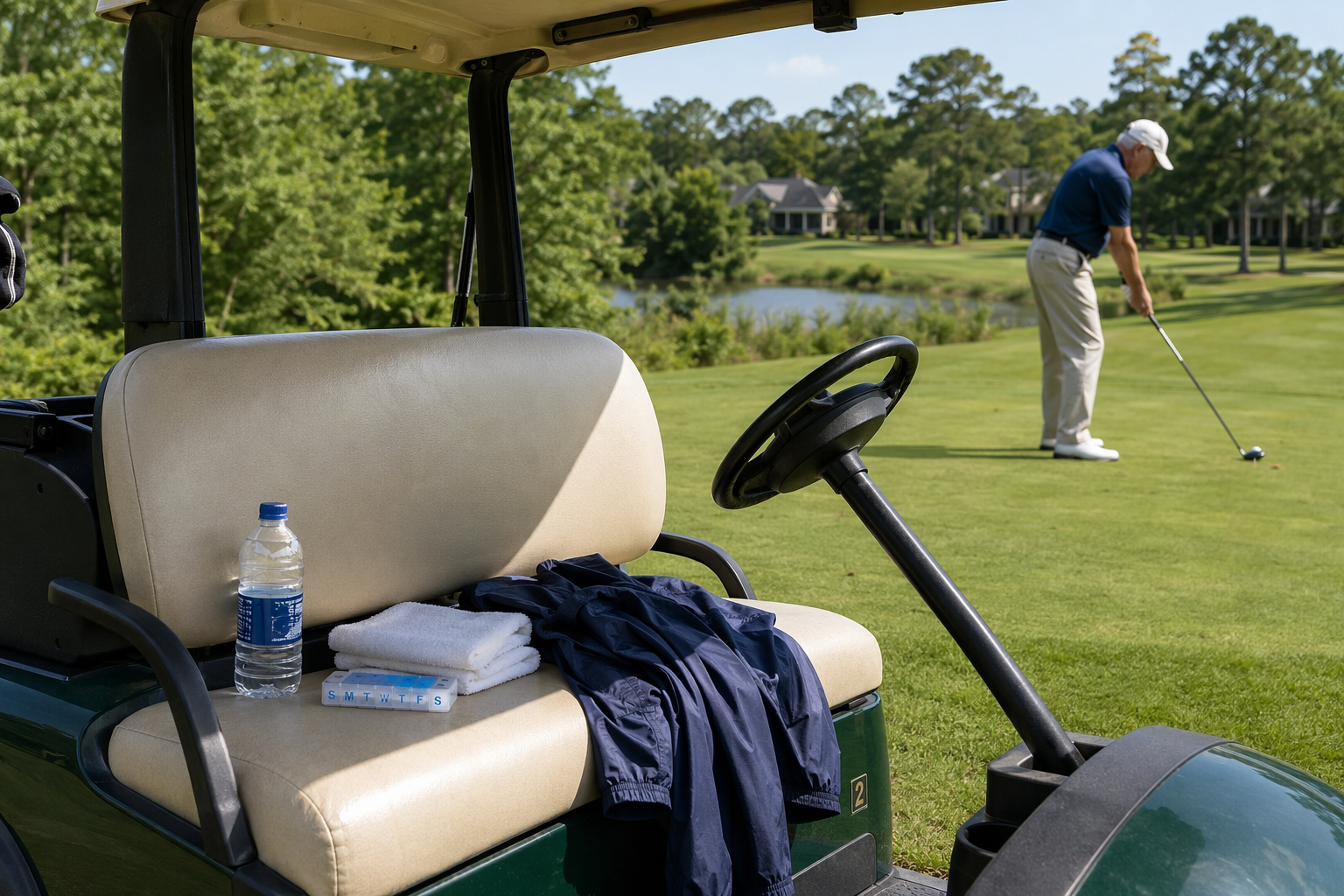
- Put medication, water, a towel, weather layer, and emergency contact information where your parent can reach them without help.
- Tell the director about oxygen, mobility equipment, or other practical needs before tournament morning.
- Agree with your parent on what kind of help is welcome and what kind feels embarrassing.
The Senior-Specific Rules Families Misread Most Often
A family member who only knows standard weekend stroke play may misread senior tournament rules as casualness. In reality, many modifications are there to keep the competition moving and to keep one bad hole, one slow search, or one difficult lie from disrupting the field. The etiquette is to know which modifications apply and to use them without making a production of it.
Ready golf and pace are not optional manners
Some senior league rules state pace expectations plainly. The Senior Golf League’s speed-of-play rules describe ready golf, a 4.5-hour target, and enforcement for groups that fall more than 15 minutes behind; MBSGA’s rules also emphasize ready golf and pace responsibilities.[2][3] Those are examples from specific organizations, not universal law, but they show the tone many senior events expect.
For a caregiver, the practical etiquette is simple: help your parent arrive early enough that the group is not rushed before the first shot, and do not interrupt play with extra reminders once the round has started. Pace help should look like small logistics, not coaching from the cart.
Lost balls may have a shorter search window
The modern Rules of Golf use a three-minute search time for a lost ball, and senior league documents often reinforce short searches because one extended hunt can hold up several groups.[2][3] Some senior events also use local procedures that allow a lateral fairway drop instead of returning to the original spot, especially to avoid the delay of stroke-and-distance. That must be checked in the tournament rules, because it is exactly the kind of local modification that changes from event to event.
Preferred lies, lift-clean-and-place, and one-club relief are local rules
Some senior club tournament rules allow preferred lies or lift-clean-and-place in certain areas, and SSBGC’s tournament rules include local-rule language that illustrates how specific these permissions can be.[4] Other senior league discussions have considered one club-length relief, limits on where relief may be taken, and similar adjustments.[5] The etiquette issue is not whether your parent “needs” relief. The issue is whether the field is playing under that rule today.
Senior tees and flights protect fairness, not pride
Senior events may use age divisions, handicap divisions, or both. Common senior tournament structures include divisions such as 55-64, 65-74, and 75+, often paired with forward tee options or handicap adjustments.[6] Some clubs also use formulas for tee eligibility, such as an age-plus-handicap threshold, but these are local policies rather than a national standard.[5]
This is one of the places families can either preserve dignity or chip away at it. If the event assigns a senior tee, do not call it “easier” in front of the group. It is the tee for that competition. If your parent is eligible and chooses it, the correct response is to treat the choice as ordinary.
Max scores and gimmies need confirmation
Max-score caps, such as triple or quadruple bogey, are used in some senior settings to protect pace and morale after a hole has gone sideways. Some groups also use short conceded putts, often called gimmies, in informal or league play. But these are not safe assumptions in a tournament. If the rules sheet does not say a putt can be conceded, the player should hole out.
Older players usually know this. The family risk is over-helping: “That’s good, pick it up,” said from a cart can create a rules problem and an awkward moment. Let the marker, playing partners, and tournament rules govern the score.
Check-In Etiquette: Handle Needs Before They Become Announcements
At check-in, the caregiver’s best role is often temporary and quiet. Confirm the cart number, starting hole, tee assignment, scorecard procedure, and any local rules that were unclear. If there is a medical device, mobility aid, or timing issue, speak to staff privately unless your parent prefers to handle it.
Senior golf associations commonly publish etiquette or conduct expectations around keeping pace, being considerate of playing partners, and following local procedures.[7][8] None of that requires turning check-in into a health briefing. It means the event works better when practical information reaches the right person before the first group is called.
- If your parent wants privacy, ask staff questions away from the pairing table.
- If your parent wants control, stand back and let them check in while you handle only the gear.
- If there is a safety concern, state the practical need, not a diagnosis.
- If the rules are unclear, ask the committee or director rather than debating with another player.
During the Round: Support the Conditions, Not the Shot
Once the round starts, the etiquette changes. Unless you are officially caddying under the event’s rules, you are not there to advise on club selection, reads, swing thoughts, or strategy. The cleaner role is to support conditions around the player: water available, jacket reachable, cart parked safely, no unnecessary walking back and forth, no family commentary after a bad swing.
This restraint matters because senior events still have competition integrity. A caregiver who drifts into coaching can put the player in an uncomfortable position. A caregiver who simply makes sure the water bottle did not roll under the seat is doing something useful without changing the round.
Cart positioning is a safety issue and an etiquette issue
Golf courses create quiet fall risks: wet grass, bunker lips, cart-path edges, slopes beside tees, and uneven lies. There is no reliable tournament-specific injury rate for older golfers in the materials here, so it would be wrong to imply every senior player is at high risk. Still, practical fall prevention on uneven terrain is sensible, especially when balance has already started to change.
Park the cart on level ground when possible. Avoid making your parent step downhill out of the cart if there is a flatter option a few feet away. Encourage use of handrails on course steps. If bunker exits are steep, offer a hand without making it a public rescue. For broader home and daily-life balance planning, families can adapt ideas from a CDC STEADI fall prevention checklist without turning the golf course into a clinic.
Hydration and medication timing should be planned, not performed
Heat deserves respect, especially for older adults, but it does not need theater. Put water where your parent can reach it. Build the medication schedule around the tee time before leaving home. If the day is unusually hot, smoky, or humid, check the tournament’s weather policy and your parent’s own clinician guidance rather than improvising on the first tee.
A simple habit helps: use natural pauses every few holes to drink, reapply sunscreen, or check whether a layer needs to come off. If outdoor air quality is part of the concern, a smoke and outdoor activity checklist for seniors can help families think through conditions before tournament morning.
Mobility aids are not a breach of etiquette
If a player uses a cane, rollator, oxygen, brace, or other support, the etiquette is to make it workable and unremarkable. Tell the tournament contact ahead of time, confirm where the device can be kept, and avoid blocking play. If a parent is beginning to need more stability between the cart and tee, the choice between devices belongs in a practical conversation, not in a parking-lot argument; this walker vs. rollator guide for balance problems can help families compare options outside the pressure of tournament day.
Physical therapy guidance for senior golfers commonly emphasizes balance, flexibility, warmups, and working within current mobility rather than pretending nothing has changed.[9] That advice is useful when it stays in its lane: it can inform preparation, but it should not become a family member correcting posture after every swing.
What Not to Do Around Playing Partners
Most senior tournament etiquette problems involving family are not dramatic. They are small, repeated intrusions: explaining a parent’s limitations to strangers, apologizing for their pace when the group is on time, reminding them about water loudly, or treating every local rule as a concession. These moments can make a competent older player feel supervised instead of accompanied.
- Do not debate a senior tee choice with other players; ask the committee if there is a real rules question.
- Do not over-explain oxygen, medication, or balance support unless your parent has asked you to.
- Do not give advice during play unless the event allows your role and your parent wants it.
- Do not turn a slow moment into a public correction; help the group move when there is a natural opening.
- Do not assume informal league habits apply in a tournament with posted rules.
Ordinary course-care etiquette still matters: repair ball marks, rake bunkers where required, keep carts where they belong, and stay aware of others’ shots. The senior-tournament twist is that pace and accommodations are part of respect, too. USGA course-care guidance treats care for the course as a shared responsibility; senior events add the practical need to keep a field moving without making older players feel rushed or singled out.[10]
After the Round: Let the Tournament End Before the Review Begins
After the final putt, the first jobs are scoring, returning the cart, gathering medication or equipment, and cooling down. If there was a rules question, direct it to the committee or tournament staff. If there was a health or mobility issue, write it down for next time instead of conducting a post-round audit in front of the group.
This is a good time to notice what worked. The cart was parked better. The water was easy to reach. The director already knew about the oxygen. The senior tee assignment did not become a family discussion. These small arrangements are not glamorous, but they are often what let an older player participate without being treated as fragile.
If golf is part of a parent’s broader independence, it may belong in a larger aging-in-place care plan: transportation, medication routines, mobility support, and social commitments all affect whether activities remain possible. The point is not to medicalize tournament golf. It is to make the ordinary logistics strong enough that golf can stay golf.
The Right Amount of Help
A family caregiver cannot remove every risk from a senior golf tournament, and trying to do so can take away the very thing the parent came for: competition, routine, friendship, and the familiar dignity of knowing how to behave on a course. The better goal is narrower and more respectful.
Know the local rules. Communicate practical needs early. Keep pace without fuss. Make water, medication, and safer footing easy to access. Let the tournament’s senior structure do its job. Then step back far enough that your parent is still the golfer, not the project.
References
- Golfing regularly could be a hole-in-one for older adults' health — American Heart Association.
- TSGL Speed of Play Rules — The Senior Golf League.
- Rules of Play & Conduct of Members — MBSGA.
- Tournament Rules and Tips — SSBGC.
- Rules of play being considered for senior golf leagues in U.S. — Leisure World Weekly.
- Tournament Rules and Regulations — McHenry County Senior Amateur.
- Etiquette Guidelines — Albuquerque Seniors Golf Association.
- Etiquette — Victoria Senior Men's Golf Club.
- Expert Tips For Senior Golfers: Improve Your Game — Highbar Physical Therapy.
- Back to the Basics of Course Care Etiquette — USGA.
Questions to bring to a clinician or OT
This is not medical, legal, or a family's final decision — only a framework. Bring these questions to a clinician, occupational therapist, or your local Area Agency on Aging.
Find Local HelpRelated reading
Noticed something outdated or inaccurate on this page? Flag a correction. We review every report against CDC, NIA, and AARP HomeFit guidance before updating a page.