
Glossary entry
How the 2025 Law Changes Medicaid for Seniors
Last verified 2026-07-30
This is not financial or legal advice. Medicare/Medicaid and benefits rules vary by state and change over time — verify current rules with your state Medicaid office or Area Agency on Aging.
Last verified: July 30, 2026. The short answer for most families asking whether Medicaid eligibility changed for seniors in 2025 is this: the 2025 federal law did not create a broad 2025 eligibility cliff for adults age 65 and older, and it does not impose the new Medicaid work requirements on seniors 65+. The One Big Beautiful Bill Act was enacted on July 4, 2025, but many of its Medicaid provisions phase in later, especially in 2026, 2027, and 2028. Medicaid is still administered state by state, so this article is general information, not legal, financial, or benefits advice for any individual household. [1][2]
That distinction matters. A parent who already has Medicaid nursing home coverage did not lose it overnight because of the 2025 law. A widow applying for a Medicare Savings Program did not suddenly become subject to a work test because she is 72. But a family planning for long-term care should not stop reading at “seniors are exempt,” because the law also increases pressure on Medicaid: federal funding reductions, delayed enrollment simplification, a future home equity cap, and state-level eligibility decisions can all affect how hard it is to get or keep care.

What did not change much in 2025
For adults 65 and older, the central Medicaid eligibility framework remained largely familiar in 2025. Seniors generally qualify through non-MAGI Medicaid pathways, including aged, blind, and disabled categories, Medicare Savings Programs, and long-term care pathways, rather than through the Affordable Care Act expansion rules used for many younger adults. KFF’s 2025 survey of eligibility levels for older adults and people with disabilities found minimal change in baseline income and asset limits from 2024 to 2025. [3]
That does not mean every state is the same. Medicaid eligibility is not one national income chart. States set many of the practical thresholds that families run into when applying for long-term services and supports, Medicare Savings Programs, and certain disability-related pathways. KFF’s 2025 and 2026 surveys also have an important data gap: Florida did not respond to either survey, so the national picture is missing information from the third most populous state. [3][4]
The new federal work requirement is the part of the 2025 law that produced the loudest headlines, but it is not the main eligibility issue for a 70-year-old parent. The federal work requirements apply to certain younger Medicaid adults, not to seniors age 65 and older. Families with someone in the 50–64 age range should check that person’s category carefully, especially if disability, caregiving, or medical frailty is involved, but that is a different question from Medicaid eligibility for seniors 65+. [1][2]
The dates matter more than the headline
For a family caregiver, the useful way to read the 2025 law is as a calendar. Some things were immediate. Many were not. The most important senior-related changes are spread across several years, and confusing those dates can lead to either panic or missed preparation.
| Time frame | What families should know |
|---|---|
| 2025 | OBBBA becomes law on July 4, 2025. Seniors 65+ are not subject to the new federal Medicaid work requirements. Baseline senior eligibility levels changed little nationally from 2024 to 2025. [1][2][3] |
| January 2026 | California reinstates an asset test for certain older adults and people with disabilities: $130,000 for an individual and $195,000 for a couple. Other state-level eligibility rules still vary. [4] |
| 2026–2027 | OBBBA implementation continues in phases. States face budget and administrative pressure as federal Medicaid changes roll out. [5] |
| Through October 2034 | Two Biden-era Medicaid enrollment streamlining rules are frozen, delaying rules that would have simplified enrollment and reduced redetermination burdens for seniors and people with disabilities. [5] |
| January 2028 | A flat $1 million home equity cap for long-term care applicants takes effect, replacing the prior inflation-adjusted maximum of about $1.13 million. California will also reinstate a home equity limit for the first time. [1] |
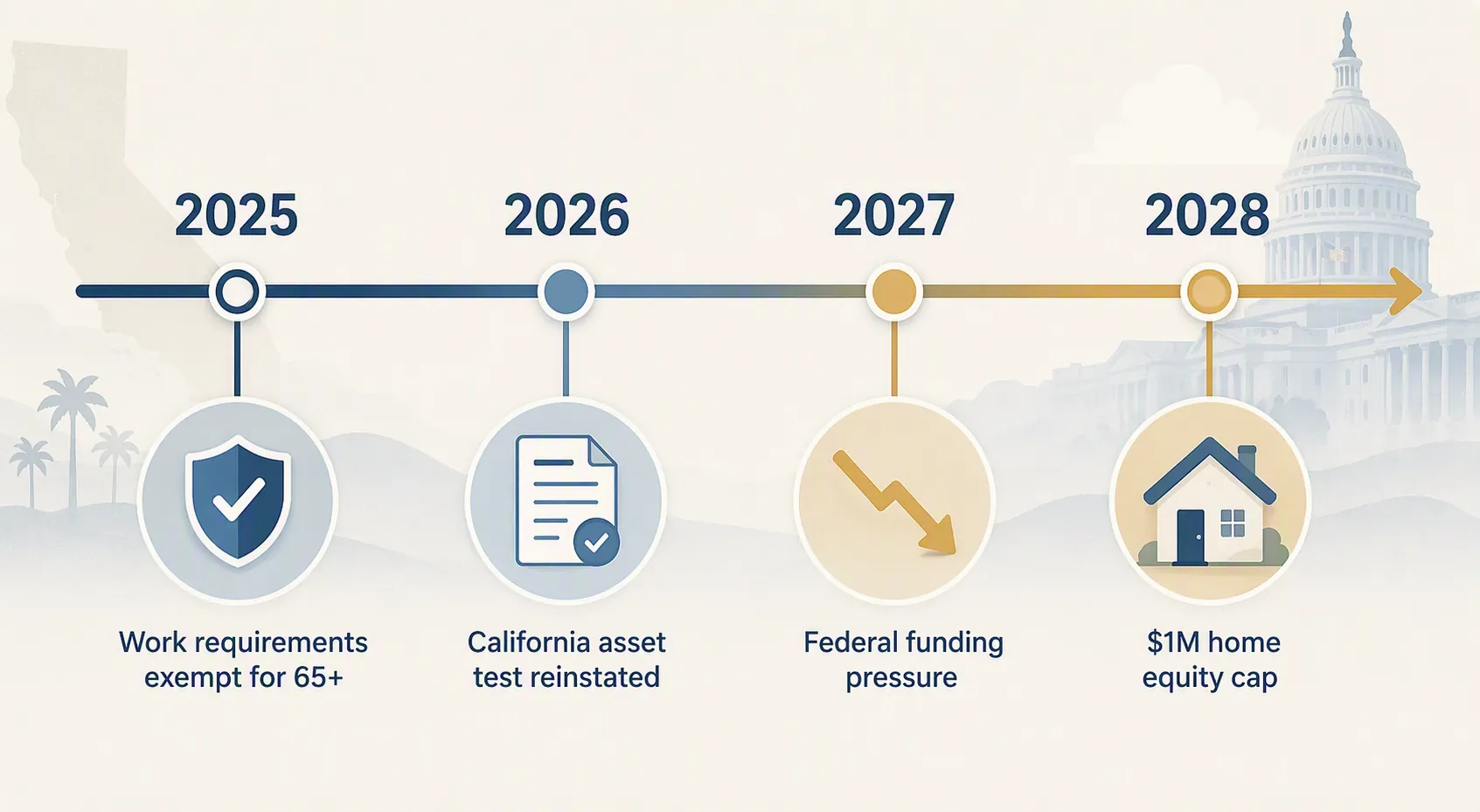
What changed for seniors right now
Seniors 65+ are exempt from the new work requirements
This is the first fact to put on the kitchen table: the 2025 law’s Medicaid work requirements do not apply to adults age 65 and older. If your parent is 68, 74, or 89, the new federal work requirement is not the reason they would lose Medicaid. [1][2]
Coverage can still be lost for ordinary reasons: a missed renewal notice, incomplete bank statements, a change in income, an asset issue, a transfer-of-assets review for nursing home Medicaid, or a state-specific rule. Those are less dramatic than a national work requirement, but they are much more likely to be the paperwork problems a family actually faces on a Monday morning.
Income and asset limits did not move much nationally, but California is a major exception
KFF’s 2026 survey again shows that senior and disability Medicaid eligibility is a state-by-state system, not a single federal number. Nationally, the broad baseline did not swing dramatically from 2025 to 2026, but California’s change is large enough that families there should treat 2026 as a new planning year. Beginning in January 2026, California reinstated an asset test of $130,000 for an individual and $195,000 for a couple. [4]
That California number should not be copied into another state’s planning spreadsheet. Some states have stricter asset limits. Some have more generous rules for particular pathways. Some have different treatment of income for nursing home care, home- and community-based services, or Medicare Savings Programs. The right starting point is always the state Medicaid agency’s current eligibility manual or application page, not a national news summary.
The personal needs allowance changed a little, and it still matters
For someone in a nursing home on Medicaid, the personal needs allowance is the small amount the resident may keep each month for personal expenses after most income is applied toward care. It is not the same as an asset limit, and it is not enough to solve the financial strain of institutional care, but it affects day-to-day dignity: haircuts, clothing, toiletries, a birthday card, or a small phone bill.
The median personal needs allowance rose from about $62 in 2025 to $70 in 2026, with 13 states raising their allowances. The 2026 range runs from $30 in Alabama to $200 in Alaska. [3][4]
That is a small change in policy terms, but it is not small to the resident who is trying to keep a little control over ordinary purchases. If a parent is already in a nursing facility, it is worth checking whether the facility’s patient liability calculation reflects the current state allowance.
Where the law creates real risk: long-term care and home care
The biggest senior-facing risk is not that a 78-year-old suddenly has to prove 80 hours of work. It is that Medicaid long-term care sits inside a program now facing reduced federal funding and delayed administrative simplification. KFF describes the 2025 reconciliation law as reducing federal Medicaid spending by $911 billion over a decade. [1]
For families, a federal funding reduction does not translate neatly into one rule that says “your parent is no longer eligible.” It usually shows up through state choices: tighter optional benefits, slower waiver expansion, lower provider payments, longer waiting lists, more administrative friction, or fewer available home care workers willing to accept Medicaid rates. Those effects vary by state and program, which is exactly why blanket reassurance is not enough.
HCBS may be where families feel the squeeze first
Home- and community-based services, often called HCBS, are the services that can help an older adult remain at home instead of entering a nursing facility: personal care, homemaker services, respite, adult day services, and sometimes home modifications through waiver programs. KFF’s 2025 HCBS work describes Medicaid home care as a central part of long-term services and supports, but these programs are often shaped by state choices and waiver capacity. [6]
If your family is trying to age in place, do not wait until a fall, hospital discharge, or caregiver burnout forces a rushed application. Review the state waiver name, eligibility criteria, waiting list status, and covered services. For home safety changes, see CareWise Guide’s step-by-step guide to Medicaid HCBS waivers and home modifications. For the broader funding pressure on home care, read Protect Your Parent's Home Care During the Medicaid Freeze.
The frozen streamlining rules keep the paperwork burden in place
One of the quieter but more practical changes is the freeze on two Biden-era Medicaid enrollment rules until October 2034. Those rules would have simplified enrollment and reduced redetermination frequency for seniors and people with disabilities. Because they are frozen, families should expect the old paperwork problems to continue: renewal packets, documentation requests, income verification, asset questions, and deadlines that may arrive when no one in the household has the time or emotional bandwidth to handle them. [5]
This is where eligibility becomes less about the written rule and more about execution. A senior may qualify on paper and still lose coverage if a renewal form is missed, a bank account is not explained, or mail goes to an old address. Adult children who are helping from another city should make sure the Medicaid agency has the correct mailing address, authorized representative forms if allowed, and a reliable way to receive notices.
The January 2028 home equity cap deserves early attention
The home equity change is not immediate, but it is important for long-term care planning. Starting in January 2028, the law sets a flat $1 million home equity cap for long-term care applicants, replacing the prior inflation-adjusted maximum of about $1.13 million. California will also reinstate a home equity limit for the first time. [1]

This does not mean every senior with a home loses Medicaid eligibility in 2028. Home equity rules are more specific than home ownership, and exceptions, valuation methods, and spousal protections can depend on federal and state rules. But families in high-cost housing markets should not wait until a nursing home application is already urgent to ask whether home equity could become a problem.
If long-term care is a realistic possibility within the next few years, gather the mortgage balance, property tax assessment, deed information, and any state Medicaid materials on home equity. Then talk with a qualified elder-law attorney or benefits professional before making transfers, adding names to deeds, taking out loans, or assuming that a house is automatically protected. For a broader view of the financial risk around care, CareWise Guide’s long-term care cost and coverage guide may help frame the conversation.
Nursing home access is also affected by staffing policy
The 2025 law also delayed nursing home staffing standards, another change that does not alter an income limit but can affect the care environment available to Medicaid residents. KFF’s older-adult analysis identifies delayed nursing home staffing standards among the health-related provisions that could matter for older adults. [7]
A family choosing a facility should therefore keep eligibility and quality separate in its checklist. Medicaid approval answers how care may be paid for. It does not answer whether a facility has enough staff, whether it accepts Medicaid pending, whether it has a Medicaid bed available, or whether it can safely manage dementia, mobility limitations, wounds, or complex medication needs.
What to do now if Medicaid may pay for a parent’s care
Start with the state, not the headline. Find the current Medicaid eligibility page for your state and confirm which program you are dealing with: regular Medicaid for an older adult, a Medicare Savings Program, nursing home Medicaid, or an HCBS waiver. If you are new to the Medicare-versus-Medicaid distinction, this primer on senior health care can help separate the programs before you fill out forms.
- Check the state Medicaid agency’s current income, asset, and renewal rules. Do not rely on a national asset figure unless your state confirms it applies.
- Save renewal notices, approval letters, bank statements, pension and Social Security proof, life insurance documents, burial account records, deeds, mortgage statements, and trust or annuity paperwork.
- If the person lives in California, review the January 2026 asset test reinstatement before assuming prior no-asset-test rules still apply.
- If nursing home care may be needed before or after January 2028, review home equity exposure early with a qualified elder-law or benefits professional.
- If the goal is to stay at home, check HCBS waiver availability, waiting lists, reassessment rules, and whether the needed services are actually covered in your county or region.
- Keep Medicare Savings Programs and other senior benefits on the table; Medicaid is not the only benefits pathway that may reduce monthly strain.
For families comparing care options, CareWise Guide’s 2026 guide to paying for home help can help organize non-nursing-home options. If you are looking beyond Medicaid, the categorized guide to government benefit programs for seniors and the article on the elder care assistance benefits gap may point to programs families often miss.
Common family questions
Did Medicaid eligibility for seniors change in 2025?
Not in the sweeping way many headlines suggested. KFF’s 2025 survey found little change in baseline eligibility levels from 2024 to 2025 for older adults and people with disabilities. The bigger issues are phased OBBBA changes, state rules, paperwork requirements, and long-term care planning. [3][5]
Will my parent have to work to keep Medicaid?
If your parent is 65 or older, the new federal Medicaid work requirements do not apply to them. If the person is under 65, do not assume the answer is the same; check their eligibility category, disability status, caregiving situation, and state implementation details. [1][2]
Can a senior still qualify for nursing home Medicaid?
Yes, but the application remains highly state-specific and document-heavy. The 2025 law did not erase nursing home Medicaid for seniors. The concerns are practical: income treatment, asset limits, transfer reviews, patient liability, facility availability, and the January 2028 home equity cap for long-term care applicants.
Should we move money or change the house title now?
Do not make transfers, retitle property, or restructure accounts based only on a general article. Medicaid has lookback, transfer, estate recovery, spousal, and state-specific rules that can create serious consequences. If long-term care is possible, take the documents to a qualified elder-law attorney or benefits professional before acting.
What if we need help this week?
If a discharge planner is asking where your parent will go, or a renewal deadline is already close, prioritize immediate triage: identify the exact Medicaid program, call the state or county eligibility office, ask the nursing facility or HCBS agency what documents they need, and keep copies of everything submitted. CareWise Guide’s senior care assistance triage guide can help sort what to do now, next week, and next month.
The protection point is straightforward: do not panic about a 2025 senior work requirement that does not apply, but do not ignore the slower changes that can still block care. Confirm the state rule, keep the paperwork, watch HCBS access, review home equity before 2028 if long-term care is likely, and get individual advice before making financial moves.
References
- Health Provisions in the 2025 Federal Budget Reconciliation Law — KFF
- A Summary of Federal Medicaid Work Requirements — Center for Health Care Strategies
- Medicaid Eligibility Levels for Older Adults and People with Disabilities (Non-MAGI) in 2025 — KFF
- Medicaid Eligibility Levels for Older Adults and People with Disabilities (Non-MAGI) in 2026 — KFF
- Implementation Dates for 2025 Budget Reconciliation Law — KFF
- Medicaid Home Care (HCBS) in 2025 — KFF
- What Could the Health-Related Provisions in the Reconciliation Law Mean for Older Adults? — KFF
Browse more in the Glossary.