
Glossary entry
Safe Places for Retirees to Keep Savings Besides a Bank
Last verified 2026-08-25
This is not financial or legal advice. Medicare/Medicaid and benefits rules vary by state and change over time — verify current rules with your state Medicaid office or Area Agency on Aging.
If Mom wants to move her savings out of a bank account, the useful question is not simply whether the new place feels safe. Ask what protects the money, who provides that protection, how much it covers, and how quickly the money can be accessed. The map below separates those answers.
| Option | What it is | Where you buy or hold it | Backstop and limit | Liquidity | Who it may fit |
|---|---|---|---|---|---|
| FDIC-insured bank savings account, money market deposit account, or CD | A bank deposit. A CD generally trades some access for a stated term and rate. | At an FDIC-insured bank. | FDIC insurance covers up to $250,000 per depositor, per insured bank, per ownership category. The FDIC reports that no depositor has lost a penny of FDIC-insured funds since 1933. [1] | Savings and money market deposit accounts are generally designed for access. CDs may charge for early withdrawal or restrict access until maturity. | Someone who prioritizes a familiar deposit structure, clear insurance, and access to cash. Larger balances require an ownership-category and institution check. |
| NCUA-insured credit-union share account or share certificate | The credit-union equivalent of a deposit account or CD. Credit unions call deposits “shares.” | At a federally insured credit union. | NCUA Share Insurance covers up to $250,000 per member-owner, per federally insured credit union, with rules that vary by ownership category. [2] | Share accounts are intended for access; share certificates may limit withdrawals or impose an early-withdrawal charge. | Someone comfortable using a credit union who wants a deposit-like account with federal share insurance. The credit union's insurance status still needs to be verified. |
| Brokerage cash in an FDIC bank sweep | Uninvested brokerage cash automatically distributed among participating banks. | Inside a brokerage account, under the brokerage's sweep program. | FDIC insurance may apply at each participating FDIC-insured bank, generally up to $250,000 at each bank, subject to the program's aggregation and ownership rules. [4] | Usually accessible through the brokerage, but timing, sweep terms, and withdrawal procedures vary. | Someone who already uses a brokerage and wants idle cash moved to deposit accounts. The sweep disclosure matters more than the brokerage brand. |
| Brokerage money market fund or money market sweep | A mutual fund that invests in short-term instruments. It is not a bank deposit. | Through a brokerage or fund provider. | SIPC protection can cover up to $500,000 per customer, including a $250,000 cash limit, if a member brokerage fails and customer assets are missing. SIPC does not protect against market losses. [3] Money market funds are not FDIC-insured and can theoretically lose value. | Often easy to buy and sell on a business day, but it is not the same as an insured checking or savings balance. | Someone who understands the difference between custody protection and protection from a decline in value. Mid-2026 examples included a 3.32% Fidelity SPAXX yield as of 07/31/2026 and a 3.62% Vanguard Federal Money Market Fund yield as of 08/21/2026; these figures can change. [5] |
| U.S. Treasury bills, notes, bonds, or savings bonds | Debt issued by the U.S. Treasury. Treasury securities have set maturities; I bonds are savings bonds with inflation-linked interest. | Through TreasuryDirect, a bank, or a brokerage, depending on the security. | Treasuries are backed by the full faith and credit of the U.S. government and have no FDIC-style dollar cap. Interest on Treasury securities is exempt from state and local income taxes. [6] I bonds have separate purchase and access rules. | Treasury bills can mature in as little as four weeks, while other securities can run much longer. I bonds cannot be redeemed during the first 12 months; redemption before five years costs the last three months of interest. [7] | Someone who can match the maturity or holding period to the need for cash. I bonds are not a substitute for an emergency savings account. |
That table contains an important distinction: “protected” does not always mean “the balance cannot fall.” FDIC and NCUA insurance protect eligible deposits or shares when an insured institution fails. SIPC is mainly a custody backstop if a brokerage fails and customer property is missing. A Treasury's repayment depends on the U.S. government's obligation. A money market fund remains an investment whose value and yield are not guaranteed by the FDIC.
The Limits Are Part of the Answer
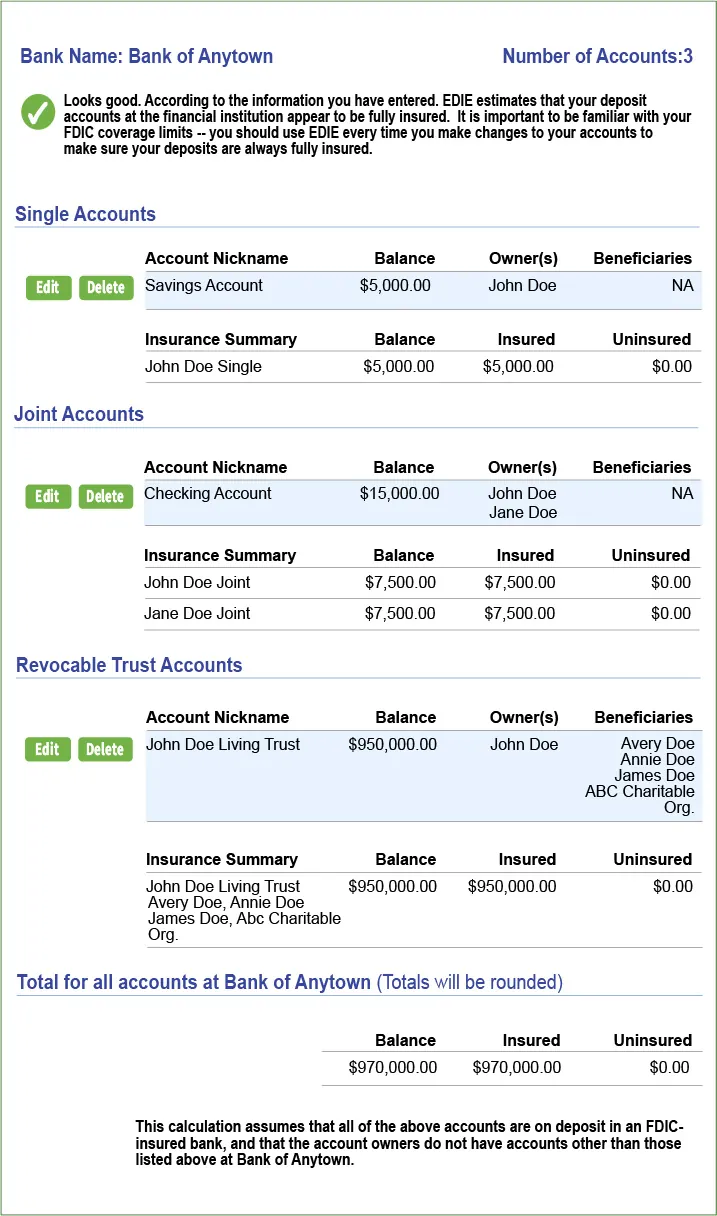
For a bank account, the headline number is $250,000 per depositor, per insured bank, per ownership category. It is not $250,000 for every account under one person's name at that bank. Accounts in different ownership categories may receive separate coverage, but the rules can become complicated for joint accounts, retirement accounts, and revocable trusts. A family should use the FDIC's Electronic Deposit Insurance Estimator rather than assume that two account titles create two separate limits. [1]
The NCUA limit is also $250,000, but the relevant terms are member-owner and federally insured credit union. Joint accounts, IRAs, and KEOGH accounts have their own treatment. That makes the institution's insurance status and the account's ownership details worth checking before moving a parent's money. [2]
SIPC is where many brokerage explanations become misleading. The limit is up to $500,000 per customer, including a $250,000 limit for cash, but SIPC does not reimburse losses caused by a stock, bond, or fund falling in value. It addresses missing securities or cash when a SIPC-member brokerage fails. A money market fund held in a brokerage account can be treated as a security for SIPC purposes, but that does not turn the fund into an FDIC-insured deposit. [3]
Brokerage sweep language deserves a close reading. In a bank sweep, uninvested cash may be placed at several FDIC-insured banks, with coverage determined at each participating bank and subject to the program's terms. In a money market sweep, the cash is invested in a money market fund and may receive SIPC custody protection instead. The same brokerage can offer both arrangements, so the account statement alone may not answer the question. [4]
Treasuries Are Safe From One Risk, Not Every Inconvenience
Treasury securities are not bank deposits, so FDIC insurance is irrelevant to them. Their stated government backing is the full faith and credit of the United States, and ordinary Treasury securities do not have a $250,000 coverage ceiling. The tradeoff is timing: selling before maturity can produce a gain or loss based on the market price, while waiting for maturity ties the cash to that schedule. Treasury maturities range from four weeks to 30 years. [6]
I bonds need an even clearer label. For issues dated May 1 through October 31, 2026, the composite rate is 4.26%, including a 0.90% fixed rate. The rate applies to that issue period, not permanently to every I bond. Electronic purchases are limited to $10,000 per person per calendar year, the bond cannot be redeemed for the first 12 months, and redemption before five years forfeits the previous three months of interest. [7]
Those terms can make I bonds useful for money that is not needed immediately. They make the bonds a poor location for the cash needed to pay next month's rent, replace a broken furnace, or cover an urgent medical bill.
What These Protections Do Not Cover
A government or regulatory backstop applies to a defined product and failure scenario. It does not make every financial product, document, or possession in the same location protected. In particular:
- Stocks, bonds, and mutual funds are not FDIC-insured. SIPC does not cover losses because their market prices decline. [1][3]
- Money market funds are not FDIC-insured deposits. Their SEC regulation does not create a guarantee against loss. [3][5]
- Annuities and life insurance are not bank deposits and are not covered by FDIC deposit insurance. Their protections, if any, depend on the contract and applicable state insurance system. [1]
- Cryptocurrency is not an FDIC-insured deposit, and money held on a crypto platform does not become insured because the platform has an account-like interface.
- Cash and documents stored in a safe-deposit box are not FDIC-insured. The FDIC covers eligible deposits at an insured bank, not the contents of the box. [1]
- Treasuries are not an FDIC-insurance matter. Their protection comes from the U.S. government's debt obligation, not from a bank-insurance program.
Three Free Checks Before Moving the Money
- Check the bank in FDIC BankFind. Then enter the account ownership and balances into the FDIC Electronic Deposit Insurance Estimator, or EDIE. Use the result as a coverage estimate to review, especially when trusts, joint owners, or multiple account types are involved.
- Check the credit union in the NCUA Credit Union Locator. Use the NCUA Share Insurance Estimator to examine how the member-owner, joint-account, IRA, or other ownership details affect the $250,000 limit.
- Read the brokerage cash-sweep disclosure. Look for whether uninvested cash is placed at FDIC-insured banks or invested in a money market fund, which protection applies, which participating institutions are used, and how the program handles balances above stated limits.
Once the backstop and limit are documented, the remaining choice is mainly about liquidity and yield. A savings account may be easier to access, a CD may impose a term, a money market fund may offer a different yield without deposit insurance, and a Treasury may require matching the maturity to the cash need. That is a more useful decision than moving money because a headline made a familiar institution feel unsafe.
A small, documented emergency stash can be part of a household emergency plan, but keeping a large amount of cash under a mattress or in an undocumented home hiding place usually removes the protections the retiree was trying to preserve. For related emergency-document organization, see the Senior Emergency Kit Checklist.
For broader caregiver benefits checks, see the 2026 Medicare Benefits Checklist for Seniors.
This article is for educational purposes only and is not financial advice. Coverage depends on the institution, product, ownership category, and current program terms. Last verified: August 25, 2026. Reviewed by the site's consumer-finance editor, with expertise in deposit insurance and retirement benefits.
References
- Understanding Deposit Insurance — FDIC
- Share Insurance Coverage — NCUA
- What SIPC Protects — SIPC
- Cash Sweep Programs for Uninvested Cash in Your Investment Accounts — SEC Investor.gov, May 14, 2025
- High-yield savings accounts vs. CDs vs. money market funds — Vanguard
- Wondering Where to Stash Your Cash? Start Here — Charles Schwab
- I bonds — TreasuryDirect
Browse more in the Glossary.