
Product term
Match Your Priority to a Senior-Friendly Caribbean Island
Last verified 2026-07-25
A safe trip works a lot like a safe home: the setting has to match the older adult, not the brochure. For Caribbean travel, that means the best answer is rarely “the prettiest island.” It is the island least likely to turn your parent’s main risk—weather disruption, a long walk to the room, confusing paperwork, weak medical access, or a too-complicated resort day—into the thing everyone remembers.
So if you are searching for senior-friendly Caribbean islands with perfect weather, start by tightening the meaning of “perfect.” For older travelers, perfect weather usually means low hurricane exposure, steady warmth, manageable heat, fewer rainy interruptions, and less chance that a delayed flight or storm watch upends medication schedules and mobility plans. By that standard, Aruba and the wider ABC islands deserve the first serious look.
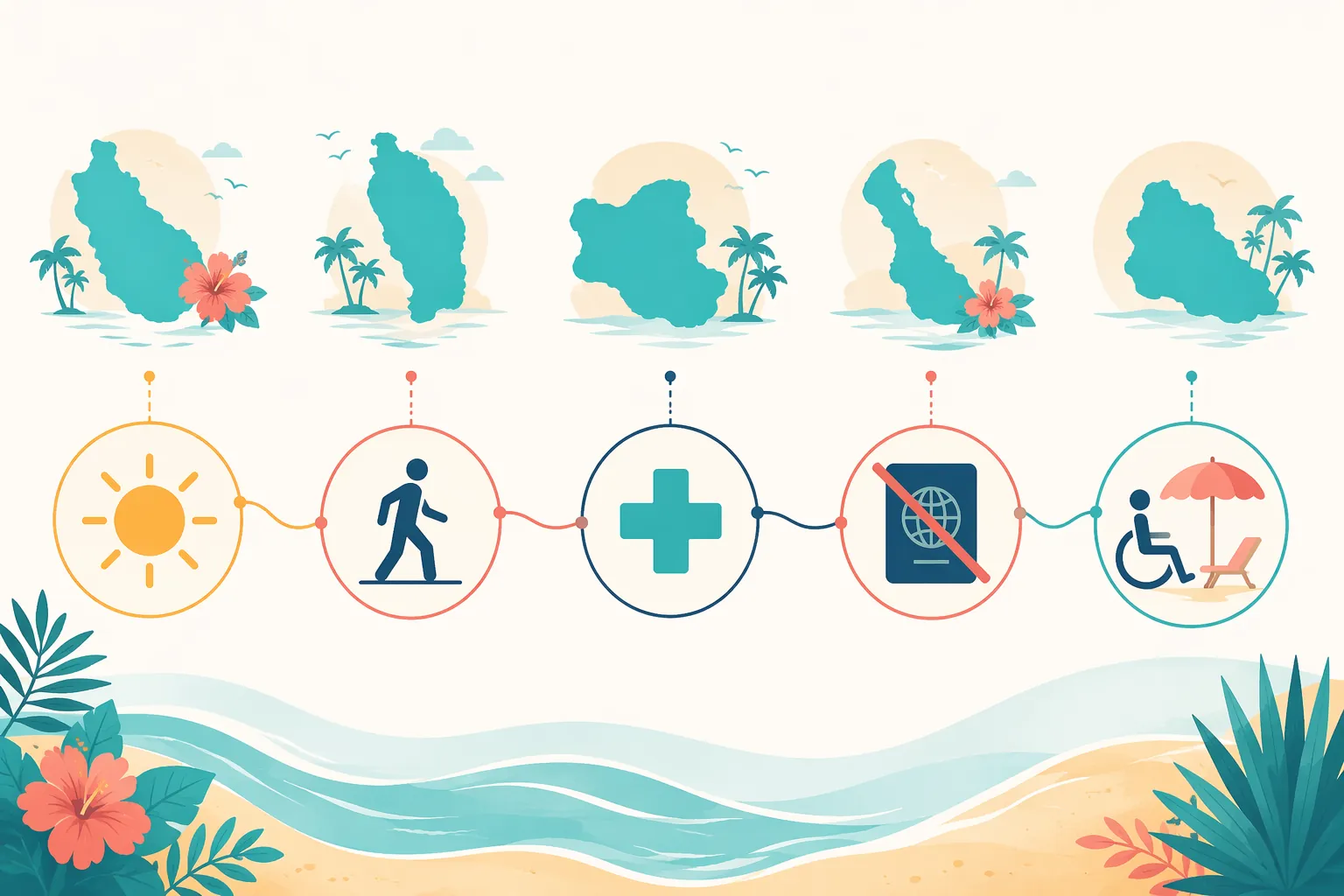
Quick Answer: Let the Constraint Pick the Island
| If the top priority is... | Start with... | Why it moves up the list |
|---|---|---|
| Most reliable warm weather and hurricane avoidance | Aruba, then Bonaire and Curaçao | Aruba averages about 82°F year-round, receives roughly 18 inches of annual rainfall, and sits outside the hurricane belt. |
| Flat beach access and easy resort movement | Aruba | Eagle Beach and Palm Beach are known for easier shoreline access, and the island’s flatter terrain helps with walking and taxi transfers. |
| Medical access feels like the biggest concern | Barbados | The Barbados Tourism Authority describes the island as having the highest standard of healthcare in the Eastern Caribbean, with private hospitals, government polyclinics, and geriatric hospitals. |
| No passport and U.S.-system familiarity for U.S. citizens | Puerto Rico or the U.S. Virgin Islands | U.S. citizens can travel without a passport and use U.S. currency, reducing paperwork and payment friction. |
| Bundled all-inclusive ease with accessible resort features | Specific resorts in Antigua, St. Lucia, and Jamaica | The useful question is property-specific: accessible rooms, ramps, elevators, and beach access—not a vague island-wide promise. |
That table is more useful than a single winner. A senior who walks well but gets anxious about hurricane-season uncertainty is choosing differently from someone with Parkinson’s symptoms, balance changes, or post-surgery fatigue. If mobility is already a planning issue at home, it is worth pairing trip decisions with the same practical lens used in a Parkinson’s Home Safety Checklist: reduce avoidable transfers, remove surprise steps, and know where help is before it is needed.
Weather First: Aruba and the ABC Islands
Aruba’s strongest senior-travel argument is not that it is sunny in a general postcard way. It is that the island gives planners fewer weather variables to manage. The Aruba Tourism Authority describes Aruba as averaging 82°F year-round, receiving about 18 inches of rain annually, and sitting outside the hurricane belt.[1] For an older traveler, those details affect more than beach time. They shape flight confidence, travel insurance decisions, packing, hydration planning, and whether the family feels comfortable booking during months that might be more nerve-racking elsewhere in the region.
Bonaire and Curaçao belong in the same first-pass conversation because the ABC islands sit off the coast of South America, below the main hurricane belt. Secondary travel reporting says Aruba was last directly grazed by Hurricane Felix in 2007, while Bonaire has no recorded direct hurricane landfall in that reporting; the same source notes Curaçao’s government hurricane-preparedness posture rather than presenting the island as immune to storms.[2] That wording matters. “Lower exposure” is useful. “No weather risk” is not a promise anyone should sell to an older traveler.
For many families, Aruba rises above its neighbors because it combines the weather advantage with easier resort logistics. Flat terrain is not glamorous, but it is the sort of detail that can decide whether a parent joins breakfast without hesitation or starts skipping outings by day two. A hot, pretty island with stairs everywhere is not senior-friendly for someone who is trying not to admit that curbs and slopes have become work.
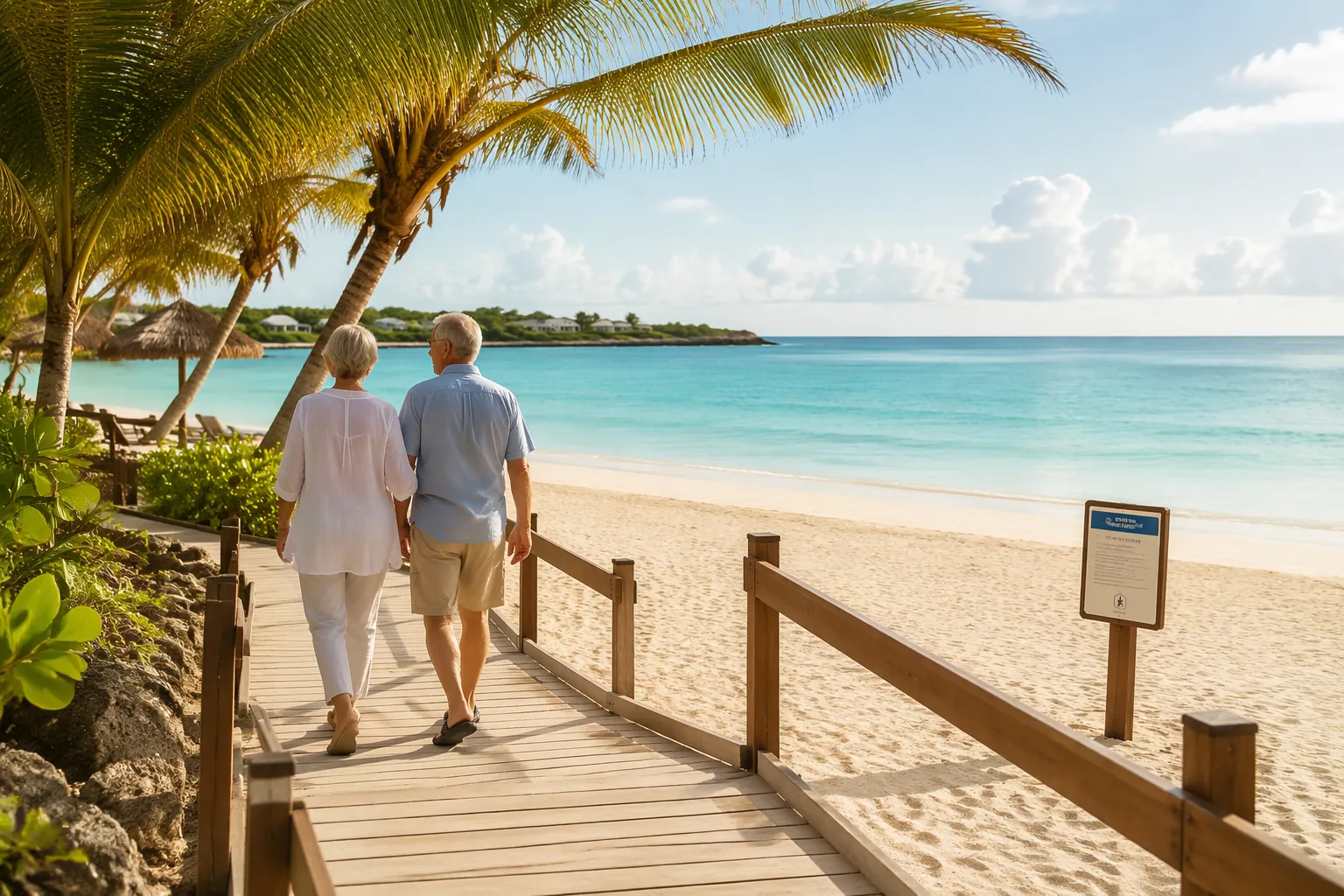
The practical way to compare Aruba resorts is to ignore the word “easy” until it becomes specific. Ask where the accessible rooms are located, whether the route to the pool is step-free, whether beach chairs require walking through loose sand, whether shade is close to the water, and how far the room is from breakfast. Eagle Beach and Palm Beach are the names that tend to come forward for easier shoreline days, but even there, the room-to-beach path is the real test.
What “Perfect Weather” Should Mean for an Older Traveler
Perfect weather is not just blue sky. A younger traveler may tolerate a stormy travel day, a long rebooking line, and a soggy transfer with a shrug. An older traveler may be managing blood pressure medication, a CPAP machine, insulin supplies, a cane, or a carefully timed rest schedule. The cost of disruption is higher.
That is why Aruba’s low rainfall and outside-the-hurricane-belt position have real planning value.[1] They do not eliminate heat stress, sun exposure, dehydration, or the usual travel risks. They simply remove one large uncertainty that often dominates Caribbean planning. If the trip is meant to be low-drama, that reduction is worth more than a longer list of excursions.
Walkability Starts With the Beach Path, Not the Island Brand
Walkability in the Caribbean is easy to overstate. A resort may be compact but full of short stairways. A beach may be gorgeous but reached by a sloped path. A town may be charming but paved unevenly. For seniors, “walkable” should mean predictable surfaces, short distances between daily needs, reliable seating, visible shade, and transport that does not require climbing into an awkward vehicle.
Aruba again earns attention here because of its flatter terrain and the practical reputation of Palm Beach and Eagle Beach for easier resort days. That does not mean every property works for every older guest. A room at the far end of a large resort can undo the benefit of a flat island. A beautiful lobby can still have a poor route to the beach. The better question is not “Is Aruba senior-friendly?” but “Can my parent move from room to meals to shade to bathroom to taxi without spending the day rationing steps?”
Airport transfers and rental cars deserve the same scrutiny. If the family plans to rent a vehicle, comfort is not just legroom; it is seat height, door opening, balance support, and whether the older adult can get in and out without twisting. Caregivers comparing vehicles before a trip may find the same principles in senior-friendly electric cars and car door safety for elderly drivers. A Caribbean taxi line is not the ideal place to discover that a low sedan is a problem.
Medical Access: Why Barbados Deserves a Careful Look
Some families can relax only when they know where medical care is. That does not make the trip feel medicalized; it makes the beach day possible. Barbados is the island that moves up the list when healthcare access is the deciding factor, but the claim should be framed honestly. Visit Barbados describes the country as having the highest standard of healthcare in the Eastern Caribbean, with multiple private hospitals, eight government polyclinics, and five geriatric hospitals.[3]
That is a tourism-authority claim, not an independent audit of hospital outcomes. Still, for a planner comparing islands, the existence of a described healthcare network changes the conversation. If a parent has a cardiac history, recent surgery, medication complexity, or a tendency to minimize symptoms until they are serious, “where would we go?” is not a side question.
The useful pre-trip call is not to ask whether an island has hospitals. Ask the resort which hospital it uses for guest emergencies, how long transfers usually take from the property, whether a doctor can come to the resort, and whether the front desk has a written emergency procedure. If the answer is vague, that tells you something. Older travelers do not need fear built into the itinerary, but they do need fewer blanks.
No-Passport Convenience: Puerto Rico and the U.S. Virgin Islands
For U.S. citizens, Puerto Rico and the U.S. Virgin Islands solve a different problem: they reduce administrative friction. U.S. citizens do not need a passport for these destinations, and both use U.S. currency.[4] That can be a quiet relief when someone is already managing medications, mobility aids, insurance cards, and family travel documents.
Puerto Rico is often the lowest-friction choice when U.S.-system familiarity matters. It can be especially practical for an older traveler who has not traveled internationally in years, someone whose passport is expired, or a family that does not want one more document risk near departure. It also gives planners more flight options from many U.S. cities than smaller islands do, which can matter if a nonstop flight is the difference between a manageable day and a punishing one.
The U.S. Virgin Islands offer similar no-passport convenience for U.S. citizens, with the familiar comfort of U.S. currency.[4] The tradeoff is that island-to-island logistics, resort location, and terrain still need close attention. No passport removes one problem; it does not automatically create a flat resort path, a short airport transfer, or shade near the pool.
If the conversation starts drifting from vacation into repeated winter stays or eventual relocation, it belongs in a broader planning frame. A long-stay Caribbean idea can affect healthcare access, taxes, insurance, family visits, and emergency planning; those questions fit more naturally beside a Retirement Planning Checklist for Seniors than inside a simple vacation search.
All-Inclusive Ease Depends on the Property
All-inclusive resorts can be wonderfully practical for older travelers. Meals are nearby, staff are used to guest routines, transportation can be bundled, and the day can be as quiet as the traveler wants. But “all-inclusive” is not the same as accessible. Nor is a brand name enough. The only claims worth relying on are the ones tied to a specific resort and a specific feature.
Seven Corners identifies Sandals Halcyon in St. Lucia among resort choices for seniors with limited mobility, with accessible-room and resort-layout considerations presented at the property level.[5] TripSavvy also points readers toward Sandals Grande Antigua among Caribbean resorts suitable for travelers with mobility concerns.[6] Those examples are useful because they move the conversation from “Is St. Lucia senior-friendly?” or “Is Antigua senior-friendly?” to “Does this particular property reduce the number of difficult movements my parent has to make each day?”
St. Lucia is beautiful, but parts of the island are hilly. Jamaica has many resort options, but airport distance and property size vary widely. Antigua can offer a gentler resort rhythm, but the same caution applies: verify the route from room to restaurant, pool, beach, lobby, and medical assistance. If a resort cannot clearly explain ramps, elevators, accessible bathrooms, beach wheelchair availability, and transfer arrangements, do not let a cheerful adjective do the work of a floor plan.
- Ask for the exact accessible-room category and whether it is guaranteed or only requested.
- Confirm whether the route to meals, pools, and the beach is step-free.
- Ask how far the room is from the elevator, lobby, and breakfast area.
- Check whether beach access means a hard path to the sand or actual help reaching the water.
- Request written confirmation of mobility-related promises before booking.
Where Anguilla Fits
Anguilla may come up in safety-focused searches. Islands.com reported that Anguilla was named the safest Caribbean island for tourists in 2025 and noted that 16.4% of visitors were age 65 or older.[7] That is worth noticing, especially for independent seniors who want a quieter island environment.
But that fact does not automatically make Anguilla the best answer to a perfect-weather or medical-access question. Safety rankings, visitor age mix, hurricane exposure, healthcare depth, and mobility comfort are different dimensions. Anguilla can belong on a shortlist for a calm, lower-key trip, but it should not displace Aruba for hurricane-belt logic or Barbados for healthcare-focused planning unless the traveler’s own constraints point that way.
A Practical Shortlist by Traveler Need
If the older traveler is healthy, mobile, and mainly wants warm, reliable weather, start with Aruba and compare Bonaire or Curaçao only if the traveler prefers a quieter or different island feel. Aruba carries the cleanest combination of low rainfall, hurricane-belt advantage, steady warmth, and easy resort infrastructure.
If the traveler walks independently but tires easily, start with Aruba and then choose the smallest workable resort footprint. A flat island helps, but daily distances still matter. The best room may not be the room with the best view; it may be the room closest to breakfast and shade.
If the traveler has a meaningful medical history, put Barbados into the comparison early and ask more detailed emergency-care questions before booking.[3] A beautiful island with vague medical logistics is not a bargain if everyone spends the trip quietly worrying.
If the biggest risk is paperwork, expired passports, currency confusion, or a parent who is anxious about international travel, Puerto Rico and the U.S. Virgin Islands deserve priority for U.S. citizens.[4] The trip may feel less exotic on paper, but less friction can be exactly what makes it possible.
If the goal is a low-effort resort week, compare specific all-inclusive properties in Antigua, St. Lucia, and Jamaica rather than ranking the islands broadly. Sandals Halcyon and Sandals Grande Antigua are useful examples because the accessible-travel conversation is tied to named properties, not a general promise that “the Caribbean” is welcoming to seniors.[5][6]
The final choice does not need to crown one island for everyone. It only needs to answer the question that will matter on day three: which uncertainty did we remove before leaving home? For perfect-weather planning, that points strongly to Aruba and the ABC islands. For medical reassurance, Barbados rises. For no-passport ease, Puerto Rico and the U.S. Virgin Islands simplify the trip. For accessible all-inclusive comfort, the property details decide. The best Caribbean choice is the one that removes the most dangerous uncertainty before the trip begins.
References
- Aruba Weather, Aruba Tourism Authority.
- Aruba, Bonaire, and Curacao Hurricane History, Beth Graham Travel.
- Health Care, Visit Barbados.
- Puerto Rico and U.S. Virgin Islands Travel Requirements, Discover Puerto Rico.
- Best Vacations for Seniors with Limited Mobility, Seven Corners.
- The Best Caribbean Resorts for Seniors, TripSavvy.
- The Safest Caribbean Island For Tourists In 2025, Islands.com, 2025.
Browse more in the Glossary.