
Caregiver decision guide
What Car Door Safety Features Prevent Falls for Elderly Drivers?
This guide explains how vehicle design, built-in safety features, and low-cost adaptive tools can prevent the roughly 37,000 annual ER visits seniors sustain from car entry/exit falls—whether you're buying a new car or modifying an existing one.
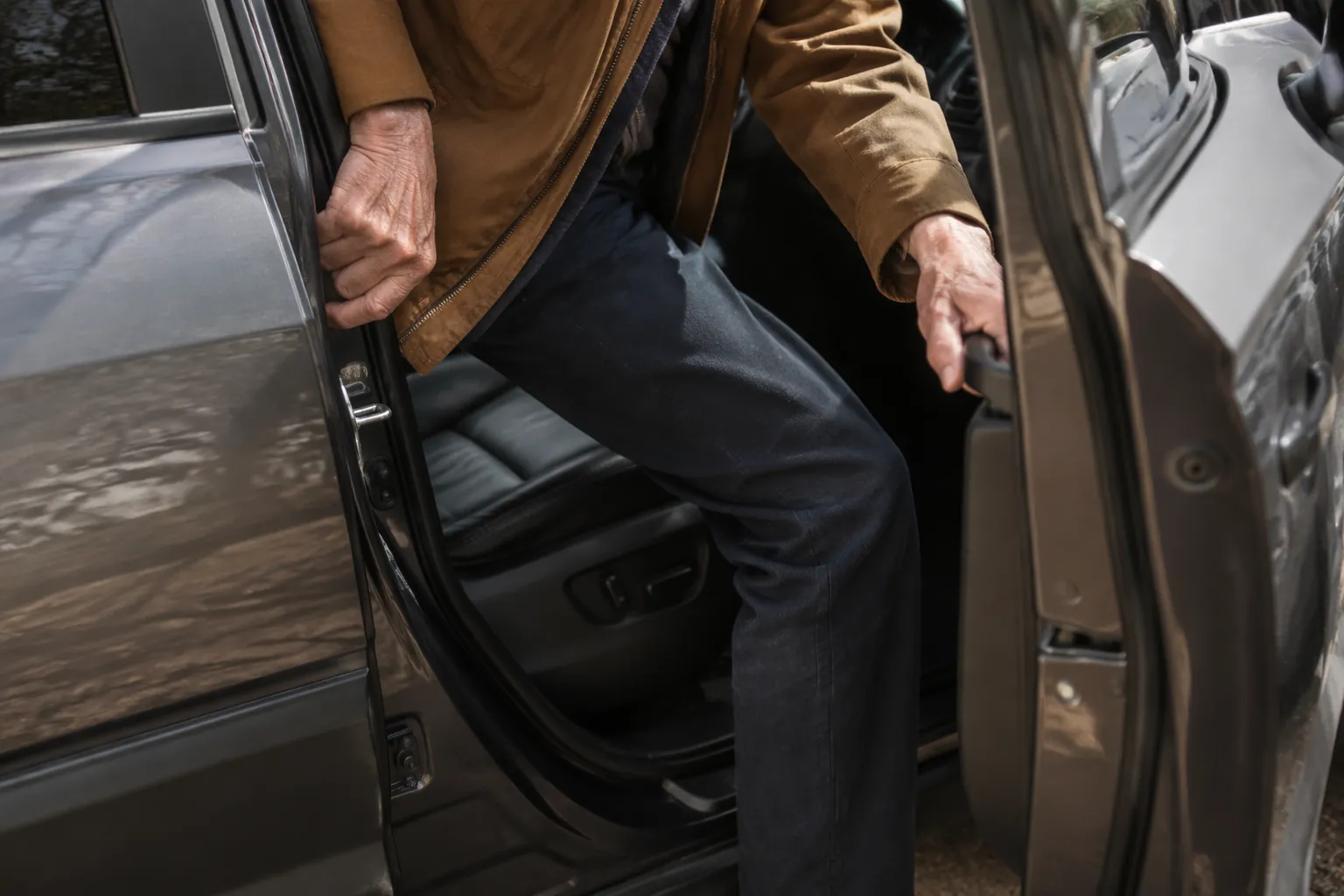
The dangerous moment often starts after the engine is off. An older driver opens the door, turns toward the parking lot, reaches for the door frame, and tries to stand before both feet are settled. If the seat is too low, the door does not open far enough, or the only available handhold moves with the door, the body has to solve too many problems at once.
That is the real meaning of car door safety features for elderly drivers. It is less about the latch and more about the whole entry-and-exit environment: seat height, door opening, door weight, stable grab points, visibility, and whether the driver can pivot, plant, and stand without twisting or lunging.
The numbers are old enough to handle carefully, but they still describe a familiar clinical pattern. A 2008 study using 2001–2003 injury data estimated that about 37,000 older adults were treated in emergency departments each year for injuries while getting into or out of vehicles; about 40% were fall injuries, exiting was more than twice as dangerous as entering, and older adults were 10 times more likely than younger adults to be hospitalized for these injuries.[1]
A fall at the car door also may say something about what happens later on the road. A meta-analysis of 15 studies with about 47,000 participants found that older adults who had fallen were 40% more likely to experience a subsequent car crash, while noting that post-fall rehabilitation and vehicle modifications may reduce that risk.[2] A parent who slips getting out of the car does not automatically become unsafe to drive, but the fall deserves more than a new floor mat and a reminder to “be careful.”
Start With The Transfer, Not The Car Brochure
Before shopping for equipment or a different vehicle, watch one ordinary transfer. Not the best transfer of the day, and not the one performed while everyone is giving instructions. Watch how the person actually gets out at the grocery store, medical office, church, or driveway.
- Do both feet reach the ground before standing, or does one foot stay trapped inside?
- Does the person pull on the door, the steering wheel, the dashboard, or the seatback?
- Does the door swing away, push back, or require one hand just to control it?
- Does the person twist through the knees, hips, or low back instead of pivoting?
- Is the seatbelt hard to reach, routed across the neck, or left behind the shoulder?
- Is the driver rushing because traffic, rain, curb height, or embarrassment changed the pace?
This small observation usually tells a caregiver where to spend money. A person who cannot rise from a low sedan needs a different solution than someone who stands well but cannot rotate without knee pain. A driver who backs poorly out of a tight parking space needs crash-prevention help, but that does not replace a stable handhold at the door.
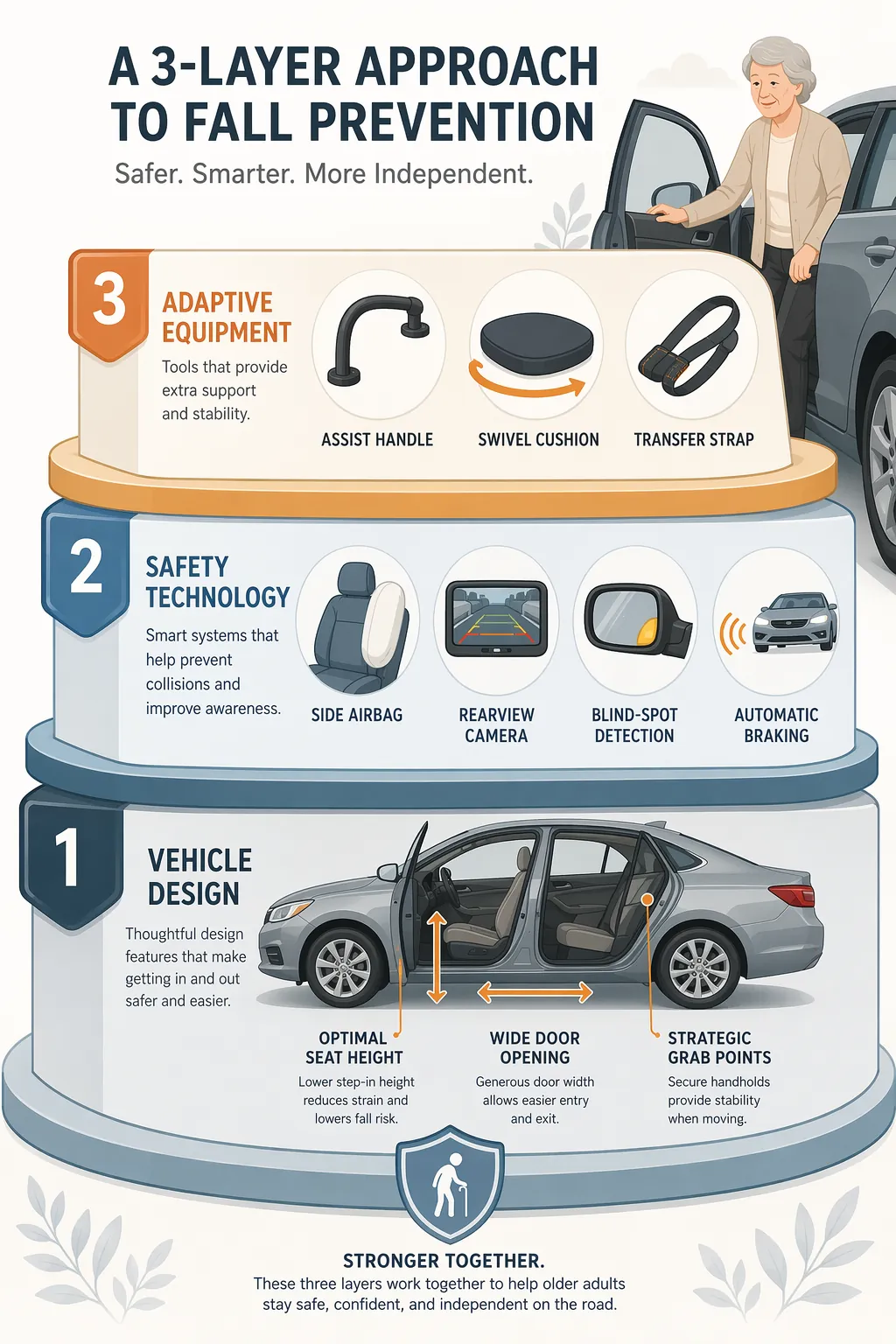
The useful system has three layers: vehicle design, built-in safety technology, and adaptive equipment. They overlap, but they do not do the same job.
The Vehicle Design Features That Change Body Mechanics
A good entry-and-exit vehicle does not make an older adult climb up, drop down, or fold sideways. The seat should be close enough to hip level that sitting and standing feel like using a firm dining chair, not a low sofa or a step stool. The doorway should allow the legs to turn together. The threshold should not demand a high step. The door should open wide enough to create space without becoming too heavy to control.
AARP and Consumer Reports vehicle guidance points many older drivers toward crossovers and SUVs because their seat height often lines up closer to hip level. The same guidance notes that minivans such as the Honda Odyssey, Kia Carnival, and Toyota Sienna tend to offer wide door openings and low step-in heights, and that Honda CR-V, Pilot, Odyssey, and Accord were top picks in four of six Consumer Reports size categories for ease of entry and exit.[3]
Those names are useful for a starting list, not a promise. Model-year changes, trim differences, running boards, seat bolsters, and optional packages can change the transfer. The test-sit matters more than the badge.
| Feature To Test | What To Look For | Why It Matters |
|---|---|---|
| Seat height | Seat close to hip level when standing beside the car | Reduces the drop into the seat and the push needed to stand |
| Door opening | Enough room to turn knees and feet together | Limits twisting through painful hips, knees, and low back |
| Door weight and swing | Door can be opened, held, and controlled without pulling the person off balance | Prevents the door from becoming the thing the driver has to fight |
| Threshold and step-in | No high sill or awkward climb over the frame | Helps both feet land where the driver expects them to land |
| Grab points | Stable places to place a hand without relying only on the moving door | Gives the body a predictable support point during the sit-to-stand |
| Visibility while exiting | Clear view of curb, pavement, puddles, and traffic | Lets the driver choose foot placement before weight shifts |
On a test drive, do not only drive. Park, turn the engine off, unbuckle, open the door, and get out the way it would happen after a long appointment. Then get back in. Try it again with the passenger seat if the older adult often rides with someone else. A car that feels fine during a five-minute drive can fail the person at the curb.
If declining mobility is showing up in the car, it is often showing up elsewhere too. Families who are trying to keep transportation, errands, and medical visits manageable may also want to look at broader ways to help aging parents maintain mobility and independence, because the car transfer is rarely the only place balance and strength are being tested.
Safety Technology Belongs Here, But It Does A Different Job
Side airbags, cameras, blind-spot systems, lane warnings, and automatic braking do not make the sit-to-stand easier. They matter because an older driver who is already working harder to enter, exit, turn, and scan may have less margin for traffic conflicts, backing crashes, and side impacts.
The Insurance Institute for Highway Safety reports that head-and-torso side airbags reduce fatalities in nearside impacts by 45% for front-seat occupants ages 70 and older, compared with 30% for ages 13 to 49. IIHS also reports that rearview cameras reduced backing crashes among drivers over 70 by 36%.[4]
IIHS research further estimates that front crash prevention, blind-spot detection, and lane-departure warning could address up to 20% of older drivers’ annual crash involvements and 25% of their fatalities.[4] That is not a reason to ignore the door opening or seat height. It is a reason to treat crash-prevention technology as the layer that protects the trip around the transfer.
- Prioritize side airbags with head and torso protection when comparing vehicles.
- Use rearview cameras and parking sensors to reduce backing stress, especially in tight lots.
- Consider blind-spot detection for drivers with neck stiffness or limited trunk rotation.
- Treat lane-departure warning and front crash prevention as added protection, not permission to continue driving when attention, vision, or reaction time has clearly declined.
When prevention fails, the consequences can move quickly from a scraped knee to a crash, hospital stay, insurance dispute, or legal problem. Caregivers dealing with a collision involving an older adult may need a different kind of guidance than fall-prevention equipment can provide, including resources on car accidents involving seniors.
If You Are Keeping The Current Car, Start With Low-Cost Transfer Aids
Many families jump from “Mom slipped getting out of the car” to “We need to buy a different car.” Sometimes they do. But if the current vehicle is otherwise safe, reliable, and reasonably close to the right height, a small adaptation may solve the actual transfer problem first.
Car assist handles, often sold as HandyBar-style handles or car canes, slide into the door-latch striker plate to create a temporary weight-bearing handle. Consumer Reports describes these as low-cost tools, commonly around $10 to $30, and notes that many are rated for 300 to 400 pounds.[5] Occupational-therapy consumer guidance also commonly recommends them for safer car transfers when the person needs a steadier push point than the door itself.[6]
The reason they help is simple: the handle gives the hand a place to push down, not pull sideways. Pulling on a moving door can shift the center of gravity away from the feet. Pushing through a stable handle lets the person rise more like standing from a chair.
| Tool | Usual Use | Important Caution |
|---|---|---|
| Assist handle or car cane | Temporary handhold in the door-latch striker plate during entry or exit | Use only if it fits the vehicle securely and does not damage the latch area |
| Swivel cushion | Helps the hips and legs turn together, reducing twisting strain | Remove before driving because an unanchored cushion can slide |
| Transfer strap | Gives a caregiver or passenger a planned handhold during a difficult pivot | Needs instruction so the helper does not pull the person off balance |
| Seatbelt reacher or aid | Brings the belt within reach and may reduce awkward shoulder twisting | Must not interfere with correct belt routing |
| Large interior handles | Make doors easier to grasp for painful or weak hands | Should support the movement needed without blocking controls |
| Pedal adjustments | Improve foot reach and driving position | Should be evaluated carefully because they affect driving control |
Swivel cushions deserve their own warning because they can be very useful and very easy to misuse. AARP describes swivel cushions, often around $20 to $60, as accessories that can reduce twisting during entry and exit.[7] The cushion should be used while the vehicle is parked, then removed before driving if it is not anchored, because a sliding cushion during a crash or sudden stop is a different hazard.
That distinction matters for every add-on: some equipment can stay in place while driving, and some exists only for the transfer. A blind-spot mirror can stay. A properly installed large handle may stay. An unanchored swivel cushion should not. A temporary assist handle comes out after the person is seated and before the door closes.
A Safer Exit Routine
Equipment works best when it supports a repeatable sequence. For many older adults, the safer exit is: unbuckle, open the door fully enough to create space, turn the body so both legs face out, place both feet flat, place one hand on a stable support, lean the trunk slightly forward, then stand. The caregiver’s job is not to yank. It is to slow the transfer down and make sure the feet and hands are ready before weight shifts.
If the older adult cannot complete that sequence without pain, dizziness, knee buckling, or breathlessness, the next purchase should not be another gadget. That is the point to involve an occupational therapist, physical therapist, primary-care clinician, or driver rehabilitation specialist.
Use CarFit When The Vehicle Almost Works
Sometimes the car is close to right, but the setup is wrong. The seat is too far back. The steering wheel is too high. The mirrors make the driver twist more than necessary. The seatbelt crosses the neck. These are fit problems, and they are exactly where a structured check helps.
CarFit, developed by AARP and the American Occupational Therapy Association, offers a free 20-minute vehicle-fit check covering 12 adjustment points, including seat position, steering wheel height, seatbelt routing, mirror placement, and head restraint. The program is available through in-person events and virtual workshops.[8]
CarFit is not a medical clearance to drive. It is a practical fit check. That boundary is useful. If the problem is that the driver cannot reach the pedals safely, cannot turn to scan, gets confused by controls, or has had repeated falls or near misses, a driver rehabilitation specialist is a better next step. Costs vary widely by region and insurance, with caregiver-facing guidance commonly describing a range of about $50 to $500 for consultation or evaluation.
Adapted-Vehicle Features Are Not Only For Wheelchair Users
NHTSA’s adapted-vehicle guidance lists support handles, large interior door handles, and adjustable foot pedals among features that may help drivers with disabilities.[9] Those features can sound more serious than a family thinks it needs, but arthritis, reduced grip strength, limited hip motion, and weak ankles are exactly the kinds of ordinary changes that make standard vehicle layouts harder.
Large handles help when small recessed pulls punish painful fingers. Adjustable pedals can help a shorter driver keep a safer distance from the steering wheel while still reaching the brake and accelerator. Support handles can reduce the temptation to grab the steering wheel, dashboard, or a caregiver’s sleeve.
Anything that changes braking, steering, pedal reach, or seating position should be treated more carefully than a removable transfer handle. If the adaptation affects driving control, get professional fitting or evaluation rather than guessing from an online product photo.
When Replacing The Car Makes Sense
A different car becomes more reasonable when the current one fails the transfer in ways equipment cannot fix: the seat is far too low, the door opening is narrow, the threshold is high, the door is too heavy, or the driver cannot enter without pain even after trying fit adjustments and simple aids.
Bring the actual older driver to the dealership, not just their measurements. Bring the cane, walker, purse, winter coat, or brace they normally use. If the driver gets tired after medical appointments, do not judge the vehicle only during a rested morning test. Fatigue changes transfers.
- Reject any vehicle that requires a climb, drop, or sideways collapse into the seat.
- Favor doors that open wide enough for both knees to turn together.
- Check whether the driver can control the door on a slight slope or in a breeze.
- Confirm that the seatbelt can be reached and routed correctly without shoulder strain.
- Compare safety technology after the transfer passes, not before.
This is where broad class guidance helps. Crossovers and some SUVs may reduce the push from a low seat. Minivans may give the best door opening and step-in geometry. Sedans can still work for some drivers, especially if the seat height and doorway match the person well, but a low sedan that requires a deep rise from the hips and knees is usually not kind to a weakening transfer.
What Not To Overbuy
Luxury convenience packages can be pleasant, but they do not automatically solve car-door falls. Heated seats, premium audio, panoramic roofs, and soft-close doors may make a car feel nicer without changing the body mechanics of getting out. Power seats can help if they allow the right height and distance; they are less useful if the doorway still forces a twist.
The same caution applies to “senior-friendly car” lists. A model can be excellent for one older driver and wrong for another. Hip replacement history, knee arthritis, height, arm strength, balance, vision, and parking environment all change the answer. The better question is not “Which car is best for seniors?” It is “Which setup lets this person get in and out without rushing, twisting, pulling on a moving door, or guessing where the ground is?”
A Practical Order For Caregivers
For a parent who has begun struggling, act in the order that changes the most with the least disruption.
- Observe the real transfer in the real parking situations where trouble happens.
- Adjust fit first: seat position, steering wheel, mirrors, head restraint, and belt routing.
- Try low-cost transfer aids when the vehicle is close to workable.
- Use CarFit when the setup feels awkward but the driver is still generally managing.
- Consult OT, PT, a clinician, or a driver rehabilitation specialist when falls, pain, dizziness, pedal-control problems, or repeated near misses appear.
- Replace the vehicle only when design problems cannot be corrected with fit or equipment.
Fall prevention also matters in situations where driving is not optional, such as evacuations or urgent trips. Families thinking through emergency planning may want to connect vehicle transfers with broader fall-prevention planning during severe-weather safety.
If mobility keeps declining, the long-term answer may eventually include fewer personal driving trips, more rides from family, paratransit, rideshare support, or future transportation options such as self-driving services for senior mobility. But most families are not starting there. They are starting with one parent, one car door, and one transfer that no longer looks steady.
Readers who are also rethinking the home environment can apply the same logic indoors: start with the places where ordinary movements have become risky, then decide whether smaller changes are enough before making larger housing decisions. Related guidance on choosing home modifications over downsizing may help keep the same practical lens.
Make that transfer safer first. Use vehicle design criteria if the car needs replacing. Add built-in safety technology as protection around the trip, not as a substitute for getting in and out safely. The goal is not just avoiding a fall in a parking lot. It is preserving the older adult’s ability to leave home without making every errand feel like a hazard.
References
- Getting in and out of cars risky for seniors, Reuters, https://www.reuters.com/article/business/healthcare-pharmaceuticals/getting-in-and-out-of-cars-risky-for-seniors-idUSHAR363182/
- Older Drivers Who Experience Falls May Be at a Higher Risk for Car Accidents, Health in Aging, https://www.healthinaging.org/blog/older-drivers-who-experience-falls-may-be-at-a-higher-risk-for-car-accidents/
- Getting In and Out of Cars, AARP, https://www.aarp.org/auto/driver-safety/getting-in-out-of-cars/
- Older drivers, Insurance Institute for Highway Safety, https://www.iihs.org/research-areas/older-drivers
- How to Make Your Car More Accessible, Consumer Reports, https://www.consumerreports.org/cars/cars-driving/how-to-make-your-car-more-accessible-a9092978287/
- Safe Car Travel for Seniors, AskSAMIE, https://www.asksamie.com/blogs/answers-for-accessibility/safe-car-travel-for-seniors
- Car Accessories for Disabled Adults, AARP, https://www.aarp.org/auto/trends-technology/car-accessories-for-disabled-adults/
- CarFit, https://car-fit.org/
- Adapted Vehicles, National Highway Traffic Safety Administration, https://www.nhtsa.gov/vehicle-safety/adapted-vehicles
Questions to bring to a clinician or OT
This is not medical, legal, or a family's final decision — only a framework. Bring these questions to a clinician, occupational therapist, or your local Area Agency on Aging.
Find Local HelpRelated reading
Noticed something outdated or inaccurate on this page? Flag a correction. We review every report against CDC, NIA, and AARP HomeFit guidance before updating a page.