
Glossary entry
How Much Is the 3.6% Social Security COLA for 2027?
Last verified 2026-08-25
This is not financial or legal advice. Medicare/Medicaid and benefits rules vary by state and change over time — verify current rules with your state Medicaid office or Area Agency on Aging.
Last verified: August 25, 2026. Reviewed for benefits literacy by a CFP® benefits reviewer and a geriatric RN reviewer. This article is educational and is not financial advice.

If the 2027 Social Security COLA ends up at 3.6%, a senior receiving about $2,000 a month before deductions would see about $72 more per month. At the average-benefit figures used by several major sources, the projected increase lands roughly between $69.75 and $75.03 per month.
That 3.6% figure is The Senior Citizens League’s July 2026 projection, not the official 2027 COLA. The Social Security Administration says the official 2027 COLA will be announced October 14, 2026, after the July, August, and September inflation data used in the formula are known.[1][2]
What a 3.6% COLA would add to a monthly benefit
Use the current gross monthly benefit as the starting point—the amount before Medicare premiums, tax withholding, or other deductions. The table below includes simple benefit levels plus the source-attributed averages reported by Kiplinger, Money.com using The Senior Citizens League’s all-beneficiaries average, CBS News, and CNBC Select/AARP.[3][4][5][6]
| Current monthly benefit base | What 3.6% would add | Projected gross monthly benefit if 3.6% holds | What the figure represents |
|---|---|---|---|
| $1,000.00 | $36.00 | $1,036.00 | Simple benefit-level example |
| $1,500.00 | $54.00 | $1,554.00 | Simple benefit-level example |
| $1,937.53 | $69.75 | $2,007.28 | All-beneficiaries average cited by The Senior Citizens League via Money.com[4] |
| $2,026.00 | $72.94, or about $73 | $2,098.94, or about $2,099 | Average used by CNBC Select/AARP[6] |
| $2,071.00 | $74.56, or about $75 | $2,145.56, or about $2,146 | January 2026 average retired-worker benefit used by CBS News[5] |
| $2,084.40 | $75.03 | $2,159.43 | June 2026 SSA average retired-worker benefit used by Kiplinger[3] |
| $2,500.00 | $90.00 | $2,590.00 | Simple benefit-level example |
The spread in the “average” increase is not an error. One source is using an all-beneficiaries average; others are using retired-worker averages measured at different points in 2026. A 3.6% increase on $1,937.53 is $69.75, while the same percentage on $2,084.40 is $75.03. The percentage is the same; the benefit base is different.
For a household budget, that distinction matters. A person receiving $1,500 would not get the same dollar increase as someone receiving $2,500. The useful shortcut is: multiply your own gross monthly benefit by 0.036. If your current gross benefit is $1,800, for example, a hypothetical 3.6% COLA would add $64.80 before deductions.
Why the 3.6% number is still moving
The 3.6% estimate sits beside other midyear forecasts. AARP has pointed to a 3.5% early forecast, while independent analyst Mary Johnson has estimated 3.4%.[7][8] Those differences are small in percentage terms, but they can still matter when someone is checking next year’s rent, utilities, or prescription budget.
The estimate has already shifted during 2026: 2.8%, then 3.9%, then 3.8%, then 3.6% across the January-through-July projection window cited in current COLA coverage.[1][4] That movement does not mean the calculation is arbitrary. It means the final pieces of the inflation data are not yet in.
SSA calculates the COLA by comparing the average Consumer Price Index for Urban Wage Earners and Clerical Workers, or CPI-W, for July through September 2026 with the average for the same quarter in 2025, then rounding to the nearest one-tenth of one percent.[2] A fuller walkthrough of the formula is available in How Is the 2027 Social Security COLA Calculated?.
If the 2027 COLA did finish at 3.6%, it would be the largest adjustment since 2023 and about a full percentage point above the 2026 COLA of 2.8%.[9][10] That historical comparison is useful for context, but it still does not turn the projection into a personal benefit amount.
The gross increase and the deposited amount are not always the same
The COLA applies to the Social Security benefit amount. The payment that arrives in a bank account can be lower if Medicare Part B premiums, federal tax withholding, or other deductions come out first.
For 2027, the Medicare Part B premium is also still provisional. The 2026 Medicare Trustees Report projects a standard Part B premium of $209.50 per month for 2027, compared with $202.90 in 2026, but that is not the final premium announcement.[11] For more on why a check can rise by less than the COLA percentage, see Can the 2027 Social Security COLA Be Cut? Your Check Can.
This is also why an average-benefit headline should not be used as a personal promise. SSA’s 2026 fact sheet showed monthly Social Security payments ranging from a $52 special minimum benefit to a $5,108 maximum retirement benefit, so the dollar value of the same percentage increase can vary widely.[9]
How to verify your own 2027 COLA amount
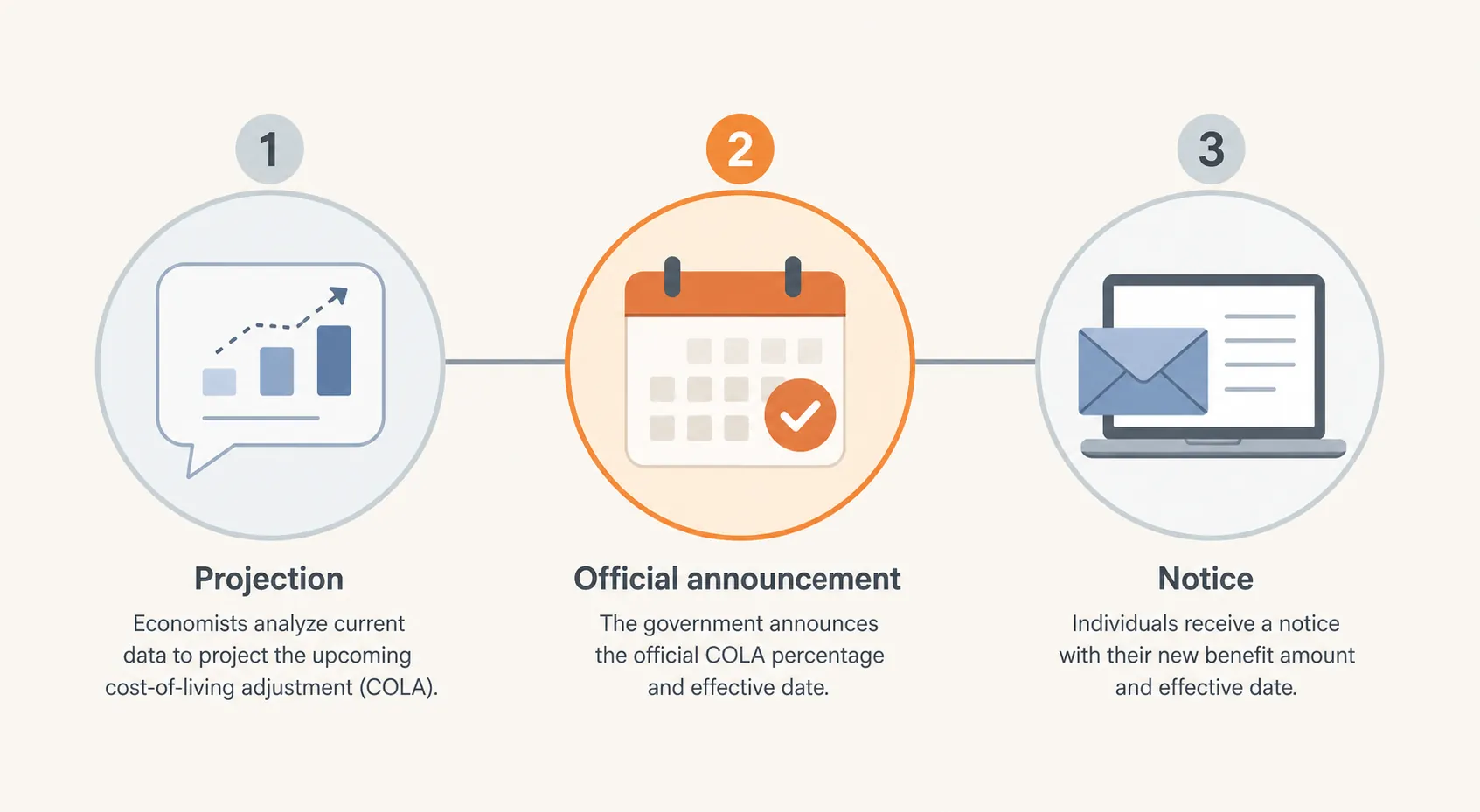
There are three different moments to keep separate: the projection people are seeing now, the official COLA announcement, and the personal notice that shows an individual’s benefit.
- Now: use 3.6% only as a planning estimate. Multiply your current gross monthly benefit by 0.036 to see the possible gross increase.
- October 14, 2026: check the official SSA announcement for the final 2027 COLA rate.[2]
- December 2026: look for your COLA notice by mail or check it online through your my Social Security account.[2]
For someone helping a parent from another household, the cleanest approach is to work from the parent’s gross Social Security benefit, not the most recent bank deposit. The deposit may already reflect Medicare withholding or tax withholding. The December notice is the document that ties the final COLA rate to that person’s actual benefit.
If the main concern is whether the COLA keeps up with older adults’ real expenses, that is a separate buying-power question covered in Does Social Security COLA keep up with inflation for seniors?. Here, the practical answer is narrower: a 3.6% COLA would add about $36 per month for each $1,000 of gross monthly benefit, and about $70–$75 for the average-benefit figures currently being cited. The final rate and the individual notice are what establish the real 2027 increase.
References
- TSCL COLA Watch, The Senior Citizens League
- Latest Cost-of-Living Adjustment, Social Security Administration
- 2027 Social Security COLA Forecast, Kiplinger
- 2027 Social Security COLA Estimate Falls to 3.6%, Money
- Social Security 2027 COLA estimate is shrinking as inflation cools, CBS News
- How Much Will the Social Security 2027 COLA Be?, CNBC Select
- Early Forecast Suggests a Social Security Increase in 2027, AARP
- Seniors could see a bigger raise in 2027, Yahoo Finance
- 2026 COLA Fact Sheet, Social Security Administration
- Cost-Of-Living Adjustments, Social Security Administration
- 2026 Medicare Trustees Report, Centers for Medicare & Medicaid Services
Browse more in the Glossary.