
Glossary entry
Why the 2.8% Social Security COLA Won't Cover Rising Costs
Last verified 2026-07-30
This is not financial or legal advice. Medicare/Medicaid and benefits rules vary by state and change over time — verify current rules with your state Medicaid office or Area Agency on Aging.
The 2026 Social Security COLA is 2.8%, but that is not the number most people feel in the checking account. For the average retired worker, the raise is about $56 a month. The standard Medicare Part B premium rises by $17.90, to $202.90 a month. That one premium increase takes roughly a third of the average raise before groceries, prescriptions, rent, property taxes, home insurance, utilities, or transportation enter the math [1][2].

So, will the Social Security COLA cover rising costs for seniors in 2026? For many households, no. The official raise helps, but the first subtraction is automatic for people whose Part B premium is deducted from Social Security. After that Medicare increase alone, the average retired worker is looking at about $38 more per month, not $56. For people with smaller checks or other deductions, the practical breathing room can be closer to the low $30s.
| 2026 monthly item | What it means for the average retired worker |
|---|---|
| 2.8% Social Security COLA | About $56 more per month for the average retired worker [1] |
| Medicare Part B premium increase | $17.90 more per month, bringing the standard premium to $202.90 [1] |
| Approximate amount left after Part B increase | About $38 per month before other rising costs |
| Part B share of average Social Security benefit | Projected to reach 9.4% in 2026, described by CRR as an all-time high [2] |
That is why the headline percentage can feel misleading. A 2.8% COLA is applied to the Social Security benefit, but many retirees do not live on the gross benefit. They live on what remains after Medicare premiums and ordinary bills. A person trying to decide whether to refill a prescription now, turn the heat up, or cover a higher grocery total does not experience the COLA as a clean 2.8% raise.
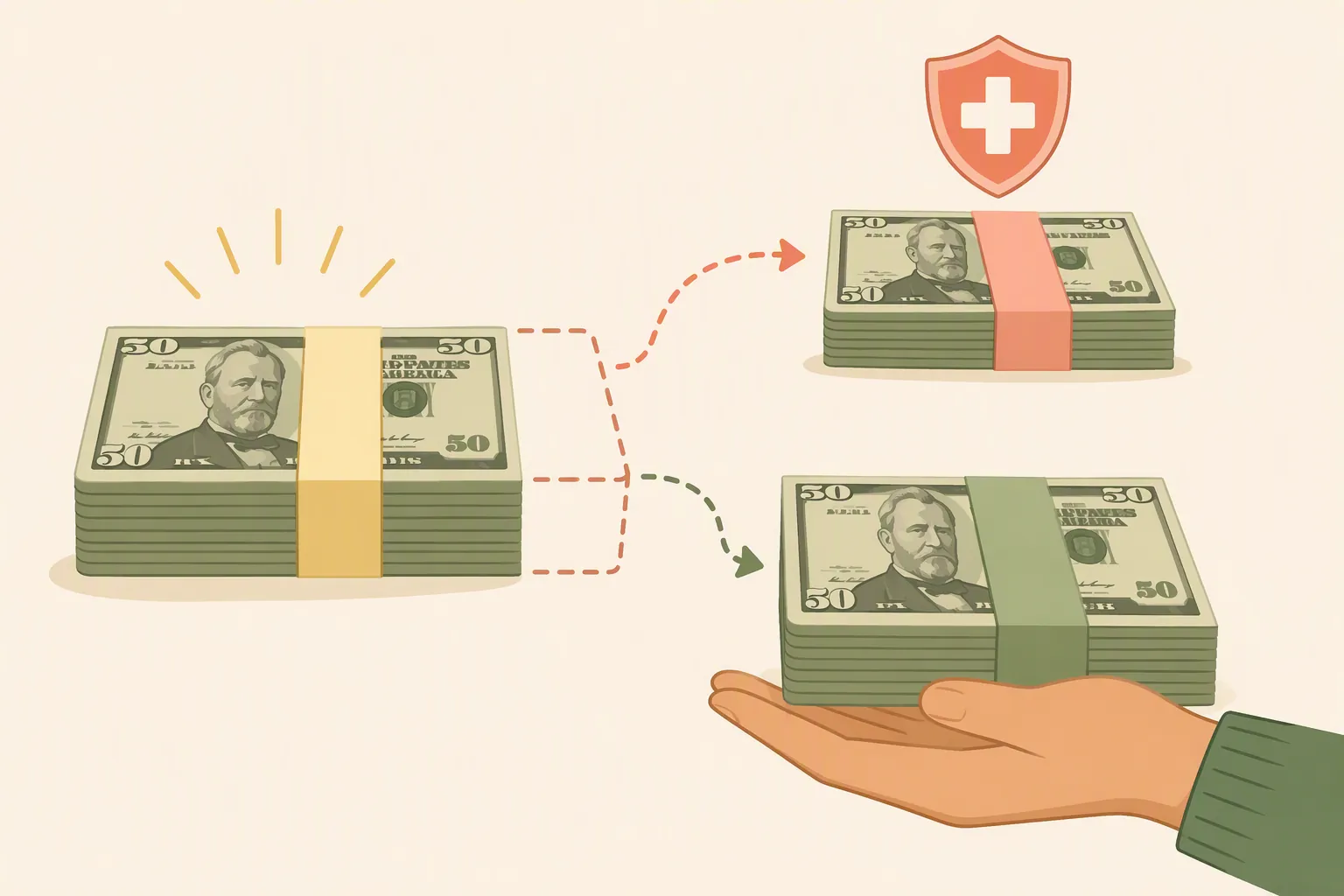
Why the official COLA and the lived budget separate
The Medicare premium explains the first cut. The inflation formula explains the deeper problem.
Social Security COLAs are based on the Consumer Price Index for Urban Wage Earners and Clerical Workers, or CPI-W. That index tracks spending patterns for working-age urban wage earners, not retirees. It is an official measure, and the 2.8% COLA is technically correct under current law. The problem is that the index does not match the way older households spend money.
Healthcare and housing are the two places where the mismatch matters most. CPI-W gives healthcare a 6.9% weight and housing a 41.9% weight. The experimental elderly index, CPI-E, gives healthcare an 11.3% weight and housing a 48.1% weight [3][4]. That difference is not a footnote for a retiree. It is the doctor visit, the Part D copay, the supplemental premium, the rent increase, the homeowners insurance renewal, or the electric bill attached to keeping a home safe.

If CPI-E had been used for 2026, the COLA would have been 3.1% instead of 2.8% [3]. That may sound like a small difference until it compounds over years. One comparison cited by retirement economist Teresa Ghilarducci shows that a $500 monthly benefit in 1982 would grow to about $1,440 under CPI-W, compared with about $1,555 under CPI-E. That is a gap of about $115 a month, created not by one bad year but by repeated small differences in the inflation measure [3].
The long-term pattern points the same way. CPI-W lagged CPI-E in 18 of the past 26 years, according to reporting that draws on Congressional Research Service comparisons [4]. That does not mean CPI-E is perfect, and it is still a research index rather than the official Social Security formula. It does mean the current COLA formula can be accurate by statute while still undercounting costs that dominate many older adults’ budgets.
The timing problem makes the check feel late
There is also a timing lag. The COLA arrives after inflation has already raised prices. Seniors pay higher grocery, utility, rent, insurance, and medical costs during the year, then receive the annual adjustment later. Ghilarducci’s analysis estimated that, at 3% inflation, a monthly adjustment rather than an annual one would leave retirees with about $360 more over a year [3]. That is not a luxury amount. In many households, it is a utility bill, a prescription copay, or the difference between replacing something worn out and putting it off again.
What seniors are reporting in 2026
The survey data does not prove every household has the same shortfall, but it confirms that the squeeze is widespread. In AARP’s May 2026 Financial Security Trends Survey, 69% of older adults said prices were rising faster than their income [5]. AARP also reported that 77% of its members said even a 3% COLA would not be enough [6].
A February 2026 Chapter survey of 1,000 seniors found that 86% reported grocery price increases, 67% had changed their diet, 66% faced higher utility costs, 22% had reduced heating or cooling, and 25% had skipped medical care or prescriptions because of cost [7]. Chapter is a Medicare-related company, so its survey should not carry the whole argument by itself. Still, those findings line up with what the official benefit math already shows: the net raise is too small to absorb several categories of increases at once.
The Senior Citizens League, an advocacy group focused on older Americans, estimated that the average Social Security benefit has lost 13.7% of its buying power since 2010 [8]. Advocacy groups naturally frame the problem sharply, but the direction is consistent with the CPI-W issue, the Part B offset, and the household surveys.
The hardest part of this budget is that the categories do not wait politely in line. A higher Part B premium can arrive at the same time as a Part D drug cost, a winter heating bill, a rent renewal, or a grocery receipt that no longer buys the same food. Adult children often see the shortfall in fragments: one pharmacy pickup covered, one utility bill quietly paid, one grocery run stretched with cheaper protein and fewer fresh items.
Why “average” can hide the person who is worse off
The average retired worker figure is useful, but it can soften the real difference between households. Someone with a higher Social Security check receives a larger dollar increase from the same 2.8% COLA. Someone with a smaller check still pays the same standard Part B premium if they are in that category. For that person, the $17.90 premium increase eats a larger share of the raise.
That is why the same COLA can feel adequate to one retiree and insulting to another. The formula is a percentage. The grocery bill is not. The Part B increase is not. A copay is not. A utility minimum charge is not. Fixed-dollar increases press hardest on people whose checks are already small.
It is also why benefit notices deserve a line-by-line reading. The number to look for is not only the new gross Social Security amount. It is the net deposit after Medicare deductions. For readers trying to understand payment timing as well as COLA changes, CareWise Guide’s explanation of why SSI is paid early in August 2026 can help separate a calendar quirk from an actual benefit increase.
Would a different inflation measure fix it?
A different inflation measure would likely change the size of the COLA, but it would not erase every budget problem. CPI-E would have produced a 3.1% COLA for 2026 instead of 2.8% [3]. The Senior Citizens League has also discussed a CPI-BEST approach, which it says would have produced a 3.1% COLA in 2026 and averaged about 4.0% over the last 10 years, compared with 2.8% under the current measure [8].
Those comparisons are useful because they show the direction of the formula problem. They are not the same as a guarantee that any one proposal would pass Congress or be implemented exactly as modeled. CPI-E remains an experimental elderly index, and COLA reform proposals have not become law.
Even so, the 2026 numbers make the basic answer clear. The COLA helps, but it does not fully cover seniors’ real rising costs once Medicare premiums, healthcare, groceries, housing, utilities, and the inflation-index mismatch are counted. For a household planning next month’s budget, the practical number is not 2.8%. It is the new net deposit, the bills already waiting, and how little room remains after the automatic Medicare subtraction. This article is educational information, not personal financial advice.
References
- SSA 2026 COLA Fact Sheet, Social Security Administration
- Higher Medicare Premiums Will Eat Up More Than 25 Percent of the Social Security COLA, Center for Retirement Research at Boston College
- Today's Social Security COLA Is Inadequate For Three Reasons, Forbes, October 24, 2025
- Why Your Social Security Raise Might Not Be What You Expect, Investopedia
- Older Americans Feeling Financial Strain as Costs Rise, AARP, May 28, 2026
- 6 Big Social Security Changes for 2026, AARP
- Golden Years, Growing Costs: Seniors' Difficult Financial Trade-Offs, Chapter, February 2026
- COLA Watch, The Senior Citizens League
Browse more in the Glossary.