
Glossary entry
How the Social Security Payment Schedule Works for Seniors
Last verified 2026-08-04
This is not financial or legal advice. Medicare/Medicaid and benefits rules vary by state and change over time — verify current rules with your state Medicaid office or Area Agency on Aging.
There is no single Social Security payday for all seniors, but most people can find their payment bucket in a few minutes. Social Security first separates people by benefit type and exception status; most remaining retirement, survivors, and disability beneficiaries are then assigned to a Wednesday based on birth date. [1]
Last verified: August 4, 2026. This article explains general benefit schedule rules, not financial, legal, or tax advice. For a personal benefit record, use SSA’s official tools or contact Social Security directly.

Find your payment bucket first
Before looking up a month-by-month calendar, sort the benefit into the right bucket. This is the part that prevents most calendar mistakes.
| If this describes the benefit | Usual payment rule |
|---|---|
| Social Security retirement, survivors, or disability benefits, and none of the 3rd-of-month exceptions apply | Paid on the 2nd, 3rd, or 4th Wednesday of the month, based on birth date. [1] |
| Entitled to or filed for Social Security before May 1997 | Paid on the 3rd of the month. [1] |
| Receiving both Social Security and SSI | SSI is paid on the 1st; Social Security is paid on the 3rd. [1] |
| State pays the person’s Medicare premiums | Paid on the 3rd of the month. [1] |
| Living outside the United States | Paid on the 3rd of the month. [1] |
| SSI only | Paid on the 1st of the month. [1] |
| Scheduled payday falls on a weekend or federal holiday | Payment moves to the first preceding business day. [2] |
The most common wrong turn is to jump straight to the Wednesday rule when the person is actually in one of the 3rd-of-the-month groups. The second most common wrong turn is mixing up Social Security retirement or disability benefits with SSI. They can arrive on different days.
The Wednesday rule for most Social Security beneficiaries
For most people receiving Social Security retirement, survivors, or disability benefits, the birth date determines which Wednesday is payday:
- Birth date on the 1st through the 10th: payment on the 2nd Wednesday of the month. [1]
- Birth date on the 11th through the 20th: payment on the 3rd Wednesday of the month. [1]
- Birth date on the 21st through the 31st: payment on the 4th Wednesday of the month. [1]
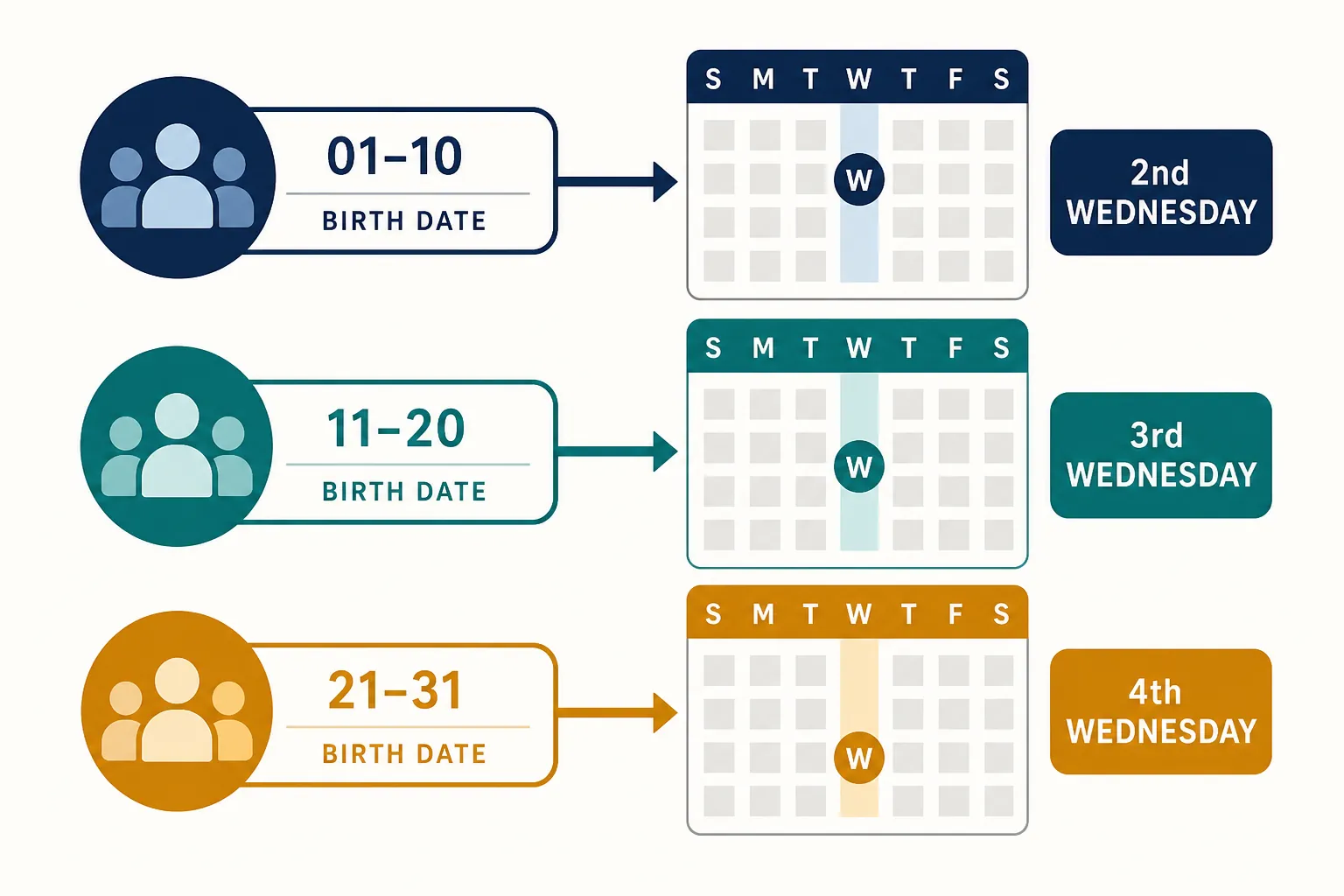
In plain terms: someone with a birthday on the 8th looks at the second Wednesday. Someone with a birthday on the 17th looks at the third Wednesday. Someone with a birthday on the 28th looks at the fourth Wednesday. Once that bucket is correct, the exact calendar date changes from month to month, but the rule does not.
SSA introduced this staggered, birth-date-based payment system in June 1997, which is why the pre-May-1997 exception still matters. It is not about being born before May 1997. It is about being entitled to or having filed for benefits before that cutoff. [6]
Who is paid on the 3rd instead
The 3rd-of-the-month group is small enough to state clearly, but important enough not to skip. A person is generally paid on the 3rd if any of these apply: they were entitled to or filed for Social Security before May 1997; they receive both Social Security and SSI; their state pays their Medicare premiums; or they live outside the United States. [1]
The wording matters. “Filed before May 1997” is not the same as “born before May 1997.” A retired parent born in the 1940s who first claimed Social Security years after 1997 is not in this exception just because of age. If no other exception applies, that person usually follows the Wednesday rule.
The Medicare-premium exception can also surprise families. If a state is paying the person’s Medicare premiums, the Social Security payment date may be the 3rd rather than the birthday-based Wednesday. If a deposit date has always seemed “off” compared with a birthday chart, this is one of the first details to verify.
SSI uses the 1st, and mixed benefits can split the calendar
SSI is Supplemental Security Income. It is administered by Social Security, but it is not the same benefit as Social Security retirement, survivors, or disability insurance. SSI payments are scheduled for the 1st of the month. [1]
For someone who receives both SSI and Social Security, two rules may be visible in the bank account: SSI on the 1st and Social Security on the 3rd, subject to the weekend and holiday shift. [1][2]
That split is one reason caregivers should label the payments on a calendar by benefit type, not just by dollar amount. A rent payment, prescription refill, or automatic utility draft may depend on knowing which deposit is expected first.
Weekends and federal holidays move the date earlier
If the scheduled payment date falls on a Saturday, Sunday, or federal holiday, SSA says the payment is made on the first preceding business day. [2]
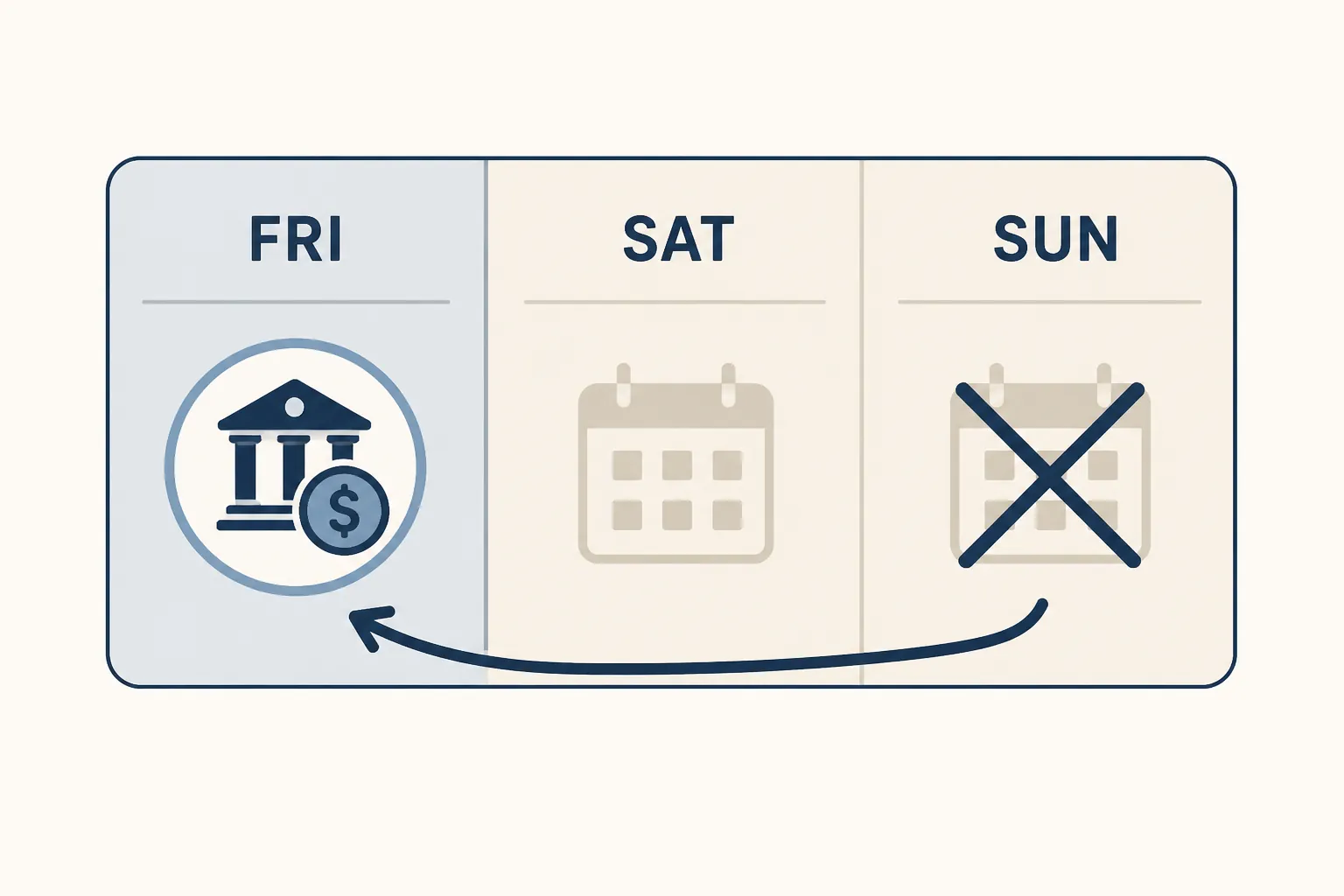
That “preceding business day” phrase is the safe rule to use. If a summary article says a 3rd-of-the-month payment always moves to “the first Friday of the month,” check the official SSA calendar instead. The point is not the name of the weekday; the point is the business day immediately before the blocked date.
For a wall calendar, mark the normal rule first, then check whether the date lands on a weekend or federal holiday. If it does, move the mark backward, not forward.
Why the August deposit is for July
Social Security benefits are paid the month after they are due. That means a payment received in August is for the July benefit month. [3]
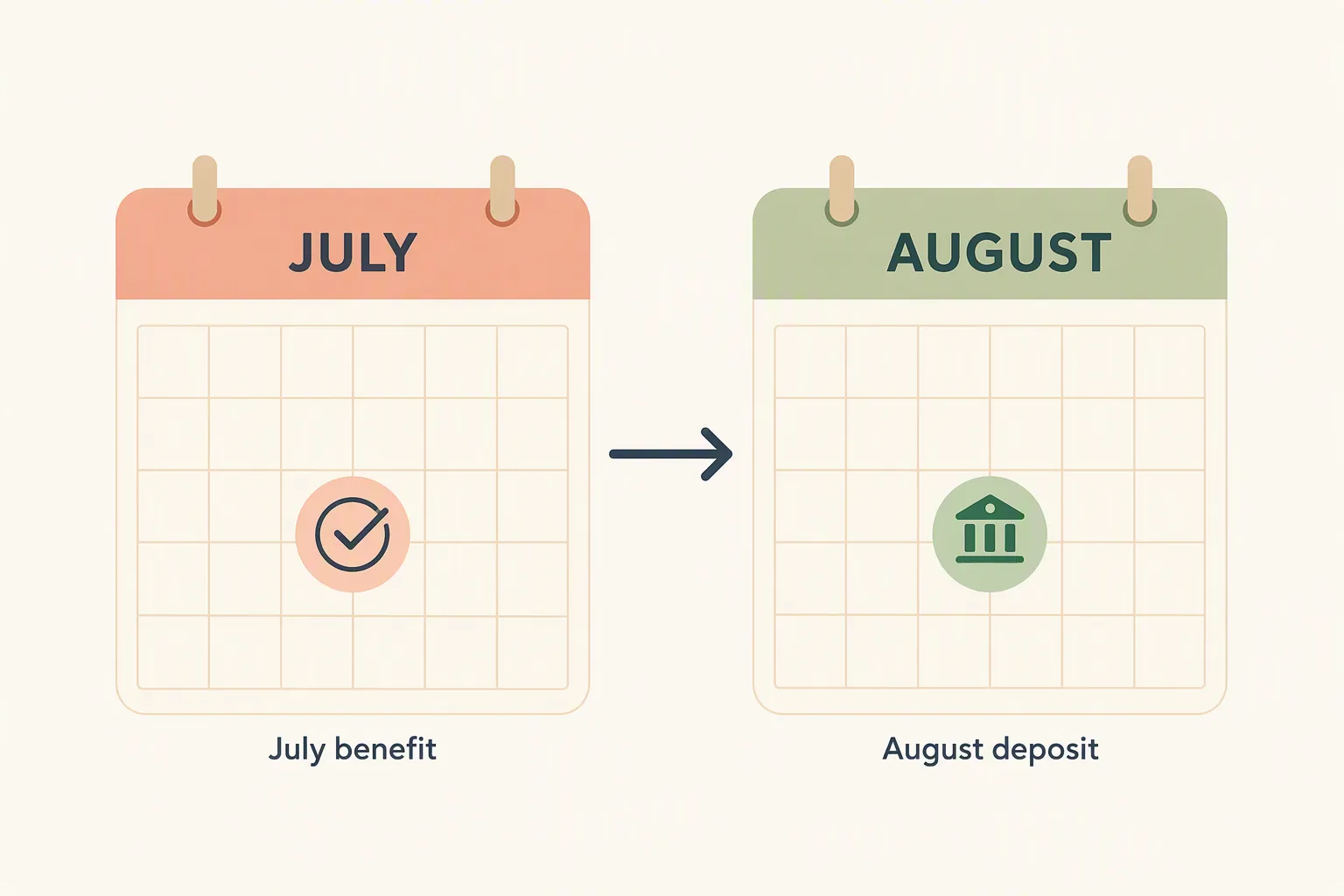
This is not a delay in the household sense. It is how the benefit month is labeled. The label matters when someone starts benefits, stops benefits, changes bank accounts, or tries to match a notice from SSA to a deposit that appeared weeks later.
First-payment timing has its own rules, especially around the month a person elects to start retirement benefits. SSA has a separate first-payment timing page for that question, so do not use an ordinary monthly payment chart to guess the first deposit. [3]
Verify the exact date before you write it on the calendar
The rules are stable, but the exact dates change every year. The cleanest way to confirm a personal payment date is through a my Social Security account, where SSA says beneficiaries can view their benefit payment schedule. [4]
For a year-at-a-glance view, use SSA’s official payment schedule hub. It is the better source for marking a full-year calendar than a news article that rewrites the same rules around one month’s dates. [5]
- If you know the benefit is ordinary Social Security retirement, survivors, or disability and no exception applies, use the birthday Wednesday rule.
- If the person receives SSI, check the 1st-of-the-month rule before assuming the Wednesday rule.
- If the person receives both SSI and Social Security, expect two different schedule rules.
- If Medicare premiums are paid by the state, or the person lives abroad, check the 3rd-of-the-month rule.
- If the scheduled date lands on a weekend or federal holiday, move it to the preceding business day.
If a family member helps manage the account, use the official schedule and the person’s own SSA record rather than guessing from the deposit history alone. A past deposit pattern can hide an exception, a holiday shift, or a benefit-type difference.
A few nearby questions that are easy to mix in
COLA changes affect benefit amounts, not the basic payment bucket. SSA handles cost-of-living adjustment timing separately from the monthly schedule rules. [7] For a deeper plain-English discussion, see what determines the 2027 Social Security COLA estimate.
Medicare Part B premiums can be deducted from a Social Security payment, which can change the deposit amount without changing the scheduled payment day. [8]
Fraud monitoring is a separate household task. If a deposit date or account change looks suspicious, use SSA’s official channels and be careful with calls, texts, or emails that pressure someone to “verify” benefit information. For caregiver guardrails, see how the executive order on senior benefit fraud affects your parent.
Medicaid and state assistance programs may affect a senior’s broader budget, and state payment of Medicare premiums can affect which Social Security schedule bucket applies. For the Medicaid side of the benefits picture, see how the 2025 law changes Medicaid for seniors.
If an expected deposit is missing, first confirm the exact official payment date and the benefit type. Do not rely on a headline about “this month’s checks” if the person may be in an exception group. Once the date is confirmed, check with the bank and SSA through official contact routes.
References
- Paying Monthly Benefits, Social Security Administration.
- What happens if my payment date falls on a weekend or holiday?, Social Security Administration.
- Timing your first payment, Social Security Administration.
- View benefit payment schedule, Social Security Administration.
- Schedule of Social Security Benefit Payments, Social Security Administration.
- Cyclical payment data, Social Security Administration.
- When will I receive my cost-of-living adjustment (COLA)?, Social Security Administration.
- How are Medicare Part B premiums paid?, Social Security Administration.
Browse more in the Glossary.