
Clinical term
Is subpotent levothyroxine causing falls in seniors?
Last verified 2026-07-27
Start with the bottle on the table. If an older adult who takes levothyroxine has become weaker, slower, foggier, more withdrawn, or newly unsteady, the question is not whether thyroid medicine “caused” the fall. The useful question is simpler: is the current dose actually delivering enough active thyroid hormone, and have the thyroid labs been checked since the change began?
That question became more concrete after a 2025 levothyroxine recall. The American Thyroid Association issued an alert in August 2025 about an FDA recall involving levothyroxine sodium tablets distributed by Major Pharmaceuticals because some tablets were subpotent, meaning they contained less active ingredient than expected.[1] Public reporting on the recall described more than 160,000 bottles, with published lot numbers and expiration dates extending into 2026 and 2027.[2] FDA Class II recall coverage also identified multiple strengths, from 25 mcg through 150 mcg.[3]
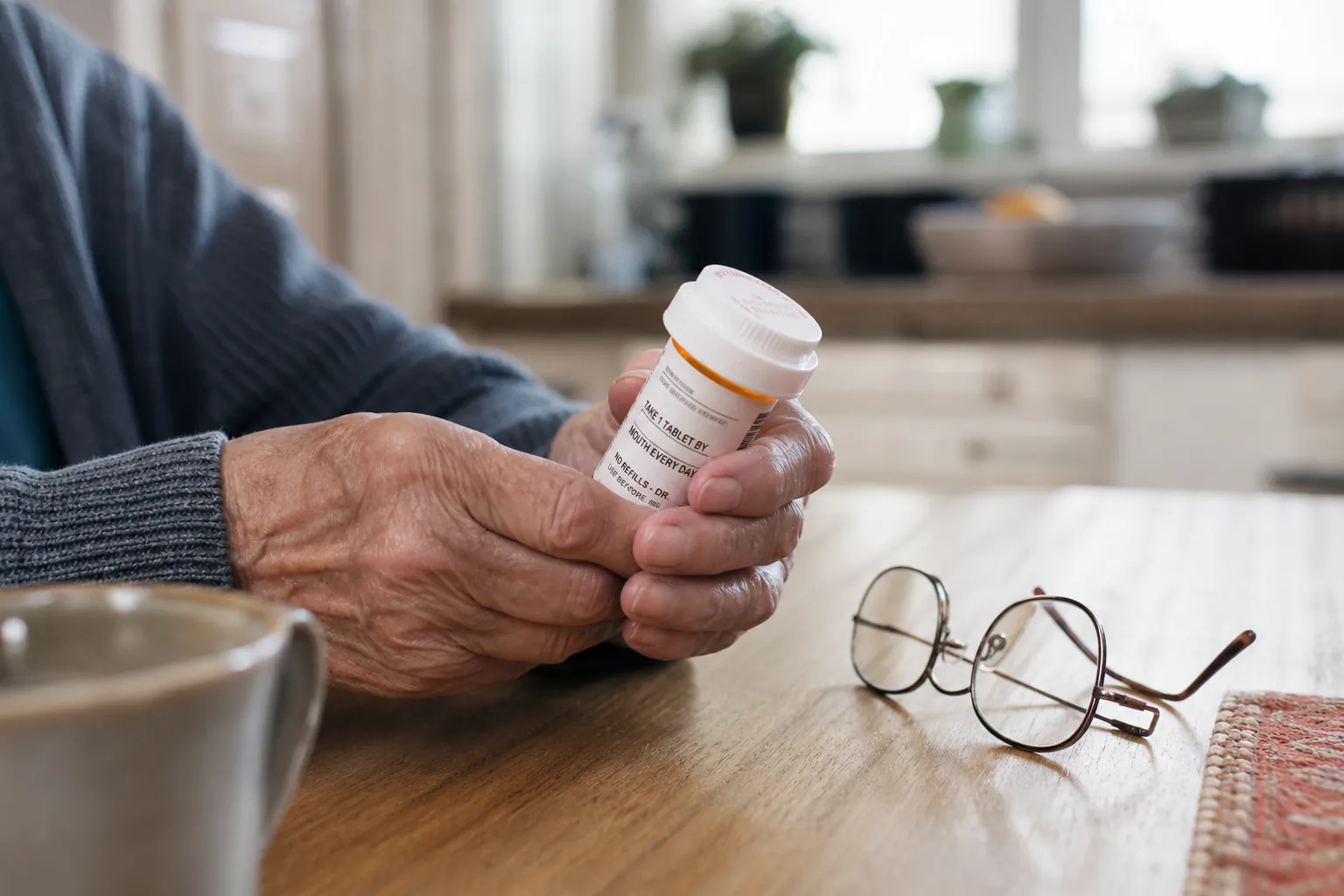
A recall is not a reason to panic over every levothyroxine bottle in the house. It is a reason to turn the bottle around, find the manufacturer or distributor, lot number, strength, and expiration date, and compare those details with the current recall information or ask the pharmacy to do it. More importantly, it is a reminder that too little thyroid replacement can look a lot like “Mom is slipping.”
What subpotent levothyroxine symptoms in seniors can look like
The textbook version of hypothyroidism is easy to picture: cold intolerance, weight gain, constipation, dry skin. Those signs can happen, but older adults do not always read the textbook. Harvard Health notes that hypothyroidism in an older person may show up with symptoms that are easy to mistake for other problems, including cognitive changes, depression, fatigue, and muscle weakness.[4]
Endotext makes the same point in a more clinical way: older adults with hypothyroidism often have fewer classic symptoms than younger adults, and fatigue or weakness may be among the more common complaints.[5] The American Thyroid Association also notes that thyroid disease in older patients can be hard to recognize because symptoms may be subtle, nonspecific, or attributed to other illnesses.[6]
That is where families lose time. A parent stops walking to the mailbox. The cane comes out, then gets left in the hallway. They rise from the recliner more slowly and grip the stair rail with both hands. At the same time, they seem less interested in church, cards, phone calls, or dinner. The family starts using words like dementia, frailty, depression, or “just age,” while the pill bottle sits untouched in the kitchen bin.
Those explanations may still be partly or fully true. A thyroid check does not replace a dementia evaluation, medication review, vision exam, balance assessment, or home safety review. But in a senior already prescribed levothyroxine, new weakness and mental slowing are not vague background noise. They are reasons to check whether the treatment is working.
How too little thyroid replacement can raise fall risk
Falls usually do not have one clean cause. A loose rug, a rushed bathroom trip, poor sleep, low blood pressure, foot pain, vision changes, dehydration, and medication side effects can all sit in the same week. Subpotent levothyroxine belongs in that review because its symptom pattern can weaken several parts of daily movement at once.
| Possible sign in a senior on levothyroxine | Why it matters for falls |
|---|---|
| Leg or grip weakness | Harder to recover from a trip, climb stairs, rise from a chair, or hold a rail firmly |
| Slower gait or unsteady walking | More time in contact with thresholds, cords, pets, rugs, and uneven flooring |
| Cognitive fog | Poorer judgment about when to stand, where to step, or whether to use the walker |
| Fatigue | Less walking and standing during the day, which can further reduce strength and balance |
| Depression or withdrawal | Less movement, fewer visitors noticing changes, and less willingness to ask for help |
Severe hypothyroidism in older adults can involve neurologic and cognitive changes, slowed movement, weakness, and reduced function.[7] Most families are not dealing with severe hypothyroidism, and a subpotent bottle does not automatically mean a dangerous hormone shortage. Still, the direction of the problem matters: if the medicine is not strong enough, or the dose has been chronically too low, the body can drift back toward undertreated hypothyroidism.

A slower reaction time does not need to be dramatic to matter. One extra half-step at the bathroom threshold, one missed grab for the counter, one moment of deciding not to use the walker because it is across the room — that is enough for a near-fall to become a fall. The thyroid issue is not the only thing to check, but it is checkable.
Why the signs get mistaken for aging or dementia
Caregivers often wait for the wrong clue. They look for a parent saying, “I am cold all the time,” or for a clear weight change. In older adults, hypothyroidism may instead show up as a narrower, quieter decline: sleeping more, moving less, thinking more slowly, losing interest, or needing more help with tasks that were automatic a few months earlier.[4][5]
That pattern is especially easy to misread after a birthday, a hospitalization, a move, a bereavement, or a winter of less activity. Everyone has a story ready for why the change makes sense. The problem is that a good story can still leave a reversible medication problem untouched.
The American Thyroid Association says older patients may have fewer symptoms than younger patients and that thyroid problems may be mistaken for aging.[6] The same ATA page notes that up to 1 in 4 nursing home residents may have undiagnosed hypothyroidism.[6] That does not mean every nursing home fall is a thyroid problem. It means thyroid status is too common and too easy to miss to leave out of the conversation.
There is also a trap in symptom checklists. A review of levothyroxine therapy in elderly patients discusses evidence that classic hypothyroid symptoms do not reliably identify thyroid hormone insufficiency in older adults, and it includes the TRUST trial’s finding that treating subclinical hypothyroidism in adults 65 and older did not improve symptoms.[8]
That TRUST caveat matters, but it should not be stretched into the wrong lesson. Subclinical hypothyroidism means an elevated TSH with normal FT4. That is different from a senior with established hypothyroidism who is already prescribed replacement therapy and may be receiving too little active medication from a recalled bottle, a dose that no longer fits, missed doses, absorption problems, or a changed medication routine.
What to do after a fall, near-fall, or sudden decline
This is not medical advice or a substitute for care from the senior’s clinician. It is a practical way to organize the call, because “Could this be the thyroid medicine?” is easier to answer when the bottle, timeline, and symptoms are in front of you.
1. Inspect the current bottle, not an old refill record
Use the bottle the senior is taking from this week. Write down the drug name, strength, manufacturer or distributor, lot number, expiration date, pharmacy name, and refill date. The 2025 recall details were tied to specific levothyroxine sodium tablet lots, not to every levothyroxine product on the market.[1][2]
Then compare those details with the FDA recall database or the published recall notices, and call the pharmacy if there is any uncertainty. Pharmacies can usually check the dispensing record more cleanly than a family can read a smudged lot number under kitchen lighting.
2. Do not stop levothyroxine while sorting it out
Do not skip doses, double doses, or stop levothyroxine because a bottle might be affected. The ATA recall alert tells patients not to stop taking levothyroxine without speaking with a healthcare provider.[1] AACE patient guidance also emphasizes that thyroid hormone replacement should be taken as prescribed and managed with medical supervision.[9]
If the bottle appears to match a recalled lot, call the pharmacy and prescribing clinician for replacement instructions. The right next step is usually a verified replacement supply and lab follow-up, not an improvised medication holiday.
3. Ask for TSH and FT4, not a guess
When you call, be specific: “She is on levothyroxine, she has had new weakness and unsteadiness since about this date, and I want to ask whether TSH and FT4 should be rechecked.” TSH helps show how hard the body is signaling for thyroid hormone. FT4 helps show the circulating thyroid hormone level. Together, they give the clinician more information than symptoms alone.
Do not try to interpret the numbers alone. Older adults may have different treatment targets than younger adults, and the review on levothyroxine therapy in elderly patients notes that ATA guidance allows a higher TSH target range of 4–6 mIU/L in adults over 70.[8] That context is exactly why the caregiver’s job is to ask for the check, not to adjust the dose.
4. Bring a timeline of movement and thinking changes
A useful timeline is plain: “She started holding the rail with both hands in late May,” “He stopped walking to the mailbox after the June refill,” “She had two near-falls the week after the new bottle,” or “He began leaving the walker behind and seemed more confused in the evenings.” Exact medical language is less important than dates, sequence, and what changed from the senior’s usual baseline.
Add the practical details clinicians often need: recent missed doses, whether the pill is taken with food or other medications, new supplements, pharmacy changes, hospitalization, weight change, and whether someone else began filling the pill organizer. These are not accusations. They are the ordinary places where thyroid replacement can stop matching the person’s real life.
5. Keep the fall-prevention review broader than thyroid
Even when levothyroxine turns out to be part of the problem, the home still needs the usual fall review: lighting, rugs, footwear, blood pressure symptoms, vision, bathroom route, assistive device use, and strength or balance changes. If the decline happened during hot weather, this companion guide on cooling seniors without AC and preventing falls during heat waves is worth reading alongside the medication review.
For families who have never built a recall routine, a broader guide to keeping an aging parent safe from food recalls can help turn one scare into a calmer household system. And if the senior has already fallen or needs therapy after a risk assessment, this Medicare fall-prevention coverage FAQ may help with the next insurance and referral questions.
When the bottle is not recalled
A clean lot number does not end the thyroid question. The 2025 recall was one specific pathway to subpotency. A senior can still be undertreated because the dose no longer fits, doses are missed, the timing has changed, another medication interferes with absorption, or the prescription was never rechecked after a major health change.
The caregiver does not need to prove which pathway is responsible before calling. The pattern is enough: new weakness, slower walking, mental fog, fatigue, withdrawal, or falls in someone taking levothyroxine. The clinician can decide whether labs, dose adjustment, replacement medication, or a broader evaluation is needed.
Subpotent or insufficient levothyroxine will not explain every fall in seniors. It should not be used to dismiss dementia, Parkinsonism, stroke symptoms, cardiac problems, medication side effects, dehydration, or home hazards. But it is reversible enough, common enough, and easy enough to check that it belongs in the post-fall and sudden-decline review.
References
- FDA Alert for Levothyroxine — American Thyroid Association, August 2025.
- Commonly Prescribed Thyroid Medication Recalled Nationwide, FDA Warns — Prevention.
- FDA Issues Class II Recall of Multiple Strengths of Levothyroxine Tablets Due to Subpotency — HMP Global.
- Hypothyroidism symptoms and signs in an older person — Harvard Health.
- Hypothyroidism in Older Adults — Endotext, NCBI Bookshelf.
- Older Patients and Thyroid Disease — American Thyroid Association.
- Severe Hypothyroidism in the Elderly — Endotext, NCBI Bookshelf.
- Levothyroxine Therapy in Elderly Patients With Hypothyroidism — PMC.
- Hypothyroidism Treatment — AACE.
Browse more in the Glossary.