
Clinical term
Do Shorter Telomeres Mean Slower Muscle Recovery After a Fall?
Last verified 2026-08-04
Short answer: shorter telomeres may be part of the reason an older adult has less muscle reserve, but they are not a proven clock for how fast muscles recover after a fall, injury, or hospital stay. The best evidence links telomere length with muscle strength, lean mass, thigh muscle volume, and sarcopenia risk. It does not yet show that a person with shorter telomeres will rebuild muscle more slowly after a specific fall.
That distinction matters. A caregiver may see “telomeres” in an aging article and wonder whether a parent’s slow rebound was already written into their cells. The honest answer is more useful and less frightening: telomeres belong in the biology of aging muscle, but they are not a home-use recovery forecast.
Evidence grade: what is known, what is plausible, and what is still unknown
| Evidence tier | What the evidence supports | How to read it after a fall |
|---|---|---|
| Established association with muscle reserve | Longer telomeres are linked with better grip strength, more appendicular lean mass, greater MRI-measured thigh fat-free muscle volume, and lower sarcopenia risk in several human studies, including genetically informed and longitudinal evidence.[1][2][3] | Shorter telomeres can reasonably be treated as one marker connected to lower muscle reserve. That is not the same as measuring recovery speed. |
| Mixed and population-dependent evidence | Not every study finds a clean relationship. In NHANES adults age 60 and older, telomere length did not differ overall by sarcopenia status, although one male subgroup with ALM:BMI-defined sarcopenia had shorter telomeres.[4] | A single telomere result should not be overread, especially across sex, ancestry, health status, and measurement differences. |
| Biologically plausible recovery mechanism | Telomeres shorten with cell division; critically short telomeres can trigger cellular senescence. Satellite cells help repair muscle, and satellite-cell number and capacity change with age, with decline noted after about age 70.[5][6] | This makes slower repair plausible in an aging muscle system. It does not prove that telomere length determines an older adult’s post-fall recovery timeline. |
| Unknown for fall-recovery speed | The reviewed evidence does not include a study that directly measured recovery speed after a fall against telomere length. | Telomere length should not be used to predict how many weeks a parent will need to regain walking, stair climbing, transfers, or confidence. |
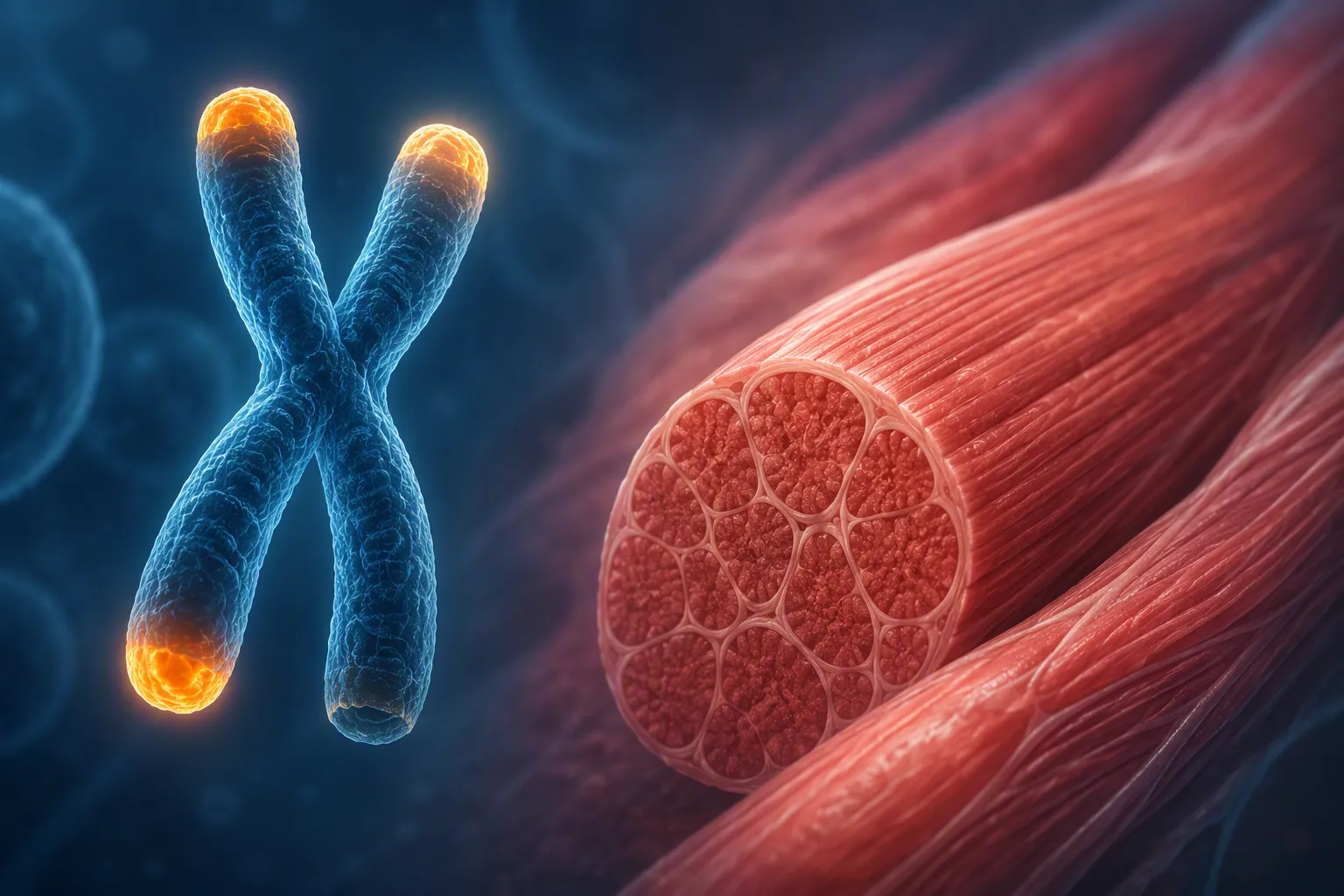
The strongest human evidence is about muscle reserve, not fall recovery
The most persuasive human findings do not come from a supplement trial or a dramatic “biological age” claim. They come from studies that connect telomere length to physical measures caregivers already recognize: hand strength, lean mass, thigh muscle volume, and sarcopenia.
Wang and colleagues used bidirectional Mendelian randomization with genome-wide association data involving up to about 472,000 participants. In that analysis, genetically longer telomeres were associated with a lower risk of low grip strength, with an odds ratio of 0.915 and a 95% confidence interval of 0.860 to 0.974. Longer telomeres were also suggestively linked with larger appendicular lean mass, with an odds ratio of 1.053 and a 95% confidence interval of 1.009 to 1.099.[1]
That kind of design is not magic, and it still depends on assumptions, but it carries more weight than a simple “people with X also have Y” snapshot. Grip strength is not a decorative endpoint. It is one of the simplest ways weakness becomes visible in ordinary life: opening jars, pushing up from a chair, using a walker, catching balance before a stumble becomes another fall.
Kirk and colleagues brought the evidence closer to muscle tissue itself. In 16,356 UK Biobank adults with a mean age of 62.8 years, longer leukocyte telomere length was associated with greater MRI-measured thigh fat-free muscle volume. The association was small but statistically clear, with an adjusted beta of 0.017 per standard deviation and P<0.001, and it appeared stronger in men.[2]
There is a measurement caveat tucked inside that sentence: the study measured leukocyte telomere length, meaning telomere length in blood cells, and compared it with MRI-based muscle volume. That is useful, but it is not the same as opening a window into every muscle stem cell in the thigh. It gives a population-level biological signal, not an individualized repair report.
The longitudinal evidence is also worth attention. In a SAGE-Mexico cohort of 1,738 adults age 50 and older followed for four years, Salinas-Rodriguez and colleagues found that one standard deviation shorter telomeres were tied to higher odds of prevalent sarcopenia, with an odds ratio of 1.31. Shorter telomeres were also associated with higher incidence of sarcopenia, with a relative risk ratio of 1.55, and higher persistence of sarcopenia, with a relative risk ratio of 1.50.[3]
That four-year view matters because sarcopenia is not just a lab label. It is the shrinking margin between “I can still get up” and “I need help getting up.” If shorter telomeres track with the development and persistence of sarcopenia, they belong in the conversation about why some older adults arrive at a fall with less reserve.
The evidence is not uniform. Rippberger and colleagues studied 2,672 NHANES participants age 60 and older from 1999 to 2002 and found no overall telomere-length difference by sarcopenia status. In a male subgroup with ALM:BMI-defined sarcopenia, telomeres were shorter, 0.85 versus 0.91, with p=0.013.[4]
That counterweight matters because telomere length is not behaving like a simple blood pressure number where one reading cleanly maps to one clinical problem. The signal seems related to muscle aging, but it is shaped by how sarcopenia is defined, which tissue is measured, who is studied, and how telomere length is tested.
Generalizability also needs a plain warning. The Mendelian randomization evidence and UK Biobank data are heavily weighted toward people of European ancestry. The SAGE-Mexico cohort broadens the picture, but it does not erase the need for more diverse aging and recovery studies. A caregiver should not turn a population association into a personal prediction for one parent.
Why telomeres make biological sense in muscle repair
The mechanism is real enough to take seriously. Telomeres are protective DNA-protein structures at chromosome ends. They tend to shorten as cells divide, and when they become critically short, they can trigger senescence, a state in which a cell no longer divides normally and may change the tissue environment around it.[5]
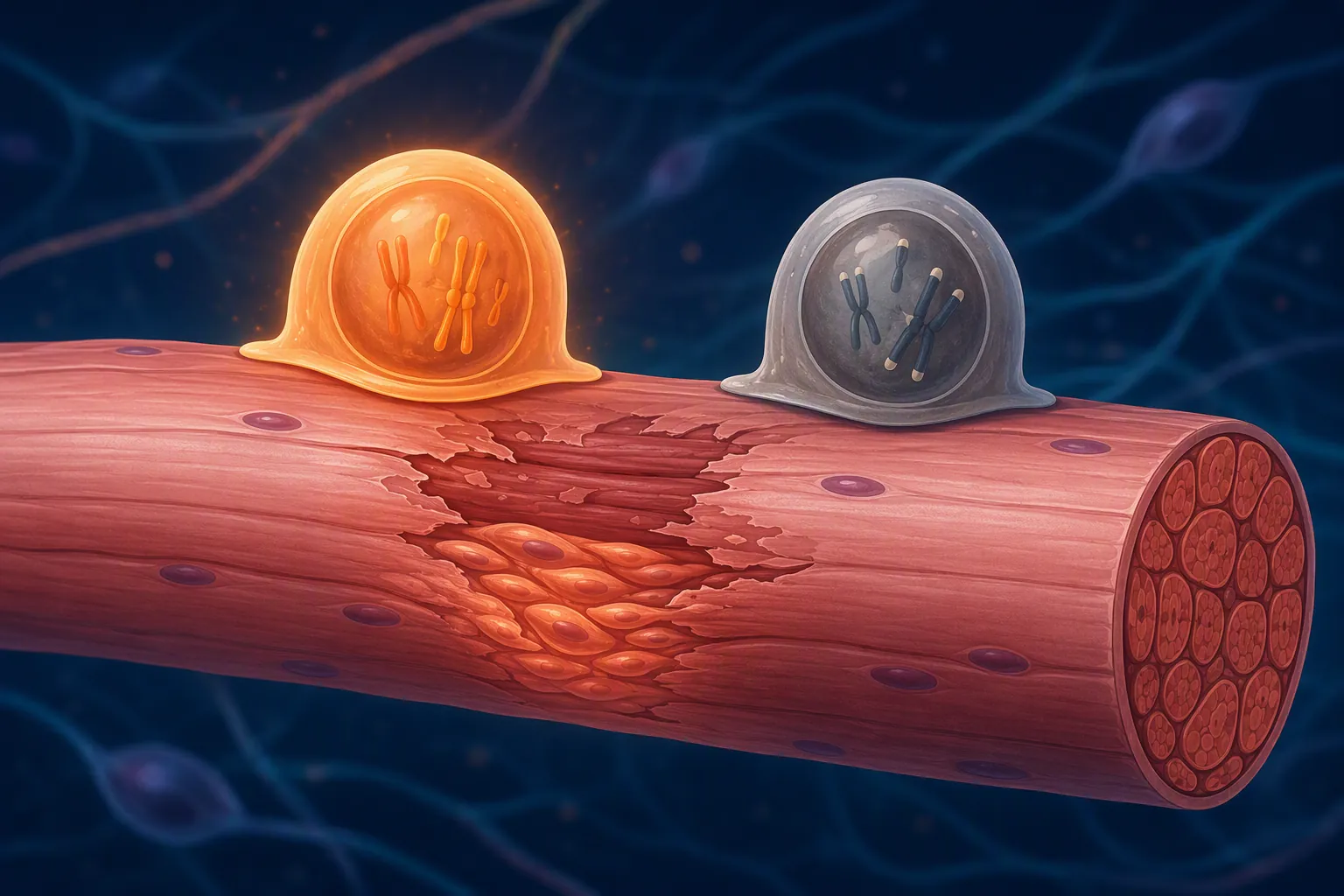
Muscle repair depends partly on satellite cells, the resident muscle stem cells that can activate after damage, contribute to repair, and help maintain muscle tissue. Reviews of satellite-cell biology describe their role in muscle adaptation and repair, while aging reviews note that satellite-cell numbers decline after about age 70.[5][6]
That gives a reasonable bridge from telomere biology to recovery: if an older person has fewer responsive satellite cells, and if some of those cells are pushed toward senescence, the muscle may have less ability to rebuild after a period of bed rest, injury, or reduced use. The bridge is biologically plausible. It is still a bridge.
The missing piece is direct clinical evidence. A study would need to measure telomere length before or soon after a fall, then track recovery outcomes such as walking speed, chair-rise ability, stair use, thigh strength, muscle volume, therapy progress, and time to regain baseline function. The evidence summarized here does not do that. It measures muscle reserve and sarcopenia risk, not the pace of post-fall rebuilding.
This is where a scientific phrase can quietly become a private worry. A slow recovery after a fall can happen because of fracture, pain, fear of falling, poor sleep, medication effects, inadequate nutrition, inflammation, hospitalization, deconditioning, neurological disease, depression, or simply too little rehabilitation support. Telomere length may belong somewhere in the background biology, but it should not crowd out the problems that can actually be evaluated this week.
Exercise is a useful reality check, not a telomere guarantee
Exercise often gets pulled into telomere discussions because it is one of the few aging-related behaviors people can act on. The evidence is encouraging in a broad sense, but it is not clean enough to support a consumer promise that exercise reliably “lengthens telomeres.”
A 2025 meta-analysis of 16 randomized controlled trials with 1,908 participants reported that exercise maintained telomere length, with a standardized mean difference of 0.59 and a 95% confidence interval of 0.14 to 1.06, and increased telomerase activity, with a standardized mean difference of 0.35 and P<0.00001. The telomere-length finding was significant only in programs lasting at least 16 weeks; resistance-only programs showed a non-significant trend.[7]
The same meta-analysis reported very high heterogeneity, with I2=92%, and noted method differences such as qPCR versus Southern blot testing.[7] In practical English, the trials did not all measure the same thing in the same way, and their results were not tightly aligned. That is exactly why “base pairs gained” or “years of cellular age reversed” claims should be treated with suspicion unless they come from a specific, verified study and a clinically meaningful outcome.
For recovery after a fall, the reason to care about exercise and rehabilitation is more direct than telomeres: muscles, balance, gait, confidence, and daily function need progressive loading and practice. Telomere findings may help explain part of the aging landscape. They do not replace the ordinary work of rebuilding strength safely.
What to do with this information after a fall
If an older adult is recovering slowly, telomere length is not the thing to test at home or use to estimate the calendar. The more grounded questions are whether pain is controlled, whether an injury was missed, whether medications are increasing dizziness or fatigue, whether appetite and protein intake have dropped, whether the person is afraid to move, and whether rehabilitation is matched to the person’s current abilities.
Clinicians can evaluate the parts of recovery that are visible and modifiable: grip strength, walking, transfers, balance, nutrition, cognition, mood, sleep, medical complications, assistive devices, home safety, and the need for physical or occupational therapy. Families planning care after a hospitalization or fall may also find it useful to compare short-term rehabilitation and support settings in the short-term care guide.
The best current answer to “how telomere length affects muscle recovery in older adults” is careful rather than dramatic: shorter telomeres are linked with lower muscle reserve and higher sarcopenia risk, so they may be part of why some older adults have less capacity to rebuild after stress. They are not currently a proven recovery-speed test after a fall.
For a broader example of how to read aging-science headlines without turning early biology into a senior-care promise, see the companion FAQ on the new enzyme aging-reversal study.
Last verified: August 4, 2026. This article is for educational purposes only and is not medical advice. A slow or worsening recovery after a fall should be discussed with a qualified clinician.
References
- Telomere length and sarcopenia-related traits: A bidirectional Mendelian randomization study, PLOS ONE, 2024.
- Leukocyte telomere length is associated with MRI-derived lower limb muscle volume in UK Biobank, Journal of Cachexia, Sarcopenia and Muscle, 2024.
- Leukocyte telomere length and sarcopenia in older adults: A four-year follow-up study from the SAGE-Mexico cohort, Archives of Medical Research, 2024.
- Telomere length and sarcopenia in older adults from the National Health and Nutrition Examination Survey, 1999–2002, European Journal of Clinical Nutrition, 2018.
- Physical activity and telomere length: Impact of aging and potential mechanisms of action, Oncotarget, 2017.
- The biology of satellite cells and telomeres in human skeletal muscle: Effects of aging and physical activity, Scandinavian Journal of Medicine & Science in Sports, 2010.
- The effect of exercise on telomere length and telomerase activity: A systematic review and meta-analysis of randomized controlled trials, Frontiers in Physiology, 2025.
Browse more in the Glossary.