
How to check your Social Security disability claim status online
The fastest way to check a Social Security disability claim status online is to use a free personal my Social Security account or start from SSA's check application or appeal status page. SSA says you can check the status of a pending application or appeal online after signing in to your personal account.[1]
Before you sit down, put these items on the table: an email address you can open, a government-issued photo ID such as a driver's license, state ID, or passport, a phone number, and your Social Security number. SSA says account setup usually takes 5 to 20 minutes.[2]
One detail matters before you try an old password from a notebook: as of June 7, 2025, SSA moved personal account sign-in to Login.gov or ID.me. Old Social Security username-and-password credentials no longer work for signing in.[2] If an older printed guide tells you to use a prior SSA username, the guide is out of date, not you.
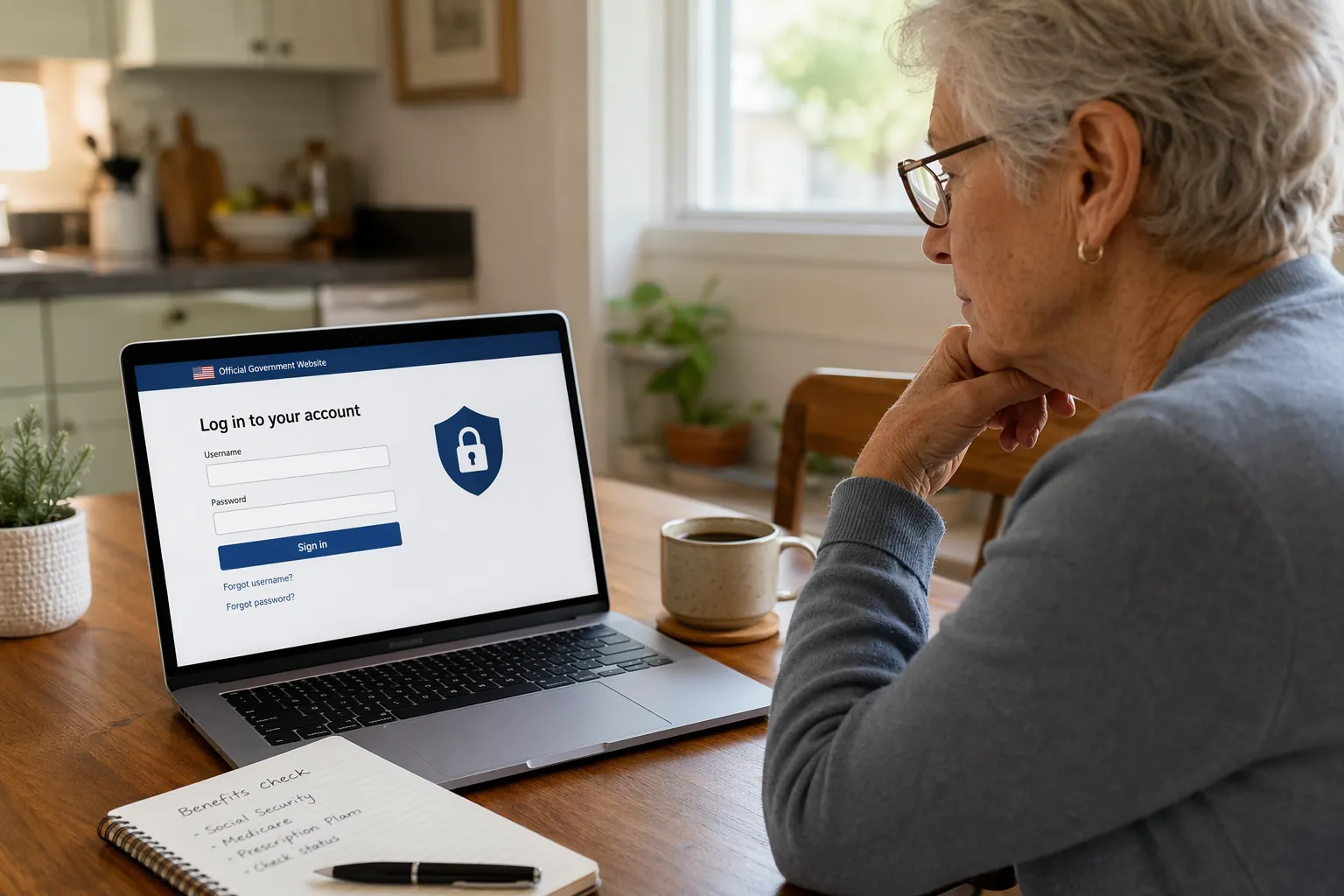
Check Your Disability Claim Status Online
You do not need to know every Social Security term before checking. The online status method works for both SSDI and SSI claims. If the portal or a mailed letter uses wording you do not recognize, make a note of whether it says Social Security Disability Insurance, Supplemental Security Income, SSDI, or SSI; those programs have different eligibility rules even though you can track both online.[7]
- Go to SSA's check application or appeal status page, or go directly to my Social Security.
- Choose the option to sign in or create an account.
- Use Login.gov or ID.me. If you do not already have one, follow the prompts to create and verify the account.
- Verify your identity with the requested information and your government-issued photo ID.
- After you reach your personal SSA dashboard, look for the application or appeal status area.
- Open the disability claim or appeal shown there and read the filing date, current location, office information, and status label.
Do this from ssa.gov rather than from a search result that only looks official. If you help a parent or spouse, slow down at the identity-verification screens. Many failed attempts happen because the helper enters their own phone number, email, or ID information where SSA needs the applicant's information.
What the Status Screen Can Show
The online dashboard is useful because it gives you more than a vague "pending" message. SSA has described the claim-status area as showing details such as the filing date, current claim location, servicing office, hearing office location if the case has reached that stage, scheduled hearing date and time if applicable, and re-entry numbers for incomplete applications.[3]
| What you may see | How to use it |
|---|---|
| Filing date | Use it as the starting point when estimating how long the claim has been pending. |
| Current claim location | This may show whether the file is with an SSA office, DDS, or a hearing office. |
| Servicing office | Keep this name handy if you need to call or send follow-up information. |
| Hearing date and time | Treat this as appointment information, but still watch for mailed notices. |
| Re-entry number | Use it to return to an incomplete online application. |
If you see a re-entry number, that usually means there is an unfinished application to return to, not a final decision. Write the number down exactly as shown, then finish or review the application from the same SSA online system.
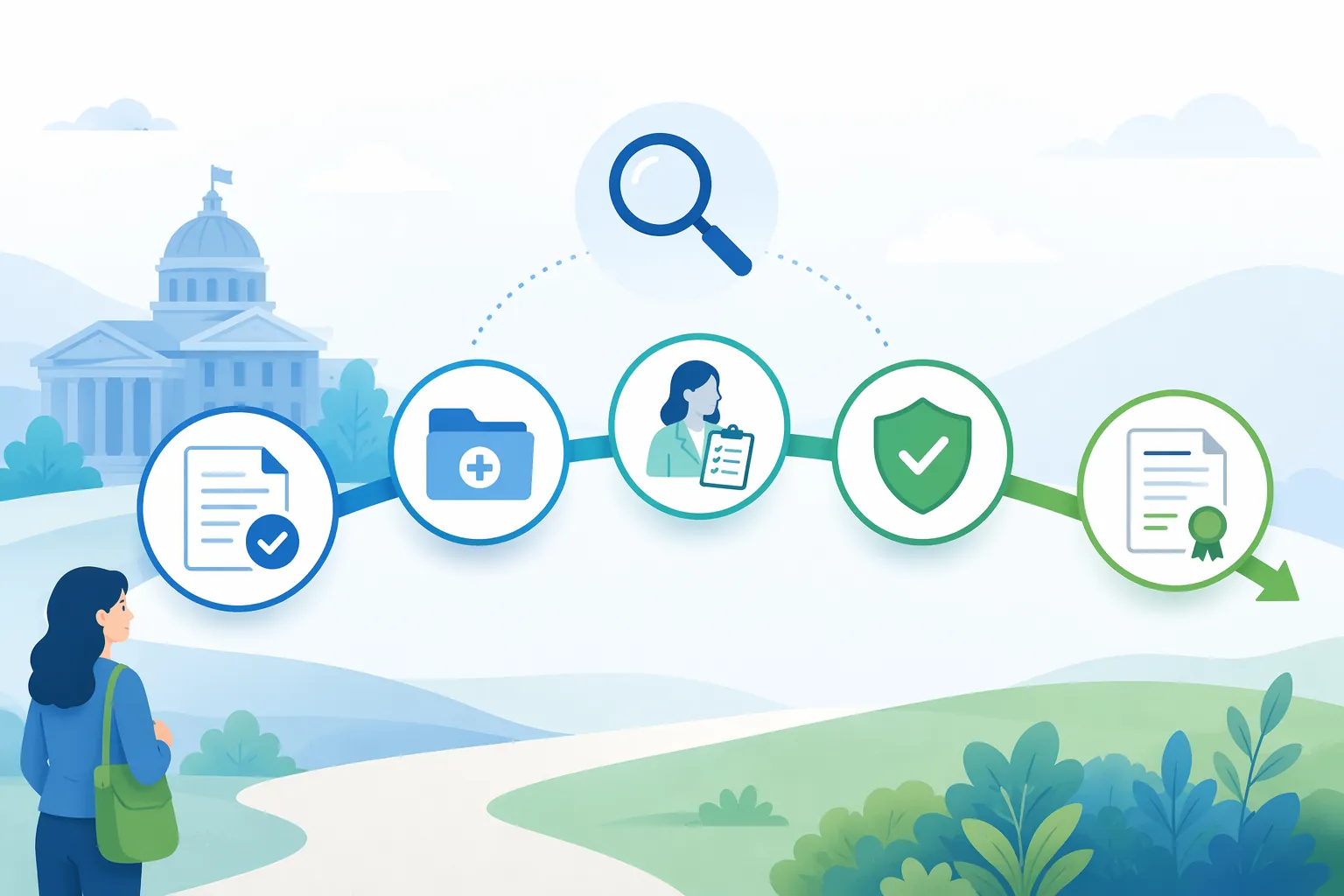
How to Read Common Disability Status Labels
The status screen tells you where the claim is in the process. It does not always tell you why it is there, and it usually will not give you the decision before the official notice arrives.
Application Received or Submitted
This means SSA has the application in its system. At this point, the important question is whether anything is missing. Watch your mail and online messages for requests for forms, medical releases, work-history information, or other documents. A quiet screen is not the same as a denial.
Medical Review in Progress
This usually means the file is with Disability Determination Services, often called DDS. Advocate guidance describes this as typically the longest stage, commonly lasting 3 to 6 months or more.[4] During this stage, DDS may be gathering medical records, reviewing evidence, or arranging a consultative examination.
This is the stage where repeated refreshing rarely helps. What does help is answering mail quickly, keeping medical appointments, and making sure SSA or DDS has a current address and phone number.
Non-Medical Review
A non-medical review is about eligibility factors outside the medical decision. Depending on the program, that can include work, income, resources, living arrangement, or other administrative requirements. This is one reason it helps to know whether the claim is SSDI, SSI, or both.
Appeal or Hearing Status
If you appealed, the dashboard may show appeal information rather than initial-application information. If the case has reached a hearing office, the portal may show the hearing office location and a scheduled hearing date and time when one has been set.[3] Still read every mailed notice carefully; hearing details are too important to rely on memory or a screenshot alone.
Decision Made
"Decision Made" does not mean approved. It means SSA has made a decision and will send the outcome by mail. Impact Disability Law, citing SSA FY24 workload data, reports that about 38% of initial claims were approved, which is a useful reminder not to celebrate or panic until the letter arrives.[5]
The mailed notice is the document that tells you whether the claim was approved or denied and what to do next. If it is a denial, the letter should explain appeal rights and deadlines. If it is an approval, keep watching for payment and award information.
How Long the Wait May Be
Once you can see the claim status, the next question is usually whether the wait is normal. Processing times are not promises. They vary by state, medical evidence, case complexity, staffing, and whether SSA or DDS needs more information.
As of December 2025, reported SSA processing data showed initial disability decisions averaging about 193 days, down from 231 days in December 2024. Reconsideration averaged about 213 days, and hearings averaged about 263 days.[5] Those figures may have changed by July 2026, but they give a realistic scale: many disability claims take months, not days.
| Stage | Reported average as of December 2025 | What that means at the kitchen table |
|---|---|---|
| Initial decision | About 193 days | A several-month wait can still be within ordinary processing time. |
| Reconsideration | About 213 days | An appeal can take as long as, or longer than, the first review. |
| Hearing | About 263 days | The hearing stage often requires patience and careful mail-watching. |
If your status has not changed for weeks, that alone does not prove the claim is lost. But if SSA asked for something and you sent it, or if your address changed, or if a hearing date seems close and no letter has arrived, it is time to use another channel instead of simply checking the same screen again.
When Online Status Is Not Enough
Start online because it is available at any hour and gives you the claim's current location without waiting on hold. Then decide what problem you are actually trying to solve.
- If the status shows ordinary review and SSA has not requested anything, keep the account information handy and check again later.
- If the status has not changed in weeks and you are worried something is stalled, use our guide on contacting Social Security for delayed disability benefits.
- If SSA says a decision was made, wait for the mailed notice before assuming approval or denial.
- If the claim was approved but money has not arrived, see what to check when an SSDI payment is delayed.
For a phone backup, call SSA at 1-800-772-1213. Automated service is available 24 hours a day, and live representatives are available Monday through Friday from 8 a.m. to 7 p.m. ET.[6] AARP also notes that local SSA office appointments may take several weeks to secure.[6]
Phone waits change over time. SSA reported an 89% answer rate and a 5-minute average hold time as of May 2026, but your own call may still depend on the day, time, and reason for calling.[6]
Online status checking will not tell you everything, and it will not reveal the decision before the letter. It is still the clearest first step before calling, waiting for an appointment, or assuming something has gone wrong. This article is general information, not legal advice; SSA processes and individual results can vary.
References
- Check application or appeal status | SSA
- Creating an Account | my Social Security | SSA
- Check the Status of Your Social Security Benefits Claim Online | SSA Blog
- SSDI Application Status: How To Check And What Each Status Means | Trajector Disability
- How Long Does It Take to Get Approved for Disability? | Impact Disability Law
- How to Track a Social Security Disability Case | AARP
- SSI vs. SSDI: Key Differences, Eligibility, and Benefits Explained (2026 Guide) | NCOA