
How to Contact Social Security for Delayed Disability Benefits
A practical guide for seniors and caregivers on reaching the Social Security Administration about a delayed disability claim, including best calling times, online status checks, and escalation steps when standard methods stall.
Start with the shortest useful step: check the claim in your my Social Security account if you can, because SSA’s May 2026 performance data show that the national 800 number is no longer the black hole many people expect — the agency reported an 89% answer rate and a 5-minute average speed of answer. [1] If the online status is unclear, stale, or you need a live person, call the national number at 1-800-772-1213, or use TTY 1-800-325-0778 if hearing access is a concern. [3]

Check the claim status before you call
The online account is the fastest place to start because it can show where the claim sits right now instead of forcing you to guess. SSA and disability status guides describe a simple progression: Application Received, Medical Review in Progress, Pending Decision, then Decision Made. [4] That matters because a call is more productive when you already know whether you are chasing a missing file, a stalled medical review, or a decision that should already have been mailed.
- Use the online status if you need the quickest read on whether anything has moved.
- Use the phone if the status is unclear, outdated, or you need the office or person who actually has the file.
- Use both if the online screen is frozen on an old stage and you need a human to explain why.
Which contact channel fits the problem
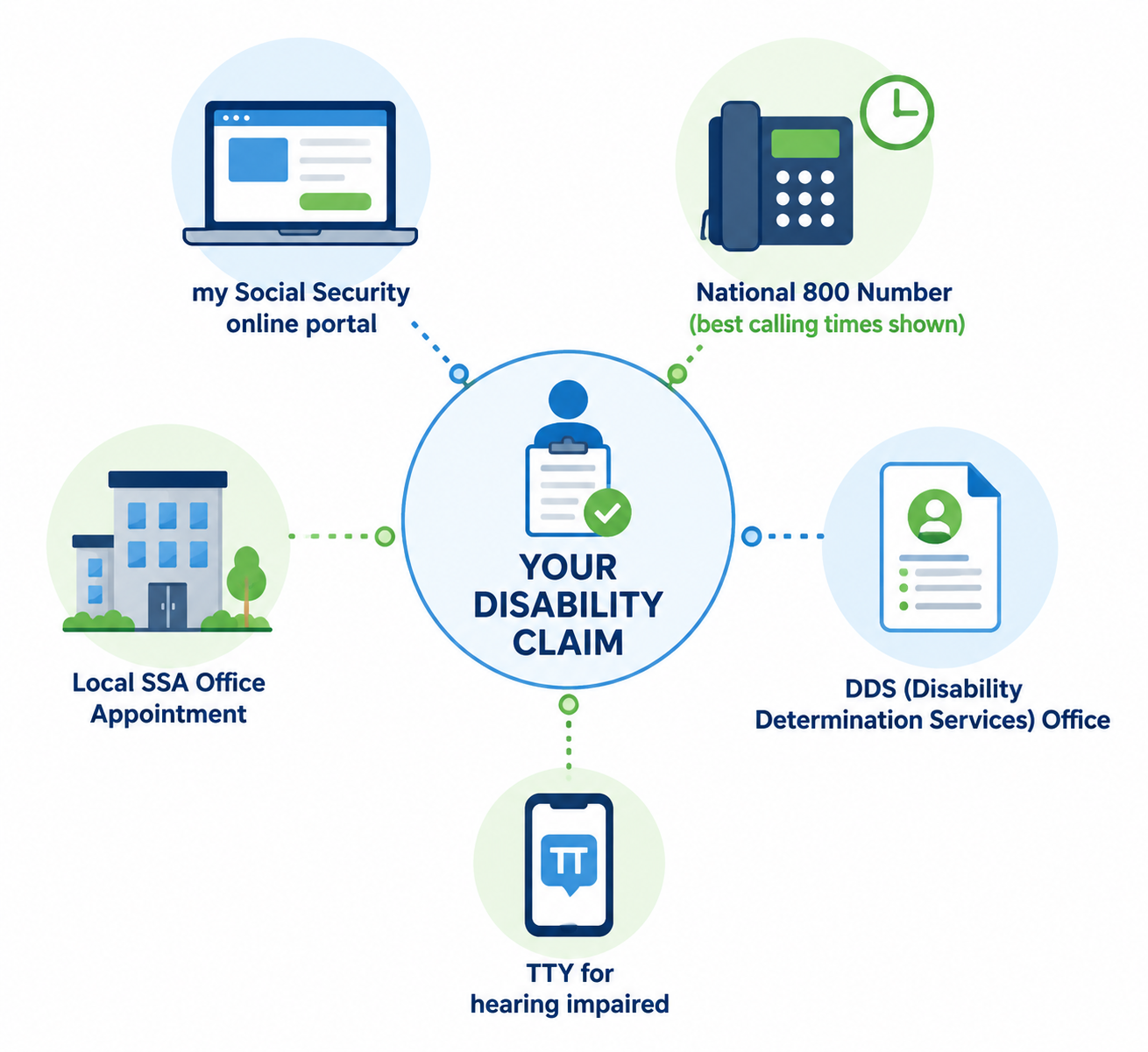
Not every delay should go through the same door. A basic status check belongs online; a file that seems lost may need the national 800 number; a local office appointment can help when paperwork, identity issues, phone anxiety, or a missing notice are part of the problem; DDS questions belong with the office handling the medical review; and TTY is the right route when hearing access matters. SSA’s contact page says local office appointments are generally required now, so it is better to plan the call than to assume a walk-in visit will solve it. [3]
| Channel | Best use | Notes |
|---|---|---|
| my Social Security | Check claim stage first | Fastest way to confirm whether the file has moved [4] |
| National 800 number: 1-800-772-1213 | General status, missing notice, or stalled claim | Use when you need a person to look up the case [3] |
| TTY: 1-800-325-0778 | Hearing-impaired callers | Use this instead of the voice line when needed [3] |
| Local office appointment | In-person help with identity, paperwork, or a stuck file | Appointments are generally needed now [3] |
| DDS office | Medical review question or no movement on the disability file | Ask which DDS office has the file and request a status update [5] |
Call at the times that avoid the longest hold
The hold-time story changed in 2026, but the clock still matters. Kiplinger’s report, based on SSA operational data, found that Friday at 8 a.m. averaged 21 minutes on hold, while Monday at 6 p.m. averaged 2 hours 27 minutes. It also found that calls placed between 8 and 10 a.m. and during Wednesday through Friday generally faced shorter waits. [2]
| When to call | What the data showed | Practical read |
|---|---|---|
| Friday, 8 a.m. | About 21 minutes average wait [2] | One of the best low-volume windows |
| Monday, 6 p.m. | About 2 hours 27 minutes average wait [2] | A poor time if the matter can wait |
| 8–10 a.m. | Generally shorter holds than later in the day [2] | Good default window for most calls |
| Wednesday–Friday | Lower waits than early-week calls overall [2] | Better than Monday for most people |
Those timing differences matter even with SSA’s improved 2026 phone performance, because a better national average does not guarantee a fast pickup for every office or every hour. The point is not to call endlessly; it is to choose the hour that gives the claim the best chance of reaching a person on the first try. [1][2]
Have the right information in front of you
A prepared call is usually a shorter call. Keep the folder open before you dial and have the basic identifiers ready so the representative does not spend the first 10 minutes trying to find the record.
- Claimant’s full name, Social Security number, and date of birth
- Application date, if known, and whether the claim is SSDI or SSI
- Any claim number, receipt notice, or recent SSA letter
- Current mailing address and callback number
- The date of the last update and the name of the person who gave it
- If you are calling for a parent or spouse, the papers that show you are allowed to help
The first question should be narrow and concrete. Ask for the current stage, whether the file is still in Medical Review, which office has it, and whether anything is waiting on you. If the answer is vague, ask the same question one layer higher: who owns the next action, and when should you call back if nothing changes.
When a delay is beyond ordinary waiting
SSA’s phone-page guidance says disability claims can take roughly 200 to 230 days on average, depending on the case and the region. That range is long, but it also means a slow claim is not automatically a lost claim. The more useful cutoff is whether the file has sat in Medical Review for more than 60 days without movement; at that point, ask which DDS office has the file and request a status update instead of accepting a generic “still pending.” [3][5]
If a decision already exists and the problem has shifted to payment, the call changes. You are no longer asking whether the case exists; you are asking where the money is and which unit is holding it.
Escalate only after the basic route stalls
Escalation works best when it follows the file, not your frustration. A reasonable ladder is to ask for a supervisor at the local office, then use a congressional inquiry if the case has gone past the normal window, and only then try a payment-center fax if the issue is a post-decision payment delay. That sequence appears in disability-law guidance because each step is meant for a different bottleneck, not as a magic replacement for the last one. [6][7]
- Ask the local office for a supervisor review when the front-line answer does not match the status you can see.
- Use your U.S. representative or senator’s office for a congressional inquiry when the claim has been stalled beyond the normal timeline. [6]
- If the problem is payment after approval, a payment-center fax is one option to try, but it is not a universal fix. [7]
The most important part is to log every attempt: date, time, number called, office name, the person’s name if given, and the exact next step promised. That record is what makes the second and third call easier when the first answer goes nowhere.
If the case may qualify for faster handling
- Compassionate Allowances can move some cases much faster if the condition is on SSA’s list and was clearly named on the application. There is no separate CAL form, so the diagnosis itself has to be stated clearly. [8][9]
- If the claim is SSI and the family is facing immediate hardship, ask whether expedited payment options apply. [10]
These are not reasons to assume the claim should already be finished. They are prompts to ask whether a known fast-track rule fits your situation.
Keep each call tied to one task
A delayed disability claim is easier to handle when each call has one job. The status check tells you whether anything has moved. The national number is for reaching a live person. The DDS question tells you who is holding the medical review. The local office helps when the problem is paperwork or identity. Escalation is for the claims that have crossed the ordinary waiting line and still have no real answer.
References
- Social Security performance — Social Security Administration, May 2026 — ssa.gov/ssa-performance
- Social Security Phone Wait Times: The Best Times to Call — Kiplinger — https://www.kiplinger.com/retirement/social-security/social-security-phone-wait-times-the-best-times-to-call
- Contact Social Security — Social Security Administration — ssa.gov/agency/contact/
- SSDI Application Status: How To Check And What Each Status Means — Trajector Disability — https://www.trajector.com/disability/blog/ssdi-application-status-how-to-check-and-what-each-status-means/
- SSA Backlogs in 2026 — Gordon, Wolf & Carney — gordonwolfcarney.com/ssa-backlogs-in-2026
- How to Initiate a Congressional Inquiry for a Disability Claim — Atticus — atticus.com/advice/disability/how-to-initiate-a-congressional-inquiry-for-a-disability-claim
- Delayed Social Security Disability Benefits — Olympia Disability Lawyers — olympiadisabilitylawyers.com/delayed-social-security-disability-benefits
- Are You Eligible for CAL? — National Council on Aging — ncoa.org/article/are-you-eligible-for-cal
- Approval Process, Disability Benefits — Social Security Administration — ssa.gov/benefits/disability/approval.html
- Expedited Payments, SSI — Social Security Administration — ssa.gov/ssi/text-expedite-ussi.htm
Where this decision comes from
Suggest a correction
We keep this content strictly product-neutral and reviewed against CDC STEADI, NIA, and AARP HomeFit guidance. If something here looks outdated, unclear, or inaccurate, tell us — this page does not carry open public comments, because it touches medical urgency, cost, or capacity-adjacent decisions where a discussion thread is a trust liability rather than a trust asset.
See the correction process on our editorial standards page →