Elder Care Help: A Step-by-Step Guide to Figuring Out What Your Aging Parent Needs and Where to Start
Elder Care Help: A Step-by-Step Guide to Figuring Out What Your Aging Parent Needs and Where to Start
A practical, structured guide for adult children who recognize their parent needs help but feel overwhelmed. Learn how to assess needs using ADLs and IADLs, have the conversation, find services, and create a week-by-week action plan.
By Editorial Team
The most effective care plans are built together, not imposed.
Recognizing the Signs: When Help Becomes Necessary
You are not alone in feeling uncertain. According to the Pew Research Center's February 2026 report, 10% of all U.S. adults are caregivers for a parent 65 or older. Among those with a parent over 75, that figure jumps to 31%. The National Alliance for Caregiving and AARP report that nearly 1 in 4 Americans is now a family caregiver — a 45% increase from 2015. The need is widespread, but the path forward rarely feels clear.
The National Institute on Aging (NIA) recommends watching for changes across four categories. These signals often appear gradually, which is why families normalize them rather than act on them.
Changes at home: Spoiled food in the refrigerator, unpaid bills piling up, difficulty preparing meals safely, or a noticeable decline in personal hygiene and bathing routines.
Mental health concerns: Depression that seems to lift during a phone call but returns during extended visits. Withdrawal from social activities or hobbies they once enjoyed.
Physical health changes: Unexplained weight loss or gain, poor hygiene, confusion about familiar tasks, frequent falls, or trouble walking. Loneliness is also a significant health risk.
Memory issues: Occasional forgetfulness is normal, but serious memory problems — getting lost in familiar places, repeating questions, or forgetting to take medications — require attention.
This is often the hardest step. A direct approach — "Mom, I think you need help" — can trigger defensiveness, shame, or outright refusal. The NIA suggests a collaborative, observation-based approach that focuses on specific concerns rather than general judgments.
The NIA provides a simple but effective script structure: start with a concrete observation, express concern, and offer partnership.
"Mom, it looks like you don't have much food in the house. Are you having trouble getting to the store? I could drive you this weekend, or we could look into a grocery delivery service together."
This approach works because it is specific, non-accusatory, and offers a collaborative solution. Here are additional strategies that can help the conversation go better.
Frame it around your needs, not their deficits: "Dad, I worry about you when I'm at work and can't reach you. Would you feel better if we had a way to check in during the day?" This positions the help as something that eases your anxiety, not as a judgment on their capability.
Use a health event as a natural entry point: A recent fall, a hospitalization, or a new diagnosis creates a natural opening. "Since your surgery, the doctor said it would be good to have someone help with meals for a few weeks. Let's figure out what that looks like."
Involve a third party: Sometimes a parent will resist suggestions from a child but accept the same advice from their doctor, a trusted friend, or a geriatric care manager. A joint visit to the primary care provider can be a neutral, non-confrontational setting.
Start small and temporary: "Let's try having someone come in to clean once every two weeks for a month. If you hate it, we stop." Small, reversible commitments are less threatening than permanent changes.
Conducting a Needs Assessment Using ADLs and IADLs
Most families skip this step. They know something is wrong, but they cannot articulate exactly what kind of help is needed. This leads to vague requests — "I need help with Mom" — rather than specific, actionable needs. The solution is a structured assessment using two well-established frameworks: Activities of Daily Living (ADLs) and Instrumental Activities of Daily Living (IADLs).
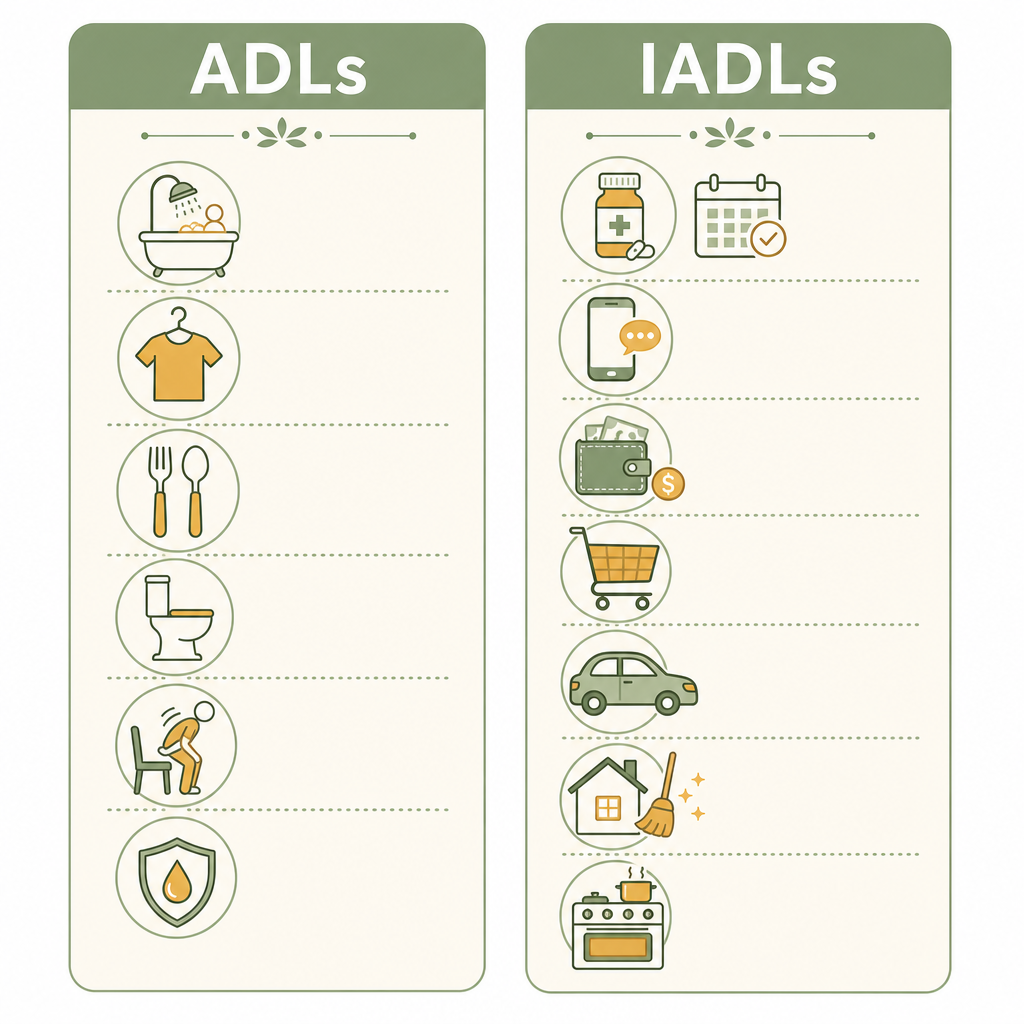
ADLs are the fundamental self-care tasks that a person must be able to perform to live independently. IADLs are more complex skills that require higher cognitive function. A decline in IADLs often appears before a decline in ADLs, making the IADL assessment a critical early-warning tool.
Use this framework to identify exactly where support is needed.
ADL and IADL Assessment Checklist. Print this table and fill it out with your parent, not for them.
Category
Task
Can Do Independently?
Needs Some Help?
Cannot Do
ADL
Bathing (getting in/out of tub or shower safely)
ADL
Dressing (choosing clothes, buttoning, zipping)
ADL
Eating (feeding self, using utensils)
ADL
Toileting (using the toilet, managing hygiene)
ADL
Transferring (getting in/out of bed or chair)
ADL
Continence (controlling bladder and bowel)
IADL
Managing medications (taking correct doses on time)
IADL
Preparing meals (planning, cooking safely)
IADL
Managing finances (paying bills, budgeting)
IADL
Using transportation (driving, using public transit)
IADL
Shopping (groceries, household items)
IADL
Housekeeping (cleaning, laundry, home maintenance)


Comments
Join the discussion with an anonymous comment.