
Middle-Stage Alzheimer's Care: A Planning Guide for Family Caregivers
A comprehensive, stage-specific guide for adult children caring for a parent with moderate Alzheimer's — covering what to expect, how to manage daily care and behavioral symptoms with dignity-preserving techniques, which home safety changes matter most at this stage, how to build a sustainable support team, and why legal and financial planning cannot wait.

What the Middle Stage of Alzheimer's Actually Means
Most people who have heard of Alzheimer's know it in three broad phases: early, middle, and late. The middle stage — also called the moderate stage — is when the disease shifts from something the family is managing around the edges to something that restructures daily life entirely. It is also, by most measures, the longest phase.
According to a dementia progression framework published by the National Academies of Sciences, Engineering, and Medicine, the moderate impairment stage typically spans somewhere in the range of 2 to 8 years from symptom onset — though individual variation is wide, and some people live through this stage for considerably longer. The Alzheimer's Association describes it as "typically the longest" of the three stages. The point is not a precise number. The point is that this stage demands sustained planning, not a short-term response.
Functionally, the moderate stage is defined by what the person can no longer do reliably on their own: managing finances, preparing meals, choosing appropriate clothing, bathing safely, and eventually basic self-care tasks like toileting and eating. Memory gaps widen. Orientation to time and place becomes unreliable. Communication changes in ways that require caregivers to adjust how they listen and respond, not just how they speak.
Clinicians sometimes use more granular tools — the Global Deterioration Scale (GDS) or the Functional Assessment Staging Test (FAST) — to track progression in finer increments. These are useful instruments for healthcare teams. For family caregivers, the three-stage framework is the more practical lens: it maps to observable changes in daily function and helps you understand which planning tasks belong to this phase.
What to Expect: Cognitive, Behavioral, and Physical Changes
Understanding what this stage looks like in practice helps caregivers respond to changes rather than be blindsided by them. The changes do not arrive all at once, and they do not follow a perfectly predictable order — but the general territory is well-documented.
On the cognitive side, memory loss deepens beyond forgetting recent events. The person may not recognize familiar people at times, lose track of where they are in a well-known home, or repeat questions within minutes of receiving an answer. Time orientation — knowing the day, month, or year — becomes unreliable. Judgment and problem-solving, already compromised in the early stage, decline further.
Communication changes in ways that require a different kind of listening. The person may struggle to find words, use incorrect words, or lose the thread of a sentence mid-thought. They may understand the emotional tone of a conversation better than its literal content — which has direct implications for how caregivers should respond.
Physically, gait and balance become less stable, raising the risk of falls. Appetite and weight can decline, partly because the person may forget they have not eaten, partly because meal preparation is no longer possible, and partly due to swallowing changes in some individuals. Incontinence — both urinary and, eventually, bowel — typically emerges during this stage and requires a proactive care plan rather than ad hoc management.
Behaviorally, this is the stage where what clinicians call behavioral and psychological symptoms of dementia (BPSD) become most prominent. These include:
- Wandering — leaving the home or moving through it in ways that create safety risks
- Sundowning — increased restlessness, confusion, or agitation in the late afternoon and evening
- Agitation and aggression — verbal outbursts, physical resistance, or paranoid accusations
- Repetitive questioning — asking the same question minutes after it was answered, driven more by anxiety than by memory failure
- Resistance to personal care — refusing to bathe, dress, or accept help with toileting
- Sleep disturbances — disrupted nighttime sleep, daytime napping, and reversed sleep cycles
- Depression, anxiety, and social withdrawal
Early in the middle stage, the person may still be left alone for short periods. As the stage progresses, supervision becomes necessary around the clock. Planning for that transition — rather than waiting until a safety incident forces it — is one of the most important things this guide can help you do.
Structuring Daily Care to Preserve Dignity and Reduce Anxiety
Routine is not just a convenience at this stage — it is a clinical tool. A consistent daily schedule reduces the cognitive load on a person who can no longer orient themselves in time, which in turn reduces anxiety and the behavioral symptoms that anxiety drives. The goal is not a rigid timetable, but a predictable rhythm that the person's nervous system can begin to anticipate.
The Alzheimer's Association's daily care plan guidance suggests building a day around consistent wake and sleep times, meals at regular hours, and a mix of gentle activities that draw on preserved abilities — sorting objects, folding laundry, listening to music, tending plants, looking through photographs. The type of activity and how well it is completed matters less than the sense of purpose and participation it provides.
Communication Strategies That Actually Work
How you communicate changes as much as what you communicate. Several evidence-informed approaches consistently reduce frustration on both sides:
- Speak slowly and use short, simple sentences. Give one instruction at a time.
- Approach from the front, make eye contact, and use the person's name before speaking.
- Respond to the emotion behind what is said, not just the literal content. If someone asks repeatedly for a parent who died decades ago, they are expressing a feeling — often loneliness or fear — not requesting a factual update.
- Redirect rather than correct. Arguing about what is real rarely helps and often escalates distress. Gentle redirection toward an activity or a different topic is more effective.
- Use touch and tone deliberately. A calm voice and a gentle hand on the arm can communicate reassurance when words no longer land clearly.
- Avoid open-ended questions when possible. "Would you like chicken or soup for lunch?" is easier to process than "What do you want to eat?"
ADL Assistance: Preserving Participation, Not Taking Over
The goal with activities of daily living (ADLs) is to support what the person can still do, not to do everything for them. Loss of function accelerates when people stop using remaining abilities. Caregivers who take over tasks completely — even with good intentions — inadvertently speed that decline.
| ADL Task | Dignity-Preserving Approach |
|---|---|
| Dressing | Lay out clothing in the order it goes on; limit choices to two options; use adaptive clothing with elastic waistbands and large zipper pulls rather than buttons |
| Bathing | Use a sturdy shower chair; tell the person step by step what you are going to do before you do it; maintain warmth and privacy; consider a sponge bath if showering causes significant distress |
| Eating | Serve one food at a time if the person is overwhelmed by a full plate; use finger foods when utensils become difficult; ensure the person is seated upright; monitor for swallowing difficulties |
| Toileting | Establish a regular toileting schedule — every two to three hours — rather than waiting for the person to ask; use incontinence briefs proactively once accidents become frequent; respond to accidents calmly and without shame |
| Medication management | Administer medications rather than relying on the person to self-manage; use a locked pill organizer or medication dispenser; simplify the regimen with the physician's help where possible |
Managing the Hardest Behavioral Symptoms
Behavioral and psychological symptoms are the leading drivers of caregiver burden and, when unmanaged, the primary reason families move toward memory care placement earlier than they otherwise would. Research published in Nöropsikiyatri Arşivi found that BPSD is more destructive to caregiver depression than the cognitive symptoms of Alzheimer's themselves — a finding that validates what caregivers already know from experience but rarely hear acknowledged.
Non-pharmacologic approaches — environmental modification, structured activity, sensory engagement, and consistent routine — are the evidence-supported first line for managing these symptoms. The National Academies 2021 report on dementia care characterizes music therapy, massage, animal-assisted therapy, cognitive stimulation, and physical activity as showing meaningful benefit for behavioral symptoms with fewer adverse effects than medications. Physicians may prescribe medications in cases where behavioral symptoms are dangerous or severely resistant to non-pharmacologic approaches — that decision belongs to the care team, not to this guide.
Wandering
Wandering is not purposeless. The person is usually trying to go somewhere — home, work, a place from their past — or trying to escape something that feels threatening. Understanding that the behavior has a logic (even if the logic is not accessible to the person) helps caregivers respond with less alarm and more strategy.
Prevention is more effective than interception. Key strategies include:
- Install door alarms or door sensors that alert when exterior doors open — these give you time to respond before the person has left the property.
- Use door handle covers, door knob alarms, or locks positioned at the top or bottom of the door rather than at standard height — visual camouflage and physical inconvenience both reduce wandering exits.
- Consider a wearable GPS device so the person can be located quickly if they do leave. Evaluate devices based on battery life, range, ease of use by the person, and response time — not brand.
- Ensure the person is registered with local law enforcement programs designed for individuals with dementia who may become lost.
- Increase structured activity during peak wandering hours — often late afternoon. A walk, a task, or a music session at that time can redirect the restlessness that drives wandering.
Sundowning
Sundowning — increased confusion, restlessness, or agitation in the late afternoon and evening — is partly a circadian rhythm disruption and partly a response to accumulated fatigue and overstimulation through the day. It does not respond well to reason or reassurance alone.
- Keep the late afternoon environment calm and predictable — lower noise, dim harsh overhead lighting, and reduce the number of people in the space.
- Avoid scheduling demanding tasks or appointments in the afternoon. Plan cognitively easier activities for that window.
- Maintain consistent wake and sleep times — irregular sleep schedules worsen sundowning.
- Limit daytime napping to short periods and avoid naps after mid-afternoon.
- Ensure adequate exposure to natural light during the morning hours, which helps regulate circadian rhythm.
Agitation and Aggression
Agitation and aggression — including verbal outbursts, accusations, and physical resistance — are almost always triggered by something identifiable: pain that cannot be communicated, fear, overstimulation, a misunderstood interaction, or a task that feels threatening. Looking for the trigger before trying to manage the behavior is the more effective sequence.
- Check for physical discomfort first — constipation, a urinary tract infection, a skin irritation, or unmanaged pain can all present as agitation in someone who cannot describe what they feel.
- Do not escalate. Lowering your own voice, slowing your movements, and stepping back physically often de-escalates the situation faster than any verbal response.
- Validate the emotion without agreeing with the content. "I can see you're upset — let's sit down together" is more effective than attempting to correct a paranoid belief.
- Redirect to a calming activity — music the person has always liked, a familiar object, or a change of environment.
- If the person becomes physically dangerous to themselves or others, prioritize safety. Contact the care team to discuss whether the situation warrants medical evaluation.
Repetitive Questions
When someone asks the same question every five minutes, they are rarely seeking the information they appear to be seeking. Repetitive questioning is almost always an expression of anxiety, insecurity, or the need for reassurance. Answering the factual question accurately — and repeatedly — does not address the underlying need and exhausts the caregiver.
A more effective approach: respond to the emotion. If someone keeps asking "When is my daughter coming?" the question beneath the question is often "Am I safe? Am I loved? Is someone coming for me?" A response like "She's thinking of you — you're safe here with me" addresses what is actually being asked. Then redirect to an activity.
Resistance to Personal Care
Bathing, dressing, and toileting can feel threatening or confusing to someone who no longer understands what is happening or why. Resistance is not stubbornness — it is a fear response.
- Narrate each step before you do it: "I'm going to help you wash your hair now. I'll use warm water." This reduces the startle response and gives a sense of control.
- Preserve privacy and warmth throughout. Exposure and cold are common triggers for resistance.
- Try a different time of day if a consistent pattern of resistance emerges at a particular time.
- Let the person do what they can — holding the washcloth, choosing between two towels — rather than taking over completely.
- If a same-sex caregiver is important to the person's sense of dignity, arrange accordingly where possible.
Home Safety Modifications for the Middle Stage
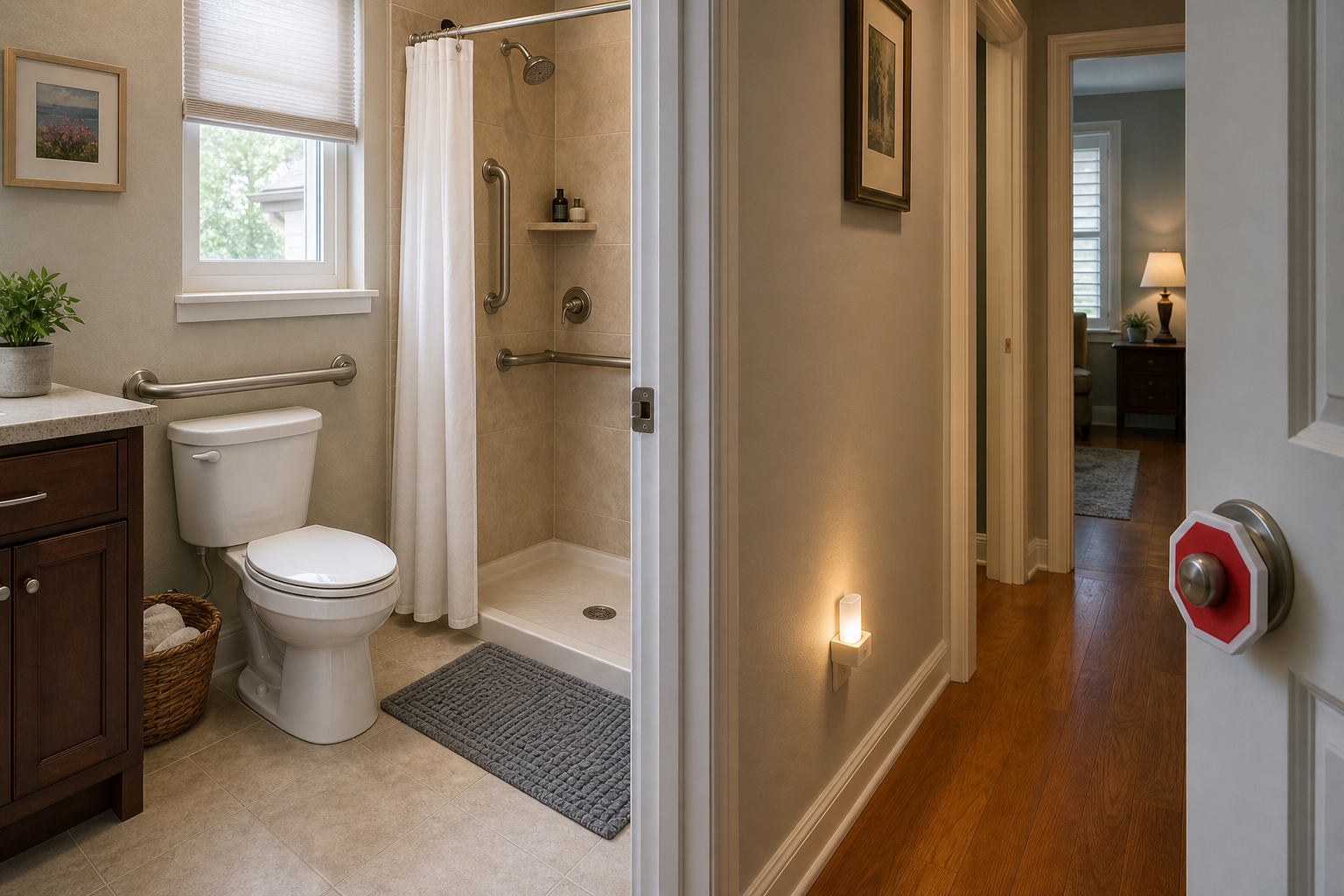
The safety needs of the middle stage are different from the early stage. Early-stage modifications focus on prompts, reminders, and reducing the risk of errors in judgment. Middle-stage modifications focus on preventing injury from falls, preventing unsafe exits, securing hazardous items, and managing the physical environment for someone who can no longer reliably assess risk.
Anti-Wandering Measures
- Install door alarms or contact sensors on all exterior doors and any interior doors that lead to unsafe areas (garage, basement, pool area).
- Use door handle covers or position deadbolt locks at the top or bottom of the door, out of the person's typical line of sight.
- Consider a wearable GPS tracking device. Evaluate options based on battery life (how often it needs charging), range, ease of use for the person wearing it, and how quickly the caregiver receives an alert. Do not select based on brand recognition alone.
- Remove or cover door handles that lead to unsafe areas if the person is a persistent exit-seeker.
Bathroom Safety
- Install grab bars beside the toilet and inside the shower or tub — not towel bars, which are not weight-bearing. Grab bars should be professionally installed into wall studs.
- Use a non-slip mat inside the shower or tub and a bath mat with a non-slip backing on the floor outside.
- Add a sturdy shower chair or tub transfer bench for anyone whose balance or strength is declining.
- Set the water heater to 120°F or below to prevent scalding — the person may no longer reliably test water temperature.
- Consider removing the bathroom door lock or replacing it with one that can be opened from the outside in an emergency.
Fall Hazard Reduction Throughout the Home
- Remove loose rugs, electrical cords, and any objects on the floor that could be tripped over.
- Ensure all stairways have at least one sturdy handrail; mark step edges with brightly colored tape if the person has difficulty perceiving depth.
- Install nightlights in hallways, the bathroom, and the bedroom — nighttime disorientation is common and falls during nighttime bathroom trips are a significant risk.
- Ensure all rooms have adequate lighting; replace dim bulbs proactively.
Kitchen and Medication Safety
- Remove access to the stove if unsupervised cooking is a risk — stove knob covers, stove shut-off devices, or simply relocating the person's primary living area away from the kitchen.
- Store cleaning products, sharp objects, and any toxic substances in locked or childproof cabinets.
- Lock up all medications — including over-the-counter medications — and administer them yourself rather than relying on the person to self-manage.
- Remove or secure alcohol.
Driving Cessation
Driving cessation is not a late-stage issue — it is a middle-stage urgency. By the time someone is in the moderate stage of Alzheimer's, the cognitive and perceptual deficits that make driving unsafe are almost always present, even if the person does not recognize them. This conversation is difficult, but it is not optional.
Practical steps include: having the physician deliver the recommendation (which carries more weight than a family member's request), removing access to the car keys, and arranging alternative transportation before the keys are taken so the person does not feel stranded. If the person continues to attempt to drive, disabling the vehicle may be necessary.
| Safety Area | Key Middle-Stage Changes Needed | Why Now (Not Early Stage) |
|---|---|---|
| Wandering prevention | Door alarms, handle covers, GPS tracking | Wandering typically begins in the middle stage; early-stage individuals can usually be redirected verbally |
| Bathroom | Grab bars, shower chair, non-slip mats | Gait and balance changes increase fall risk significantly in the moderate stage |
| Medication | Locked storage, caregiver-administered doses | Self-management of medication becomes unreliable; overdose and missed-dose risks rise |
| Kitchen | Stove safety device or restricted access | Unsupervised cooking becomes a fire and injury risk as judgment declines |
| Driving | Keys removed, alternative transportation arranged | Driving is unsafe once moderate cognitive impairment is present |
| Nighttime | Nightlights, bed rails if needed, door alarms | Nighttime disorientation and wandering increase in the middle stage |
Building a Sustainable Care Support Team
One of the most consistent findings in dementia caregiving research is that caregivers who try to do everything alone do not provide better care — they burn out faster, which ultimately harms the person they are caring for. Building a support team is not a sign that you are failing. It is a clinical strategy.
The types of support available at this stage include:
- In-home companion services: A companion provides supervised activities and social engagement, allowing the caregiver to leave the home for several hours. This is non-medical care — the companion is not providing personal care.
- Personal care aides: Aides assist with bathing, dressing, toileting, and other personal care tasks. They may work alongside the family caregiver or cover specific shifts.
- Adult day programs: Structured programs outside the home that provide activities, meals, social engagement, and sometimes health monitoring. Prior literature reviews covering decades of studies suggest that, compared to non-attendees, day program participants showed fewer mental health issues, better quality of life, and later entry into care homes. Caregivers reported reduced stress and depression.
- Overnight respite stays: Some memory care communities and long-term care facilities offer short-term overnight stays — from a few days to a few weeks — to give family caregivers an extended break.
- Geriatric care managers: These are licensed professionals (typically social workers or nurses with specialized training) who assess the person's needs, coordinate services, and help families navigate the care system. They are particularly useful for families managing care from a distance or for situations where the care needs are complex.
The Alzheimer's Association's respite care resources note directly that "seeking help does not make you a failure" and that respite services benefit the person with dementia as well as the caregiver. That framing is worth sitting with, because caregiver guilt is one of the most reliable barriers to using the support that is available.
Legal and Financial Planning: Why the Window Is Closing
This section carries an urgency that the others do not. Legal documents — the ones that give you the authority to manage finances, make medical decisions, and ensure the person's wishes are honored — must be completed while the person still has legal capacity to sign them. In many cases, the middle stage is the last practical window for this.
Waiting too long has real consequences. A person who can no longer be deemed legally competent to sign a power of attorney may require a court-supervised guardianship process — which is expensive, time-consuming, and removes family decision-making from a private to a public process.
Key Legal Documents
According to Alzheimers.gov's planning guidance, the core documents that must be in place include:
- Durable power of attorney for finances: Designates someone to make financial decisions — paying bills, managing accounts, selling property — when the person is no longer able to do so.
- Durable power of attorney for healthcare (healthcare proxy): Designates someone to make medical decisions when the person cannot make or communicate them.
- Living will / advance directive: Documents the person's wishes about end-of-life treatment — including resuscitation, mechanical ventilation, and artificial nutrition — so those decisions do not fall entirely to family members in a crisis.
- POLST or MOLST form: A physician-signed medical order (called POLST, MOLST, or similar depending on the state) that translates the person's wishes into actionable medical instructions. Unlike an advance directive, this travels with the person and is immediately actionable by emergency responders.
- Living trust: Instructs a trustee to hold and distribute property and funds according to the person's wishes, and can help avoid probate.
Financial Planning Realities
The financial scale of Alzheimer's care is significant. The 2026 Alzheimer's Disease Facts and Figures report estimates the total lifetime cost of care for a person living with dementia at $405,262 in 2024 dollars — with approximately 70% of that cost borne by family caregivers through out-of-pocket expenses and unpaid labor. Long-term care costs for all people living with Alzheimer's and other dementias are projected to reach $409 billion in 2026 alone.
Financial planning tasks at this stage include reviewing all accounts and assets to ensure the person with POA has access, understanding what Medicare covers and does not cover (most long-term personal care is not covered by Medicare), exploring whether the person has long-term care insurance, and understanding Medicaid eligibility rules if that may eventually be relevant. A certified financial planner or elder care financial specialist can help map a realistic funding plan.
Recognizing When Memory Care Placement Deserves Serious Consideration
Memory care placement is not a failure. It is one option in a range of care environments, and for some families at some points in the disease, it is the safest and most appropriate option. Naming the signals in advance — rather than discovering them in a crisis — is what allows families to make this decision with clarity rather than guilt.
The behavioral and situational signals that warrant serious evaluation include:
- Repeated wandering incidents that home safety measures have not contained, particularly if the person has left the property.
- Behavioral symptoms (aggression, severe agitation, psychosis) that are not responding to non-pharmacologic approaches and are creating safety risks for the person or for caregivers.
- The primary caregiver's own health is declining — physically or mentally — as a direct result of caregiving demands. Caregiver health is not a secondary concern; it is a care-quality concern.
- Safety incidents that the current home environment cannot prevent, even with modifications.
- The person requires around-the-clock supervision and the family cannot sustainably provide it.
When evaluating memory care communities, key dimensions to assess include: staff-to-resident ratio, staff training specific to dementia care, the physical environment (secure outdoor space, clear navigation cues, sensory-appropriate design), how behavioral symptoms are managed (non-pharmacologic approaches vs. heavy sedation), and how family involvement is structured. Visiting at different times of day — not just during a scheduled tour — gives a more accurate picture.
Protecting Your Own Health as a Caregiver
The scale of family caregiving for people with Alzheimer's is often invisible until you are inside it. In 2025, nearly 13 million Americans provided unpaid care for a family member or friend with dementia, contributing more than 19 billion hours of care valued at over $446 billion. Of those caregivers, 59% report high to very high emotional stress. That figure is not surprising to anyone who has been doing this work — but it is important to name it plainly, because the gap between what caregivers feel and what they allow themselves to acknowledge is where burnout takes root.
BPSD are more destructive to caregiver depression than the cognitive disorder itself. — Koca, Taşkapılıoğlu & Bakar, 2017, reviewing caregiver burden across Alzheimer's disease stages
This finding — that behavioral symptoms, not cognitive decline, are the primary driver of caregiver depression — has a practical implication: managing behavioral symptoms is not just about the person with Alzheimer's. It is about caregiver sustainability. Every strategy in this guide that reduces agitation, wandering, or resistance to care is also a caregiver wellbeing intervention.
Recognizing Burnout Before It Becomes a Crisis
Caregiver burnout does not always announce itself clearly. It often arrives as increasing irritability, emotional numbness, physical exhaustion that sleep does not resolve, withdrawal from relationships, and a growing sense that nothing you do is enough. These are not personal failings — they are predictable responses to sustained, high-demand caregiving without adequate support.
- Persistent fatigue that does not improve with rest
- Increasing resentment or anger toward the person you are caring for
- Neglecting your own medical appointments, medications, or basic needs
- Feeling isolated and unable to ask for help
- Loss of interest in activities or relationships that previously provided relief
- Feeling that caregiving has consumed your entire identity
What the Evidence Supports
Research consistently shows that caregivers experience lower stress and better health when they participate in caregiver skills training and support groups — and that participation in support groups can allow caregivers to provide home care for longer before transitioning to residential placement. The 2024 systematic review of adult day programs found that prior literature consistently linked day program attendance to reduced caregiver stress, depression, and conflict — and improved confidence in managing behavioral symptoms.
The Alzheimers.gov caregiver tips also note that research supports meditation as a practice that can reduce blood pressure, anxiety, depression, and insomnia in caregivers — not as a replacement for structural support, but as one tool among many.
The middle stage of Alzheimer's is long, demanding, and irreversible in its direction. But it is also a stage in which thoughtful preparation — of the home, the legal documents, the support team, and your own reserves — can make a meaningful difference in how the years ahead unfold, for the person you are caring for and for yourself.
Related reading
Noticed something outdated or inaccurate on this page? Flag a correction. We review every report against CDC, NIA, and AARP HomeFit guidance before updating a page.
Part of the Fall Prevention section.