
Understanding Wandering in Dementia: Causes, Warning Signs, and a Caregiver Action Plan
Wandering affects 6 in 10 people with dementia and is one of the most dangerous — and misunderstood — caregiving challenges families face. This guide explains why wandering happens, how it changes across disease stages, and how to build a layered safety plan before a crisis occurs.
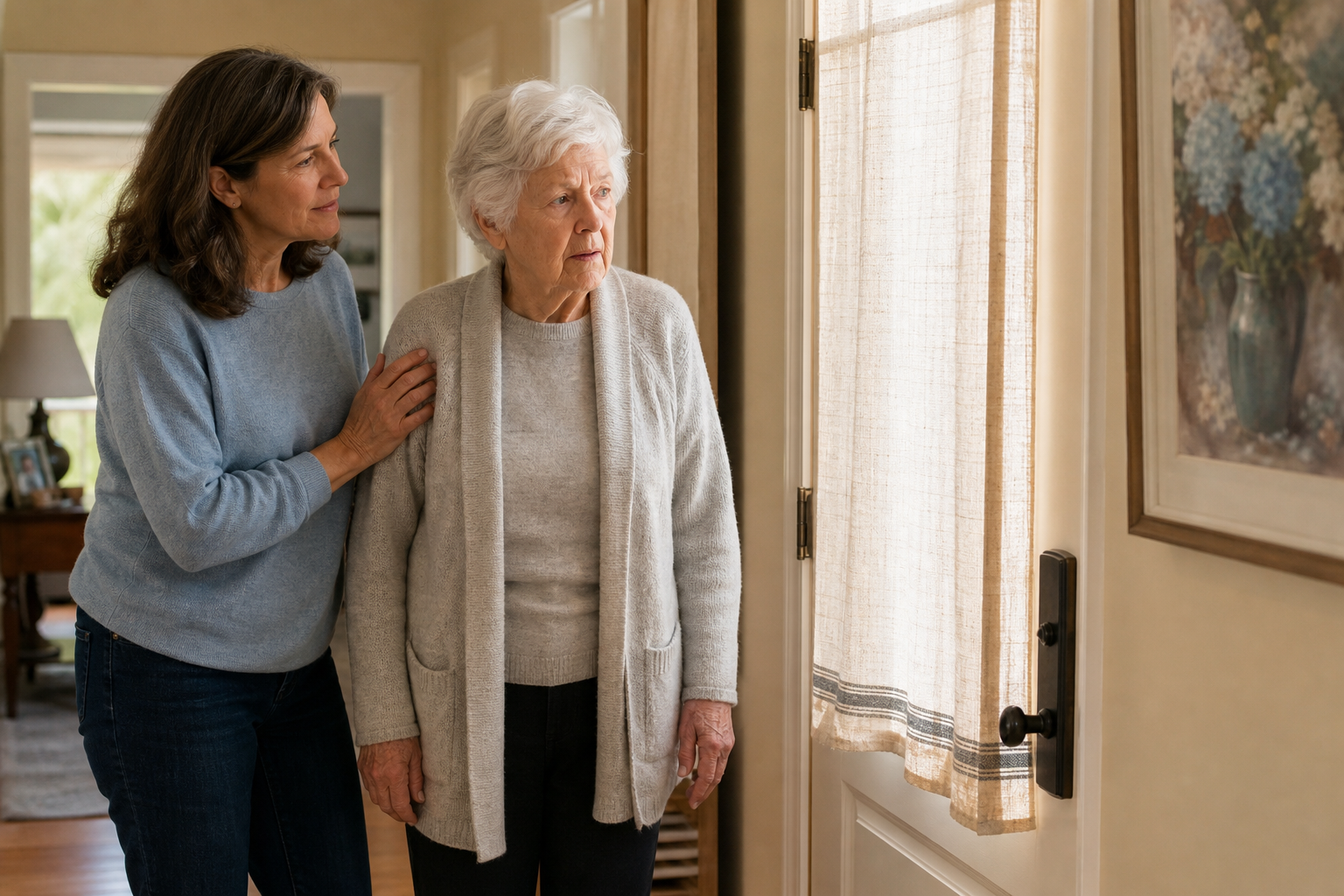
What Is Dementia Wandering?
"Wandering" is an umbrella term, not a single behavior. It describes several distinct movement patterns that occur in people with dementia, each with different triggers and different implications for caregiver response. Lumping them together makes it harder to respond effectively.
- Repetitive indoor pacing — moving through the same rooms or hallways repeatedly, often in response to restlessness, anxiety, or an unmet physical need.
- Night wandering — getting out of bed and moving through the home during nighttime hours, frequently connected to sundowning and disrupted sleep-wake cycles.
- Elopement (exit-seeking) — attempting to leave the home or a care setting, often with a specific perceived purpose: going to work, returning to a childhood home, or finding a family member. This is the highest-risk type.
The scale of the problem is significant. Six in 10 people living with dementia will wander at least once, and many do so repeatedly, according to the Alzheimer's Association. For elopement specifically — what clinicians call a "missing incident" — the stakes are severe: approximately half of those not found within 24 hours face serious injury or death.
One framing shift matters before anything else: wandering is not random or aimless. It is purposeful behavior. The person moving toward the door has a reason — even if that reason is rooted in confusion, memory loss, or a brain that is no longer accurately tracking time and place. Understanding that purpose is the foundation of an effective response.
Why People with Dementia Wander: The Brain and Unmet-Needs Explanation
Two explanations work together to account for most wandering behavior: what is happening in the brain, and what the person is trying to accomplish.
The neurological foundation
Dementia progressively disrupts visuospatial processing and memory in ways that make familiar environments feel unfamiliar and familiar routines impossible to track. A person can begin walking toward a goal — the kitchen, the front door, a former workplace — and then forget the intention mid-route, leaving them in motion without a recoverable destination.
PET imaging research has identified a distinct pattern of reduced metabolic activity in the cingulum and supplementary motor areas among people with Alzheimer's disease who wander, compared to those who do not. These are regions involved in spatial navigation and movement initiation — findings that help explain why wandering is not simply a behavioral choice but a consequence of specific brain changes, as described in Practical Neurology.
The unmet-needs framework
Layered on top of the neurological changes are psychosocial and physical drivers. Research supports three primary psychosocial scenarios associated with wandering behavior:
- Escape from a setting that feels unfamiliar, unsafe, or distressing — even if it is the person's own home of many years.
- A desire for social interaction — the person is lonely, bored, or seeking connection with someone who may no longer be alive.
- Restlessness from insufficient physical or mental stimulation — excess energy with no outlet.
Beyond these, several other triggers are common:
- Belief in a prior obligation — a conviction that they need to go to work, pick up children from school, or meet a commitment that ended decades ago.
- Searching for a person or place from the past — a deceased spouse, a childhood home, a former neighborhood.
- Unmet physical needs — hunger, thirst, pain, a need to use the bathroom, or simple discomfort (a room that is too hot or too cold).
- Environmental stressors — noise, crowding, unfamiliar visitors, or disruption to routine.
Warning Signs Your Loved One May Be at Risk
Wandering rarely appears without warning. The following behavioral patterns, drawn from Alzheimer's Association guidance and clinical sources, frequently precede or signal active wandering risk. Recognizing them early allows caregivers to build safety measures before a missing incident occurs.
- Returning from walks or outings later than expected, or becoming lost on previously familiar routes.
- Forgetting how to navigate to nearby, frequently visited places — a neighbor's house, a pharmacy, a place of worship.
- Expressing a desire to "go home" while already at home — often a reference to a past residence or a feeling of safety rather than a physical location.
- Talking about needing to get to work, meet an obligation, or fulfill a responsibility that no longer exists.
- Asking about the whereabouts of a deceased family member — a parent, sibling, or spouse — as if expecting them to arrive.
- Visible restlessness or repeated pacing, particularly in late afternoon or early evening hours.
- Disorientation in crowded, busy, or unfamiliar environments — becoming agitated or confused in stores, waiting rooms, or family gatherings.
- Attempting to leave the home unaccompanied, especially at unusual hours.
How Wandering Changes Across Dementia Stages
Wandering is not static. Its character, frequency, and the level of supervision it requires shift as dementia progresses. Understanding this trajectory helps caregivers anticipate what is coming, not just respond to what is happening now.
Clinical research supports grouping people with dementia into three risk profiles based on cognitive severity and behavioral disturbance level — a framework described in peer-reviewed literature from 2022. Wandering most commonly begins when cognitive function reaches a moderate decline level (roughly corresponding to an MMSE score of 15 or below), with the highest wandering frequency found in those with MMSE scores of 13 or below.
| Stage | Cognitive Profile | Wandering Character | Primary Caregiver Priorities |
|---|---|---|---|
| Early stage | Mild memory loss; person may still manage many daily tasks independently | Wandering in unfamiliar settings; may still carry a phone; often still able to self-correct on familiar routes | Establish a medical ID bracelet; enroll in safe-return programs; review driving safety; begin building neighbor awareness |
| Middle stage | Moderate cognitive decline; significant memory loss; may not recognize familiar people or places | Most common onset period; driven by boredom, restlessness, or stimulation-seeking; elopement risk increases substantially | Implement environmental modifications; consider adult day programs; establish structured daily activity; introduce GPS monitoring |
| Late stage | Severe cognitive decline; limited or no verbal communication; high behavioral disturbance in some individuals | Wandering may be delusion-driven; person may be less physically mobile but some remain active; constant supervision typically required | 24-hour supervision or structured care setting; continue environmental safeguards; focus on comfort and safety |
Home Safety and Environmental Modifications
Environmental changes are the most immediate, lowest-cost, and most consistently recommended first-line interventions for reducing unsafe elopement risk. Most can be implemented in a single afternoon without professional installation.

Door and exit modifications
- Deadbolts positioned high (above eye level) or low (near the floor) — placing locks outside the typical visual field makes them less likely to be noticed and operated.
- Door camouflage — painting the door the same color as the surrounding wall, hanging a curtain over the door handle area, or placing artwork over the door itself reduces the visual salience of the exit.
- Black two-foot threshold tape — a strip of black tape or paint applied to the floor in front of an exit door creates a visual barrier that many people with dementia perceive as a step or opening and will not cross.
- Child-safe doorknob covers — add a manipulation step that may interrupt the exit sequence.
- Warning bells or chimes mounted above doors — audible alerts that notify caregivers when a door is opened, even from another room.
Interior and whole-home modifications
- Pressure-sensitive mats at the bedside and at door thresholds — alert caregivers when the person gets up or approaches an exit, providing response time before elopement occurs.
- Night lights throughout hallways, bathrooms, and stairways — reduce disorientation during nighttime movement and lower the risk of falls associated with wandering in darkness.
- Fenced outdoor safe zones — a secured garden or yard where the person can walk freely satisfies the need for movement and outdoor access without elopement risk.
- Remove or store triggering items — coats, shoes, keys, wallets, and purses near exits can activate the behavioral sequence of "I'm going somewhere." Keeping these out of sight reduces that trigger.
Behavioral and Routine-Based Strategies
Environmental changes address the opportunity to wander. Behavioral and routine-based strategies address the underlying drive. Both are necessary — and they work best together.
- Structure daily activity during peak wandering times. Restlessness is the most common trigger for indoor pacing and late-afternoon elopement attempts. Scheduling walks, light tasks, music, or social engagement during these windows gives the energy somewhere to go.
- Offer supervised walks and regular exercise. Physical movement addresses restlessness directly. A supervised walk in the morning or early afternoon can reduce the urgency to wander later in the day.
- Be aware of sundowning patterns. Many people with dementia experience increased confusion, agitation, and restlessness in the late afternoon and early evening — a phenomenon linked to circadian rhythm disruption. Reducing stimulation, dimming lights gradually, and shifting to calming activities before sunset can lower the wandering drive during this window.
- Meet basic needs proactively. Hunger, thirst, pain, and a need to use the bathroom are all common wandering triggers. Regular toileting schedules, consistent meal and hydration routines, and attention to signs of physical discomfort can reduce wandering frequency meaningfully.
- Avoid crowded or overstimulating environments. Busy stores, large family gatherings, and noisy waiting rooms can trigger escape-seeking behavior. When these environments are unavoidable, shorter visits and a familiar companion reduce distress.
- Redirect rather than correct "going home" requests. When a person insists they need to go home, arguing or explaining that they are already home rarely helps and often increases distress. Instead, acknowledge the feeling ("It sounds like you're ready to be somewhere comfortable") and redirect to an activity, a snack, or a change of room.
Technology Tools That Extend Caregiver Response Time
No environmental modification or behavioral strategy is fail-safe. Technology tools serve a distinct purpose: they extend the window between the moment a person exits and the moment a caregiver can respond. They do not prevent wandering — they reduce the time a person spends wandering unsafely.
| Technology Category | How It Works | Key Evaluation Dimensions |
|---|---|---|
| Wrist-worn GPS wearables | A watch-style device worn on the wrist transmits location data to a caregiver's phone or monitoring service. Some include two-way communication. | Battery life, water resistance, caregiver alert speed, whether the person will tolerate wearing it |
| Belt-clip and sewn-in GPS formats | GPS trackers designed to be clipped to clothing or sewn into garments — useful when a person removes wrist devices. | Concealment, battery life, alert method, range |
| Door and window alarm sensors | Mounted on doors or windows; emit an audible alert or send a phone notification when opened. | Alert volume, notification method (sound only vs. app alert), ease of installation, false-alarm rate |
| Bed exit pressure mats | Placed under or beside the mattress; alert caregiver when the person gets out of bed. | Sensitivity, alert method, whether it distinguishes routine movement from exit |
| Floor pressure mats at exits | Placed at doorway thresholds; trigger an alert when stepped on. | Sensitivity, alert volume, caregiver notification range |
| Medical alert systems with GPS | Wearable emergency response devices that add GPS location tracking to standard fall-detection and two-way communication capability. | GPS accuracy, response center availability, battery life, monthly monitoring cost |
Building Your Written Wandering Safety Plan
The most important thing to understand about a wandering safety plan is when to create it: before the first incident, not after. A missing episode is not the moment to be locating a recent photo, explaining a diagnosis to a 911 dispatcher for the first time, or realizing a neighbor has no idea the person next door has dementia.
A complete written plan includes the following components:
- Medical ID bracelet or tag — worn at all times, engraved with the person's name, diagnosis ("Memory Impairment" or "Alzheimer's"), and a caregiver contact number. This is the single most useful identification tool if a person is found by a stranger or first responder.
- Current close-up photograph on file — updated at least every six months, showing the person's current appearance. Keep a digital copy accessible on your phone. Law enforcement will need this immediately.
- Neighbor alert network — introduce yourself and the situation to immediate neighbors and provide them with a photo and a contact number. Neighbors who recognize the person can call before a missing incident escalates.
- Written list of likely wandering destinations — former workplaces, childhood homes, places of worship, the home of a deceased spouse or parent. People with dementia often head somewhere meaningful from their past. This list helps searchers prioritize.
- Unwashed article of clothing in a sealed bag — kept specifically for police scent-tracking dogs. Seal it now and keep it accessible.
- Safe-return program enrollment — register with at least one program before a missing incident occurs.
Safe-return programs to know
- MedicAlert + Alzheimer's Association Safe Return — a nationwide 24/7 emergency response service. When a registered person is reported missing or found, a call to the program's hotline triggers a coordinated response. Enrollment includes an ID bracelet linked to the registry.
- Project Lifesaver — a frequency-transmitting wristband or ankle band worn by the person with dementia. Specially trained law enforcement personnel use a receiver to locate the signal when a missing report is filed. Contact your local sheriff's office or police department to inquire about availability in your area.
- Silver Alert — a public notification system, similar to an Amber Alert for children, that broadcasts information about a missing person with a cognitive disorder to the public through highway signs, media, and wireless emergency alerts. Activation is handled by law enforcement after a missing report is filed.
What to Do If Your Loved One Goes Missing: The 15-Minute Protocol
This section is designed to be returned to in a crisis. Read it now so the steps are familiar. In the moment, you will not want to be reading — you will want to be acting.
- Search the entire residence first — including all rooms, closets, the garage, basement, attic, and any outbuildings. People with dementia sometimes hide or become confused in unexpected interior spaces.
- Check for missing vehicles — confirm whether any car is missing and, if so, note the make, model, color, and license plate.
- Search the yard and immediate neighborhood — include brush, shrubs, brier patches, and any areas where a person could become concealed or fall.
- Widen the search following the dominant hand — research consistently shows that people who wander tend to turn in the direction of their dominant hand. A right-handed person is more likely to have turned right from the exit.
- Stay within 1.5 miles of the departure point — the majority of people with dementia who wander are found within this radius.
When you call 911, have ready: the person's name and physical description, what they were wearing, the current photo on your phone, the list of likely destinations, your address and the direction they likely exited, and any GPS tracker information if the person is wearing one.
The Caregiver Side: Managing Fear, Guilt, and Burnout
Living with wandering risk changes how caregivers experience their own home. The hypervigilance — listening for footsteps at night, watching the door, never fully relaxing — is exhausting in a way that is difficult to explain to people who have not experienced it.
After a close call or a missing incident, guilt is almost universal. Caregivers replay the moment they looked away, the errand they ran, the phone call they answered. That guilt is understandable — and it is also not a fair measure of caregiving quality. Wandering is a feature of the disease, not a consequence of inattention.
The sustained vigilance that wandering requires is one of the clearest pathways to caregiver burnout. It is not a phase that passes — it intensifies as the disease progresses. That reality makes support not a luxury but a functional necessity.
- Caregiver support groups — both in-person (often available through local Alzheimer's Association chapters) and online — provide peer contact with people who understand the specific weight of wandering risk in a way that friends and family often cannot.
- Respite care, even for a few hours at a time, allows caregivers to step away without the constant monitoring burden. Adult day programs serve a dual function: structured activity that reduces wandering drive during the day, and genuine respite time for the caregiver.
- Professional support — a therapist, social worker, or counselor familiar with dementia caregiving — can help caregivers process the grief and anticipatory loss that accompany this stage of the disease.
Caring for someone who wanders is not a failure of vigilance. It is one of the most demanding aspects of dementia caregiving — and it is shared by millions of families. The goal is not perfection. It is a layered plan, a practiced protocol, and enough support to keep going.
Related reading
Noticed something outdated or inaccurate on this page? Flag a correction. We review every report against CDC, NIA, and AARP HomeFit guidance before updating a page.
Part of the Fall Prevention section.