
Understanding Lewy Body Dementia in Seniors
Lewy body dementia is frequently mistaken for Alzheimer's, yet the two conditions have distinct symptom profiles, progression patterns, and critically different medication safety rules. This guide helps caregivers recognize the key differences and advocate for an accurate diagnosis to keep their loved one safe.
A dementia diagnosis should not leave a family guessing what kind of dementia they are dealing with. That subtype matters when a parent is seeing people who are not there, acting out dreams, having sharply different “good hours” and “bad hours,” or becoming slower and shakier on their feet. Those clues do not prove Lewy body dementia, but they are strong enough to bring back to the clinician rather than quietly filing the diagnosis under ordinary Alzheimer’s.
The reason is not academic. Dementia with Lewy bodies is frequently missed; the 2017 DLB Consortium consensus report notes that only about 30% of cases are correctly diagnosed during life.[1] Families should not turn that statistic into self-diagnosis. They should use it as permission to ask a more precise question: “Could this be Lewy body dementia, or mixed dementia, rather than Alzheimer’s alone?”
That question becomes urgent when behavior medications enter the conversation. Some antipsychotic drugs that may be considered for severe hallucinations, delusions, or agitation in dementia can cause severe reactions in people with Lewy body dementia. The Lewy Body Dementia Association warns that up to 50% of people with LBD may have severe neuroleptic sensitivity reactions, which can include worsened confusion, heavy sedation, severe movement decline, or life-threatening complications.[2]

When the Alzheimer’s label does not explain what you are seeing
Alzheimer’s disease commonly announces itself through short-term memory trouble: repeated questions, misplaced items, forgotten appointments, and difficulty learning new information. Lewy body dementia can involve memory loss too, especially as it progresses or when Alzheimer’s pathology is also present. But in many families, the first unmistakable problems are not mainly memory. They are visual, sleep-related, attention-related, movement-related, or medication-related.
That difference can be easy to miss in a short visit. A parent may look alert in the exam room, answer social questions well, and still be having episodes at home where they stare at a corner, talk to children no one else can see, fall asleep at odd times, or become so confused in the evening that a daughter starts wondering whether every day is a new crisis. If the chart only says “dementia,” the family is left to connect symptoms that the system may not have asked about.
For a broader starting point on what dementia evaluations usually include, it can help to read a general memory-loss guide for families. But when hallucinations, dream enactment, fluctuating cognition, and parkinsonian movement show up early, the next appointment needs more specific language.
The comparison caregivers can actually observe
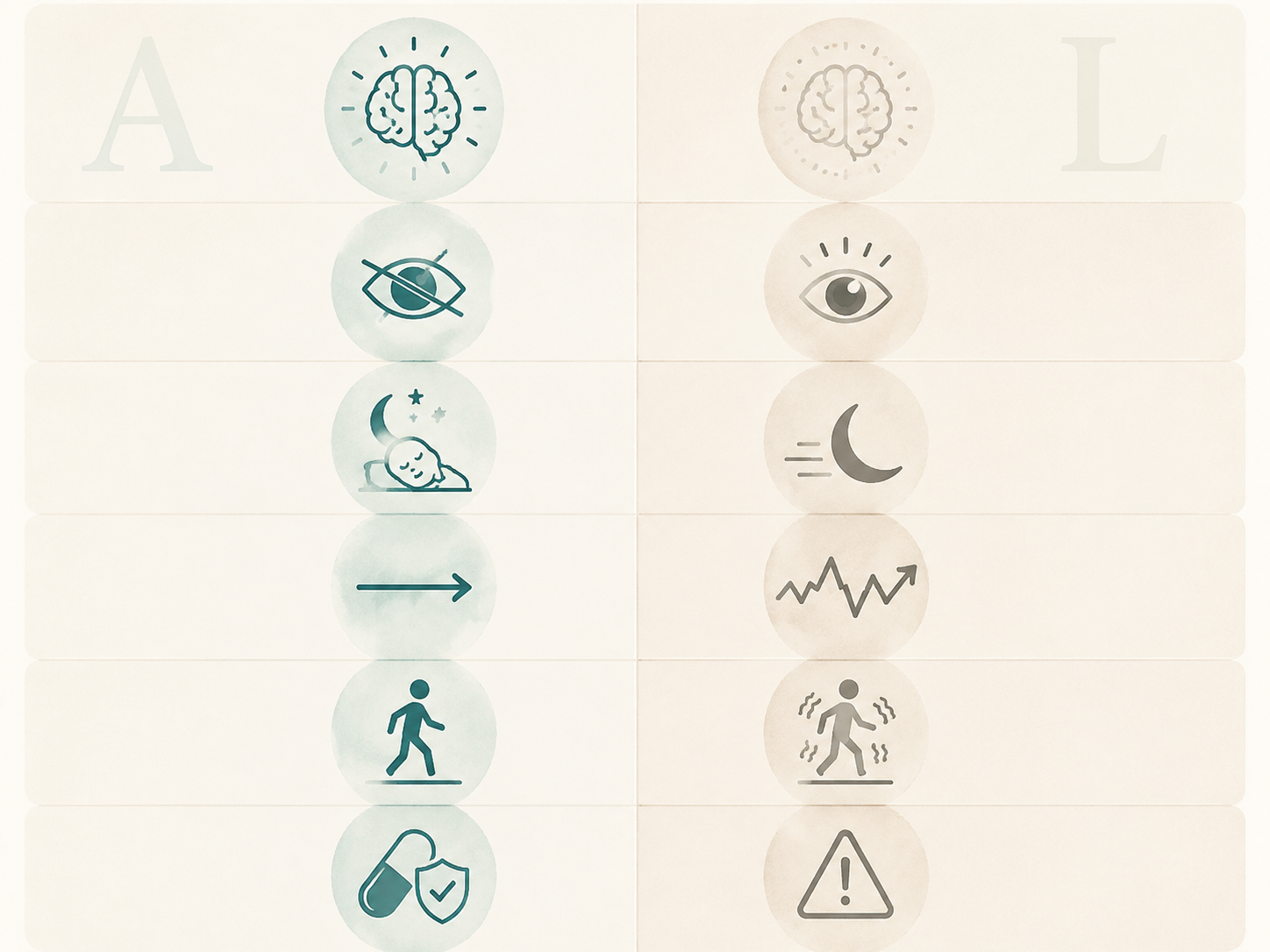
| What the family notices | More typical of Alzheimer’s early on | More suggestive of Lewy body dementia |
|---|---|---|
| Early memory pattern | Short-term memory loss is often a central early problem. | Memory may be less impaired early than attention, alertness, visual processing, or planning. |
| Visual hallucinations | Can occur, but are more often associated with later disease. | Recurrent, well-formed visual hallucinations can appear early; Mayo Clinic says they may affect up to 80% of people with LBD.[3] |
| Sleep behavior | Sleep disruption can happen, but acting out dreams is not a typical early Alzheimer’s clue. | REM sleep behavior disorder, including moving, shouting, punching, or kicking during dreams, is a core LBD feature and may precede dementia by years or decades.[1][4] |
| Good hours and bad hours | Confusion usually worsens gradually, though illness, medication, poor sleep, or delirium can cause sudden changes. | Fluctuating cognition is a core feature: alert and engaged at one time, then drowsy, blank, or very confused at another.[1] |
| Movement | Walking and stiffness problems are more commonly prominent later. | Parkinsonism can appear earlier: slowness, stiffness, shuffling, reduced facial expression, or tremor.[1] |
| Autonomic symptoms | Can occur for many reasons in older adults. | Constipation, dizziness on standing, fainting, urinary issues, and blood pressure instability can fit the LBD pattern.[3] |
| Medication safety | Behavior medications still require caution in any dementia. | Antipsychotic sensitivity is a special safety concern in LBD and should be flagged before emergency or hospital treatment.[2] |
No single row in that table diagnoses a person. A urinary tract infection, dehydration, pain, poor sleep, medication side effects, vision loss, or delirium can make any dementia look suddenly worse. The pattern matters when several clues cluster together and especially when they appear early.
Early visual hallucinations are not a small detail
The hallucinations of Lewy body dementia are often visual and well formed: people, animals, children, insects, or figures in the room. They may be frightening, neutral, or oddly matter-of-fact. A parent may say, “There are children playing in the hallway,” or “A man is sitting in that chair,” while still recognizing family members and carrying on a reasonable conversation at other times.
Mayo Clinic describes visual hallucinations as one of the first symptoms of Lewy body dementia and says they may occur in up to 80% of people with the condition.[3] That timing is what makes them so important. Hallucinations can occur in Alzheimer’s, but when they are recurrent, detailed, and early, they should not be brushed aside as just another dementia behavior.
The caregiver’s job is not to argue about whether the vision was “real.” It is to record what happened: what the parent saw, whether they were frightened, what time it occurred, whether they were ill or sleep-deprived, whether a new medication had started, and whether similar episodes have happened before. That record gives the clinician something more useful than “Mom is confused.”
Dream enactment can be the long look-back clue
REM sleep behavior disorder is different from ordinary restless sleep. During normal REM sleep, the body is largely still. In REM sleep behavior disorder, a person may physically act out dreams: yelling, punching, kicking, grabbing, falling out of bed, or injuring a bed partner. Families often remember it only after someone asks the right question: “Has your parent ever acted out dreams?”
The 2017 DLB Consortium criteria include REM sleep behavior disorder as a core clinical feature of dementia with Lewy bodies.[1] The LBDA also reports research showing that about 97% of people with isolated REM sleep behavior disorder developed a synucleinopathy within 14 years.[4] That does not mean every person who has kicked during sleep has Lewy body dementia. It does mean a history of true dream enactment deserves to be mentioned during a dementia evaluation, even if it began long before memory symptoms.
If a spouse or adult child has been sleeping separately because of nighttime hitting, shouting, or falls from bed, that is medical information. It also belongs in the safety plan, because nighttime injuries can happen before the family fully understands the dementia diagnosis.
Good hours and bad hours can be a diagnostic clue
Fluctuating cognition is one of the most frustrating parts of Lewy body dementia for families because it can make the caregiver look unreliable. The parent may be sharp enough for a phone call in the morning, then unable to follow simple directions in the afternoon. They may seem present during one visit and almost unreachable during another. A clinician who sees only the good window may underestimate what is happening at home.
The DLB Consortium criteria identify fluctuating cognition, with pronounced variations in attention and alertness, as a core clinical feature.[1] Family Caregiver Alliance also describes fluctuations in alertness and attention as part of dementia with Lewy bodies.[5] The practical question for caregivers is not “Was today good or bad?” but “How wide is the swing, how often does it happen, and what else changes with it?”
Write down examples that show the contrast. “At 9 a.m., he made breakfast with reminders. At 2 p.m., he could not find the bathroom in his own house.” “She recognized me at lunch, then stared through me at dinner.” Patterns like that help separate a vague complaint from a clinically meaningful fluctuation. They also help clinicians look for treatable triggers such as infection, medication effects, dehydration, pain, or delirium.
Movement, falls, and body signals belong in the same conversation
Lewy body dementia often overlaps with symptoms families associate with Parkinson’s disease: slowed movement, stiffness, shuffling steps, tremor, balance trouble, softer speech, smaller handwriting, or a face that looks less expressive. These changes may be subtle at first. A parent may simply stop swinging one arm when walking, take longer to rise from a chair, or begin falling without a clear explanation.
Autonomic symptoms can add to the risk. Mayo Clinic lists problems such as blood pressure changes, dizziness, falls, urinary incontinence, constipation, and temperature regulation issues among Lewy body dementia symptoms.[3] In daily life, that can mean the person gets lightheaded when standing, faints in the bathroom, becomes constipated, or has new bladder problems. Each symptom can have other causes, but together they strengthen the case for a more careful evaluation.
Fall risk is not a side issue. If your parent has hallucinations, fluctuating alertness, dizziness, stiffness, or nighttime dream enactment, the home environment needs attention before the next crisis. A practical early-stage dementia home safety checklist can help families look at lighting, rugs, stairs, bathrooms, medications, and nighttime pathways while the diagnostic workup continues.
Why the right diagnosis changes medication safety
The highest-stakes difference between Alzheimer’s disease and Lewy body dementia often appears when hallucinations, delusions, or agitation become hard to manage. In a rushed setting, a clinician may consider an antipsychotic medication to reduce distress or dangerous behavior. In Lewy body dementia, that decision requires special caution.
The LBDA warns that up to 50% of people with LBD may have severe sensitivity reactions to antipsychotic drugs.[2] The Alzheimer’s Association also notes that antipsychotic medications can cause serious side effects in people with dementia with Lewy bodies and should be used with extreme caution.[6] This is the information families need available in an emergency department, urgent care clinic, hospital room, or long-term care facility—not buried in memory-care paperwork at home.
A useful sentence is direct and calm: “My parent may have Lewy body dementia and may be sensitive to antipsychotic medications. Please check before giving any medication for agitation, hallucinations, or sleep.” That is not refusing care. It is putting a known safety risk in front of the team before a routine order becomes a preventable complication.
This does not mean families should manage hallucinations alone or stop prescribed medication without medical guidance. Some hallucinations are not distressing and may be handled with reassurance and environmental adjustments. Others are terrifying, dangerous, or tied to delirium, pain, or another treatable medical issue. When agitation or hallucinations are already disrupting care, families may also need structured behavior-management guidance for dementia symptoms while the medical team weighs risks and benefits.
Mixed dementia can blur the picture
Families are often handed a clean label, but the brain may not follow one clean category. The LBDA notes that about half of LBD cases also have Alzheimer’s pathology at autopsy.[7] That mixed-pathology reality matters because it can make symptoms overlap. A person can have prominent memory loss and still have Lewy body features. Another person can start with hallucinations and fluctuations, then develop more obvious memory impairment later.
This is one reason a checklist cannot confirm the diagnosis at home. It is also why “but she does forget things” should not end the conversation. Memory loss does not rule out Lewy body dementia, especially in later stages or mixed disease. The better question is whether the full pattern has been considered.
DLB, Parkinson’s disease dementia, and the one-year rule
Families may hear several terms: Lewy body dementia, dementia with Lewy bodies, Parkinson’s disease dementia, or simply LBD. Lewy body dementia is often used as an umbrella term. Dementia with Lewy bodies and Parkinson’s disease dementia are closely related conditions within that spectrum.
The specialist distinction often uses timing. If dementia appears before or within about one year of parkinsonian movement symptoms, clinicians may diagnose dementia with Lewy bodies. If well-established Parkinson’s disease comes first and dementia develops more than a year later, the diagnosis may be Parkinson’s disease dementia.[1] For families, the safety and care implications are often similar enough that the most important step is making sure Lewy body disease is on the chart and medication sensitivity is recognized.
What to bring to the next appointment
The appointment will go better if the family brings observations instead of only conclusions. A neurologist, geriatric psychiatrist, geriatrician, or memory clinic may still need cognitive testing, medication review, physical examination, sleep history, imaging, lab work, or collateral history from someone who sees the person daily. Your notes help them decide what to look for.
- Hallucinations: what the person sees, how often, whether it is visual, whether they are frightened, and whether it began early in the dementia course.
- Sleep behavior: yelling, punching, kicking, falling out of bed, or acting out dreams, including when it first started.
- Cognitive fluctuations: examples of good hours and bad hours, including time of day and whether alertness changes suddenly.
- Movement changes: shuffling, stiffness, tremor, falls, slower walking, softer voice, or difficulty rising from a chair.
- Autonomic symptoms: fainting, dizziness on standing, constipation, urinary changes, or blood pressure swings.
- Medication history: new prescriptions, over-the-counter sleep aids, prior reactions to antipsychotics, sedatives, nausea medicines, or hospital medications.
Bring another person if possible. The parent may not remember hallucinations, falls, or dream enactment, and some may be embarrassed to report them. A spouse may know the sleep history. An adult child may know the medication changes. A home aide may know when the “bad hours” actually happen. The clinician needs the whole picture, not just the most polished version of the day.
Questions that move the visit from vague to useful
Families do not need to sound like neurologists. They need to ask questions that force the subtype and safety issues into the open.
- “What type of dementia do you think this is, and what evidence supports that?”
- “Could the hallucinations, dream enactment, fluctuations, and movement changes fit Lewy body dementia?”
- “Could this be mixed dementia rather than Alzheimer’s alone?”
- “Should we see a neurologist, movement-disorders specialist, geriatric psychiatrist, or memory clinic?”
- “Are there medications we should avoid because of possible Lewy body dementia?”
- “Can you document possible antipsychotic sensitivity risk in the chart and medication list?”
If the answer is “it does not matter because dementia is dementia,” push for a more careful explanation. The exact label may remain uncertain for a while, and mixed dementia may complicate it, but medication safety and fall risk are not abstract. They affect what happens at home tonight and what happens if the person lands in the emergency department next month.
What prognosis numbers can and cannot tell you
Families often ask how long Lewy body dementia lasts. Mayo Clinic says people with Lewy body dementia live an average of 7 to 8 years after symptoms begin.[3] Family Caregiver Alliance gives a commonly cited range of 5 to 7 years.[5] Those ranges are averages, not a clock for one parent. Age, other illnesses, falls, swallowing problems, infections, medication complications, and the level of support at home can all affect the course.
Prognosis should not overtake the immediate work: clarifying the diagnosis, preventing medication harm, reducing falls, planning supervision, and supporting the caregiver. If daily care is already intensive, a middle-stage dementia caregiving guide may be more useful than trying to predict the exact timeline.
The safety note every caregiver should keep visible
Until the diagnosis is clearer, treat possible Lewy body dementia as a safety flag. Keep a short note in the medication list, emergency folder, and phone contacts: “Possible Lewy body dementia. History of visual hallucinations, cognitive fluctuations, dream enactment, parkinsonism, or falls. Use caution with antipsychotic medications; discuss with treating clinician.”
Caregivers also need backup. Lewy body dementia can be especially hard because the person may look capable one hour and unsafe the next. Respite, care coordination, and benefits navigation are not extras after the family has “earned” help; they are part of keeping care stable. If you are trying to understand what support may be available, a caregiver support and Medicare guide can help organize the next layer of planning.
Lewy body dementia cannot be confirmed by a family checklist, and Alzheimer’s pathology can be part of the same person’s disease. Still, early visual hallucinations, dream enactment, fluctuating cognition, movement changes, autonomic symptoms, and medication sensitivity risk are too important to leave out of the conversation. Document them, ask directly about LBD, and make sure every clinician who treats your parent knows why the distinction matters.
References
- 2017 DLB Consortium Consensus Criteria — McKeith et al., Neurology
- Is It LBD or Something Else? — LBDA
- Lewy body dementia — Symptoms and causes — Mayo Clinic
- Sleep Disorder Increases Odds of DLB by Five Times Over Alzheimer's — LBDA
- Dementia with Lewy Bodies — Family Caregiver Alliance
- Dementia with Lewy Bodies (DLB) — Alzheimer's Association
- Alzheimer's and Lewy Bodies: When Two Pathologies Collide — LBDA
Related reading
Noticed something outdated or inaccurate on this page? Flag a correction. We review every report against CDC, NIA, and AARP HomeFit guidance before updating a page.
Part of the Fall Prevention section.