
Caregiver decision guide
What the 2026 AHA Statin Guidelines Mean for Your Aging Parent
The 2026 AHA cholesterol guidelines replaced the old risk calculator with a more accurate one, changing who qualifies for statins. This guide explains the key changes — from the PREVENT risk equations to shared decision-making — and what they mean for your aging parent's heart health.
When a parent’s doctor says, “The new AHA cholesterol guideline changed statin eligibility,” the hard part is not understanding that guidelines exist. It is knowing what to do with that sentence before the next appointment: start a statin, stop one, recalculate the risk, ask for a scan, or simply slow the conversation down.
The practical change in the 2026 AHA/ACC dyslipidemia guideline is this: the old pooled cohort equations, often called PCE, are no longer the main calculator for estimating 10-year cardiovascular risk. The guideline now uses the PREVENT-ASCVD equations, which were derived from about 3.3 million contemporary U.S. adults and generally produce risk estimates 40% to 50% lower than the old PCE for the same risk profile. At the same time, the threshold for considering statin therapy moved from a 7.5% 10-year PCE risk to a 3% 10-year PREVENT risk.[1]
That does not mean every older adult suddenly became “low risk.” It means the yardstick changed. For some older adults without a prior heart attack, stroke, or other established atherosclerotic cardiovascular disease, a recommendation that once looked automatic under the older calculator may now need a fresh discussion.

The first question: is this primary prevention?
Before anyone argues about a risk score, separate two situations. If your parent already has known ASCVD — for example, a prior heart attack, stroke, coronary stent, bypass surgery, or symptomatic artery disease — the conversation is not mainly about predicting a first event. It is about preventing another one. The 2026 eligibility shift discussed here matters most for primary prevention: older adults who have not had a cardiovascular event but may be offered a statin because their future risk appears high.
That distinction sounds small in the exam room, especially when everyone is staring at the same cholesterol numbers. It is not small. A parent who has already had a stroke is in a different category from a parent whose main risk factor is age plus a borderline LDL number. If the appointment starts with “Does Mom qualify for a statin?” the first follow-up is, “Are we talking about primary prevention, or does she already have ASCVD?”
Why PREVENT changes the conversation for older adults
The old PCE calculator had a problem that many families could feel even if they could not name it: age carried so much weight that older adults could look statin-eligible almost by default. That is not the same as saying age is irrelevant. Age is a real cardiovascular risk factor. But a calculator that leans too heavily on age can make a healthy 82-year-old look like a treatment decision rather than a person.
PREVENT was built from a much larger and more contemporary population than the old PCE, and the 2026 guideline explicitly replaces the older framework with this newer one. The striking part for families is the size of the difference: PREVENT estimates are usually 40% to 50% lower than PCE estimates for the same person.[1]
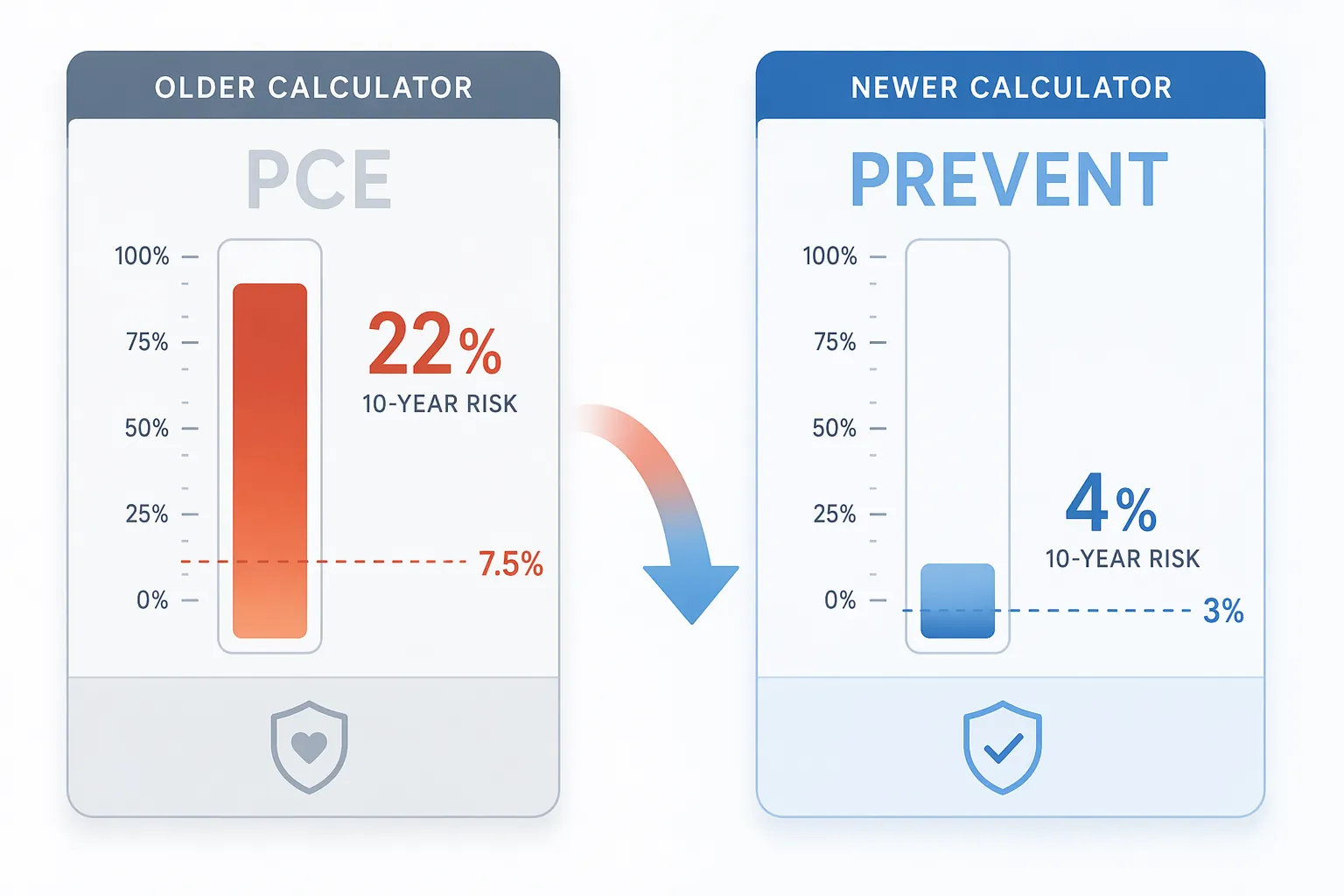
The threshold changed too. Under the older approach, a 10-year PCE risk of 7.5% was the familiar point where statin therapy entered the discussion. Under the 2026 guideline, a 10-year PREVENT risk of 3% is the treatment-consideration threshold.[1] Because the new calculator produces lower estimates, the lower threshold is not simply “more aggressive.” It is part of a new measuring system.
| Old framework | 2026 framework | What it means at the appointment |
|---|---|---|
| PCE risk calculator | PREVENT-ASCVD equations | Ask which calculator was used if a statin recommendation is based on estimated 10-year risk. |
| 7.5% 10-year risk threshold | 3% 10-year risk threshold | Do not compare the two percentages as if they came from the same tool. |
| Tended to rate many older adults as high risk | Produces 40% to 50% lower estimates for the same risk profile | Some older adults who looked eligible before may fall below the new treatment-consideration line. |
The most caregiver-relevant evidence comes from adults at the oldest ages. In a validation study using ASPREE data, PREVENT accurately predicted 10-year ASCVD risk in adults age 80 and older, with a C statistic of 0.854. The old PCE overpredicted events by nearly threefold in that age group.[2]
That finding matters because it gives shape to a suspicion many families have had after seeing a risk printout: maybe the calculator was not seeing Dad’s actual health as much as it was seeing his birthday. Still, the ASPREE validation has a boundary. The participants were healthier community-dwelling older adults; the study excluded people with dementia, disability, or life expectancy under five years.[2] That means PREVENT may be more useful than PCE for many older adults, but it is not a magic translation device for the frailest patients.
For adults over 75, “can be considered” is doing real work
For adults over 75 without ASCVD, the guideline language is cautious. Statins can be considered; they are not presented as a blanket “should” or “must.” In guideline terms, this is a class IIb recommendation, meaning treatment may be reasonable for selected patients rather than routinely indicated for everyone in the category.[1]
That one phrase changes the caregiver’s job. The task is not to talk a parent into or out of a pill before the doctor has finished the sentence. The task is to make sure the decision uses the right risk estimate and then brings in the parts no calculator can fully carry: function, frailty, other illnesses, current medication burden, likely time to benefit, and what the parent is trying to preserve.

A clean risk number can be reassuring when the rest of aging feels disorganized. But frailty and life expectancy are not messy exceptions to the guideline. They are part of the decision logic. A parent who is still gardening, driving, and managing a long medication list with no major symptoms is not in the same situation as a parent with repeated falls, weight loss, advanced dementia, or a care plan focused mainly on comfort.
The appointment frame that actually helps
The useful conversation is not “Are statins good or bad for older people?” It is more specific: “Given this parent’s PREVENT risk, health status, medication burden, and goals, is starting or continuing a statin likely to help within a meaningful time window?”
- Ask whether the recommendation is for primary prevention or because your parent already has ASCVD.
- Ask whether the 2026 PREVENT-ASCVD calculator was used, especially if the recommendation is based on estimated 10-year risk.
- Ask what the actual PREVENT risk estimate is and whether it is above or below the 3% treatment-consideration threshold.
- Ask how frailty, falls, cognition, kidney disease, diabetes, cancer history, or other major conditions affect the recommendation.
- Ask how many daily medications your parent already takes and whether a new pill is likely to improve outcomes they personally care about.
The question about time matters. The estimated time-to-benefit for primary-prevention statins in older adults is about 2.5 years.[3] That does not mean a person must have a precisely predicted life expectancy before a statin can be discussed. It does mean the expected benefit is not immediate. If the parent’s health situation makes a 2.5-year prevention window unlikely to matter, the argument for starting a preventive statin becomes weaker.
Where a CAC score can clarify uncertainty
When the risk estimate and the family conversation still leave everyone unsure, coronary artery calcium scoring may help. CAC is a CT-based measure of calcified plaque in the coronary arteries. It is not needed for every older adult, and it should not be ordered just to postpone a hard conversation. But in the right person, it can shift the decision from guessing to evidence about whether coronary plaque is actually present.
A CAC score of zero deserves special attention. The 2026 guideline and the NLA/AGS consensus both treat CAC of zero in an older adult as a strong negative predictor, suggesting that the potential benefits of lipid-lowering therapy are unlikely to outweigh potential risks and that deferring statin therapy can be reasonable.[1][3]
That is not the same as saying CAC of zero makes a person invincible. It is a deferral signal, not a guarantee. It can be especially useful when an older parent is being offered a statin mainly because their calculated risk crosses a line, but the family and clinician are uncertain whether treatment is worth adding.
The benefit evidence is real, but not perfectly settled
It is tempting to read the new guideline as a retreat from statins in older adults. That would be too simple. Older adults often have higher baseline cardiovascular risk, so when a statin helps, the absolute benefit can be meaningful. In the Cholesterol Treatment Trialists’ Collaboration meta-analysis, the number needed to treat to prevent one ASCVD event over five years for adults ages 80 to 100 was 42 for every 1 mmol/L LDL-C reduction, compared with 345 for adults ages 50 to 59.[4]
That comparison is a useful antidote to the casual line that prevention is pointless once someone is old. But it does not settle every primary-prevention decision after age 75. In the same meta-analysis, among people older than 75 without prior vascular disease, the primary-prevention trend was not statistically significant, with a relative risk of 0.92 and a 95% confidence interval from 0.73 to 1.16.[4]
Observational evidence also points toward possible benefit. In a study of 326,981 U.S. veterans age 75 and older, new statin use was associated with 25% lower all-cause mortality and 20% lower cardiovascular mortality.[5] That is encouraging, and it helps explain why clinicians do not simply abandon statins after a birthday. It is still observational evidence, not the same as a randomized trial proving that every similar older adult should start treatment.
The evidence gap is why the wording stays cautious. Large randomized trials focused on older adults, including PREVENTABLE and STAREE, are expected to add clarity, but the current decision still relies on a mix of extrapolation from broader statin trials, subgroup data, observational studies, and clinical judgment.[3]
When stopping a statin becomes a legitimate question
Starting is not the only decision families face. Sometimes the harder question is whether a statin that made sense years ago still makes sense now. That question often arrives after a hospitalization, a fall, a new diagnosis, or a medication list that no longer fits on one page.
There is randomized evidence supporting deprescribing in a narrow but important group. In patients with less than one year of life expectancy, stopping statins did not increase mortality and improved quality of life in a JAMA Internal Medicine trial.[6] That does not mean stopping is harmless for every older adult. It means that when a person’s prognosis is limited and goals are focused on comfort or function, deprescribing can be a medically legitimate conversation rather than a sign that the family is giving up.
Some observational studies have found higher cardiovascular event rates after statin discontinuation, but those findings are difficult to interpret because people who stop medications may be sicker at baseline. The safer way to use that information is not “never stop,” but “do not stop casually.” A statin that is causing no problems in a robust older adult with meaningful life expectancy is a different decision from a statin in a frail parent whose care has shifted toward minimizing pill burden.
What to bring to the next visit
The best preparation is not a stack of printouts about cholesterol. It is a short, accurate picture of your parent’s real situation. Bring the medication bottles or a current medication list, including supplements. Bring any history of heart attack, stroke, stents, bypass surgery, peripheral artery disease, diabetes, kidney disease, major bleeding, falls, memory changes, and recent hospitalizations. If your parent has had a CAC scan, bring the result.
- “Is this recommendation for primary prevention, or because my parent already has ASCVD?”
- “Did you calculate risk using PREVENT rather than the old PCE calculator?”
- “What is the PREVENT 10-year risk estimate, and is it above the 3% treatment-consideration threshold?”
- “If we are uncertain, would a CAC score help, and how would a CAC score of zero change your recommendation?”
- “Given my parent’s frailty, function, other illnesses, and medication burden, is the expected benefit likely to matter within about 2.5 years?”
- “What outcome are we mainly trying to prevent, and what side effects or daily-life tradeoffs should we watch for?”
It also helps to ask the parent before the visit what matters most. Some people will accept another daily pill to reduce the chance of a heart attack or stroke. Some are more worried about dizziness, weakness, drug interactions, or losing independence. Some simply want the doctor to explain why a medication that was “necessary” last year is now being reconsidered. Those preferences are not sentimental extras. In adults over 75 without ASCVD, they belong in the decision.
The 2026 AHA/ACC guideline does not say older parents should never take statins. It also does not say they should start automatically because a calculator crossed a line. It says the line has changed, the calculator is newer, and eligibility is more individualized. For the adult child sitting beside a parent in the exam room, the most useful role is to make sure the risk estimate meets the person in the chair.
References
- 2026 ACC/AHA/AACVPR/ABC/ACPM/ADA/AGS/APhA/ASPC/NLA/PCNA Guideline on the Management of Dyslipidemia, American Heart Association, 2026
- Performance of the AHA PREVENT Cardiovascular Risk Equations in Older Adults, Circulation: Cardiovascular Quality and Outcomes, 2025
- NLA/AGS 2024 Expert Clinical Consensus on Managing Hypercholesterolemia in Adults >75 Without ASCVD, Journal of Clinical Lipidology, 2025
- Efficacy and safety of statin therapy in older people: a meta-analysis of individual participant data from 28 randomised controlled trials, The Lancet, 2019
- Association of Statin Use With All-Cause and Cardiovascular Mortality in US Veterans 75 Years and Older, JAMA, 2020
- Safety and Benefit of Discontinuing Statin Therapy in the Setting of Advanced, Life-Limiting Illness, JAMA Internal Medicine, 2015
Questions to bring to a clinician or OT
This is not medical, legal, or a family's final decision — only a framework. Bring these questions to a clinician, occupational therapist, or your local Area Agency on Aging.
Find Local HelpRelated reading
Noticed something outdated or inaccurate on this page? Flag a correction. We review every report against CDC, NIA, and AARP HomeFit guidance before updating a page.