
Caregiver decision guide
Stage-by-stage ALS caregiving for elderly loved ones
This guide provides practical, stage-specific advice for caring for an elderly loved one with ALS at home, helping caregivers anticipate needs and adapt as the disease progresses.
Caregiving for an elderly loved one with ALS has to start with an uncomfortable timing problem: by the time a family notices that one task has become unsafe, the next task may already be starting to fail. A shirt button, a fork, a toilet transfer, a hallway turn, a cough after drinking water — each can look small until it becomes the thing that changes the whole day.
That is especially true for older adults. Target ALS reports that the mean age at ALS diagnosis is about 65, roughly 80% of cases occur between ages 50 and 79, and older adults tend to have a faster ALSFRS decline trajectory than younger patients. The same source gives a typical life expectancy of 2–3 years after diagnosis for elderly patients, compared with 3–5 years for younger patients.[1] Those numbers are not a calendar for any one person. They are a warning against waiting until the house, the equipment, and the caregiver are already behind.
ALS is a progressive, incurable disease that affects motor neurons, gradually interfering with movement, speech, swallowing, breathing, and daily function. Target ALS describes progression using measures such as the ALS Functional Rating Scale, which tracks functional abilities, and forced vital capacity, which reflects respiratory function.[2] At home, those clinical measures show up as ordinary losses: slower dressing, weaker grip, more stumbling, harder transfers, quieter speech, longer meals, and eventually breathing support decisions.
Use Stages as a Planning Tool, Not a Promise
Families often want to know which “stage” their loved one is in. That can help, but stage language can also pretend to be more exact than ALS usually allows. One person may lose hand strength before walking becomes difficult. Another may walk fairly well while speech and swallowing become the urgent problem. In an older adult, the distance between “we can manage” and “this is unsafe” can be short.
A better home-care question is: what can the person still do safely today, and what loss would make today’s setup fail? That question gives the family something practical to do before the next appointment.
| Home-care phase | What changes at home | Prepare before it becomes urgent |
|---|---|---|
| Early functional changes | Grip, buttons, fatigue, mild balance problems, slower meals, small speech changes | Adaptive utensils, dressing tools, fall review, baseline therapy referrals, bathroom planning |
| Increasing daily assistance | Help needed for bathing, dressing, toileting, walking, meal setup, stairs, longer outings | Mobility equipment, shower commode chair, doorway and ramp evaluation, caregiver training |
| Advanced dependence | Transfers, bed mobility, swallowing, communication, respiratory symptoms, full personal care | Hospital bed, lift options, communication supports, swallowing and respiratory planning, backup caregivers |
| Home care may no longer be sustainable | Unsafe transfers, caregiver injury risk, respiratory-stage care beyond family capacity, exhausting 24-hour needs | Hospice discussion, facility-based support, paid care, emergency plan, realistic family limits |
Early Changes: Protect Independence While It Still Exists
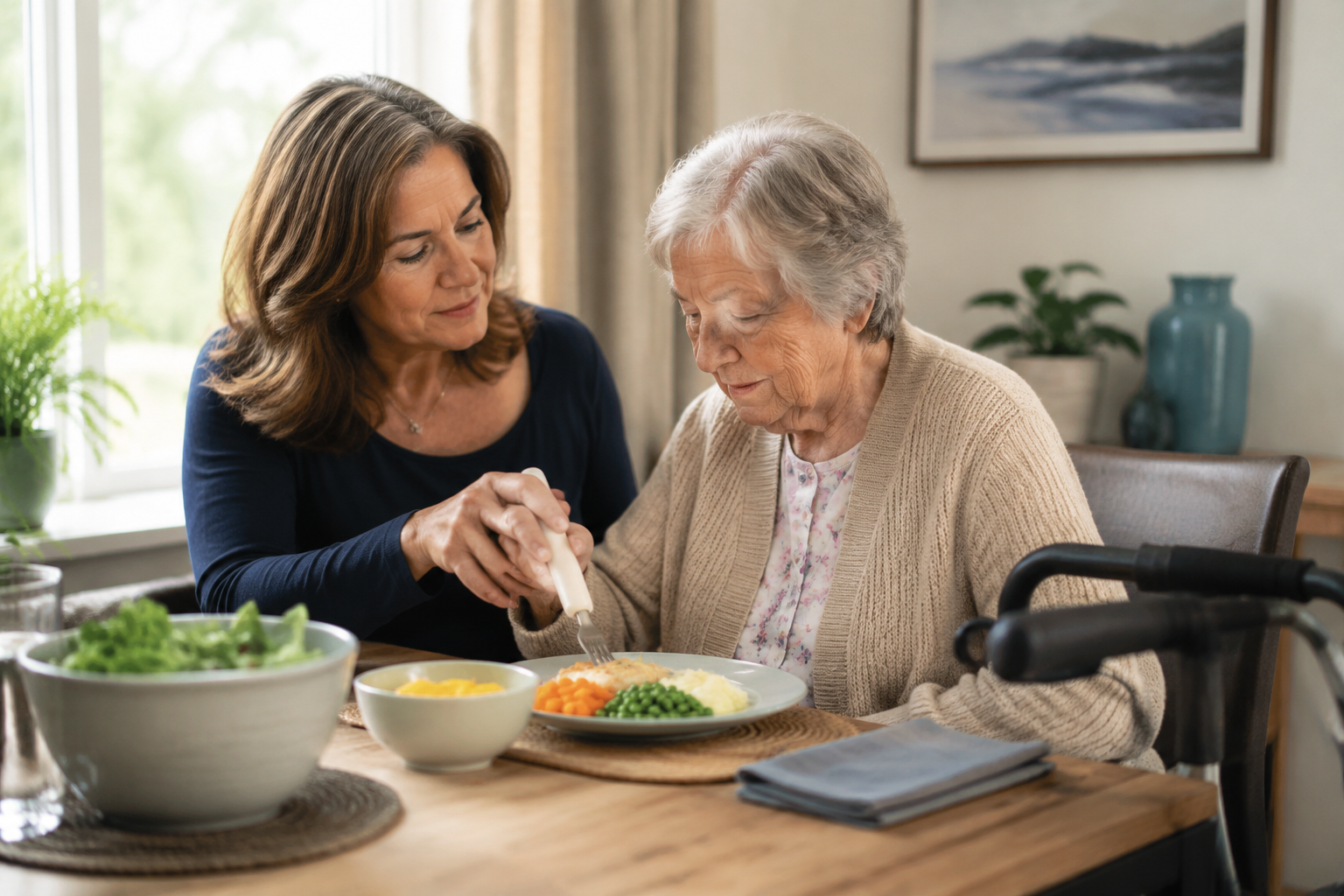
Early ALS caregiving at home is not just watching for decline. It is buying time for dignity. If a parent can still feed themselves with the right handle, pull on clothing with the right tool, or get through the bathroom routine with less risk, that is not a minor convenience. It is one less intimate task handed over before it has to be.
This is the stage for occupational and physical therapy input, even if the family still feels they are “not there yet.” Les Turner ALS Foundation’s Activities of Daily Living Guide lists practical supports such as built-up utensil handles, universal cuffs, dressing sticks, shower commode chairs, hospital beds, and ceiling lifts, organized around the type of assistance a person needs.[3] The early items matter because they reduce the number of tasks that require hands-on help.

For hand weakness, ask about built-up handles, universal cuffs, lightweight cups, plate guards, button hooks, zipper pulls, elastic shoelaces, and dressing sticks. For fatigue, look at where the person stands longer than they should: bathroom sink, kitchen counter, closet, shower, front step. For mild balance changes, remove loose rugs, tighten railings, improve lighting, and stop pretending that “just one step” is harmless.
- Ask for an occupational therapy assessment before dressing, bathing, and eating become daily battles.
- Start a home access list: entry steps, bathroom layout, bedroom location, hallway turns, doorway widths, and flooring.
- Move frequently used clothing, toiletries, medications, and dishes to easy-reach locations.
- Treat near-falls, dropped utensils, missed buttons, and new exhaustion after basic tasks as early planning signals, not quirks.
Rochelle Walwer, LCSW, quoted by AARP, emphasizes that ALS caregiving becomes more difficult as the disease progresses and that caregivers need practical support, not just encouragement.[5] That point lands hardest in the early phase because this is when families can still make changes without doing everything under crisis pressure.
When Daily Tasks Need Hands-On Help
The next phase usually announces itself through activities of daily living: bathing takes too long, dressing requires another person, the toilet feels too low, meals require setup, walking is more deliberate, and stairs become a negotiation. The caregiver may still say, “I only help a little.” The body of the person with ALS may say something different.
At this point, the family should stop solving each task separately. A grab bar here and a taller chair there may help, but ALS will keep changing the transfer, reach, grip, balance, and endurance requirements. The home needs a mobility plan, a bathroom plan, and a backup caregiver plan.
Bathroom changes should move up the list
Bathrooms become dangerous because they combine wet surfaces, narrow clearances, low fixtures, privacy habits, and caregiver awkwardness. Les Turner’s Home Modifications Guide recommends planning for wheelchair access with doorways at least 32 inches wide, ramp design using a 12:1 ratio, and tub-to-shower conversion when appropriate.[4] Those details are not remodeling trivia. They decide whether a person can enter the room, turn safely, and bathe without a spouse trying to improvise a lift on tile.
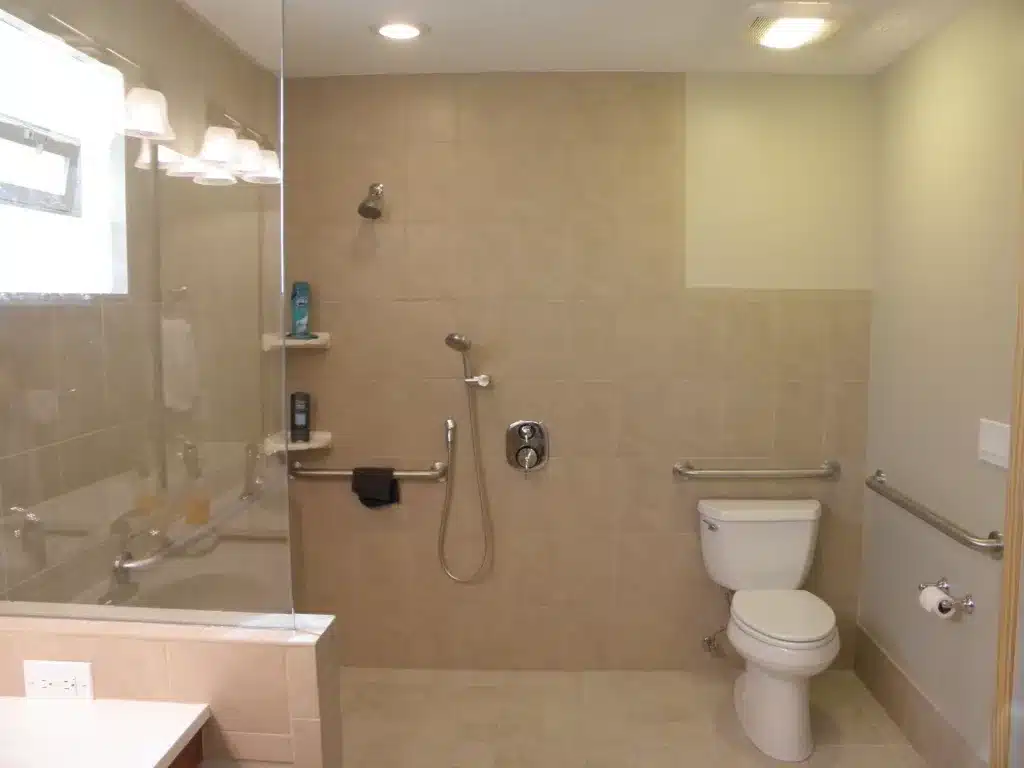
If there is a tub-shower combination, ask early whether a tub-to-shower conversion or roll-in shower is realistic. If the toilet is low, ask about raised toilet seats, toilet safety frames, or a shower commode chair. If the bathroom doorway is narrow, measure it before a wheelchair arrives. A family can tolerate a bad layout for a while; the person with ALS has to live inside it every morning.
Transfers are a caregiver safety issue, not just a patient issue
A spouse in their seventies may be able to steady someone at the sink. That does not mean they can safely lift them from the toilet at midnight. As weakness increases, transfers from bed, toilet, recliner, wheelchair, car, and shower chair become the pressure points of home care.
Ask a physical therapist to watch real transfers in the real home if possible. The question is not only what equipment exists, but who will use it, at what hour, and with how much strength. Depending on the person’s function and the home layout, equipment may include a gait belt, transfer board, lift recliner, wheelchair, hospital bed, portable lift, or ceiling lift. Les Turner includes hospital beds and ceiling lifts among ADL-related supports for people with ALS.[3]
- Prepare next if one caregiver cannot complete a transfer without pulling, twisting, or bracing the person’s weight.
- Prepare next if the person avoids drinking, toileting, bathing, or leaving the bedroom because transfers feel too hard.
- Prepare next if a wheelchair can enter the house but cannot reach the bathroom, bedroom, or main sitting area.
- Prepare next if the family’s plan depends on one spouse being physically available every hour.
Advanced ALS at Home: Swallowing, Speech, Breathing, and Full Dependence
Advanced home care is where vague encouragement becomes thin. The person may need help with nearly every activity of daily living. They may not be able to reposition in bed, get to the toilet, bathe, dress, or eat without assistance. Speech may be difficult to understand. Swallowing may become slower or less safe. Breathing concerns may move from the clinic into the bedroom.
Target ALS notes that progression can be tracked through functional decline and respiratory measures such as forced vital capacity.[2] At home, families should watch for the practical signs that need professional review: coughing or choking with meals, unexplained weight loss, meals that take much longer, a weaker cough, morning headaches, new shortness of breath, trouble lying flat, increased sleep disruption, or speech that no longer carries across a room. These signs do not diagnose the next stage by themselves, but they should not wait for the next routine appointment.
This phase needs a coordinated care team: neurology, primary care, occupational therapy, physical therapy, speech-language pathology, respiratory therapy, nutrition support, social work, and home health when available. The caregiver’s job is not to become all of those specialists. The caregiver’s job is to notice what changed, report it clearly, and push for the equipment or service before the home routine breaks.
Eating and swallowing require earlier conversations than families want
Food is emotional. So is being fed by another person. That is exactly why swallowing changes should be addressed early, while the person with ALS can still say what tradeoffs they will accept. Ask the clinician when a speech-language pathologist should evaluate swallowing, what texture changes are appropriate, how to handle pills, and which signs should trigger urgent contact.
Do not turn every meal into a test of will. If adaptive utensils preserve self-feeding, use them. If fatigue makes dinner harder than breakfast, adjust timing and portions. If choking, coughing, or weight loss appears, bring that information to the care team. The goal is not to keep meals looking normal for the family; it is to keep eating as safe and dignified as possible for the person doing the swallowing.
Communication support should not wait until speech is gone
When speech weakens, families often compensate by guessing. Guessing works for small preferences until it does not. Pain, fear, toileting needs, breathing discomfort, medication questions, and end-of-life choices need clearer channels.
Start with low-tech supports if they help: alphabet boards, yes/no cards, printed common requests, a bell or call button, and agreed signals. Ask about speech-generating or eye-gaze options before fatigue and hand weakness make setup harder. The important part is not the sophistication of the device. It is whether the person can still direct their own care.
Respiratory-stage care changes the home-care calculation
Breathing changes are frightening because they expose the limit of ordinary caregiving. A family can learn positioning, equipment routines, and symptom monitoring, but respiratory-stage care may require rapid professional input and clear decisions about what the person wants.
Ask the ALS clinic or respiratory team what to watch for, whom to call after hours, what equipment is expected, and how changes in forced vital capacity affect planning. Also ask what would make home care unsafe. That question can feel harsh. It is kinder than discovering the answer during a nighttime crisis.
Home Modifications: Make the House Fit the Next Month, Not Last Month
ALS home modification is difficult because families are usually modifying for a moving target. A cane may be followed by a walker, then a wheelchair, then a power wheelchair, then transfers that require more room and equipment. If an elderly loved one is declining faster than expected, the house can become obsolete almost as soon as the family adapts it.
Les Turner’s Home Modifications Guide gives concrete access specifications, including a 32-inch minimum doorway clearance for wheelchair access and a 12:1 ramp ratio.[4] Those measurements should be checked early because they decide what options remain possible. A beautiful bedroom on the second floor is not a plan if stairs are about to disappear from the person’s safe world.
- Entry: evaluate steps, threshold height, ramp feasibility, railings, lighting, and weather exposure.
- Bathroom: measure doorway clearance, turning space, toilet access, shower entry, grab bar placement, and whether a shower commode chair can be used.
- Bedroom: consider first-floor relocation, hospital bed access, caregiver space on both sides, lift clearance, and a path to the bathroom.
- Hallways and common rooms: remove tight furniture turns, loose rugs, low tables, cords, and anything that makes a wheelchair route dependent on precision.
- Communication and safety: place phones, call buttons, lights, medication lists, and emergency contacts where the person and caregiver can actually reach them.
If money, rental restrictions, or construction time limit what can be changed, prioritize the bottlenecks that would trap the person: entry, bathroom, bedroom, and safe transfer space. Cosmetic upgrades can wait. Doorways and toilets will not become more negotiable in a crisis.
Caregiver Capacity Is Part of the Care Plan
It is easy to write a care plan as if “the caregiver” is a stable resource. In real homes, the caregiver has arthritis, a bad back, a job, a spouse, a mortgage, poor sleep, or their own medical appointments. AARP’s caregiver accounts describe the intensity of ALS caregiving and the way practical demands expand as function declines.[5] That is not a side issue. It determines whether home care remains safe.
The family should name the tasks that cannot depend on one person indefinitely: transfers, toileting, bathing, overnight repositioning, respiratory equipment routines, medication management, transportation, and emergency decisions. Then assign backup coverage before the first caregiver is injured or exhausted.
- Ask which tasks require two people now or may require two people soon.
- Ask which tasks a spouse should not perform because of size, strength, balance, or injury risk.
- Ask what home health, respite, paid caregiving, or hospice services may be available and what triggers eligibility.
- Ask who can arrive within an hour if a transfer fails, equipment breaks, or the primary caregiver becomes sick.
This is also where adult children and spouses may disagree. One person sees planning as abandonment. Another sees delay as danger. Both may be grieving. The practical compromise is to separate acceptance from preparation: ordering a shower chair does not mean giving up; measuring a doorway does not make ALS progress faster.
A Brief Note for Veteran Families
If the person with ALS is a veteran, contact the VA early. The VA Caregiver Support Program notes that veterans are at 1.5–2 times higher risk of developing ALS than people who did not serve in the military, and its ALS caregiver page points families toward diagnosis-specific caregiving support.[6] Benefits, equipment, home-based services, and caregiver support can take time to understand, so do not leave this for later paperwork.
When Home Care Is No Longer Safe
Some elderly people with ALS decline faster than their families expect. A setup that was workable in spring may be unsafe by summer. The responsible endpoint of planning is not always “keep them home no matter what.” Sometimes the responsible endpoint is hospice, facility-based care, more paid support, or a different living arrangement because the current home cannot safely meet the person’s needs.
The clearest warning signs are practical: transfers cannot be done safely, the primary caregiver is getting hurt, the person is falling or nearly falling, toileting and bathing are being skipped because they are too hard, swallowing or breathing symptoms are escalating, equipment needs exceed the space, or care is required around the clock without reliable backup.
Hospice should not be introduced as a whispered last resort. It is a support model for serious decline, comfort-focused care, symptom management, equipment coordination, and caregiver guidance when cure is not available. Facility-based care is not a moral failure when a spouse cannot lift safely or when respiratory-stage care has outgrown what the house and family can provide.
Good ALS caregiving for an elderly loved one means treating each current ability as temporary without treating the person as already gone. Preserve independence while it is still possible. Change the bathroom before the fall. Ask about the lift before the back injury. Plan communication before guessing takes over. Bring hospice or facility support into the conversation before crisis makes the decision for everyone.
References
- ALS in the Elderly: Recognizing ALS in Seniors, Target ALS
- What to Expect After an ALS Diagnosis, Target ALS
- ALS Activities of Daily Living Guide, Les Turner ALS Foundation
- ALS Home Modifications Guide, Les Turner ALS Foundation
- ALS Caregiving, AARP
- Amyotrophic Lateral Sclerosis (ALS), VA Caregiver Support Program
Questions to bring to a clinician or OT
This is not medical, legal, or a family's final decision — only a framework. Bring these questions to a clinician, occupational therapist, or your local Area Agency on Aging.
Find Local HelpRelated reading
Noticed something outdated or inaccurate on this page? Flag a correction. We review every report against CDC, NIA, and AARP HomeFit guidance before updating a page.