
Caregiver decision guide
How to Check Air Quality for an Elderly Loved One
This guide explains how to check both outdoor and indoor air quality for an elderly loved one, using the EPA AirNow system for outdoor AQI and consumer-grade monitors for indoor air, with specific thresholds and action steps for seniors.
Checking air quality for an elderly loved one starts with a small but important split: outdoor air and indoor air are different problems. The outdoor number is easiest to find, and the best first stop is AirNow.gov or the AirNow app. But that number does not tell you what is happening in the bedroom, recliner corner, kitchen, basement, or hallway where an older adult may spend most of the day.
For seniors, this split matters because AirNow identifies adults with heart or lung disease, children, older adults, and people active outdoors as groups that may be affected earlier by particle pollution and ozone. On the AQI scale, that concern becomes practical at Code Orange — AQI 101 to 150 — when the air is “Unhealthy for Sensitive Groups.” Older adults are part of that sensitive group, so a reading that may look merely cautionary for a healthy younger adult can already change the day’s plan for a 79-year-old with coughing, COPD, asthma, heart disease, or frailty.[1]
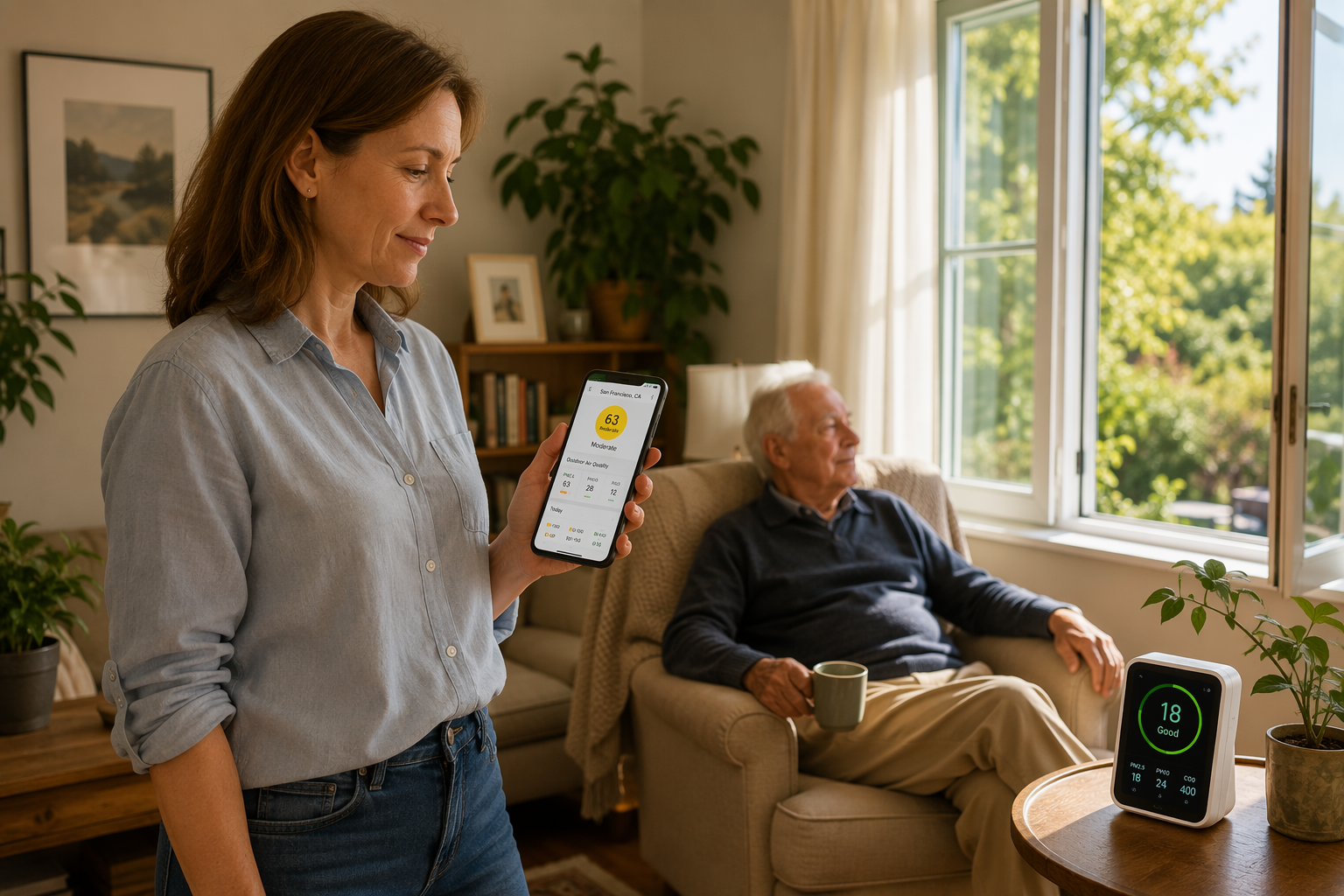
The uncomfortable part is that a correct outdoor AQI check can still be incomplete. EPA researchers have reported that, among older adults, a 10 microgram per cubic meter rise in annual PM2.5 exposure was associated with a 13.6% increase in mortality, and the study focused on risks even at low levels of air pollution.[2] Indoor air also deserves its own check because indoor pollutant levels can be two to five times higher than outdoor levels, according to the American Lung Association.[3]
So the useful caregiver question is not simply, “Is the air bad today?” It is: “Which number am I checking, where does it come from, and what action does it trigger?”
Start With Outdoor AQI: AirNow Is the Main Track
For outdoor air, use AirNow.gov or the AirNow app before walks, errands, medical appointments, yard work, or opening windows for “fresh air.” AirNow is run by U.S. government agencies and reports the Air Quality Index, or AQI, using color-coded bands that turn pollution data into public health guidance.[1]
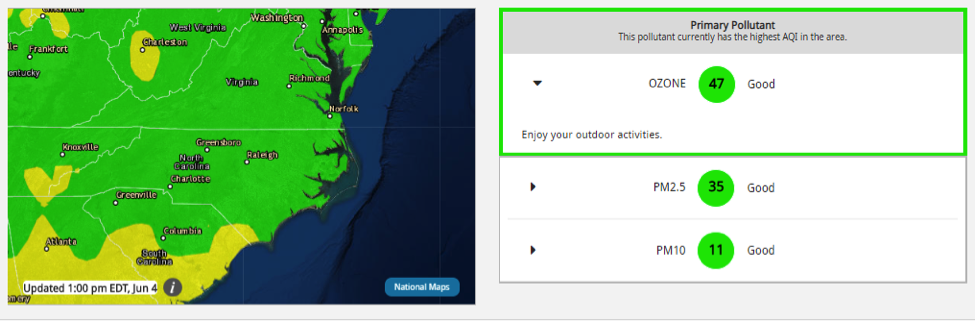
The first caregiver habit is simple: search the older adult’s ZIP code, not just your own. If you live across town, across the state, or in another region, your phone’s weather widget may be telling you about the wrong air. For appointments or family events, also check the destination. A senior may leave a Green neighborhood and spend the afternoon in an Orange one.
| AQI band | Range | What it means for an older adult |
|---|---|---|
| Green — Good | 0–50 | Outdoor activity is generally fine unless the person has unusual symptoms or a clinician has given stricter instructions. |
| Yellow — Moderate | 51–100 | Most people can continue normal activity, but unusually sensitive people may need to reduce prolonged or heavy exertion. |
| Orange — Unhealthy for Sensitive Groups | 101–150 | This is the first major action point for older adults. Reduce prolonged or heavy outdoor exertion; move walks or chores indoors when possible. |
| Red — Unhealthy | 151–200 | Older adults and people with heart or lung disease should avoid prolonged or heavy outdoor exertion; others should reduce it. |
| Purple — Very Unhealthy | 201–300 | Treat outdoor activity as a health risk. Keep activity indoors and limit time outside. |
| Maroon — Hazardous | 301 and higher | Follow emergency-style air quality guidance. Stay indoors with cleaner air as much as possible. |
Code Orange is the band caregivers tend to underestimate. The color does not look alarming, and the word “sensitive” can sound vague. But for a person over 65, it is already the point where the plan should change. That may mean shortening a walk, choosing an indoor hallway instead of an outdoor loop, rescheduling yard work, keeping windows closed during peak pollution hours, or moving a non-urgent errand to another day.
The American Lung Association’s AQI guidance is especially useful because it ties the color bands to behavior rather than leaving the caregiver with a number and no next step. For particle pollution and ozone, older adults and people with heart or lung disease are among the groups that should take earlier precautions as AQI rises.[4]
What to Do Before the Day Starts
A practical morning check takes less than a minute, but it works best if the action is decided before anyone is standing by the door with shoes on.
- Check AirNow for the older adult’s ZIP code before outdoor exercise, appointments, errands, and open-window days.
- At Green or Yellow, continue normal plans unless the person is unusually sensitive, symptomatic, or under stricter medical advice.
- At Orange, treat the older adult as part of the sensitive group: shorten outdoor time, avoid heavy exertion, and move activity indoors when possible.
- At Red or worse, avoid outdoor exertion and use delivery, rescheduling, telehealth, or a family errand run when available.
- If coughing, chest tightness, wheezing, unusual fatigue, confusion, or shortness of breath appears, follow the clinician’s care plan rather than trying to solve the problem with AQI interpretation alone.
This is also where independence needs a little protection. “The AQI is Orange, so you can’t go outside” is different from “Let’s move the walk to the mall this morning and check again after lunch.” The number should narrow the risk, not automatically shrink the person’s life.
Then Check the Air Indoors Where the Person Actually Breathes
Indoor air checking is messier than outdoor AQI because there is no single public dashboard for a living room. A home can have good outdoor AQI and still have indoor problems from cooking smoke, dust, combustion appliances, dampness, cleaning products, attached garages, poor filtration, or a closed-up room that has not had enough air exchange.
The American Lung Association puts source control first: identify and reduce the sources of indoor pollution rather than relying only on ventilation or filtration after pollutants are already present.[5] That is the right order for a caregiver, too. A monitor can tell you something changed. It cannot always tell you why.
Use a Monitor for Patterns, Not Medical Precision
Consumer-grade indoor air quality monitors can be useful, especially when they sit in the rooms where the older adult spends the most time. Consumer Reports describes indoor air quality monitors by the pollutants and conditions they track, such as particulate matter, carbon dioxide, volatile organic compounds, temperature, and humidity, and notes that features and prices vary by model.[6]
That last point matters. A home monitor is not the same as a laboratory instrument, and it should not be treated like a diagnosis machine. Its best use is pattern recognition: Does PM2.5 jump when someone fries food? Does the bedroom get stuffy overnight? Does humidity stay high in the basement? Does a reading improve after changing a filter, running a portable purifier, or closing windows during a smoke event?
| Indoor signal | What it can suggest | Caregiver action |
|---|---|---|
| PM2.5 or particle reading rises | Smoke, cooking particles, dust, outdoor pollution entering the home, or combustion-related particles may be present. | Look for the source first: cooking, fireplace, candles, nearby wildfire smoke, open windows, dusty HVAC return, or recent cleaning. |
| Carbon dioxide runs high | The room may be poorly ventilated, especially when several people are present or the door stays closed. | Improve safe air exchange when outdoor AQI allows; avoid opening windows on bad outdoor-air days. |
| VOC reading rises | Cleaning products, paints, solvents, air fresheners, new furnishings, or stored chemicals may be contributing. | Remove or reduce the product source before adding more equipment. |
| Humidity stays high | Dampness can support mold and dust mite problems. | Check bathrooms, basements, window condensation, leaks, and whether exhaust fans are actually being used. |
| Temperature is too hot or cold | Heat and cold can strain older adults, especially those with chronic illness. | Treat comfort as a safety condition, not just a preference. |
Place the monitor where the result will change a decision: the bedroom, favorite chair, kitchen-adjacent sitting area, or room used during smoke days. Avoid judging the whole home from a device tucked near an open window, beside a purifier outlet, directly over a stove, or in a hallway no one uses for long.
Walk the Home Before Buying Another Device
The room check does not need to be dramatic. It needs to be repeatable. Start with the places where the older adult sleeps, sits, cooks, and recovers after exertion. The American Lung Association recommends practical indoor air improvements such as controlling pollution sources, improving ventilation when appropriate, maintaining heating and cooling systems, using exhaust fans, and addressing moisture.[3]
- Kitchen: Does cooking smoke linger? Is the range hood vented and used? Does the monitor spike during frying, broiling, or gas burner use?
- Bedroom: Does the door stay closed all night? Is the HVAC supply or return blocked? Is there dust around vents, carpet edges, or bedding?
- Living room: Are candles, incense, fireplaces, wood stoves, air fresheners, or hobby materials adding particles or gases?
- Bathroom and basement: Is there persistent dampness, visible mold, musty odor, condensation, or a fan that no one turns on?
- Garage and storage areas: Are paints, solvents, fuel, pesticides, or car exhaust connected to indoor spaces?
- HVAC system: Is the filter changed on schedule, installed in the right direction, and compatible with the system?
The point of the walkthrough is not to blame anyone for how they keep house. It is to find the source that makes the same room feel stale, smoky, damp, dusty, or irritating again and again. If the answer is obvious — a filter overdue for replacement, a bathroom fan no one uses, a candle habit that matches particle spikes — fix that before turning the home into a gadget shelf.
Know When a DIY Test Kit Is the Better Tool
Some indoor hazards are not well handled by a general air quality monitor. Radon is the clearest example: the American Lung Association identifies radon as a naturally occurring radioactive gas and recommends testing homes for it.[5] A radon test kit, not a general PM2.5 or VOC monitor, is the appropriate starting point.
Carbon monoxide also deserves separate treatment. Use working carbon monoxide alarms near sleeping areas and on each level as required by local rules and manufacturer instructions; do not rely on a general air quality display to protect someone from CO exposure. If an alarm sounds or symptoms suggest possible carbon monoxide poisoning, leave the home and call emergency services.
Mold is another case where a number may not be the first useful answer. If there is visible mold, repeated dampness, water damage, or a persistent musty smell, the practical first step is to fix the moisture source and clean or remediate appropriately. A test that confirms what the nose and wall already show can delay the repair that actually changes the air.
Why Seniors Need an Earlier Trigger Point
The reason for all this extra caution is not that every older adult is fragile in the same way. It is that aging leaves less margin when pollution irritates the lungs, strains the heart, worsens inflammation, or adds stress to a body already managing chronic disease. The National Council on Aging notes that poor air quality can be especially risky for older adults and people with chronic conditions such as heart disease, asthma, and COPD.[7]
In practical terms, bad air can turn a normal errand into a coughing spell, a short walk into unusual fatigue, or a borderline breathing day into a call to the clinician. GoHealth’s older-adult guidance also connects air pollution concerns with conditions including COPD, asthma, heart disease, and cognitive decline, using the kind of health language families often hear in clinic rooms rather than environmental reports.[8]
That does not mean every Orange day requires panic. It means the threshold for changing the plan is lower. A younger person may decide to push through. For an older adult, especially one who has already had symptoms during smoke, heat, ozone, or high-particle days, the safer habit is to reduce exposure before symptoms force the decision.
A Two-Track Routine Caregivers Can Actually Repeat
The routine below is meant for ordinary days and bad-air days. It is not a substitute for a clinician’s instructions for asthma, COPD, heart failure, oxygen use, or emergency symptoms. It is a way to stop rebuilding the decision from scratch every time an app sends an alert.
| When | Outdoor track | Indoor track | Decision |
|---|---|---|---|
| Morning | Check AirNow for the senior’s ZIP code and destination. | Glance at the monitor in the main room or bedroom if one is used. | Set the day’s outdoor plan before the person is ready to leave. |
| Before a walk or errand | Recheck AQI if conditions are changing, especially during smoke, heat, ozone, or wildfire periods. | If staying in, check whether the indoor room is actually comfortable and stable. | Move, shorten, reschedule, or continue the activity. |
| When AQI is Orange or worse | Treat the older adult as a sensitive-group member and reduce outdoor exertion. | Close windows if outdoor air is the likely source; run appropriate filtration if available. | Create a cleaner indoor place to spend the highest-exposure hours. |
| When symptoms appear | Do not argue with the AQI color if the person feels worse. | Check for indoor triggers: cooking smoke, odors, dampness, heat, dust, or combustion sources. | Follow the care plan; call the clinician or emergency services when symptoms warrant. |
| After repeated problems | Look for patterns by date, AQI, weather, and activity. | Look for room-specific sources or HVAC issues. | Plan durable fixes rather than one-off reactions. |
A written note helps more than most families expect. Record the date, outdoor AQI, main indoor reading if available, what was happening in the home, symptoms, and what changed after closing windows, running filtration, using an exhaust fan, skipping a walk, or changing rooms. A pattern over several weeks is more useful than one alarming screenshot.
If the pattern points to a persistent room or system problem, connect air quality to the broader aging-in-place plan. A bedroom that stays stuffy, a bathroom that stays damp, or an HVAC system that cannot handle better filtration may belong in the same conversation as fall prevention, heat safety, and room-by-room home updates. For budgeting context, see Carewise Guide’s home modification cost guide and its guide to prioritizing aging-in-place modifications.
What Not to Overread
There are a few traps that make air quality harder than it needs to be.
- Do not use outdoor AQI as proof that the indoor air is fine. Cooking, dampness, dust, combustion, and product fumes can create a separate indoor problem.
- Do not use one indoor monitor reading as a medical conclusion. Use it to find patterns, triggers, and changes after an intervention.
- Do not wait for Red AQI before changing plans for an older adult. Code Orange already matters for sensitive groups.
- Do not buy ventilation or purification equipment before checking sources that can be removed, reduced, repaired, or used differently.
- Do not turn air quality into constant surveillance. The goal is a safer routine that still lets the older adult make choices.
The most dependable protocol is modest: check AirNow before outdoor exposure, treat AQI 101 and higher as meaningful for seniors, watch indoor rooms where the person actually spends time, investigate sources before shopping, document repeated symptoms or spikes, and bring persistent patterns into medical or home-modification decisions.
References
- Older Adults and Air Quality. AirNow.
- Study Shows Low Levels of Air Pollution Pose Risk for Older Adults. EPA Science Matters.
- Indoor Air Quality Improvements. American Lung Association.
- Air Quality Index. American Lung Association.
- Source Control. American Lung Association.
- Indoor Air Quality Monitor Buying Guide. Consumer Reports.
- Protecting Yourself from Poor Air Quality. National Council on Aging.
- How Air Quality Affects Health in Older Adults. GoHealth.
Questions to bring to a clinician or OT
This is not medical, legal, or a family's final decision — only a framework. Bring these questions to a clinician, occupational therapist, or your local Area Agency on Aging.
Find Local HelpRelated reading
Noticed something outdated or inaccurate on this page? Flag a correction. We review every report against CDC, NIA, and AARP HomeFit guidance before updating a page.