
Caregiver decision guide
How Artificial Sweeteners Affect Gut Health in Seniors
Emerging research suggests artificial sweeteners are not inert—they can alter the gut microbiome and raise blood sugar and insulin levels. This article explains what the latest studies reveal about the potential effects on older adults, whose gut health already faces age-related changes.
If your parent uses artificial sweeteners for diabetes, weight control, or simply because sweet drinks make hydration easier, the practical answer is not “panic” and not “ignore it.” The better answer is: artificial sweeteners are not inert, the strongest current evidence points to effects on insulin, HbA1c, and gut microbes, but the senior-specific evidence is still inferred rather than directly proven.
That distinction matters in a real kitchen. A “sugar-free” yogurt, a diet soda, a powdered drink mix, and a diabetic dessert can all look like responsible choices. For an older adult with diabetes, constipation, diarrhea, low appetite, reflux, or a long list of medications, the question is not whether sweeteners are morally good or bad. It is whether daily exposure is quietly adding another variable to a body that already has very little room for surprises.
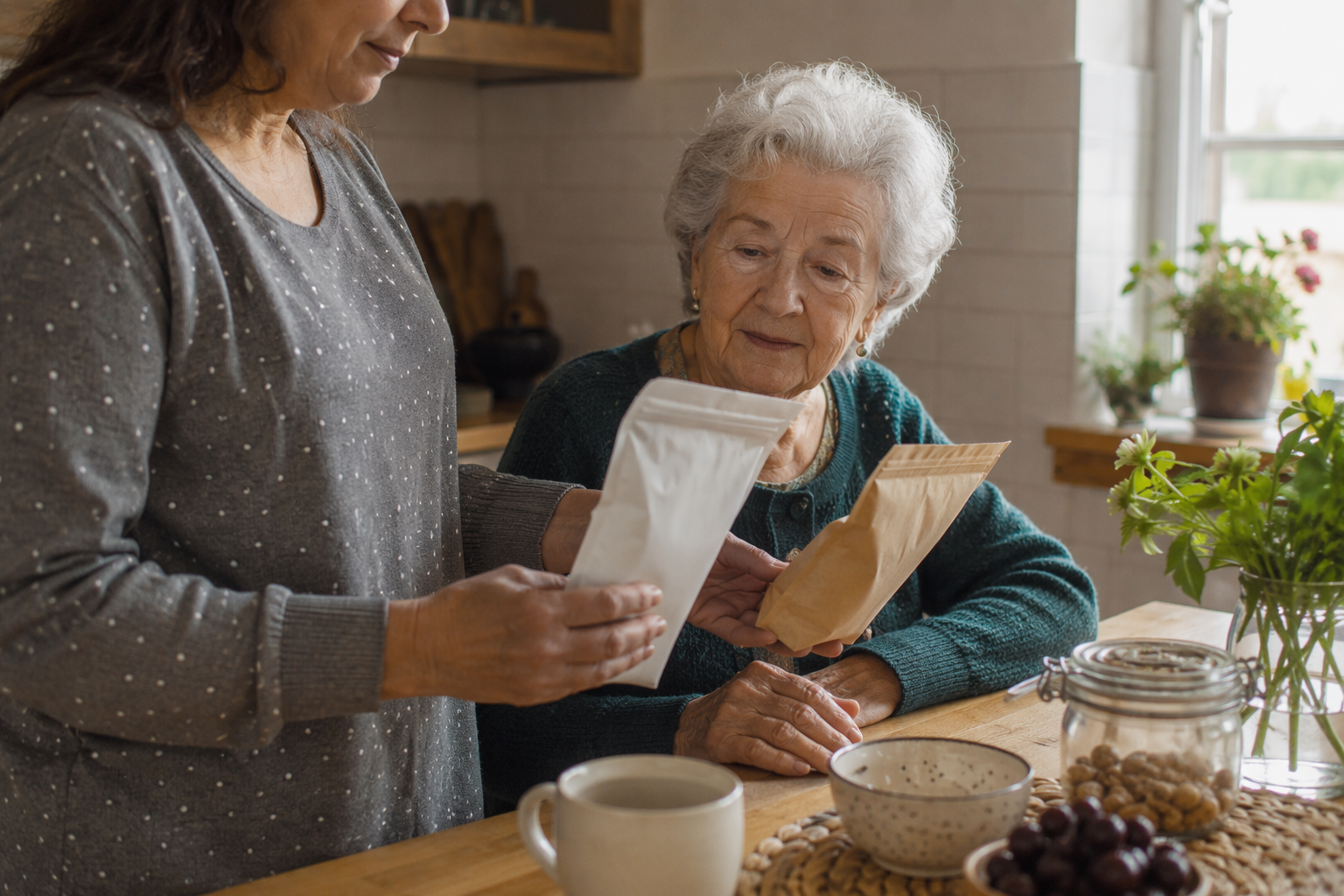
The Newer Evidence Is Mostly Metabolic, Not Just Digestive
The most important recent finding for caregivers is not a vague claim about “gut health.” It is a June 2026 Tufts meta-analysis of 21 randomized controlled trials finding that non-nutritive sweeteners raised fasting insulin and HbA1c compared with non-caloric controls.[1]
Those are not obscure research endpoints. Fasting insulin is part of the body’s response to glucose regulation. HbA1c is the longer-term blood sugar marker many families already hear about at diabetes visits. If a sweetener is being used mainly to make glucose control easier, evidence that it may worsen insulin or HbA1c deserves attention.
The same Tufts report also cautions that different sweeteners may have different effects, and that observational studies can be hard to interpret because people may switch to sweeteners after weight gain, diabetes, or other health concerns have already appeared.[1] That does not erase the randomized trial signal. It does mean the evidence is better used for careful review than for sweeping household bans.
What Gut Studies Suggest
The effect of artificial sweeteners on gut health in seniors is best understood as a plausible concern built from several lines of evidence, not as a settled senior-specific diagnosis. The gut microbiome is not a decorative wellness term here; it is one possible route by which a sweetener could affect glucose handling, inflammation, bowel symptoms, or tolerance of a diet.
A 2025 Frontiers in Microbiology minibioreactor study made that route more concrete. In a simulated gut system, sucralose and saccharin significantly reduced microbial diversity and enriched Enterobacteriaceae, including E. coli and Citrobacter. In the same study, rebaudioside A promoted beneficial butyrate-producing Lachnospiraceae.[2]

This does not mean a serving of diet pudding automatically causes a gut problem. A minibioreactor is not an older adult living with medications, meals, illness, and habits. But the finding is useful because it moves the concern away from “chemicals sound scary” and toward a more specific possibility: some sweeteners may shift microbial communities in ways that matter.
Human evidence also suggests that location in the gut matters. A Cedars-Sinai small-bowel study reported that non-nutritive sweeteners, except aspartame, reduced microbial richness in the duodenum and altered inflammatory markers.[3] That is notable because much public discussion of the microbiome focuses on stool samples and the colon, while digestion and absorption begin earlier.
Why One Person Reacts and Another Does Not
One of the most caregiver-relevant studies is not the largest one. In a 2022 Cell trial, Suez and colleagues found that saccharin induced glucose intolerance in only 4 of 7 healthy volunteers, and the response was mediated by differences in baseline microbiota.[4]
That small result is easy to overuse, but it explains a familiar household problem. One older adult may drink diet soda every day and have stable glucose readings. Another may add sugar-free drinks and start showing higher fasting numbers, bloating, loose stools, or appetite changes. The available evidence does not support assuming everyone will respond the same way.
It also cuts against a simplistic “this sweetener is always safe” or “that sweetener is always harmful” approach. Baseline microbiota, existing metabolic health, bowel disease, diet quality, medications, and dose may all affect the response. For seniors, that is exactly why monitoring the person in front of you matters more than winning an argument about a label.
The Senior-Specific Gap
There is an important limitation: no published study has directly tested artificial sweetener effects on gut microbiome health in adults over 65 as a distinct population. So the senior concern is not based on proof that older adults are uniquely harmed. It is based on combining sweetener research with what is already known about aging and the microbiome.
Older adults tend to show reduced microbial diversity and altered Firmicutes/Bacteroidetes patterns compared with younger adults.[5] Diversity is not automatically “good” in every context, and a single ratio should not be treated like a lab value. Still, reduced diversity can be a sign of a less resilient microbial ecosystem, especially when an older person has limited diet variety, frailty, repeated antibiotics, chronic illness, or institutional living.
That is where the concern becomes practical. If a younger adult’s microbiome is disturbed, it may have more reserve to recover. If an older adult already has lower diversity, a narrower diet, and more medication pressure, the same disruption could be harder to absorb. The evidence does not prove that sequence, but it makes the question worth asking before artificial sweeteners become an automatic daily default.
| What the evidence shows | What it does not show |
|---|---|
| Non-nutritive sweeteners raised fasting insulin and HbA1c versus non-caloric controls in a meta-analysis of 21 RCTs.[1] | That every older adult using sweeteners will have worse glucose control. |
| Sucralose and saccharin reduced microbial diversity in a simulated gut model.[2] | That a single serving causes measurable harm in a specific senior. |
| Responses can vary by baseline microbiota, as shown in the Suez et al. trial.[4] | That one person’s reaction predicts another person’s reaction. |
| Older adults show age-related microbiome changes, including reduced diversity.[5] | That senior-specific sweetener harm has already been directly proven. |
Why the Evidence Still Does Not Justify Alarm
The case for caution is real, but it is not airtight. A 2023 systematic review in Nutrients found mixed randomized trial results, including several RCTs that found no significant microbiota changes after aspartame or sucralose at realistic doses.[6]
That mixed evidence is one reason abrupt elimination can be a bad caregiving move. If a parent with diabetes uses a sugar-free drink to avoid regular soda, replacing it with juice or sweet tea may worsen glucose control. If a spouse with low appetite will only take medication with a flavored drink, removing the drink may create a different problem. If someone has strong food routines because dementia, depression, or grief has narrowed their day, a sudden “no more sweeteners” rule can turn meals into a fight without clearly improving health.
Animal evidence should be kept in its lane as well. A 2026 Frontiers report described a mouse study suggesting negative effects of artificial sweeteners may pass to the next generation, but that is non-human evidence and not directly actionable for an older adult’s grocery list.[7]
How to Review Sweetener Exposure Without Turning Meals Into a Battle
The first step is not to strip the pantry. It is to find out how often sweeteners are showing up. Many families think of sweeteners as a diet soda issue, then discover them in protein shakes, “diabetes-friendly” desserts, flavored waters, powdered drink mixes, chewing gum, tabletop packets, yogurts, syrups, and some medications or supplements.
- Check frequency first: occasional use, daily use, or multiple times per day.
- Look for stacking: several “sugar-free” products in the same day may matter more than one product by itself.
- Compare symptoms and timing: note bloating, diarrhea, constipation changes, reflux, appetite changes, or unusual cravings after repeated exposure.
- Watch glucose trends: for someone with diabetes, fasting glucose and HbA1c patterns are more useful than a single reading.
- Avoid replacing sweeteners with high-sugar substitutes unless the clinician has agreed it fits the person’s diabetes plan.
A simple review can be more revealing than a strict rule. For example, a caregiver might realize that an older adult is using a tabletop packet at breakfast, a diet soda at lunch, sugar-free gelatin in the afternoon, and a powdered drink mix at night. None of those choices may look extreme alone. Together, they create daily exposure worth discussing.
When to Involve the Clinician
Involving the clinician is especially important when the older adult has diabetes, unexplained glucose changes, inflammatory bowel disease, irritable bowel symptoms, chronic diarrhea, significant constipation, kidney disease, weight loss, poor appetite, or recent antibiotic use. Mayo Clinic’s general guidance emphasizes moderation and notes that people with bowel disease or digestive sensitivity may need particular care with artificial sweeteners.[8]
The most useful appointment note is specific: which products, how often, what changed, and over what time period. “She drinks three diet sodas a day and her fasting readings have been higher for the last month” gives a clinician more to work with than “Are sweeteners bad?”
A Careful Way to Reduce Intake, If It Makes Sense
If the older adult is a heavy daily user, a gradual reduction is usually more realistic than a clean break. The goal is not to make food joyless. It is to reduce unnecessary exposure while preserving hydration, calories, medication adherence, and blood sugar safety.
- Start with the easiest source to change, not the most emotionally important one.
- Reduce one repeated item before changing several products at once.
- Track bowel symptoms and glucose trends during the change.
- Keep the diabetes care plan intact unless the clinician changes it.
- Preserve pleasure foods when they are helping appetite, routine, or quality of life.
For one family, the lowest-friction change might be replacing a second daily diet soda with unsweetened tea. For another, it might be cutting back on sugar-free candy because it clearly worsens diarrhea. For someone with low appetite, the right answer may be leaving the sweetened nutrition drink alone until the clinician can help weigh risks and benefits.
The Bottom Line for Seniors
Artificial sweeteners are worth reviewing in older adults, especially when diabetes, GI sensitivity, or heavy daily intake is involved. The strongest current evidence says they are not metabolically inert; some can affect insulin, HbA1c, microbial diversity, and inflammatory markers. The evidence does not yet prove direct senior-specific harm, and it does not support blanket elimination for every older adult.
The most defensible caregiving approach is moderation, monitoring, and clinician-guided adjustment. Treat “sugar-free” as information, not as a guarantee.
References
- Growing Evidence: Sugar Substitutes Disrupt Gut Health and Metabolism, Tufts Now, June 2026
- Non-nutritive sweeteners alter human gut microbial communities and metabolic outputs in a minibioreactor model, Frontiers in Microbiology, 2025
- Research Alert: Artificial Sweeteners Significantly Alter the Small Bowel Microbiome, Cedars-Sinai, 2023
- Personalized microbiome-driven effects of non-nutritive sweeteners on human glucose tolerance, Cell, 2022
- Gut microbiota and aging, PMC
- Effects of Non-Nutritive Sweeteners on the Gut Microbiota: A Systematic Review of Clinical Trials and Cross-Sectional Studies, Nutrients, 2023
- Negative effects of artificial sweeteners may pass to next generation, Frontiers, April 2026
- Artificial sweeteners and other sugar substitutes, Mayo Clinic
Questions to bring to a clinician or OT
This is not medical, legal, or a family's final decision — only a framework. Bring these questions to a clinician, occupational therapist, or your local Area Agency on Aging.
Find Local HelpRelated reading
Noticed something outdated or inaccurate on this page? Flag a correction. We review every report against CDC, NIA, and AARP HomeFit guidance before updating a page.