
Caregiver decision guide
The Inflation Mistakes That Derail Caregivers' Retirement Plans
Family caregivers face unique inflation risks that standard retirement plans often miss. Learn the five most damaging mistakes — from underestimating compounding care costs to relying solely on Social Security COLAs — and how to correct them.
The first time inflation really shows up in a caregiver’s retirement plan, it often does not look like an economic headline. It looks like a daughter moving from five workdays to four because Friday appointments have become impossible to cover. It looks like rides, supplies, home care hours, copays, and takeout meals running through checking. It looks like someone saying, with real hope, that the retirement plan is still basically on track because the market recovered or because Social Security gets a cost-of-living adjustment.
That is where many inflation mistakes in retirement planning begin for family caregivers: not with one reckless decision, but with a plan that treats caregiving as a temporary household inconvenience instead of a separate inflation layer.
EBRI’s 2026 Retirement Confidence Survey, published July 22, 2026, makes the exposure plain. Among caregivers, 34% had less than $10,000 in retirement savings, compared with 25% of non-caregivers. EBRI also found that 69% of caregivers said debt was a problem, and caregiving retirees were more likely to rate their retirement lifestyle as only “fair” and to say expenses were higher than expected.[1]

Those numbers do not say caregivers are bad planners. They say the standard planning model often misses the household reality. If you are helping a parent with medications, bills, transportation, home safety, or paid care decisions, your inflation risk is not only groceries, utilities, and gas. It is also the rising cost of care, the lost growth in your own wages, the retirement contributions you skip, and the savings you use quietly because the need is immediate.
The caregiving inflation layer most plans do not model
A regular retirement projection usually asks a reasonable question: What happens if expenses rise by a certain percentage each year? A caregiver’s plan needs a second question: Which expenses are rising because care has entered the household?
That second question changes the math. A parent’s care needs may add recurring costs before the caregiver has reached retirement. Those costs may arrive while the caregiver is still trying to pay a mortgage, support children, save in a workplace plan, or catch up after earlier financial interruptions. And because caregiving can reduce work hours or force an earlier retirement, it can shrink the very income that was supposed to absorb inflation.
| Planning issue | Standard retirement view | Caregiver-specific problem |
|---|---|---|
| Inflation | Household spending rises over time | Care expenses may rise faster and begin before retirement |
| Income | Paychecks continue until planned retirement | Work hours, bonuses, promotions, or employment may change |
| Savings | Contributions continue steadily | Care costs may crowd out 401(k), IRA, or HSA contributions |
| Social Security | COLAs help preserve benefit value | Medicare premiums and care costs can absorb much of the increase |
| Retirement date | Chosen based on age and savings target | Caregiving may move the date earlier than planned |
The five mistakes that follow are not five equal boxes to check off. The first two deserve the most attention because they are the ones families often misunderstand: the compounding of care costs and the limits of Social Security COLAs.
Mistake 1: Treating care costs as a temporary bill instead of a compounding expense
A caregiver may notice that home care, medical supplies, transportation, or respite help is expensive. What is easier to miss is that recurring care costs behave differently from a one-time emergency. They sit inside the monthly budget, rise over time, and compete with retirement savings for years.
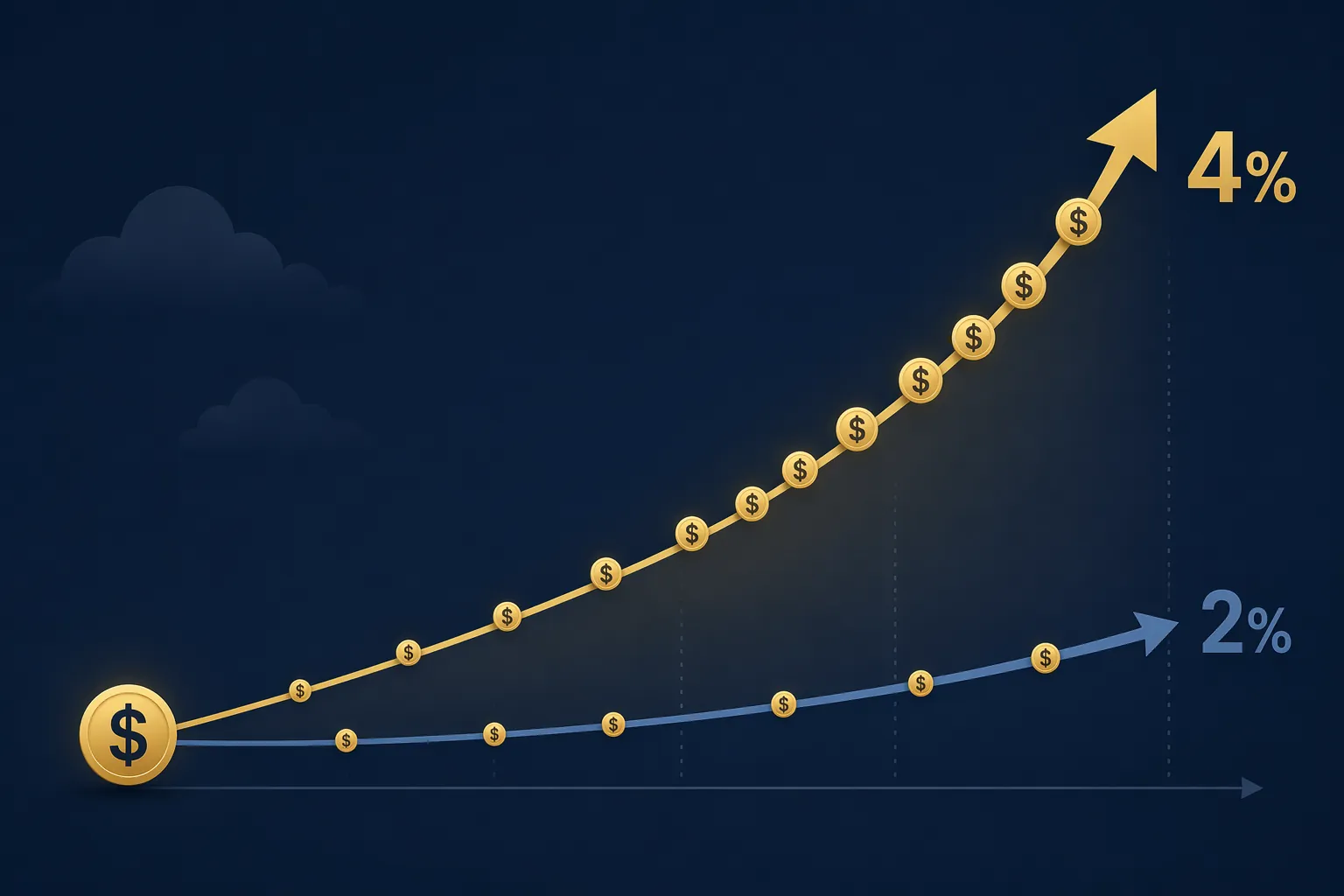
A simple inflation illustration shows why the assumption matters. SGL Financial uses an $80,000 annual spending example: at 2% inflation, that spending grows to about $131,000 after 25 years; at 4%, it grows to about $213,000. That is a 62% difference. The example assumes steady inflation, which real life does not deliver, but it shows how a one- or two-point miss can become a household-changing gap over time.[2]
Now add caregiving. AARP has estimated average out-of-pocket caregiving costs at $7,242 per year, with 78% of caregivers paying out of pocket.[1] That figure is not a forecast for your parent’s needs. Some families spend less; others spend much more, especially when paid help enters the picture. The point is that these costs are often real, recurring, and absent from the retirement projection.
This is how a plan that looked fine in a meeting can start leaking. The caregiver pays for a few extra rides. Then a few hours of help. Then home modifications, incontinence supplies, medication copays, meal delivery, or a monitoring device. No single item looks like a retirement decision. Together, they may reduce emergency savings, delay debt payoff, and interrupt contributions at exactly the age when catch-up savings were supposed to happen.
The corrective move is not to guess perfectly. It is to separate the parent’s care budget from your retirement budget, then model what happens if those care costs last longer or rise faster than expected. If you are still early in the process, start with a written monthly care ledger: paid help, transportation, supplies, medications, safety equipment, extra food, extra utilities, and time away from work. If paid home care is already under discussion, compare your assumptions with current local rates and review practical funding options such as home care costs in 2026 and ways to pay for in-home care.
What to ask before the next planning meeting
- Does my retirement projection include a separate line for parent-care expenses, or are they buried inside general spending?
- What happens if these costs continue for three, five, or more years?
- Which account am I using to pay care costs, and what retirement purpose did that money originally have?
- Am I reducing 401(k), IRA, HSA, or taxable savings contributions because of caregiving?
- Are siblings or other family members assuming these costs are temporary without seeing the monthly totals?
Mistake 2: Assuming Social Security COLAs will preserve purchasing power
Social Security cost-of-living adjustments matter. For many older adults, they are one of the few automatic inflation adjustments in retirement income. But it is a mistake to treat the COLA as if it protects the whole household from the costs older adults actually face.
The 2026 numbers show the problem in a way families can understand. Social Security’s COLA was 2.8%, or about $56 per month on average, while Medicare Part B premiums rose 9.7%, a $17.90 monthly increase. AARP calculated that roughly 32% of the average COLA was consumed by the Part B increase before beneficiaries saw any net gain.[3]
That does not mean the COLA failed. It means the word “inflation-adjusted” can be too comforting. A benefit can rise and still leave a parent with less usable room in the budget if Medicare premiums, supplemental coverage, prescriptions, food, utilities, or care expenses rise faster than the COLA.
Caregivers feel this gap twice. First, the parent may have less left over to pay for help. Second, the adult child or spouse may become the backstop. That backstop role is rarely labeled as a retirement decision, but it is one. If Mom’s Social Security increase is mostly absorbed by Medicare premiums, the extra home care hours may come from someone else’s paycheck or savings account.
Delaying Social Security can be part of a stronger plan for some people. Cardinal Point Wealth has described delaying benefits to age 70 as “the single most reliable inflation hedge available to mass-affluent retirees,” because the resulting benefit is higher and continues to receive COLAs for life.[4] But that does not make delay a universal answer. Health, caregiving demands, cash reserves, marital status, survivor benefits, taxes, and employment stability all matter.
If you are coordinating a parent’s money, the practical question is not just, “What is the COLA?” It is, “What fixed or care-related costs will absorb it before it reaches the household?” For more detail on why COLAs often fail to keep pace with senior care costs, see the 2027 Social Security COLA forecast.
Questions that make the COLA more honest
- After Medicare premiums, supplemental coverage, and drug costs, how much of the COLA remains?
- Is the parent’s benefit being asked to cover paid care that was never part of the original budget?
- If a caregiver is filling the gap, is that support tracked as a family expense or treated as invisible help?
- Would claiming earlier or later change survivor income, tax exposure, or the caregiver’s future burden?
Mistake 3: Believing a stock-heavy portfolio is the whole inflation plan
Stocks can help a retirement plan keep up with inflation over long periods. That is not the same as saying a stock-heavy portfolio solves inflation risk for a caregiver.
Retirement Researcher’s useful distinction is that investment returns and retirement income planning are related, but they are not the same thing. A portfolio can earn reasonable long-term returns and still fail the household if withdrawals, timing, taxes, medical costs, and care expenses are not coordinated.[5]
For caregivers, this matters because the portfolio may be asked to do two jobs at once: fund the caregiver’s future retirement and cover today’s family care gap. A market recovery five years from now does not replace the match you missed this year, the debt you carried because of care costs, or the taxable account you spent down to keep a parent safely at home.
The better conversation with a planner is more specific than “Am I invested aggressively enough?” Ask how the plan handles withdrawals during high-inflation years, which assets would be used first if care expenses rise, whether cash reserves are sized for caregiving, and whether your allocation still fits if retirement comes earlier than planned.
Mistake 4: Using general inflation when medical and care costs are the pressure point
General inflation is a blunt tool when the budget problem is healthcare and care support. A household can cut travel, subscriptions, or restaurant spending. It is much harder to negotiate away wound-care supplies, medication needs, mobility equipment, or a safe number of home care hours.
Morningstar has noted the gap between general inflation and healthcare inflation, citing healthcare costs rising at 5% to 6% annually versus 2% to 3% general CPI. It also reported a Milliman estimate, cited through PlanAdviser/NAPA-Net, that a 65-year-old couple retiring in 2026 faces an estimated $955,411 in lifetime healthcare costs.[6]
That lifetime estimate should be handled carefully. It is not a bill every couple will receive, and it comes here through secondary reporting rather than direct access to the original Milliman report. Still, the direction is hard to ignore: medical and care-related costs deserve their own assumptions. Folding them into a single general inflation number can make the plan look calmer than the household feels.
This is also where benefits gaps matter. Families often assume Medicare, Medicaid, veterans benefits, a long-term care policy, or a parent’s savings will cover more than they actually do. Before increasing your own withdrawals, check whether there are available benefits, policy options, or legal planning steps to review with a qualified professional. The elder care assistance benefits gap is a useful place to start, and families with older life insurance or annuity contracts may also want to ask an adviser about whether a 1035 exchange for long-term care is relevant.
Mistake 5: Not stress-testing the retirement date caregiving may force
Many caregivers tell themselves they will work longer to make up for interrupted savings. Sometimes that works. Sometimes caregiving is exactly what makes working longer impossible.
The Society of Actuaries Research Institute reported that 59% of retirees leave the workforce earlier than planned. Its retirement-planning discussion also highlights persistent financial shocks, caregiving gaps, and inflation pressures facing retirees.[7] Morningstar, citing Michael Finke, has warned that if high inflation hits during the first five years of retirement, retirees may need more than 20% additional savings.[6]
Caregiving can bring those two risks together. A person may retire earlier than planned, enter retirement with less saved, and face higher care-related costs in the first years of retirement. That timing is dangerous because early withdrawals have less time to recover, and inflation raises the amount that must be withdrawn in later years.
This stress test does not need to be elegant. Ask your planner to run the plan with retirement two, three, or five years earlier than expected. Ask what happens if contributions stop before the planned date. Ask which expenses would be reduced and which cannot be reduced because they involve safety, medical needs, or basic care.
If the early-retirement version of the plan only works by assuming a sibling contributes, a parent qualifies for benefits, or home care stays affordable, write those assumptions down. Then decide who is responsible for checking them. Unwritten assumptions are where family resentment and retirement damage often meet.
The corrective work is separate modeling, not perfect forecasting
Caregivers do not need another lecture about budgeting. Most are already making hard choices with incomplete information. What they need is a retirement plan that shows the care layer clearly enough to make decisions before the damage compounds.
Bring these five items to a financial planner, tax professional, benefits counselor, elder law attorney, or other qualified adviser as appropriate:
- A monthly record of parent-care costs paid by you, your parent, and other family members
- A list of work changes caused by caregiving, including reduced hours, missed overtime, unpaid leave, or delayed promotions
- Retirement contributions you have reduced, paused, or redirected because of care costs
- Healthcare, Medicare, insurance, and long-term care assumptions used in the current plan
- A stress test showing what happens if you retire earlier than planned or paid care costs rise faster than general inflation
A retirement plan is not caregiver-ready until it separately models care costs, lost earnings, healthcare inflation, Social Security limits, and the possibility that caregiving changes the retirement date.
References
- Caregivers and Retirement: Findings from the 2026 Retirement Confidence Survey, EBRI, July 22, 2026
- How Do 1-2% Inflation Errors Impact Retirement?, SGL Financial
- Biggest Changes 2026, AARP
- Inflation Rates in Financial Planning: What Your Planner Is Actually Doing and Why It Matters, Cardinal Point Wealth, March 6, 2026
- The Biggest Inflation Mistake Retirees Make, Retirement Researcher
- Retirement Planning Mistake That Makes Inflation Much More Expensive, Morningstar
- Financial Shocks, Caregiving Gaps and Inflation Pressures Persist in Retirement Planning, SOA Research Institute
Questions to bring to a clinician or OT
This is not medical, legal, or a family's final decision — only a framework. Bring these questions to a clinician, occupational therapist, or your local Area Agency on Aging.
Find Local HelpRelated reading
Noticed something outdated or inaccurate on this page? Flag a correction. We review every report against CDC, NIA, and AARP HomeFit guidance before updating a page.