
Caregiver decision guide
Which River Cruise Line Is Best for Seniors with Limited Mobility?
Choosing a river cruise for a senior with limited mobility means matching the cruise line to their specific mobility aid. This guide compares top lines like Viking, AmaWaterways, and American Cruise Lines, explaining which can accommodate cane users, rollators, or wheelchairs and detailing the real-world challenges to expect.
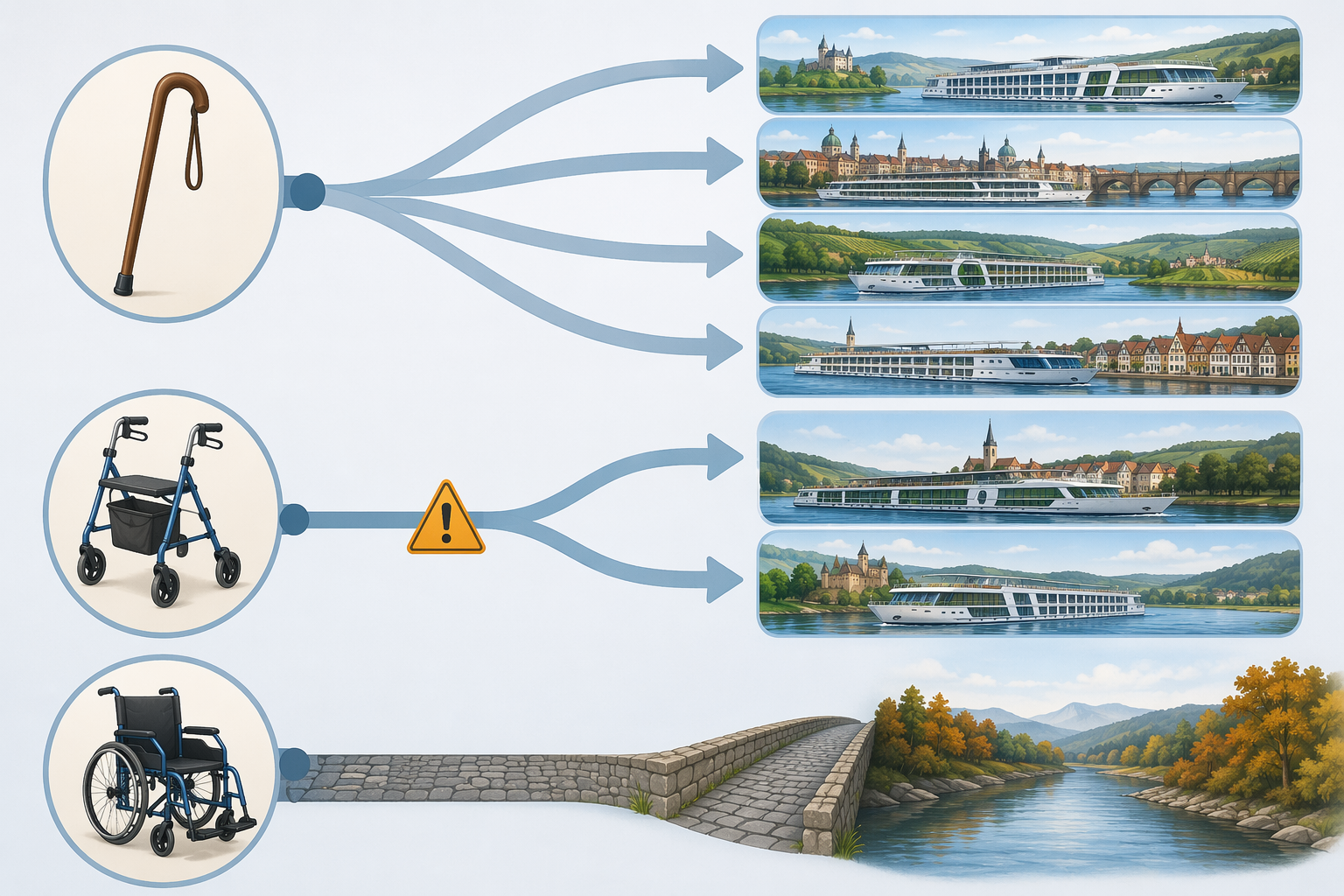
The best river cruises for seniors with mobility issues are not the same for a cane user, a rollator user, and someone who uses a wheelchair or scooter full time. That distinction matters more than the brochure word “accessible.” A senior who can manage a few steps with a rail may have several workable European river cruise options. A traveler who needs a rollator inside the cabin needs a much more careful check of door width, elevator reach, and excursion logistics. A full-time wheelchair or scooter user is looking at a much narrower field, especially on European rivers.
| Mobility situation | Best starting point | Why this is the right threshold |
|---|---|---|
| Uses a cane or standard walker and can climb some steps | Viking, AmaWaterways, Scenic, and some other European river cruise lines may work | The main question is excursion pace and how often steps, gangways, or cobblestones will interrupt the day. Viking offers gentle walking groups, and AmaWaterways offers multiple excursion activity levels.[1] |
| Uses a rollator and can walk short distances without it inside the cabin | AmaWaterways, Viking, or Scenic only after checking cabin access, elevator coverage, and dock arrangements | European river ships often have limits that matter to rollator users: cabins may not accommodate wheeled mobility aids well, elevators may not reach every deck, and ports may involve steep gangways or uneven streets.[1][2] |
| Uses a wheelchair or scooter full time | American Cruise Lines first; Scenic may be worth checking for Europe; ocean cruises may be a better fit | American Cruise Lines is described as ADA-compliant, with accessible staterooms on all vessels and elevators to all decks. European river cruising remains harder because of ship design, rafting, gangways, coaches, and old-town terrain.[1][2] |
| Uses a motorized scooter or motorized wheelchair | Do not assume any European river line will accept it | Avalon Waterways prohibits all motorized scooters and motorized wheelchairs, so it should be removed from consideration for those travelers unless the policy changes.[3] |
That table is deliberately blunt because this is where bad bookings happen. A ship can be lovely, the staff can be kind, and the itinerary can still fail the person who cannot get through the cabin doorway, cannot reach the sun deck, or cannot cross another ship when the boats are rafted together at the dock.
American Cruise Lines is the strongest choice when mobility aid access is nonnegotiable
For a senior who uses a wheelchair or scooter full time, American Cruise Lines is the most practical place to start. Its ships are described as ADA-compliant, with accessible staterooms on all vessels, elevators to all decks, crew assistance available on gangways, and panic buttons in all staterooms.[2] Those details change the planning conversation. They do not merely make the cruise more comfortable; they remove some of the hard physical barriers that can make a European river cruise unworkable.
The other important difference is geography. U.S. river cruising is operating under a different accessibility environment from much of European river cruising. Cruise Critic and Cruise Specialists both point travelers with more significant mobility needs toward U.S. river cruises or ocean cruises rather than assuming that a European river ship can handle full-time wheelchair use.[1][4] That is not a comment on scenery or service. It is a comment on ramps, elevators, cabin layout, gangways, and what happens after the ship docks.
American Cruise Lines will not solve every shore-side problem. River docks still vary, and excursions still need to be checked one by one. But if the senior traveler cannot safely separate from the wheelchair or scooter, American Cruise Lines gives the family more of the basics to verify instead of making them negotiate the basics from scratch.
Scenic is the European exception worth taking seriously
Scenic stands out because it has dedicated “limited mobility suites” on all ships, with wide doors and a wheel-in shower with a stool, located near reception.[5] For European river cruising, that is not a small distinction. Many lines talk about helping guests with limited mobility; far fewer offer cabin design features that directly address the moment when the traveler has to get into the room, use the bathroom, and move around without turning every transfer into a project.
This does not automatically make Scenic right for every wheelchair or scooter user. A limited-mobility suite does not erase rafted moorings, old European streets, coach steps, or dock-by-dock gangway angles. It does mean Scenic deserves a real phone call before many other European lines do. The questions should be specific: the exact ship, the exact suite, the bathroom configuration, whether the elevator reaches the needed decks, whether the itinerary commonly involves rafting, and what assistance is and is not provided at the gangway.
This is also where accessible cabin scarcity matters. Accessible or limited-mobility cabins may be only 1–2 per ship, and booking 6–12 months ahead is typically required.[2] Waiting until the fare looks better can mean the only cabin that would have made the trip possible is already gone.
Viking can work for cane and walker users, but it has hard limits
Viking is often attractive for older travelers because it is adults-only and offers gentle walking groups on river itineraries.[1] For a senior who uses a cane, can manage some steps, and mainly needs a slower pace on shore, that can be enough to keep the trip realistic.
The limits are the part to read first. Viking does not have designated accessible cabins on its river ships, and wheelchair users are required to travel with a companion who provides all needed assistance; crew help should not be counted on as guaranteed personal mobility support.[1] Elevators serve 2–3 passenger decks but not the sun deck, which may require about 20 stairs according to a 2026 travel-advisor accessibility review.[2]
That sun deck detail may sound minor until the traveler is the one left below while everyone else goes up for sailing views. The issue is not whether the cruise can technically be boarded. The issue is how many parts of the trip quietly become unavailable.
For a cane or walker user who is steady on stairs, Viking remains a reasonable candidate. For a rollator user, the family should verify cabin doorway clearance, where the rollator can be stored, whether the traveler can move safely inside the room without it, and which decks the elevator reaches on the specific ship. For a full-time wheelchair or scooter user, Viking’s lack of designated accessible cabins is a major obstacle, not a footnote.
AmaWaterways is better for choosing the day’s pace than for full wheelchair access
AmaWaterways is one of the more appealing European choices for seniors who walk independently but need the day scaled properly. Its excursions are offered at different activity levels, including gentle, regular, and active options.[1] That matters for a parent who can walk, but not at the speed of the fastest group on uneven pavement.
The cabin limitation is the deciding fact for wheelchair users. Cruise Specialists states that cabins on AmaWaterways’ European fleet cannot accommodate a wheelchair inside the room, so the guest must be able to move around the cabin without it.[4] That may be perfectly acceptable for someone who uses a rollator outside the room and can safely furniture-walk a few steps inside. It is not acceptable for someone who needs the chair for transfers, bathroom access, or every movement after standing.
AmaWaterways therefore sits in the middle of the mobility map. It can be a good fit for seniors who need gentler excursion choices but still have enough independent mobility to handle the ship and cabin environment. It is a poor bet if the traveler’s mobility aid is not optional once the cabin door closes.
Avalon’s motorized mobility aid policy is a quick disqualifier for some travelers
Avalon Waterways should be treated carefully by anyone researching for a scooter or motorized wheelchair user. Its policy prohibits all motorized scooters and motorized wheelchairs.[3] That is the kind of rule to check before looking at dates, fares, or itineraries, because it can end the conversation immediately.
For cane, walker, or possibly some non-motorized mobility-aid users, Avalon may still be part of a broader comparison. But for travelers who rely on powered mobility, there is no useful reason to soften the point: choose another starting point unless Avalon’s current written policy says otherwise.
The ship is only half the problem
River cruising creates a particular trap for families: the ship can look manageable, but the itinerary can still be the problem. European river ports were not designed around rollators, scooters, and transfer chairs. The hard parts often appear between the cabin and the cathedral, not in the dining room.
Rafted moorings can turn one ship into an obstacle course
On busy European rivers, ships may tie up alongside each other, a practice known as rafting. When that happens, passengers may have to cross through or over another ship to reach shore, and that crossing can involve stairs or awkward transitions.[1][5] A traveler who could handle their own ship’s lobby and gangway may still be blocked by the ship parked between them and the dock.
This is one reason a simple “does the ship have an elevator?” answer is not enough. The elevator may get the traveler to the lobby. It does not guarantee a clean, step-free path to land when another vessel is tied alongside.
Gangways change by dock and water level
Gangways on river cruises can be steep, narrow, and different from one port to the next.[6] Traveler reports also describe gangway access as a practical concern for rollator users, especially when the angle is sharp or the walking surface is narrow.[7] A line may be able to assist, but assistance is not the same as independent access, and it may not be enough for someone who cannot safely manage a slope.
This is where the family should ask about the specific river, month, and ports rather than asking only whether the cruise is “suitable for limited mobility.” A Danube or Rhine itinerary may still vary from town to town, and the docking position on the day can change the amount of effort required.
Cobblestones are not charming when the wheels are small
Historic European ports often mean cobblestone streets, uneven curbs, and old-town walking routes. Cruise Critic forum participants discussing rollator use repeatedly describe cobblestones as a real barrier, not just a mild inconvenience.[7] Standard rollator wheels can catch, rattle, or become exhausting to push over that surface.
A parent who walks slowly on smooth pavement at home may not have the same stamina on wet stone, sloped streets, or crowded market squares. This is why excursion descriptions matter. “Gentle walking” should still be checked for distance, surface, steps, seating opportunities, and whether the guide can keep a slower participant within the group.
Coach transfers can break an otherwise workable day
Many river cruise excursions use coaches, and those coaches may not be wheelchair-adapted. Mobility aids may be stored in the luggage hold while guests climb 3–4 steps into the coach.[5] That setup can work for a cane user. It may work for a rollator user who can climb steps with a rail. It does not work for someone who cannot board a coach without lift access.
The booking question should therefore be practical: if the excursion uses a coach, can the traveler climb the steps, and can the mobility aid be safely loaded and unloaded at every stop? If not, the family needs to know whether there is a realistic alternative, not just whether the excursion is included.
What to verify before putting down a deposit
The right questions are not vague. “Is this cruise accessible?” invites a reassuring answer that may not match the traveler’s day-to-day needs. Give the cruise line or travel advisor the exact mobility aid, the traveler’s transfer ability, and the situations that are unsafe.
- Cabin doorway and bathroom access: Ask whether the mobility aid fits through the cabin door, whether it can turn inside the room, and whether the bathroom has a step, threshold, grab bars, or a wheel-in shower.
- Elevator coverage: Confirm which decks the elevator serves and whether any important areas, such as the sun deck, require stairs.
- Gangway assistance: Ask what assistance is normally available and what the crew is not allowed or expected to do.
- Rafting frequency: Ask whether the itinerary commonly involves rafted moorings and what a mobility-limited guest must do when ships are tied side by side.
- Excursion surfaces: Ask about cobblestones, slopes, steps, distance, available seating, and whether a slower guest can remain with the gentle group.
- Coach boarding: Ask whether excursion coaches are lift-equipped or whether the traveler must climb steps while the mobility aid is stored underneath.
- Written policy on scooters and powered wheelchairs: Do not rely on a phone summary if the traveler’s main mobility aid is motorized.
If the answer comes back as “we accommodate limited mobility all the time,” keep asking. The useful answer is not a mood; it is a measurement, a policy, or a description of the actual route from cabin to shore.
So which river cruise line is best?
For a senior who uses a cane or standard walker and can manage some stairs, the best river cruise line may be Viking, AmaWaterways, Scenic, or another European line with slower excursion groups and a ship layout that matches the traveler’s stamina. Viking’s gentle walking groups and AmaWaterways’ activity-level choices are genuinely useful for this traveler.[1]
For a rollator user, the best choice is the line that can prove the cabin, elevator, gangway routine, and excursions work on the exact sailing. AmaWaterways may work if the traveler can move inside the cabin without the rollator. Viking may work if stairs and non-accessible cabin design are not deal breakers. Scenic deserves special attention because of its limited-mobility suites, but the itinerary still has to pass the rafting, gangway, coach, and cobblestone test.[1][4][5]
For a full-time wheelchair or scooter user, the safer starting point is American Cruise Lines, with its ADA-compliant ships, accessible staterooms, elevators to all decks, and gangway assistance.[2] Scenic is the European line most worth checking because of its dedicated limited-mobility suites, but European river cruising still carries barriers that a cabin feature alone cannot fix.[5]
References
- A Guide to Accessible River Cruises, Cruise Critic
- Best European River Cruises for Seniors with Limited Mobility (2026), Luxury Vacations Consulting
- River Cruise 101: Scooters, Wheelchairs & The Mobility-Impaired Traveler, Spin the Globe, 2018
- Mobility Issues And River Cruising, Cruise Specialists
- Everything Wheelchair and Scooter Users Need to Know About River Cruises, Spin the Globe, 2019
- A Guide To Accessible River Cruises: 7 Things To Consider, RiverVoyages.com
- Please help — river cruise, husband walks with rollator, Cruise Critic Forum
Questions to bring to a clinician or OT
This is not medical, legal, or a family's final decision — only a framework. Bring these questions to a clinician, occupational therapist, or your local Area Agency on Aging.
Find Local HelpRelated reading
Noticed something outdated or inaccurate on this page? Flag a correction. We review every report against CDC, NIA, and AARP HomeFit guidance before updating a page.