
Caregiver decision guide
Tom Watson's Counterintuitive Wind Advice for Senior Golfers
Senior golfers facing distance loss in windy conditions can still score well by adopting Tom Watson's strategic adjustments. Learn why swinging easier into a headwind and widening your stance often produce better results than trying to overpower the wind.
The shot that gets senior golfers in trouble usually starts before the club moves. A headwind is in the face, the old yardage is still in the memory, and the hand reaches for the same club as if nothing has changed. Then comes the extra effort: a harder swing, a higher flight, more spin, and a ball that climbs into the wind, hangs there too long, and lands short.
Tom Watson's best wind advice cuts against that instinct. Into a headwind, the answer is not to hit it harder. It is to take more club and swing easier. That sounds almost too plain until you have watched enough older players turn a manageable bogey into a double because pride chose the club and panic made the swing.
Watson earned the right to be taken seriously in this weather. His record includes five Open Championships and three Senior Open Championships, and his wind instruction is rooted in the kind of golf where impatience gets punished quickly.[1] But the useful part for a senior golfer is not the romance of links golf. It is the discipline: let the wind change the plan before it changes the swing.

Why the Headwind Feels So Punishing After 60
A headwind does not simply subtract a little distance. Golf Digest technical advisor John Calabria estimated that a shot loses roughly 18 yards for every 10 mph of headwind, while a tailwind adds only about 10 yards for every 10 mph.[1] That asymmetry matters. A windy day is not a fair trade where you get back downwind what you lost into the wind.
For a senior golfer, the same penalty takes a bigger bite. If your drive now carries or finishes around 200 yards, an 18-yard headwind loss is 9 percent of the shot. For a player hitting 280 yards, the same 18 yards is about 6.4 percent. The wind is not picking on older golfers, but the arithmetic makes it feel that way.
Galvin Green's wind-adjustment guidance gives a similar working rule from a different angle: about 1 percent distance loss per 1 mph of headwind and about 0.5 percent gain per 1 mph of tailwind.[2] Those numbers should be treated as rules of thumb, not laboratory physics. Wind angle, ball flight, strike quality, turf, temperature, and club choice all interfere. Still, a rough rule that prevents a bad decision is worth carrying.
| Wind | Working Adjustment | What It Means for a 200-Yard Senior Drive |
|---|---|---|
| 10 mph headwind | About 18 yards lost by Calabria's estimate | Plan closer to 182 yards before roll and course conditions |
| 15 mph headwind | Roughly one and a half times the 10 mph penalty | Expect the shot to play much longer than the card says |
| 10 mph tailwind | About 10 yards gained by Calabria's estimate | Helpful, but not enough to cancel the headwind penalty hole for hole |
| Crosswind | No simple yardage subtraction | Lower the flight, choose a safer start line, and allow for curve or drift |
The practical lesson is simple enough to use on the tee: decide the wind penalty before you choose the club. If the flag is straight into you and the hole already plays long, pretending you still have your calm-weather number only invites the hard swing. Once the wrong club is in the hands, the body starts trying to rescue the decision.
Take More Club Before You Try More Effort
Watson's headwind rule works because it separates judgment from effort. More club gives the ball a chance to reach the target without demanding a violent move from a body that may already be managing reduced rotation, sore joints, or less reliable balance. The easier swing is not timid. It is a way to reduce spin and keep the ball from climbing.
The common mistake is trying to muscle the ball through the wind. Watson has warned amateurs that swinging harder into a headwind creates more spin and a higher flight, which lets the wind catch the ball and cost still more distance.[3] That is the ballooning trap: the harder swing feels brave for half a second, then the ball rises, stalls, and comes down short.
A senior player can turn the yardage rule into a small pre-shot routine. Start with the normal club for the distance. Add the wind penalty. Then choose the club that lets you make a balanced three-quarter or smooth full swing. If the choice is between forcing a 7-iron and swinging a controlled 6-iron, the controlled 6-iron is usually the adult in the room.
This is especially important on approach shots, where embarrassment quietly affects decisions. Many older golfers will accept a shorter drive more easily than they will accept needing one more club into a green. But the scorecard has no column for remembered distances. A green reached with an extra club and a quiet swing is still a green reached.
A Usable Headwind Calculation
- Into a 10 mph headwind, assume the shot may play about 18 yards longer, then adjust for your normal flight and strike quality.
- Into a 15 mph headwind, do not split hairs; choose enough club to avoid the forced swing.
- If you already hit a high ball, be more conservative because height gives the wind more time to work.
- If the safe miss is short, one extra club may be enough; if short brings bunker, water, or a steep pitch, take the extra club seriously.
- If balance is uncertain that day, choose the club that permits the smoothest swing, not the one that protects your ego.
There is no shame in using a rough number. The purpose is not to become a launch monitor. The purpose is to keep the first mistake from happening.
Build a Stance the Wind Cannot Bully
The setup matters more as the years go by. A younger player may recover from a gust with speed and athleticism. An older player often needs to prevent the problem earlier, with a base that makes the swing smaller, quieter, and more repeatable.
Watson emphasizes widening the stance in windy conditions, including for full swings and even putts.[1] For senior golfers, that may be the most valuable physical adjustment in the whole wind playbook. A wider stance lowers the center of gravity and gives the body a better chance to stay organized when the gust hits during the backswing or through impact.
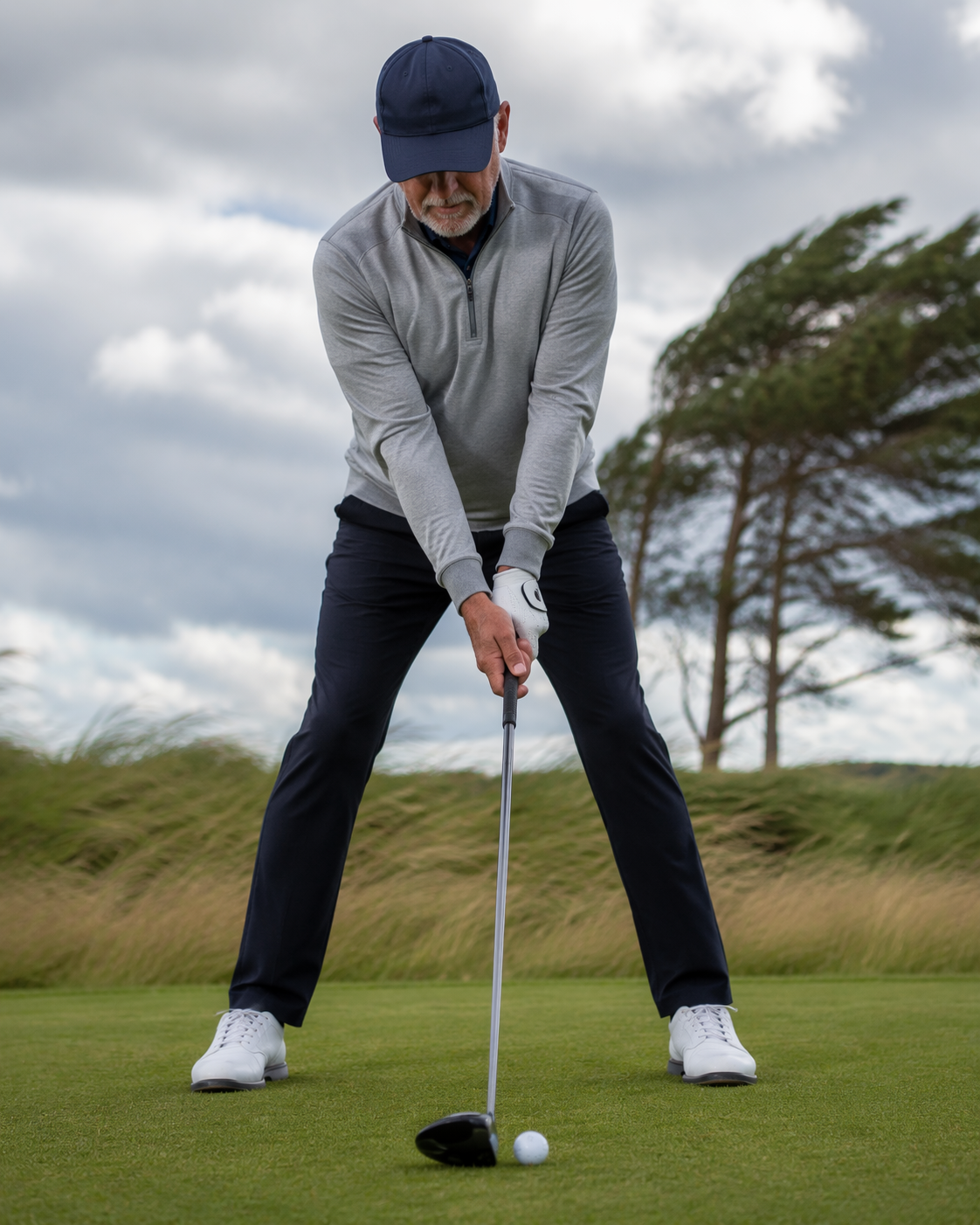
For tee shots in a crosswind, Watson has given a compact set of instructions: tee the ball lower, play it back in the stance, grip down an inch, and make a three-quarter swing with quiet wrists.[4] Each piece serves the same purpose. The lower tee and ball position help reduce launch. Gripping down shortens the club and improves control. The three-quarter swing limits excess motion. Quiet wrists keep the clubface from adding unnecessary loft or sidespin.
That is not a trick shot. It is a stability shot. For a senior golfer, that distinction matters. The goal is not to carve a heroic low bullet around the corner. The goal is to put the ball in play with a motion that does not pull you off your feet.
The Wind Setup Worth Practicing
- Widen the stance enough to feel grounded, without locking the hips so tightly that you cannot turn.
- Tee the ball lower when the priority is a flatter flight, especially in a crosswind.
- Move the ball slightly back, not so far back that the swing becomes steep or jarring.
- Grip down about an inch when control matters more than maximum clubhead speed.
- Use a three-quarter swing with quiet wrists and a balanced finish you can hold.
The caution is physical, not technical. Some golfers with joint replacements, limited rotation, neuropathy, vertigo, or balance disorders may not be able to widen the stance or move the ball back in the same way. The adjustment should make the body feel safer, not trapped. If a wider stance makes the turn painful or unstable, narrow it enough to move freely and keep the swing shorter.
The same thinking belongs on the green. Windy putting is not only about reading the gust against the ball. It is about keeping the lower body still while the hands make a small motion. Watson's advice to widen the putting stance in wind is easy to overlook, but it may save strokes for older players who feel the body sway over short putts.[1]
Downwind Is a Different Problem
If Watson's advice stopped at “swing easy,” it would be too simple. Downwind, he has said he hits the ball harder, not softer, because full speed can create the spin needed to control the ball. At the 2005 Senior Open at Royal Aberdeen, he described hitting a 6-iron 240 yards downwind.[5]
That example should not send an ordinary senior golfer chasing a 240-yard 6-iron. Its value is the distinction. Into the wind, extra speed can add spin and height that make the ball balloon. Downwind, too little spin can let the ball fall out of the air or come out hot and unpredictable. Headwind and tailwind both demand control, but they do not demand the same kind of control.
For most senior golfers, the downwind adjustment is still conservative. Expect more run. Be careful with back pins. Do not assume the wind will hold the ball online. If the green is firm and the trouble is long, landing the ball short may be wiser than trying to fly it all the way.
Crosswinds Reward Boring Golf
A crosswind tempts players into arguments with the sky. They aim at trouble and hope the wind behaves. They try to hold the ball against it with a swing they do not own. They wait too long over the ball, feel another gust, and make a steering move.
Watson's lower-flight crosswind setup is useful because it reduces how much time the ball spends exposed to the wind.[4] Jerry Kelly's advice for extreme wind points in the same direction: lower trajectory and shorter swings.[6] That agreement matters because it comes from players who know senior golf is still competitive golf, but not reckless golf.
The safer play often looks unimpressive. Aim at the fat side. Start the ball where a gust will not turn a miss into a penalty. Choose the club that keeps the swing compact. If the wind is hard off the left and the right side is safe, use the right side. If water waits on the side the wind is pushing toward, aim farther away than your pride wants to allow.
Think Two Shots Ahead
Wind golf is course management with louder consequences. A calm-weather target may be too greedy when the ball is being pushed, held up, or knocked down. The question is not only “Can I reach?” It is “Where is the next shot if this comes off slightly wrong?”
On a long par 4 into the wind, reaching the green in regulation may no longer be the right measure of success. A solid drive, a controlled second shot short of the worst trouble, and a manageable pitch may protect bogey and leave par possible. That is not surrender. That is refusing to let one difficult condition create two or three mistakes.
This is where Watson's strategy becomes especially useful for older golfers. It gives permission to stop comparing the shot to an old version of yourself. The correct club is the one for today's wind, today's body, and today's safest miss. The correct swing is the one you can finish in balance.
- Into the wind, add club before adding effort.
- In a crosswind, lower the flight and aim for the safer side.
- Downwind, expect extra carry or run and protect against the long miss.
- Around the green, widen the stance when gusts threaten balance.
- When the hole plays too long, accept the layup or short-side avoidance before the swing starts.
Par is a strong score in the wind. So is a bogey that avoids the double. Senior golf remains enjoyable when the player keeps making decisions instead of making apologies.
The Senior Wind Playbook
Watson's wind strategy for senior golfers comes down to a sequence that can be used without pretending to be a tour player. First, calculate the likely penalty. A 10 to 15 mph headwind is enough to change club selection, especially when your normal distance has already declined. Second, stabilize the body. Wider stance, lower tee, ball slightly back, grip down, shorter swing, quieter wrists. Third, manage the hole. Choose the miss that leaves a playable next shot.
The wind exposes lost speed, but it also rewards the things older golfers can still do well: notice, choose, adapt, and stay patient. The good wind player is not the one who fights hardest. It is the one who changes the plan early enough that the swing does not have to fight at all.
References
- Tom Watson's best golf tips for playing in the rain, wind and cold — Golf Digest
- Golf in the Wind: Tips, Tricks & How to Adjust — Galvin Green
- Tom Watson's tip to help amateurs drive the ball better when hitting into the wind — HITC
- Tom Watson: Drive It Lower In Crosswinds — Golf Digest
- Mid-week Lesson: Tom Watson says to hit it hard downwind — Golf Digest
- Playing in extreme wind? Use these tips from a senior major winner — Golf.com
Questions to bring to a clinician or OT
This is not medical, legal, or a family's final decision — only a framework. Bring these questions to a clinician, occupational therapist, or your local Area Agency on Aging.
Find Local HelpRelated reading
Noticed something outdated or inaccurate on this page? Flag a correction. We review every report against CDC, NIA, and AARP HomeFit guidance before updating a page.